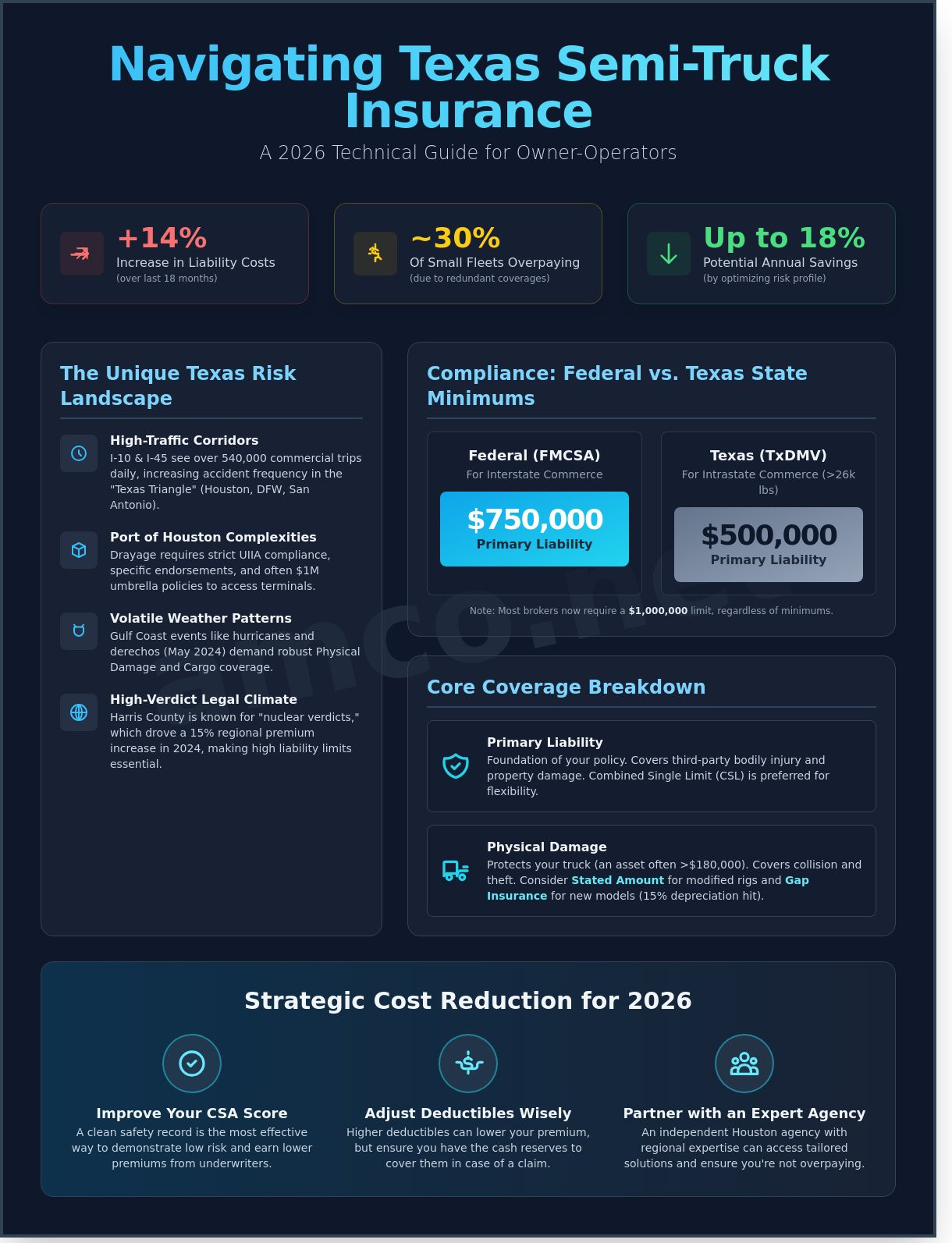
Texas owner-operators faced a 14% increase in liability costs over the last 18 months, yet roughly 30% of small fleets in Houston are currently overpaying for redundant coverages. You likely feel the pressure of these rising rates every time you renew your semi truck insurance. This is especially true when balancing the thin margins of the Port of Houston or the Permian Basin. It's frustrating to watch operational costs climb while the technical requirements for FMCSA compliance become increasingly rigid.
We promise to show you how to optimize your risk profile to lower annual premiums by up to 18% without sacrificing the protection your business requires. This guide serves as a technical manual for the 2026 market. We'll clarify the often misunderstood differences between Bobtail and Non-Trucking Liability. You'll learn the exact steps to secure instant COIs for time-sensitive loads and how to manage TxDMV Form E and H filings with professional precision. Our goal is to help you maintain operational continuity while securing the lowest possible cost per mile.
Semi truck insurance is a specialized commercial auto policy designed specifically for Class 8 vehicles with a gross vehicle weight rating (GVWR) exceeding 33,000 pounds. In the Texas market, this coverage isn't a one-size-fits-all product. The state's logistics infrastructure, particularly the I-10 and I-45 corridors, experiences some of the highest freight volumes in the United States. In 2023, the Texas Department of Transportation recorded over 540,000 commercial vehicle trips daily across these major arteries. These high-density zones, combined with volatile Gulf Coast weather patterns like the May 2024 Houston derecho, create a unique risk profile that requires high-limit liability and specialized physical damage coverage.
Operators servicing the Port of Houston face additional layers of complexity that standard commercial policies often overlook. Drayage carriers must meet specific Uniform Intermodal Interchange Agreement (UIIA) standards to access the Barbours Cut and Bayport terminals. While a private carrier might only transport their own manufactured goods, for-hire owner-operators in the Houston metro area need broader liability structures to protect against third-party claims. Understanding Semi Truck Insurance is essential for these professionals to ensure their business remains viable despite the 12% increase in average heavy-duty repair costs observed in early 2025.
To better understand these complex requirements and how they impact your business, watch this helpful video:
The Federal Motor Carrier Safety Administration (FMCSA) mandates a $750,000 minimum primary liability limit for interstate commerce involving non-hazardous freight. However, the Texas Department of Motor Vehicles (TxDMV) sets its own intrastate standards for trucks that don't cross state lines. For vehicles over 26,000 pounds operating solely within Texas, the state minimum is $500,000. The MCS-90 endorsement serves as a legal guarantee that the public will be protected even if the insurance policy itself contains exclusions that might otherwise deny a claim.
Accessing Port of Houston Authority property requires specific endorsements, including General Liability and often a $1,000,000 umbrella policy to satisfy terminal operator agreements. The "Texas Triangle" (Houston, Dallas-Fort Worth, and San Antonio) accounts for nearly 70% of the state's economic output, leading to extreme congestion and higher accident frequency. Additionally, Harris County is known for high-verdict litigation trends. In 2024, "nuclear verdicts" in the region influenced a 15% rise in regional semi truck insurance premiums, making expert risk assessment a necessity for long-term profitability.
Texas owner-operators must view their semi truck insurance policy as a technical risk management framework rather than a mere regulatory hurdle. Primary Liability serves as the foundation of this structure. It's mandated by law to cover bodily injury and property damage to third parties in the event of an accident. For interstate operations, maintaining Federal Compliance requires a minimum of $750,000 in coverage, though most Houston-based shippers and brokers now demand a $1,000,000 limit to mitigate vicarious liability risks.
When structuring a policy, the choice between a Combined Single Limit (CSL) and split limits is critical. Most Texas fleets opt for CSL because it provides a flat $1,000,000 pool of coverage per occurrence, offering greater flexibility during complex multi-party claims. Physical Damage coverage protects the asset itself. In 2026, a new Class 8 tractor represents a capital investment often exceeding $180,000. Owners must decide between Actual Cash Value (ACV) and Stated Amount. While ACV is common, Stated Amount is preferable for rigs with specialized aftermarket modifications that standard market valuations don't accurately reflect—the kind of custom work performed by vehicle conversion specialists like Auto Industries Factory LLC. New truck owners should also integrate Gap insurance; a 2026 model can depreciate 15% the moment it leaves the dealership, leaving a significant financial void if the vehicle is totaled early in the finance term.
Motor Truck Cargo insurance is the next pillar of protection. In the Houston freight market, $100,000 is the industry standard for general dry van loads, but specific commodities require deeper analysis. Just as secure industrial packaging prevents cargo shifts, the right insurance endorsements prevent financial shifts in your business model. Consider these specialized additions:
Confusion often exists between Non-Trucking Liability (NTL) and Bobtail insurance. NTL applies strictly when the truck is used for non-business, personal purposes. Bobtail insurance is broader; it covers the tractor whenever it's operated without a trailer, regardless of whether it's under dispatch. Selecting the wrong type can leave a 40% gap in your liability protection during transit transitions. Proper semi truck insurance planning ensures that these technical nuances are addressed before a claim occurs, maintaining the operational continuity of your trucking business.
Compliance serves as the foundation of operational continuity for any owner-operator in Houston. If an insurance carrier fails to submit electronic filings on time, the Federal Motor Carrier Safety Administration (FMCSA) or the Texas Department of Motor Vehicles (TxDMV) will issue an Out of Service (OOS) order. In 2026, these agencies process data in real-time; a 24-hour lapse in your semi truck insurance coverage can trigger an automatic suspension of your operating authority. This creates a cascade of logistical failures that stop revenue immediately.
Texas requires specific documentation to prove financial responsibility. Form E serves as the mandatory certificate for intrastate liability, confirming you meet the state's minimum requirements for hauls within Texas borders. Form H certifies cargo insurance compliance, which is essential for carriers hauling specific commodities under TxDMV jurisdiction. Beyond state-level forms, the Unified Carrier Registration (UCR) remains a critical annual requirement for 2026 operations. Failing to register by the December 31 deadline results in fines that typically range from $300 to $5,000 depending on your fleet size.
Your Department of Transportation (DOT) and Motor Carrier (MC) numbers dictate which filings are mandatory for your specific operation. For interstate commerce, the BMC-91X filing is the federal standard for public liability, requiring limits between $750,000 and $5,000,000. Many owner-operators overlook the fact that underwriters review these public filings during every renewal cycle. Implementing Strategies to Lower Semi Truck Insurance Costs often starts with maintaining a clean filing record. Mismatched names between the insurance policy and the DOT registration cause 12% of all roadside inspection failures in Texas, leading to avoidable delays and penalties.
By 2026, insurance underwriters have shifted toward data-driven risk assessment. They now utilize direct API feeds from ELD providers to verify actual routes, rest periods, and mileage. This data feeds directly into your SafeStat and CSA scores, which act as the primary metrics for semi truck insurance pricing. Precise ELD management ensures your premiums reflect actual safety performance rather than estimated risks. Frequent Hours of Service (HOS) violations directly lead to premium hikes of 20% or more upon your next policy renewal.
Effective cost management for semi truck insurance in 2026 requires more than just shopping for quotes; it demands a proactive approach to risk. Data from 2025 indicates that owner-operators who maintain a CSA score in the top 10th percentile pay up to 18% less than those with average ratings. Rigorous maintenance schedules and monthly driver training sessions aren't just operational burdens. They're financial investments that directly impact your bottom line. High deductibles also play a critical role in premium calculation. By increasing your deductible from $1,000 to $5,000, you can often reduce your annual premium by 12% to 20%, provided your cash reserves can cover the higher out-of-pocket cost during a claim.
Implementing a structured safety protocol is the most reliable way to secure long-term savings. Consider these specific strategies:
By 2026, AI-integrated telematics have become the industry standard for underwriting. These systems monitor hard braking, rapid acceleration, and lane departures with 98% accuracy. Insurance providers in Texas now offer a Safe Driver discount for those who maintain a clean record for three consecutive years, which can save an owner-operator between $3,500 and $5,200 annually. While some drivers express concerns regarding privacy, the financial trade-off is substantial. Real-time data allows insurers to price risk based on actual performance rather than general demographic statistics, rewarding those who prioritize road safety.
Securing the best rates for semi truck insurance in the Texas market involves meticulous documentation. Before hiring any driver, you must pull a Pre-Employment Screening (PSP) report to review five years of crash data and three years of inspection history. Carriers value Seasoned Authority. Once your business hits the 36-month mark of operation without major incidents, you unlock access to tier-one rates that are typically 25% lower than new-venture pricing. Regular safety meetings, documented via digital logs, prove to underwriters that your fleet prioritizes a culture of safety over speed.
Choosing the right insurance partner directly impacts your fleet's long-term profitability and operational stability. Most captive agents work for a single insurance company. This limits your options to whatever that specific carrier decides to offer. If their rates increase or their appetite for risk changes, you're left with no alternatives. AMCO operates differently as an independent broker. We don't answer to a single carrier; we answer to the Houston trucking community. Our team has operated from the East Freeway area since 1987, providing 38 years of specialized expertise that generalist agencies cannot match. We provide direct access to multiple A-rated carriers that focus exclusively on semi truck insurance in Texas, ensuring your coverage meets both federal FMCSA requirements and specific state mandates.
We shop your policy across 20+ specialized carriers to find a precise fit for your specific operational profile. A new authority with a single truck requires a vastly different risk strategy than an established 50-vehicle fleet. Our agents understand the specific hazards of the I-10 corridor, where heavy congestion and port-related traffic increase liability risks. We analyze your routes and cargo types to optimize your premiums. This consultative approach focuses on cost-efficiency and long-term stability rather than just finding the cheapest upfront price. Our local presence means we understand how Houston's infrastructure projects and traffic patterns affect your risk profile.
Efficiency is our priority because we know that a truck sitting still isn't making money. To provide an accurate and fast semi truck insurance quote, we typically require your DOT number, vehicle VINs, driver CDL information, and at least three to five years of loss runs. Our history in Houston since 1987 means we've navigated every market cycle and regulatory change in the industry. We provide rapid Certificates of Insurance (COIs) to ensure you never miss a load and offer dedicated claims support to get your equipment back on the road after an incident. Our goal is to serve as a long-term partner in your business growth.
Ready to optimize your coverage and reduce your fixed costs? Get your personalized Texas semi truck insurance quote today and leverage our 35+ years of Houston trucking experience.
Success for Texas owner-operators in 2026 depends on balancing rigorous federal compliance with strategic cost management. Effective semi truck insurance isn't just a monthly expense; it's a structural safeguard for your business continuity. By prioritizing precise state filings and selecting coverage from 20+ A-rated trucking carriers, you ensure your fleet remains operational and protected against rising liability risks. AMCO has provided this level of technical expertise to the Houston community since 1987. Our team understands the specific pressures of the Texas transport sector and offers direct, face-to-face support at our local office on the East Fwy. We focus on long-term stability and measurable cost optimization rather than temporary fixes. Our experts help you identify gaps in cargo or physical damage coverage before they impact your bottom line. This methodical approach ensures your assets are protected while you focus on the road ahead. Let's build a resilient foundation for your hauling operations together.
Secure Your Texas Trucking Future—Get a Quote from AMCO Now
Owner-operators in Texas can expect to pay between $12,500 and $18,200 annually for comprehensive semi truck insurance in 2026. These figures reflect a 4.2% increase from 2025 due to rising litigation costs in Harris County. Your specific rate depends on your driving record and the value of your equipment. Experienced drivers with five years of clean history often secure rates at the lower end of this spectrum.
Bobtail insurance covers your tractor when it's operated without any trailer attached, regardless of the purpose. Non-Trucking Liability (NTL) specifically provides coverage when you're using the truck for personal, non-business reasons while under lease to a motor carrier. Most Houston owner-operators need NTL because it bridges the gap when the carrier's primary liability policy isn't active. Choosing the wrong one leaves a 100% gap in your financial protection.
You don't need federal filings like the BMC-32 or BMC-91X if your operations never cross state lines. Intrastate carriers only require a Texas Department of Motor Vehicles (TxDMV) number. However, if you pick up a load in Houston that originated outside Texas, federal law classifies this as interstate commerce. In that specific case, you must maintain active federal filings to remain compliant with FMCSA regulations.
A Form E filing is a certificate submitted to the TxDMV that proves your semi truck insurance meets the state's minimum liability requirements. Every commercial motor carrier operating within Texas borders must have this filing on record. For most heavy trucks, this means maintaining at least $750,000 in primary liability coverage. Your insurance provider must submit this document electronically to ensure your authority remains active and valid.
Standard physical damage policies don't cover trailers you don't own unless you add Trailer Interchange coverage. This specific endorsement protects non-owned trailers while they're in your possession under a written interchange agreement. If you're hauling a trailer under a UIIA agreement in the Port of Houston, you'll typically need a $25,000 to $50,000 limit. Without this, you're personally liable for any damage to the equipment.
New owner-operators can reduce their initial premiums by 15% by providing a verified three-year personal driving record and a 20% down payment. Joining a professional association often grants access to group rate structures that aren't available to individuals. You should also focus on maintaining a high credit score above 700. This single factor can lower your annual insurance costs by as much as $2,400 in the Texas market.
Most freight brokers in the Houston area require a minimum of $100,000 in motor truck cargo insurance. If you plan to haul electronics or high-value machinery, brokers frequently demand $250,000 or even $500,000 in coverage. Always check the specific requirements of your lease agreement or broker contract. Carrying lower limits might save you $40 monthly but will disqualify you from 65% of available high-paying loads.
Yes, 85% of commercial insurers in Texas now offer premium discounts ranging from 5% to 12% for trucks equipped with dual-facing dash cams. These devices provide objective evidence during accident investigations, which significantly reduces legal defense costs for the insurer. To qualify, your camera system must usually include GPS tracking and G-force sensors. This technology pays for itself through premium savings within the first 14 months of operation.