
On January 15, 2026, a Houston commuter discovered that a single notification from the state led to an immediate license suspension and a 45 percent increase in regional insurance quotes. This scenario is becoming a standard reality as the Texas Department of Public Safety (DPS) automates its compliance monitoring systems. Securing SR-22 insurance Texas is more than just a bureaucratic hurdle; it's a critical technical requirement to restore your professional mobility and legal standing on the road.
It's frustrating to feel that your daily commute and financial stability are at risk because of complex filing requirements. You deserve a clear, expert-led path to resolve these issues without the typical marketing noise found in the insurance industry. This 2026 guide provides the exact specifications you need to satisfy the DPS and secure the most stable rates available in the current market. We'll detail the step-by-step filing process, compare regional cost factors across Houston and North Texas, and define the precise three-year timeline for your eventual return to standard coverage status.
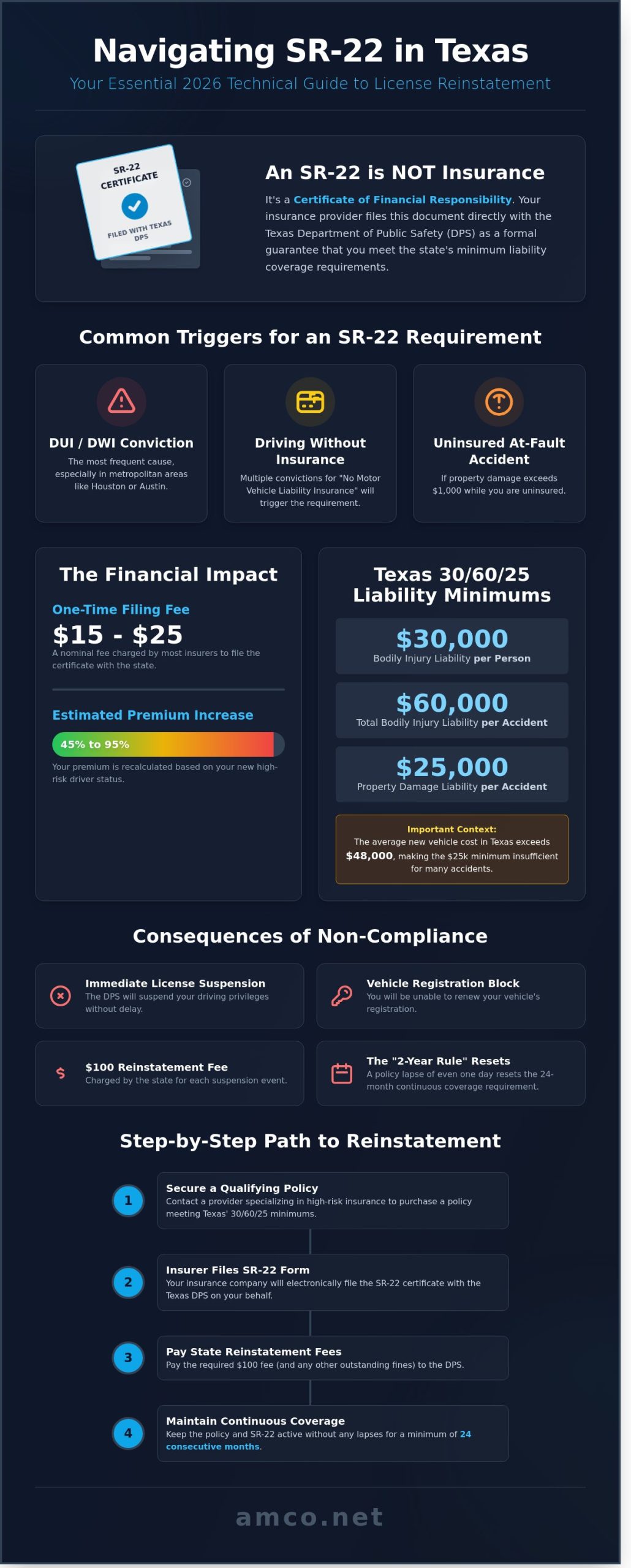
Understanding SR-22 insurance Texas starts with a critical technical distinction. An SR-22 isn't a specialized insurance policy. Instead, it's a Financial Responsibility Insurance Certificate (Form SR-22) that your insurance provider files directly with the Texas Department of Public Safety (DPS). This document serves as a state-mandated endorsement to your existing motor vehicle liability policy. It functions as a guarantee that you're maintaining the minimum coverage required by law.
The legal framework for this requirement is found in the Texas Transportation Code Chapter 601. This statute dictates that drivers who've lost their driving privileges due to specific high-risk behaviors must provide proof of financial responsibility to the state. For a foundational perspective on this document, you might ask What is an SR-22? and how it serves as a bridge between private insurance and state enforcement. In 2026, the Texas DPS uses these filings to ensure that drivers who have previously violated safety or insurance laws don't operate vehicles without active coverage.
To better understand this concept, watch this helpful video:
The DPS mandates an SR-22 insurance Texas filing for several specific violations. Convictions for DUI or DWI in metropolitan areas like Houston or Austin are the most frequent causes. Additionally, drivers who receive multiple convictions for operating a vehicle without insurance (No Motor Vehicle Liability Insurance) within a short timeframe will face this requirement. Finally, if you're involved in an at-fault accident while uninsured and the property damage exceeds $1,000, the state will require an SR-22 before reinstating your license.
Failing to secure or maintain an SR-22 has immediate professional and legal ramifications. The state will issue an immediate license suspension and place a block on your vehicle registration, preventing any renewals. You'll also face a $100 reinstatement fee for each suspension event. Texas law strictly enforces a "two-year rule," which requires you to maintain continuous coverage for 24 months. If your policy lapses for even one day in 2026, your insurer is legally obligated to notify the DPS, which typically resets your two-year compliance period and triggers a new suspension.
Securing financial responsibility in Texas requires a structured approach to insurance compliance. An SR-22 isn't a separate insurance policy; it's a state-mandated certificate filed by your carrier to prove you carry the required liability coverage. Most insurance providers charge a one-time filing fee, which typically ranges from $15 to $25. While this fee is nominal, the long-term financial impact stems from your reclassification as a high-risk driver. To maintain your driving privileges, you must ensure your policy meets the Texas Department of Public Safety SR-22 requirements for the duration of your suspension period, which is usually two years from the date of conviction.
Texas law dictates specific minimum coverage levels known as 30/60/25. This breakdown includes $30,000 for bodily injury per person, $60,000 for total bodily injury per accident, and $25,000 for property damage. As we move into 2026, these minimums are increasingly viewed as a baseline rather than a safety net. With the average cost of a new vehicle in Texas exceeding $48,000, a $25,000 property damage limit often fails to cover a total loss in a multi-vehicle accident. Drivers should evaluate if higher limits are necessary to protect personal assets from civil judgments.
Obtaining SR-22 insurance Texas typically results in a premium increase of 45% to 95% depending on the severity of the underlying violation. Insurers use several data points to calculate this high-risk surcharge:
Traffic density in major hubs like Houston and Dallas also plays a major role in rate setting. These metropolitan areas see higher accident frequencies, leading insurers to price high-risk policies more aggressively. If you're managing a vehicle through this process, it's essential to avoid any coverage lapses. Just as a business relies on stable operational support to maintain productivity, a driver must maintain continuous insurance to prevent the state from restarting the SR-22 filing period. Even a one-day lapse can trigger a license suspension and reset your compliance timeline.
Selecting between an owner and non-owner policy is a fundamental step in achieving compliance with the Texas Department of Public Safety (DPS). The primary distinction lies in vehicle registration. If you're seeking SR-22 insurance Texas coverage but don't have a vehicle registered in your name, a non-owner policy serves as a cost-effective bridge to license reinstatement. Conversely, if you hold the title to any motor vehicle, an owner policy is the mandatory technical requirement.
This certification isn't a standalone insurance product but an endorsement added to a policy. As Forbes explains SR-22 insurance, the filing acts as proof to the state that you meet the minimum liability requirements. In Texas, these minimums are currently set at $30,000 for bodily injury per person, $60,000 per accident, and $25,000 for property damage. Adhering to these specific thresholds is vital for maintaining your driving privileges over the standard three-year filing period.
Non-owner policies typically cost 15% to 30% less than owner policies because the risk is spread across vehicles you don't own. If you purchase a vehicle during your filing period, you must convert your policy within 30 days. Failure to update the policy type can lead to a lapse in coverage; this triggers an immediate notification to the DPS and subsequent license suspension. Transitioning requires contacting your agent to update the policy with the specific Vehicle Identification Number (VIN) and adjusting the premium based on the car's value and safety features.
A non-owner policy provides a strategic advantage for drivers focusing on cost-optimization while maintaining legal standing. It fulfills the state's financial responsibility mandates without the overhead of insuring a specific asset. This option is ideal for those who use public transit or drive borrowed vehicles less than 10 times per month. It ensures your driving record remains continuous, which helps lower premiums over time. Furthermore, it protects you when driving rented vehicles occasionally, providing a secondary layer of liability coverage.
Ownership of any vehicle registered in Texas necessitates an owner-specific filing. This applies even if the car is non-operational or stored in a garage. For financed vehicles, lenders often require comprehensive and collision coverage in addition to the SR-22 insurance Texas liability minimums. In multi-car households, the high-risk driver must be listed on the policy for all household vehicles. This prevents coverage gaps that could jeopardize the entire family's financial stability and ensures the state's requirements are met for every registered asset.
Restoring your driving privileges is a technical procedure that demands precision. It's not simply about buying a policy; it's about establishing a verified link of financial responsibility between your insurer and the state. By 2026, the Texas Department of Public Safety (DPS) has integrated more rigorous digital verification systems, making the sequence of these steps critical for a successful reinstatement.
Digital integration has changed how drivers interact with the state. Electronic filings now typically process within 24 to 48 hours, whereas manual paper submissions can take up to 21 business days in 2026. If the online portal flags a discrepancy, you might need to visit a regional office. For Houston residents, the Gessner Road or Dacoma Street locations are the primary hubs for reinstatement issues. In Dallas, the South Dallas or Carrollton offices handle complex compliance cases. Always check your online "Compliance Items" list before making an in-person appointment to ensure you have the specific documents required.
Continuity is the most important factor in completing your requirement. Texas law generally requires a 2-year period of continuous financial responsibility. If your policy lapses for even one day, the insurance company is legally obligated to file an SR-26 cancellation notice. This triggers an immediate license suspension and resets your 2-year clock to day one. To prevent this, set up autopay and ensure your contact information is current. If you move out of Texas, you're still required to maintain SR-22 insurance Texas levels until the state-mandated period expires. Failing to do so will result in a national hold on your driving record.
Ensuring your paperwork meets every state technicality is essential for long-term stability. Request a professional SR-22 consultation to begin your reinstatement process with accuracy.
Since 1987, Texas law has mandated strict financial responsibility for drivers with specific convictions. AMCO has spent over 35 years refining its approach to these regulations. We operate as a strategic partner for drivers in Houston, San Antonio, and Austin who require high-risk certification. Our methodology involves analyzing options from multiple carriers to identify the most cost-effective rates available. We don't just sell a policy; we manage the administrative burden by handling the direct filing with the Texas Department of Public Safety (DPS). This ensures your driving privileges are protected without technical delays or clerical errors that often plague self-filed applications.
Our regional expertise is a critical asset for drivers across the state. Whether you're dealing with the heavy traffic of the I-10 corridor in Houston or the unique municipal requirements in San Antonio, our agents provide localized insights. We utilize a broad network of insurance providers to ensure that SR-22 insurance Texas remains accessible, even for those with complex driving histories. By maintaining a professional and technical focus, we help you maintain long-term stability and legal compliance.
Achieving compliance shouldn't be a permanent financial burden. Our agents focus on immediate SR-22 insurance Texas filings to restore your license quickly. We provide a clear roadmap for transitioning back to standard, preferred insurance tiers once your required filing period concludes. This transition typically occurs after three years of clean driving. Our local experts understand regional traffic patterns and court requirements in major Texas metros. This allows us to provide data-driven advice that minimizes your long-term costs. We offer several advantages:
We prioritize efficiency and technical accuracy in every quote. Our goal is to move you through the high-risk phase as quickly as the law allows while keeping your premiums manageable.
Reinstating a suspended license involves complex paperwork and strict deadlines. AMCO simplifies this process through professional, discreet consultation. We offer free, no-obligation quotes that compare various high-risk products tailored to your specific situation. Our team understands that every driver's history is different, so we avoid one-size-fits-all solutions. You can rely on our 35 years of experience to find a path forward. Contact our office today to secure your coverage and begin the process of legal reinstatement. Our commitment to professional excellence ensures that every driver receives the technical support needed to remain on the road safely and legally in 2026 and beyond.
Navigating the legal landscape of SR-22 insurance Texas requires a methodical approach to ensure full compliance with 2026 state mandates. Whether you're distinguishing between owner and non-owner policies or calculating the impact of updated minimum requirements, accuracy is your most valuable asset. The license reinstatement process involves specific, time-sensitive steps that leave little room for error when dealing with the Texas Department of Public Safety. Understanding these technical requirements is the first step toward restoring your mobility and professional standing.
AMCO has served as a reliable partner for Texas drivers since 1987, bringing the expertise of an A+ rated independent agency to every consultation. We focus on technological efficiency and professional continuity, providing instant electronic filing with the Texas DPS to minimize your wait time. Our team understands the logistical challenges of Houston driving and offers the stability you need to resolve your insurance filings correctly the first time. This level of professional support ensures your transition back to legal driving is handled with the necessary precision and care.
Get Your Fast and Affordable Texas SR-22 Quote Now
Taking the first step toward compliance today puts you closer to a stress-free commute tomorrow.
You must typically maintain SR-22 insurance Texas for 2 years starting from the date of your driver's license suspension or conviction. Certain high-risk violations or repeat offenses under the Texas Transportation Code require a 5-year filing period. If your policy lapses during this window, the insurer notifies the Department of Public Safety immediately. This notification triggers an automatic suspension of your driving privileges until you provide a new certificate.
You can obtain a non-owner SR-22 policy if you don't own a vehicle but need to reinstate your license in Houston. This specific coverage provides the state-mandated 30/60/25 liability limits for any non-owned vehicle you operate. It's a critical solution for Harris County residents who rely on car-sharing or occasionally borrow vehicles while fulfilling state legal requirements.
The primary difference lies in the payment structure and the risk profile of the driver. A standard SR-22 certificate confirms you have the minimum liability coverage required by law. In contrast, Texas requires an SR-22A for drivers with multiple convictions or unpaid judgments. This form mandates that you pay the full 6-month or 12-month policy premium in advance to ensure continuous coverage.
Your current provider might non-renew your policy at the end of its term, but they can't cancel it immediately just because you requested an SR-22 filing. Texas Department of Insurance rules prevent mid-term cancellations for most new risk factors. However, if your driving record shows a 2026 DWI conviction, the company will likely re-evaluate your risk profile during the next renewal cycle.
The filing fee for the certificate is usually a one-time charge of $15 to $25, but your actual premiums will likely increase. Industry data suggests that Texas drivers see an average rate hike of 15% to 40% after a major violation requiring an SR-22. These costs depend on the specific violation, such as a DWI or driving without valid insurance, rather than the certificate itself.
You can't file your own SR-22 because the Texas Department of Public Safety only accepts certificates sent directly from authorized insurance carriers. The process is handled electronically through the DPS system to prevent fraud and ensure the policy meets state requirements. Once you purchase the coverage, your agent usually completes the digital filing within 24 to 48 hours.
An SR-22 certificate covers the driver by proving they meet the state's financial responsibility requirements. It isn't an insurance policy that protects a specific vehicle from damage. Instead, it acts as a guarantee to the state that the individual driver has active liability insurance. This distinction is vital for maintaining a valid license regardless of which car you drive.
If you forget to renew, your insurance company is legally required to submit Form SR-26 to the Texas DPS. This form notifies the state that your financial responsibility has ended, which results in an immediate driver's license suspension. To regain your driving privileges, you'll need to pay a $100 reinstatement fee and file a new SR-22 insurance Texas certificate.