What if the greatest threat to your vessel in Galveston Bay isn't a tropical storm, but the high probability that the boater next to you carries no protection at all? While Texas law doesn't mandate Boat Insurance for recreational craft, the reality of operating in the busy corridors of the Houston Ship Channel and open coastal waters demands a more rigorous approach to risk management. Marinas across the Houston area now strictly enforce liability requirements, often ranging from $100,000 to $300,000, making professional coverage a functional necessity for access to the water.
You likely recognize that a standard homeowners policy offers negligible protection once you leave the dock, yet the technical distinctions between liability-only and agreed value coverage remain a source of frustration. It is difficult to weigh the cost of premiums against the fear of a denied claim or high deductibles after a named storm hits the Gulf. This guide provides the professional clarity you need to secure your vessel for the 2026 season with total confidence. We will examine Texas-specific coverage structures, strategies for lowering premiums through local safety discounts, and the essential protocols for protecting your financial assets during the Atlantic hurricane season.
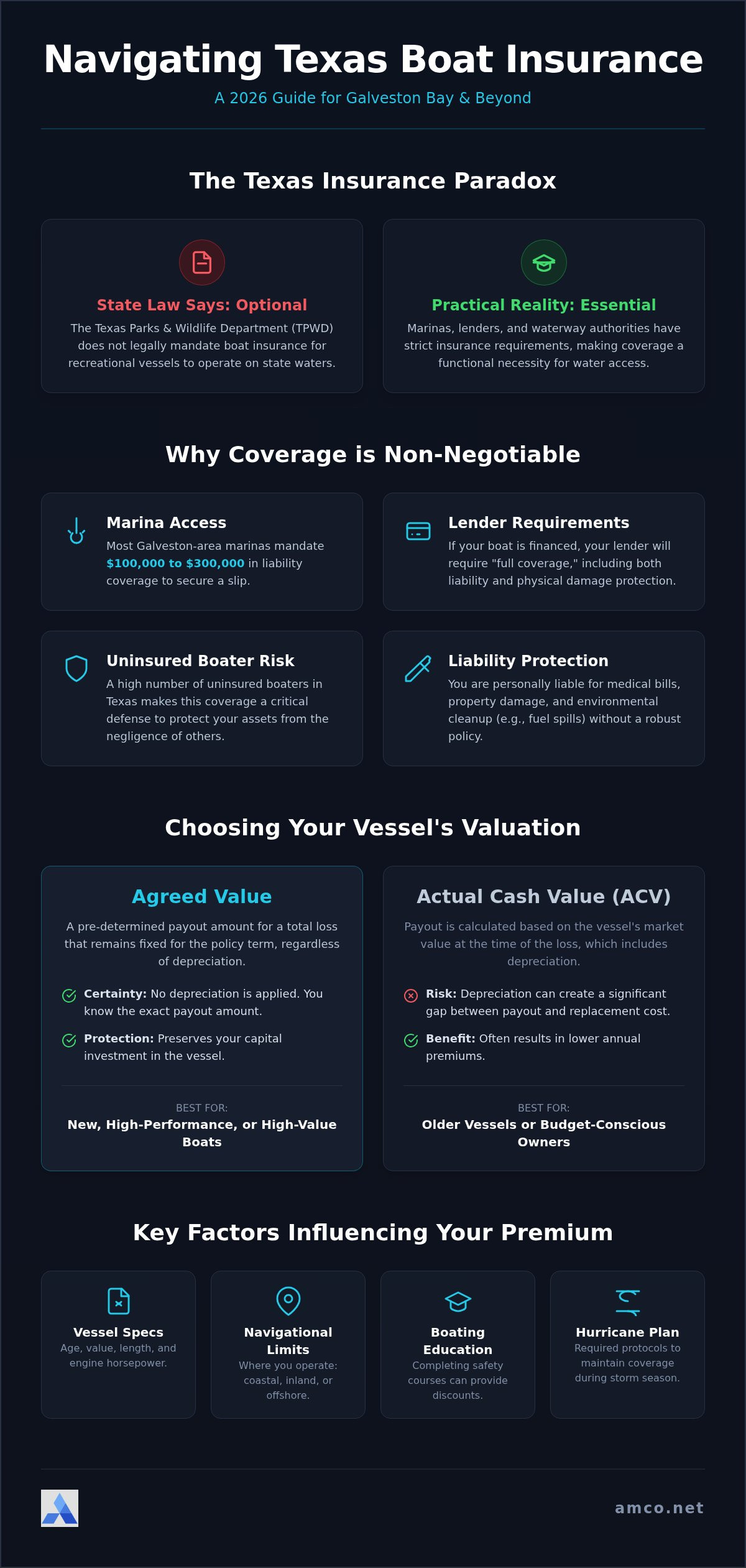
Texas boaters frequently operate under the premise that because the state doesn't mandate coverage, they're essentially off the hook. This is a technical truth that ignores the operational reality of the Houston-Galveston region. While the Texas Parks and Wildlife Department (TPWD) focuses on registration and safety equipment, they don't require proof of Boat Insurance for a vessel to be legal on the water. However, this legal loophole closes the moment you interact with a marina, a financial institution, or a local waterway authority.
To better understand the fundamental components of these policies, watch this helpful video:
Most marinas in Galveston Bay require a minimum of $100,000 to $300,000 in liability coverage before they'll issue a slip agreement. This isn't just a suggestion; it's a standard part of the Vessel Space License Agreement designed to protect the facility and other tenants from third-party damage. If your boat is financed, your lender will mandate "full coverage," which includes both liability and physical damage protection. Understanding Marine Insurance principles helps owners see why these entities view an uninsured vessel as an unacceptable risk. In 2026, maritime standards have evolved so that marinas are becoming even stricter about their insurance requirements. Boaters should expect to present proof of active coverage before being allowed to dock or renew their annual contracts.
Operating in high-traffic corridors like the Houston Ship Channel or busy inland waters carries inherent risks that go beyond simple hull damage. Without a robust policy, you're personally liable for medical payments if a passenger or a third party is injured. There's also the often-overlooked issue of environmental cleanup. A fuel spill in the sensitive ecosystems of Galveston Bay can result in massive fines and remediation costs. Professional Boat Insurance offers specialized coverage for these scenarios, including on-water towing and fuel spill liability. These aren't just "add-ons"; they're critical safeguards in a complex boating environment. Given that many boaters in Texas remain uninsured, carrying adequate liability and uninsured boater coverage is the only reliable way to protect your personal assets from the negligence of others.
Selecting the right Boat Insurance involves more than just meeting marina standards. It requires a strategic assessment of your vessel's primary components, including the hull, propulsion systems, and specialized marine electronics. In the high-traffic waters of Galveston Bay, liability coverage remains the cornerstone of any professional policy. This protects your assets against claims for third-party bodily injury or property damage. However, because Texas has a high percentage of uninsured boaters, adding uninsured watercraft coverage is a critical defensive measure. This ensures you're protected even if the party at fault lacks the financial resources to cover your losses after a collision.
Agreed Value coverage specifies a pre-determined payout amount for a total loss that remains fixed regardless of the vessel's depreciation over time. This provides significant financial certainty for owners of new or high-value boats. Conversely, Actual Cash Value policies calculate payouts based on the market value at the exact time of the incident. While these often carry lower premiums, the impact of depreciation can leave a significant gap between the insurance check and the cost of a replacement vessel. For a 2026 model, securing an Agreed Value policy is generally the most prudent choice to preserve your capital investment.
Standard policies often exclude the logistical complexities associated with a maritime accident. On-water towing and emergency assistance are vital for vessels operating far from the Port of Houston, where mechanical failure can quickly lead to a dangerous drift situation. Additionally, wreck removal and salvage coverage are essential. If a vessel sinks in a navigable channel, the owner is legally responsible for its removal. This process can cost thousands of dollars without specific coverage in place.
Modern fishing vessels and cruisers also carry significant values in personal effects and high-end electronics. From advanced sonar arrays to professional fishing tackle, these items often exceed the limits of a basic policy. Ensuring these are scheduled correctly within your coverage plan prevents out-of-pocket losses during a claim. If you're currently evaluating your current policy options, consider how these specialized endorsements align with your specific usage patterns in the Gulf. Protecting the vessel itself is only the first step; protecting the technology and equipment that make it functional is equally important for long-term security.
Operating a vessel in the Houston-Galveston region requires a dual-track risk assessment. The commercial density of the Houston Ship Channel presents navigational challenges that differ fundamentally from the recreational congestion found on inland lakes. Saltwater environments accelerate corrosion on propulsion systems and electrical components, necessitating policies that account for specialized maintenance or mechanical failure. Your Boat Insurance must reflect these geographical realities, particularly regarding navigational limits. Most Texas policies define a specific radius, such as 75 to 100 miles from a home port, or restrict coverage to coastal waters. Crossing these invisible boundaries without a specific endorsement can void your protection during a transit.
For coastal boaters, the Atlantic hurricane season dictates the structure of their coverage. Many professional policies include "haul-out" coverage, where the carrier pays a portion of the labor costs to move your vessel to a secure inland location when a named storm warning is issued. It's a proactive measure that benefits both the owner and the insurer. You should also review your "named storm deductible." Unlike standard flat-fee deductibles, these are often calculated as a percentage of the vessel's total insured value. Maintaining a documented hurricane plan with your local agent is no longer optional. It's a prerequisite for many carriers in the 2026 market to ensure you've taken reasonable steps to mitigate catastrophic loss.
Inland waters like Lake Conroe or Lake Travis present a different set of operational hazards. Submerged objects, such as tree stumps or shifting sandbars, are primary causes of lower-unit damage that many owners mistakenly assume is covered by basic maintenance. Along with these physical risks, liability concerns spike during crowded holiday weekends. If your boating activities include towing skiers, tubers, or wakeboarders, your Boat Insurance must specifically include medical payments and liability for water sports. A standard policy might have exclusions for certain high-risk activities. Inland boaters shouldn't overlook natural disaster coverage either. While they're often safe from coastal storm surges, inland flooding and localized hail storms cause significant damage to upholstery and electronics every year.
Underwriters evaluate maritime risk through a precise actuarial lens that balances vessel specifications with operator behavior. The physical attributes of your craft, including its age, length, and total horsepower, serve as the primary rating factors. High-performance vessels with significant engine output generally command higher premiums due to the increased potential for high-speed incidents and the specialized labor required for repairs. Storage location also plays a critical role in the calculation. A vessel kept in a secure, inland dry dock typically qualifies for lower rates than one moored in a coastal marina where it remains vulnerable to tidal surges, hull fouling, and theft.
Your history behind the wheel of a car is often a precursor to your behavior on the water. In 2026, data integration between different insurance sectors is standard, meaning your car insurance houston record directly affects your Boat Insurance premiums. A profile marked by speeding violations or reckless driving on Texas highways suggests a higher risk level to maritime underwriters. Maintaining a clean driving record is one of the most consistent ways to keep your maritime coverage affordable.
You can mitigate high premiums by demonstrating a commitment to safety and professional education. Completing a Texas Parks and Wildlife Department (TPWD) approved boating safety course is a highly effective way to secure a permanent discount on your policy. Carriers also offer credits for advanced safety equipment that exceeds legal requirements, such as integrated GPS tracking systems or automatic fire suppression units in the engine compartment. Bundling your maritime protection with existing homeowners or auto policies remains the most efficient strategy for reducing your total annual expenditure.
A clean claims history serves as a significant financial asset for experienced boaters. Insurance companies view a lack of previous maritime claims as evidence of both competent seamanship and diligent vessel maintenance. If you have a complex claims history or operate a specialized high-performance vessel, the independent agency model provides a distinct advantage. Because independent agents aren't restricted to a single carrier, they can compare your specific profile across multiple providers to identify the most competitive rates in the 2026 market. If you're looking to optimize your coverage, you can request a professional boat insurance comparison to ensure you aren't overpaying for your protection.
Serving the Houston and Galveston boating community since 1987, AMCO.NET LLC provides a level of regional expertise that national, captive agencies cannot replicate. Our independent agency model functions as a strategic advantage for vessel owners. Instead of offering a single proprietary product, we analyze your specific requirements across multiple specialized carriers to identify the optimal balance of coverage and cost. This consultative approach is particularly valuable in the 2026 market, where underwriting criteria for coastal risks continue to tighten. We treat Boat Insurance as a critical component of a broader risk management system, ensuring your maritime assets are protected with the same rigor as your commercial or personal property.
Our deep roots in the Houston market allow us to understand the operational nuances of Galveston Bay, from the traffic patterns of the Ship Channel to the specific storm surge risks of local marinas. We don't just sell policies; we provide technical guidance on how to structure your coverage to meet the evolving standards of 2026. This includes matching your vessel with carriers that appreciate the value of documented maintenance and professional boating education. Our goal is to provide a stable, long-term partnership that prioritizes your financial security over short-term sales metrics.
We operate as your professional advocate throughout the lifecycle of your policy, especially during the claims process. If you face a complex claim after a Gulf storm, our team leverages decades of experience to ensure the settlement process remains transparent and fair. We maintain established relationships with specialized marine insurers that often provide superior terms for high-performance vessels or unique navigational needs. These are options that national brands frequently overlook. Our focus remains on technical accuracy and logistical continuity, providing you with a reliable point of contact who understands the local maritime environment.
Securing professional protection should not be a logistical burden for busy vessel owners. We provide a streamlined online application process that delivers efficiency without sacrificing the depth of a professional review. This hybrid approach allows you to manage your Boat Insurance via mobile platforms while retaining access to expert consultation for complex coverage decisions. Whether you're insuring a new 2026 cruiser or updating the coverage on a long-held family vessel, our Houston-based team is ready to provide a detailed comparison of your options. You can Get a fast boat insurance quote from AMCO.NET to begin professionalizing your maritime risk management strategy today.
Operating a vessel in the Houston-Galveston region requires a shift from viewing insurance as a legal formality to treating it as a core component of your operational security. The technical nuances of agreed value coverage and the specific liability demands of local marinas mean that a generic policy is often insufficient for the complexities of the Gulf Coast. A proactive stance on Boat Insurance ensures that your driving record and vessel storage choices are leveraged to stabilize premiums while maintaining comprehensive protection against tropical systems.
Since 1987, our agency has functioned as a trusted partner for Texas boaters, providing the technical expertise needed to manage these risks effectively. By comparing rates from top-rated Texas carriers, we provide the expert support required for the unique challenges of Galveston Bay and the open Gulf. We invite you to leverage our deep roots in the Houston market to professionalize your maritime protection strategy before the next season begins. Secure your vessel with a custom Texas boat insurance quote from AMCO.NET and ensure your maritime assets are protected by a team that understands the Gulf Coast.
Texas law doesn't mandate Boat Insurance for recreational vessels operating on public waterways. While the state doesn't require it, you'll find that most marinas in the Galveston Bay area require liability proof between $100,000 and $300,000 to secure a slip. Additionally, financial institutions require full coverage as a non-negotiable condition of any marine loan or lease agreement.
A standard homeowners policy provides very little protection for marine vessels once they leave your primary residence. Coverage is typically capped at $1,500 and only applies while the boat is physically on your property. It doesn't provide the essential liability protection or environmental cleanup coverage necessary for incidents occurring on the water or at a professional marina.
Agreed value establishes a fixed payout amount that remains constant regardless of the vessel's depreciation over time. Actual cash value pays out based on the market price at the exact time of the claim, which accounts for wear and tear. For newer models or high-performance vessels in the Houston market, agreed value is the more stable financial choice for asset protection.
Hurricanes often trigger separate, higher deductibles that are calculated as a percentage of the boat's total insured value. Many carriers in the Gulf Coast region also require a documented hurricane plan as a condition of the policy. Some professional Boat Insurance plans will even reimburse you for haul-out costs to move the vessel inland before a named storm makes landfall.
Yes, most carriers offer premium discounts for completing a Texas Parks and Wildlife Department (TPWD) approved safety course. This certification proves to underwriters that you're a lower-risk operator with a commitment to professional maritime standards. It's a simple, effective way to reduce your annual costs while improving your navigational skills in busy shipping channels.
Engine breakdowns are usually covered only if you've specifically added an on-water towing endorsement to your policy. Standard hull coverage doesn't typically include the cost of a tow back to the dock or fuel delivery services. This add-on is highly recommended for boaters navigating the long stretches of the Houston Ship Channel or remote areas of the bay.
Standard policies typically provide very limited coverage for personal items like high-end fishing tackle, sonar arrays, or other marine electronics. You'll usually need a personal effects endorsement to fully protect these assets from theft or damage during transit. It's a good practice to keep an itemized list and photos of your gear for accurate policy scheduling.
If you're involved in a collision with an uninsured operator, your own uninsured watercraft coverage will pay for your repairs and medical bills. Since a significant number of Texas boaters lack professional coverage, this specific protection is a vital defensive measure. It ensures that another person's financial negligence doesn't result in your personal out-of-pocket loss.