
Choosing to operate as a non-subscriber in Austin’s dining scene exposes your assets to unlimited liability that a single kitchen injury can trigger. You already understand that workers compensation for restaurants in Austin is a complex necessity, especially as labor costs rise and the risk of slips or burns remains constant. Relying on luck is not a sustainable business strategy in a litigious market where the average claim can reach $41,000.
This guide provides the technical insights needed to secure comprehensive protection while maintaining fiscal discipline. You'll learn how to benefit from the 3.8% average decrease in loss costs for 2026 and how the current State Average Weekly Wage of $1,271.05 impacts your policy structure. We will examine specific NCCI class codes, safety program incentives, and the stability offered by an independent agency with roots in Texas since 1987. This data-driven approach ensures your restaurant remains protected, compliant, and profitable through the coming year.
Workers compensation is a specialized insurance system designed to provide medical benefits and wage replacement to employees injured during their employment. Within the broader U.S. workers' compensation system, these programs are managed at the state level to balance employer liability with worker protection. For local operators, workers compensation for restaurants in Austin serves as a critical risk management tool. It functions as a "grand bargain" where the employer provides guaranteed benefits in exchange for protection against most employee lawsuits.
The Texas Department of Insurance (TDI) oversees the regulations that govern these policies. For the 2026 policy year, the TDI approved an average decrease of 3.8% in loss costs, which provides a favorable environment for businesses to secure coverage. While Texas remains the only state where this insurance is technically optional, the financial exposure of an average $41,000 claim makes it a functional necessity. Smart business owners recognize that a single kitchen accident can jeopardize the entire operation without this shield.
To better understand how these policies protect your hospitality business, watch this helpful video:
Austin's hospitality sector faces unique operational pressures that differ from other Texas markets. High-volume seasonal events like SXSW or ACL Music Festival create intense windows where staff fatigue increases the likelihood of kitchen injuries. For those seeking workers compensation for restaurants in Austin, understanding these local variables is essential for accurate premium forecasting. The local labor market's competitiveness also means that providing a secure work environment is a key retention strategy. Whether you operate a high-traffic brick-and-mortar establishment or a mobile food truck, you must account for the 2026 State Average Weekly Wage of $1,271.05 when calculating potential indemnity benefits for your staff.
Texas law allows private employers to choose whether to carry insurance; those who opt out are known as "non-subscribers." However, this choice carries heavy legal consequences. Subscribers are generally protected by the "exclusive remedy" rule, which prevents employees from suing for negligence. Non-subscribers lose their common-law defenses in court. In Austin's specific legal environment, a non-subscriber cannot argue that the employee was partially at fault or that the injury was caused by a coworker's mistake. This lack of defense often leads to settlements that far exceed the cost of annual premiums, making subscription the more stable financial path.
A robust policy for workers compensation for restaurants in Austin must provide a multi-layered shield. The core of this protection is medical coverage, which pays for emergency room visits, surgeries, and ongoing care without deductibles for the employee. Because kitchen staff often face burns from high-volume equipment or lacerations from prep work, this coverage ensures that medical bills don't become the business owner's direct debt. It's the primary mechanism that maintains operational continuity after an accident.
Beyond medical costs, the Texas Workers' Compensation Program structure requires policies to address indemnity benefits. These payments compensate employees for lost wages if they're unable to work for more than seven days. For claims with injury dates between October 1, 2025, and September 30, 2026, the maximum weekly benefit is tied to the 2026 State Average Weekly Wage of $1,271.05. This standardized benefit system helps manage expectations and reduces the friction between the employer and the injured staff member.
Employer Liability (Part B) is often the most overlooked component of a policy. While Part A covers the statutory benefits, Part B protects the restaurant owner if they're sued for damages not covered by the standard workers comp agreement. This includes "dual capacity" lawsuits or claims filed by an injured worker’s family members. It acts as a final backstop against catastrophic legal expenses that could otherwise bankrupt a small to mid-sized Austin establishment.
The kitchen environment presents specialized hazards that require precise coverage focus. High-moisture areas around dishwashing stations and prep zones are frequent sites for slips and falls. Prep cooks and dishwashers are also vulnerable to repetitive motion injuries, such as carpal tunnel syndrome, which can lead to long-term claims. Ensuring your policy correctly classifies these roles is essential for both protection and premium accuracy. Without specific kitchen-risk considerations, you might find yourself underinsured for the most common claims in the hospitality industry.
Austin’s congested traffic poses a significant risk to delivery drivers. If an employee is injured while delivering an order in their personal vehicle, workers compensation for restaurants in Austin typically serves as the primary coverage for their injuries. However, this interacts closely with Hired and Non-Owned Auto (HNOA) insurance, which covers the business’s liability for property damage. For catering teams working at off-site venues, the policy must extend to these temporary locations to ensure full legal compliance. To ensure your current policy covers these specific operational gaps, you can request a professional coverage review from an experienced local broker.
In 2024, approximately 76% of private employers in Texas chose to carry workers' compensation coverage. This high adoption rate among business owners isn't accidental; it reflects a calculated response to the state’s unique "non-subscriber" legal framework. For those evaluating workers compensation for restaurants in Austin, the decision centers on a fundamental trade-off between predictable monthly premiums and the risk of uncapped, out-of-pocket legal settlements. While opting out might offer a temporary boost to cash flow, it removes the statutory immunity that protects a business from being sued for workplace injuries.
The "Austin Jury" factor adds another layer of complexity to this financial equation. Travis County is often perceived as a more plaintiff-friendly environment compared to other Texas regions, meaning local jury awards or settlements can significantly exceed state averages. When a restaurant subscribes to the state system, the "exclusive remedy" rule generally prevents employees from suing for negligence. Without this protection, a single kitchen accident could result in a lawsuit that targets the restaurant’s physical assets, equipment, and future earnings.
When a restaurant operates as a non-subscriber, it loses three critical "common law defenses" in court. First, you cannot claim the employee was partially at fault through contributory negligence. Second, you cannot argue the employee assumed the risk by taking the job. Third, you cannot blame the injury on a fellow employee’s mistake. If an employee sues a non-subscribing Austin cafe, the business is essentially defenseless if any degree of employer negligence is proven. While some operators use ERISA-based occupational injury plans as an alternative, these plans do not provide the same legal immunity as a standard policy for workers compensation for restaurants in Austin.
Financial stability in the hospitality industry relies on managing "known" versus "unknown" costs. A standard policy for an Austin restaurant typically ranges from $1,000 to $5,000 annually, depending on payroll and safety history. This is a known, fixed expense. In contrast, the cost of a single kitchen slip without insurance is an unknown variable that starts with medical bills and quickly escalates to legal fees. With attorney hourly rates for these cases reaching $300 in 2026, the cost of defending a claim often exceeds several years of insurance premiums. For a small cafe or food truck, this financial shock is frequently a business-ending event. Long-term business continuity is best served by shifting this catastrophic risk to a carrier rather than retaining it on the balance sheet.
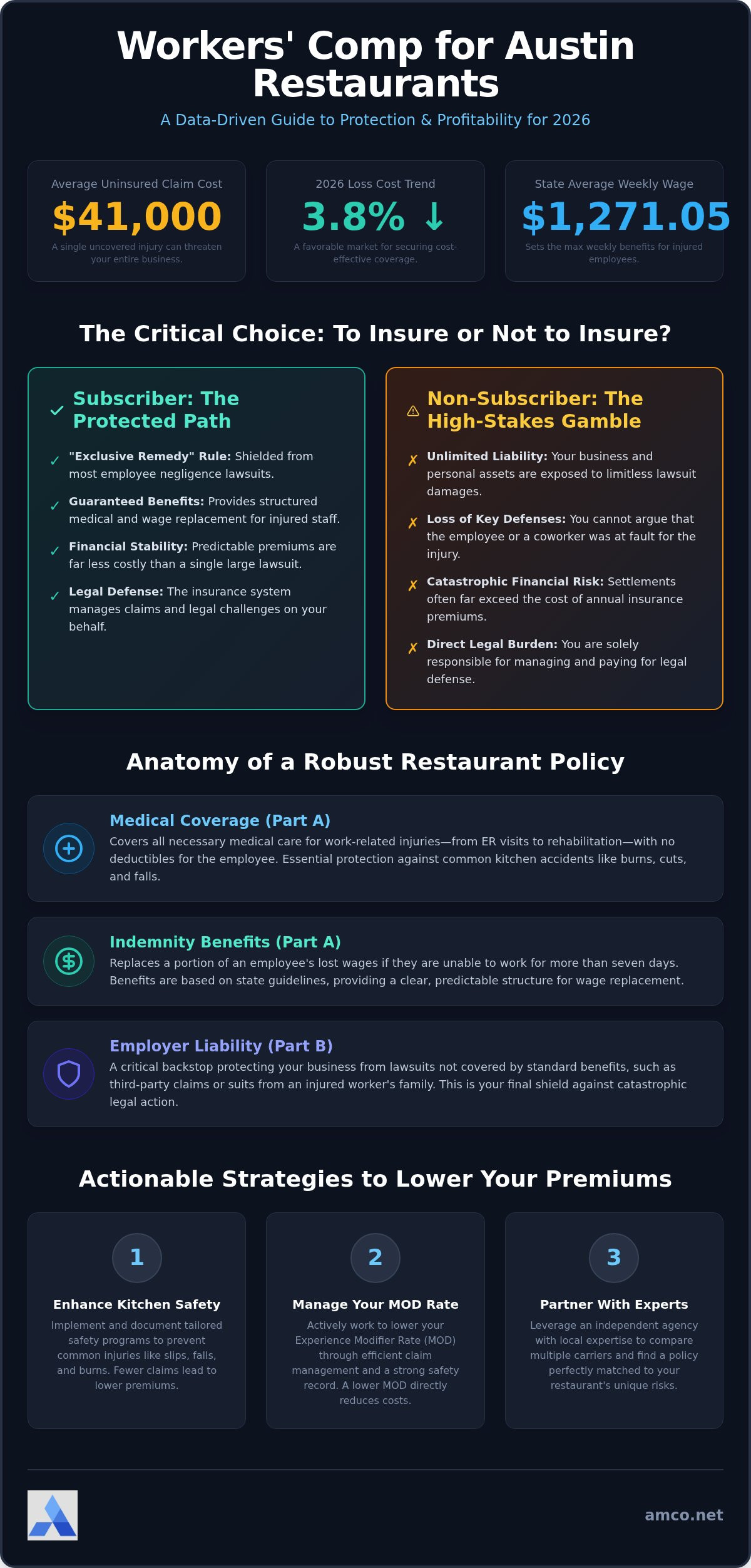
Managing the cost of workers compensation for restaurants in Austin requires a technical understanding of the Experience Modifier Rate (MOD). This numerical factor acts as a multiplier applied to your manual premium; it essentially rewards businesses with clean safety records and penalizes those with frequent claims. A MOD of 1.0 represents the industry average. Pushing this number below 1.0 through proactive risk management is the most effective way to secure long-term savings for your establishment.
Correct employee classification is another vital lever for premium control. For 2026, the advisory rate for class code 9082 (Restaurant NOC) is $1.23 per $100 of payroll. Misclassifying front-of-house staff into higher-risk categories can lead to unnecessary overpayment. Conversely, ensuring your payroll reporting is precise prevents the sticker shock often associated with year-end audits. Precise data entry is the foundation of a predictable insurance budget.
Return-to-Work programs have become even more critical following the 2026 DWC amendment, which now mandates the use of ODG by MCG guidelines for evaluating return-to-work timeframes. By offering light-duty positions to injured staff, you reduce the duration of indemnity payments. This directly improves your MOD over a three-year rolling window, as indemnity costs typically weigh more heavily on your rating than medical-only claims.
Austin's climate and social calendar introduce specific hazards that require targeted training. Training patio staff on heat stress management is non-negotiable during Texas summers to prevent dehydration-related injuries. A safety-first culture focuses on specific operational risks:
While one large claim is damaging, a high frequency of small incidents often has a more negative impact on your insurance carrier’s perception of your risk profile. Consistent training signals to underwriters that your operation is a lower risk, which can lead to more favorable pricing during renewal periods.
The most effective way to optimize your workers compensation for restaurants in Austin is to partner with an independent agency that can compare rates across a wide network of carriers. Bundling your workers comp with General Liability Insurance often unlocks multi-policy discounts that aren't available when purchasing standalone coverage. Since 1987, we've helped local operators navigate these market shifts to find the most competitive rates. To see how these strategies can lower your specific premiums, request a customized quote analysis from our team today.
Implementing a robust insurance strategy requires more than just selecting a policy; it demands a partnership with experts who understand the technical nuances of the Texas market. AMCO.NET LLC provides the professional stability required to manage these complex liabilities. As an independent agency founded in 1987, we leverage decades of market data to identify which carriers are currently offering the most competitive terms for the Austin hospitality sector. This long-standing market presence allows us to advocate effectively for our clients, ensuring that your coverage is both comprehensive and cost-effective.
Serving the Austin community involves a deep understanding of local business cycles and the specific operational pressures of the city. Our history since 1987 isn't just a figure; it represents a legacy of navigating every major regulatory shift in the Texas insurance landscape. This experience translates to better carrier relationships and a more sophisticated understanding of how workers compensation for restaurants in Austin should be structured to protect against local jury trends. For those seeking a deeper understanding of why local expertise is vital, our Insurance Company Near Me guide offers additional insights into the value of Texas-based representation. We operate as a consultant rather than a mere vendor, focusing on long-term technological and financial continuity for your establishment.
The process of securing workers compensation for restaurants in Austin is designed to be efficient, respecting the demanding schedules of restaurant owners and operators. Our digital quoting system provides a streamlined entry point for busy professionals, allowing for rapid comparisons across our wide network of carriers. To ensure the most accurate and affordable quote, you should have the following information ready for our specialists:
Restaurateurs can expect a methodical, data-driven approach that prioritizes financial return and risk mitigation. Our commitment to finding reliable coverage means we don't just look for the lowest headline price; we look for the policy that offers the strongest legal protection for your specific niche. By integrating your workers comp with other essential business liability lines, we provide a unified defense for your restaurant’s future. Contact our Austin-based team today to begin your customized coverage analysis.
Managing workers compensation for restaurants in Austin requires a shift from viewing insurance as a mere expense to recognizing it as a strategic asset. By moving away from the non-subscriber legal trap and focusing on proactive safety protocols, you stabilize your operational costs and protect your business from catastrophic lawsuits. The 2026 rate environment provides a unique opportunity to refine your coverage while benefiting from the recent 3.8% decrease in loss costs. This technical alignment ensures that your restaurant remains both compliant and financially resilient.
Since 1987, we've focused on providing the technical expertise and market access needed to navigate these complexities. Our independent agency status ensures you can compare multiple top-rated carriers to find the most efficient solution for your specific risk profile. With bilingual support for diverse restaurant teams, we ensure that every member of your staff understands the safety systems in place. Protect your Austin restaurant with a fast Workers Comp quote from AMCO.NET and secure the long-term stability your business deserves. We look forward to helping your establishment thrive in Austin's competitive dining landscape.
Workers compensation for restaurants in Austin isn't legally mandated by the state of Texas. Private employers have the unique option to be "non-subscribers" who opt out of the state-regulated system. While this might seem like a cost-saving measure, it removes critical legal protections. Without a policy, you lose the ability to argue that an employee's own negligence contributed to their injury during a lawsuit, leaving your business assets fully exposed to legal claims.
Premiums vary based on your total payroll and specific classification codes. For 2026, the advisory rate for restaurant employees under class code 9082 is $1.23 per $100 of payroll. Most small to mid-sized establishments in the area pay between $1,000 and $5,000 annually. Since rates can fluctuate based on your safety record and carrier choice, comparing multiple quotes through an independent agency is the most effective way to manage these operational costs.
Yes, workers compensation typically covers employees while they're acting within the scope of their job duties, including delivery. If a staff member is injured in an accident while delivering an order in their personal vehicle, your policy serves as the primary coverage for their medical expenses and lost wages. It's important to distinguish this from property damage, which requires Hired and Non-Owned Auto insurance to protect the business's liability for third-party vehicles or structures.
A non-subscriber is a Texas employer who chooses not to provide workers' compensation insurance through the state system. While this is legal, it's a high-stakes strategy for the hospitality industry. Non-subscribers are vulnerable to lawsuits where they cannot use common-law defenses, such as arguing the injury was an inherent risk of the job. For most Austin owners, the risk of a single catastrophic settlement outweighs the monthly premium savings offered by opting out.
You can certainly obtain workers compensation for restaurants in Austin even if you operate a mobile food truck. These policies are essential for mobile units because of the increased risks of burns and slips in confined spaces, combined with the hazards of the road. Providing this coverage helps you secure permits and protects your personal assets if a team member is injured during a busy shift or while traveling between service locations.
Your Experience Modifier Rate, or MOD, acts as a multiplier that directly increases or decreases your premium based on your claims history. A MOD of 1.0 is the industry baseline. If your restaurant maintains a clean safety record over a rolling three-year period, your MOD drops below 1.0, resulting in a premium discount. Conversely, frequent small claims or one major incident can push your MOD higher, making your insurance significantly more expensive at renewal.
If an employee is injured and you don't carry coverage, you're responsible for all medical costs and lost wages out of pocket. More importantly, the employee has the legal right to sue your restaurant for negligence. In these cases, Texas law prevents you from arguing that the worker was partially responsible for the accident. Given that the average claim cost in Texas is approximately $41,000, an uninsured injury can lead to total business failure.
You must report the injury to your insurance carrier as soon as you become aware of the incident. Under Texas law, employers are required to file DWC Form-001 with their insurance company no later than the eighth day after the injury resulted in more than one day of lost work. Timely reporting is vital for compliance and helps the carrier manage the claim costs effectively through established return-to-work guidelines and specialized medical networks.