Over 600,000 vessels currently navigate Texas waterways, yet the state remains one of the few where Boat Insurance isn't legally mandated for recreational owners. While this lack of a mandate offers initial flexibility, it creates a significant liability gap in a region prone to both crowded inland lakes and volatile coastal weather. You've likely invested heavily in your watercraft and recognize that a single hurricane or a collision on a busy weekend can result in a total loss. Relying on a standard homeowners policy is rarely sufficient; these typically provide minimal coverage for vessels valued over $1,500 or those with high-performance motors.
We understand that choosing the right policy involves more than just comparing premiums. It requires a technical understanding of how hull protection, liability limits, and specialized coverage for fishing gear integrate into a cohesive risk management strategy. This guide clarifies the complexities of marine coverage, from the nuances of agreed value versus actual cash value to the specific requirements of Texas marinas. You'll gain the expert insight needed to protect your assets against storm damage and operational accidents, ensuring your time on the water is backed by professional-grade security.
Boat insurance is a specialized risk management tool designed to mitigate the financial impact of physical damage, liability, and medical expenses resulting from watercraft operations. While it shares some conceptual similarities with auto or property coverage, it's rooted in the historical principles of understanding marine insurance. This distinction is critical because maritime environments present unique hazards, such as salvage operations and environmental liability, that standard insurance products aren't equipped to handle. For Texas boaters, having a dedicated policy ensures that the specific mechanical and structural needs of their vessel are addressed by professionals who understand marine technology.
Many owners mistakenly assume their homeowners policy provides sufficient protection through an endorsement. While this might cover a small, low-horsepower skiff, it rarely extends to the liability or physical damage needs of modern recreational vessels. Dedicated policies offer broader protections, including wreck removal and fuel spill liability, which are essential for operating on Texas waterways. Choosing to "self-insure" or rely on minimal coverage can lead to catastrophic financial consequences if a vessel sinks or causes environmental damage.
As of 2026, the Texas Parks and Wildlife Department doesn't legally require recreational boaters to carry insurance. This lack of a state mandate doesn't mean coverage is optional for most owners. If your vessel is financed, your lienholder will require a comprehensive policy to protect their collateral. Additionally, most private marinas and public docking facilities in areas like Galveston or Lake Conroe require proof of liability coverage before granting access. These contracts often specify minimum limits, making Boat Insurance a functional necessity for anyone who doesn't store their boat exclusively on private property. Choosing between liability-only and full coverage depends on your risk tolerance and the total value of your assets.
A dedicated marine policy provides security against specialized perils that are unique to the water, such as capsizing, stranding, or hitting submerged debris. During the peak summer season, Texas lakes become highly congested, significantly increasing the risk of collisions. A robust policy covers these accidents and provides protection for fuel spill liability. If your boat leaks fluids after an incident, you could face substantial environmental fines and cleanup costs. Having a professional policy in place ensures these technical and legal challenges are managed by experts, allowing you to focus on your operations without the fear of sudden, unmanageable expenses.
A standard Boat Insurance policy consists of several layers of protection designed to address specific operational risks. Hull and Machinery coverage serves as the foundation, protecting the physical integrity of the vessel and its propulsion systems. Protection and Indemnity (P&I) acts as the marine equivalent of liability insurance, covering bodily injury and property damage claims from third parties. According to the Texas Department of Insurance, understanding these distinctions is vital for selecting a policy that aligns with your specific usage patterns. Without these core components, an owner remains exposed to the full financial weight of litigation and repair costs.
Medical payments coverage addresses hospital bills for the operator and passengers regardless of who caused the accident. This is particularly useful in Texas, where the high volume of traffic on lakes like Lake Travis increases the statistical likelihood of minor injuries. Given that many Texas boaters operate without coverage, uninsured watercraft protection is a critical safeguard. It ensures you aren't left paying for repairs if a collision involves an underinsured or uninsured party. This protection is often the only way to recover costs after an incident with a negligent operator who lacks assets.
Coverage for physical damage extends beyond the fiberglass hull. Machinery includes engines, blowers, and steering controls. It's essential to distinguish between permanently attached equipment and portable gear. While built-in GPS units are typically covered under the hull policy, handheld devices may require a separate endorsement. Don't overlook the boat trailer. It's often treated as an optional add-on but is essential for transport across Texas. Ensuring the trailer is listed on the policy prevents gaps during transit to and from the water.
Professional and amateur anglers should look for fishing tournament coverage to protect their entry fees and equipment. Personal effects coverage is also necessary for expensive rods, reels, and high-end sonar electronics that are easily damaged or stolen. Finally, on-water towing and emergency assistance can prevent exorbitant salvage fees if you experience a mechanical failure. These specialized endorsements provide a level of security that generic policies lack. If you're unsure which endorsements fit your vessel, you can compare multiple marine policy options to find the right balance of protection.
The valuation method you select for your Boat Insurance policy is perhaps the most significant factor in determining your financial recovery after a major incident. While many owners focus primarily on the monthly premium, the technical distinction between Agreed Value and Actual Cash Value (ACV) dictates how depreciation is applied to a claim payout. In the event of a total loss, these two structures can result in a difference of tens of thousands of dollars. Understanding these mechanisms is essential for maintaining the financial continuity of your marine operations, especially when navigating the legal complexities outlined in Texas Boating Laws.
Partial loss payouts also vary significantly between these coverage types. On an ACV policy, the insurer depreciates the cost of parts used in a repair, meaning you'll likely pay more out of pocket for a fix. Even on high-end Agreed Value policies, certain components like canvas, upholstery, or outboard motors might still be subject to depreciation schedules. It's a technical nuance that requires careful review of the policy language to avoid unexpected costs during a restoration. Professional owners recognize that the cheapest policy often carries the highest hidden costs when it's time to file a claim.
Agreed Value coverage is the standard for newer vessels, yachts, and custom watercraft where the owner needs to lock in a specific valuation. This "Agreed Amount" is established when the policy is written and remains the payout figure regardless of market fluctuations or physical wear. Lenders almost always require this coverage for financed boats to ensure the loan balance is protected. It's an investment in stability, providing a predictable outcome if your vessel is lost to a storm or fire. For classic restorations, this is often the only way to protect the true value of the labor and custom parts invested in the boat.
Actual Cash Value is a budget-friendly option for older boats or vessels used primarily for short fishing trips in inland waters. The premiums are lower because the insurer's liability decreases as the boat ages. However, the risk is substantial. If a total loss occurs, the payout is based on the current market value, which might be significantly less than what you'd need to replace the vessel. For owners of well-maintained older boats, this gap can be a major financial hurdle. It's a choice between immediate premium savings and long-term asset protection that requires a clear understanding of your vessel's current market position.
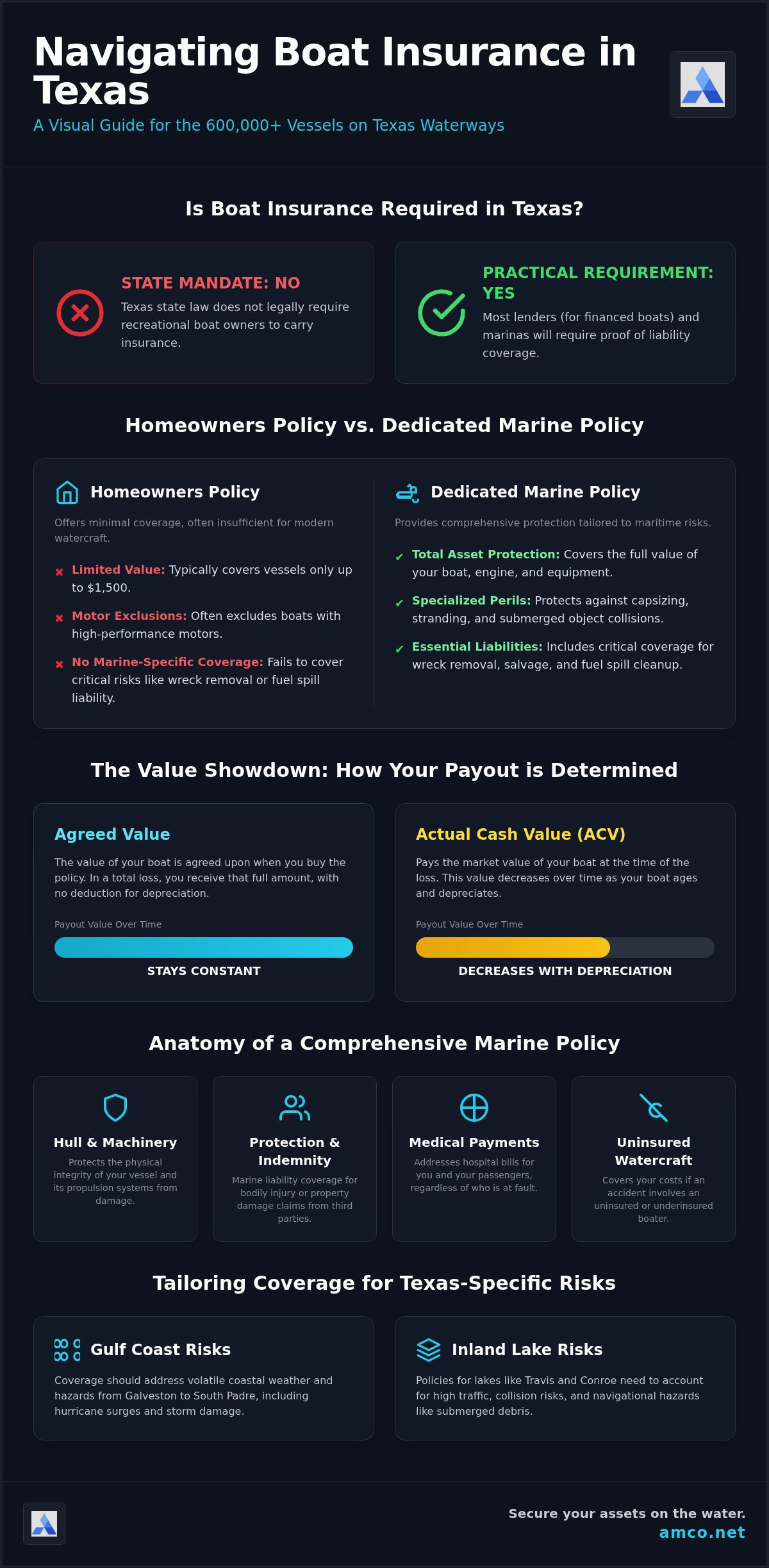
Texas boaters face a dual-threat environment. Coastal owners in the Houston and Galveston area must account for hurricane surges, while those on inland lakes like Lake Travis deal with extreme congestion and submerged hazards. A robust Boat Insurance policy must be geographically specific to these regions. Generic national policies often fail to address the high-velocity wind risks and localized flooding patterns unique to the Texas coast.
One technical detail often overlooked is the "Navigation Limits" clause. If your policy is rated for inland lakes, venturing into the Gulf of Mexico could void your coverage during an incident. You need to ensure your cruising area is clearly defined in your documents. Beyond hurricanes, sudden squalls and large-scale hail events are common across the state. These can cause significant cosmetic and structural damage to gelcoats and bimini tops in minutes. Proactive owners should request a customized Texas boat insurance quote that specifically accounts for these regional weather patterns.
For Houston-based owners, a "Hurricane Haul-out" endorsement is an essential technical add-on. This provision helps cover the labor costs of professional trailer transport or dry-docking when a named storm enters a specific geographic coordinate. Insurance carriers prioritize proactive risk mitigation. Securing your vessel in Galveston Bay requires more than just extra lines; it involves a documented plan that your insurer may review during the underwriting process. Failure to follow these stated protocols can sometimes lead to claim complications after a major event.
Navigating the Intra-Coastal Waterway (ICW) presents commercial traffic risks that differ vastly from the recreational hazards of East Texas reservoirs. In lakes like Sam Rayburn or Toledo Bend, submerged timber remains a primary cause of lower-unit damage. Additionally, the transition between saltwater and freshwater use impacts both your maintenance schedule and your policy's mechanical breakdown provisions. Saltwater environments accelerate corrosion, which most basic policies exclude as "wear and tear." Understanding how your operational area affects your risk profile is the first step toward securing comprehensive protection.
Selecting an insurance partner for your marine assets is a technical decision that directly impacts your long-term financial stability. While many owners are tempted by the convenience of national call centers, these organizations often lack the regional data necessary to price Texas-specific risks accurately. An independent agency functions as a consultant rather than a single-brand representative. This broker advantage allows you to compare multiple Boat Insurance structures from various carriers, ensuring the policy you select aligns with your vessel's operational reality. Whether you're docking a yacht in Galveston or a bass boat in San Antonio, a local expert understands the specific environmental and legal variables that a generalist might overlook.
Modern marine insurance management requires a balance of historical expertise and technological efficiency. AMCO combines the calm, reliable service of a legacy firm with the convenience of mobile-enabled policy management. This hybrid approach ensures you can access your digital ID cards or file a claim from your smartphone while still having access to a professional advisor who understands the nuances of the Texas market. Choosing an agency shouldn't be about finding the lowest entry price; it's about securing a system-wide solution that provides continuity when a crisis occurs on the water.
When you review a quote, you must look beyond the monthly premium to understand the total cost of risk. Examine the deductible structures for named storms and the specific liability limits for fuel spills. Professional owners prioritize carriers with high financial strength ratings, such as those designated as "A-Rated" by agencies like A.M. Best. These ratings indicate the insurer's ability to meet their obligations after large-scale regional events like hurricanes. Efficiency also plays a role in your decision. Integrating your marine policy with your auto insurance houston can often streamline your billing and unlock multi-policy discounts that reduce your overall overhead.
AMCO has been a staple of the Houston insurance community since 1987. Our 39-year legacy provides a depth of technical insight that newer, digital-only platforms can't replicate. We've managed claims through decades of Texas weather cycles, giving us a realistic perspective on what constitutes adequate protection for our clients. We don't just sell products; we provide complex system solutions tailored to the unique needs of Texas watercraft owners. Our independent status ensures we remain loyal to your interests, matching you with carriers that offer the most robust coverage at competitive rates. This commitment to professional professionalism and local expertise makes us a stable partner for your maritime ventures.
Texas boaters face a unique intersection of operational hazards, from the dense traffic of Lake Travis to the seasonal volatility of the Gulf Coast. While state regulations don't mandate coverage, the high cost of environmental liability and structural repairs makes professional risk management a necessity. Choosing the right Boat Insurance requires a technical understanding of valuation methods and regional navigation limits to ensure your assets remain protected during extreme weather events.
As a trusted Houston agency since 1987, AMCO provides the local expertise needed to navigate these maritime complexities. We offer the ability to compare rates from top-rated Texas carriers, ensuring your policy is both comprehensive and cost-effective. Whether you're operating in Galveston or on inland reservoirs, our team delivers the stability and professional insight your investments deserve. We understand the specific needs of Texas boaters because we've been part of this community for nearly four decades.
Get a Fast & Affordable Boat Insurance Quote from AMCO Today and gain the peace of mind that comes with expert-level protection. We're here to ensure your time on the water is safe, compliant, and backed by decades of Texas insurance experience. Enjoy the open water knowing you have a reliable partner standing behind every voyage.
Texas law does not mandate boat insurance for recreational vessels in 2026. However, it's a functional requirement for many owners because lienholders require coverage to protect their collateral. Additionally, most private and public marinas in Texas require proof of liability insurance before allowing you to dock or store your boat. Operating without coverage leaves you personally liable for all damages and environmental cleanup costs.
To receive an accurate boat insurance quote, you'll need the vessel's Hull Identification Number (HIN), make, model, and year. Be prepared to provide details about the engine's horsepower and type, as well as where the boat is primarily stored. Mentioning any completed boater education courses is beneficial, as these often qualify you for premium discounts. Providing your previous claims history helps agents find the most competitive rates from specialized Texas carriers.
Basic policies typically focus on the hull and motor, but coverage for trailers and fishing gear can be added as specialized endorsements. It's vital to list your trailer separately on the policy to ensure it's protected during transport. For anglers, personal effects coverage is necessary to protect expensive rods, reels, and electronics. Without these specific add-ons, your high-value equipment might not be covered in the event of theft or accidental damage.
Coverage in the Gulf of Mexico depends entirely on the "Navigation Limits" clause defined in your policy documents. Many inland policies only cover operations on freshwater lakes and rivers. If you plan to navigate coastal waters or venture offshore, you must ensure your policy specifically includes these geographic areas. Operating outside your defined territory can lead to a total denial of claims if an incident occurs in unauthorized waters.
You can lower your premiums by completing a Texas Parks and Wildlife-approved boater education course, which often results in a 5 to 10 percent discount. Bundling your marine policy with your existing homeowners or auto coverage is another effective strategy for reducing costs. Opting for a higher deductible can also decrease your monthly payments. Finally, storing your boat in a secure, inland location rather than a coastal marina can significantly lower your risk profile.
Damage from a hurricane is typically covered if you have a comprehensive policy, though coastal residents often face a separate "named storm" deductible. This deductible is usually a percentage of the boat's total value rather than a flat dollar amount. Many policies also include a hurricane haul-out benefit, which reimburses you for the labor costs of moving your vessel to safety before the storm arrives. Always review your policy's storm preparation requirements.
Personal watercraft (PWC) insurance is a distinct category tailored to the specific risks associated with jet skis and similar vessels. While the core components like liability and physical damage are similar to standard Boat Insurance, PWC policies account for higher speeds and different operational patterns. Insurance for a PWC often includes specific provisions for towing and water sports liability, reflecting the typical use case of these smaller, high-performance watercraft on crowded lakes.
Yes, professional marine policies usually include wreckage removal as part of the liability or Protection and Indemnity (P&I) coverage. If your vessel sinks or becomes a navigational hazard, the cost of professional salvage and removal can be astronomical. This coverage ensures that the financial burden of clearing the wreck doesn't fall entirely on you. It's a critical component for anyone operating in federally regulated waterways or busy Texas shipping lanes.