


Is your startup prepared for the January 1, 2026, mandate that nearly doubles Texas liability minimums? As an Austin founder, you're operating in the world's 16th ranked startup ecosystem, where scaling fast often means outrunning your risk management. You likely feel the pressure of the Silicon Hills' high operating costs and the confusing overlap between General Liability, Errors and Omissions, and Directors and Officers policies. It's a complex environment where one oversight can stall a funding round or a lease agreement.
Securing the right business liability insurance for startups in Austin doesn't have to be a drain on your seed funding. This guide provides a technical roadmap to build an investor-ready protection strategy that meets the new $50,000/$100,000/$40,000 state requirements. We'll examine how to leverage the July 2026 workers' compensation rate decreases and select scalable coverage that ensures your policy remains a stable foundation for your long-term growth. You'll learn how to transform necessary compliance into a strategic asset that attracts top-tier talent and venture capital.
Austin's startup ecosystem reached a global ranking of #16 by early 2026, reflecting a 30% growth rate since 2019. This expansion, often referred to as the "Silicon Hills" movement, has transformed Travis County into a high-density hub for AI, fintech, and health tech innovators. While this growth offers unparalleled networking opportunities, it also creates a complex risk environment where professional mistakes or third-party accidents carry heavy financial consequences. Founders often overlook the strategic utility of business liability insurance for startups in Austin until a contract deadline or a funding milestone requires immediate proof of coverage.
Texas legal standards have evolved significantly to keep pace with this corporate influx. On January 1, 2026, Senate Bill 1674 took effect, nearly doubling the minimum motor vehicle liability requirements for policies issued in the state. This legislative shift reflects a broader trend toward higher recovery amounts in litigation, making early-stage protection a necessity rather than an elective expense. For a startup, an uninsured claim involving bodily injury or property damage can exhaust seed capital before the product even reaches the beta phase.
To better understand this concept, watch this helpful video:
Securing commercial real estate in Austin's competitive market, from East Sixth to The Domain, requires more than just a healthy balance sheet. Most Tier-1 landlords demand comprehensive liability certificates before handing over keys. Similarly, local angel investors view a robust insurance portfolio as a trust signal. It demonstrates that the founding team possesses the professional maturity to protect investor capital against unforeseen operational disruptions. A well-structured Business Owner’s Policy (BOP) can satisfy these requirements by bundling essential protections into a single, cost-effective framework.
The high concentration of Fortune 500 tech giants and 16 local "unicorn" startups creates a litigious atmosphere in Travis County. Proximity to major tech hubs increases your firm's visibility, which naturally raises your litigation profile. In 2026, the Austin startup risk environment is defined by high-velocity growth meeting stringent regulatory and contractual scrutiny. Operating without adequate business liability insurance for startups in Austin exposes your intellectual property and personal assets to the volatile nature of a rapidly scaling market.
Austin venture capital term sheets frequently include specific insurance clauses that mandate General Liability and D&O coverage before the first wire transfer. Standard commercial leases in the city typically require a minimum of $1,000,000 per occurrence and $2,000,000 aggregate limits. Relying on "minimum coverage" often fails to meet these local contract requirements, potentially delaying your expansion or disqualifying you from lucrative partnerships. Professional-grade insurance ensures your startup remains compliant with the high standards of the Silicon Hills ecosystem.
Foundational protection begins with General Liability (GL) insurance. This coverage serves as the primary defense against third-party claims involving bodily injury or property damage. While the federal government requires certain types of insurance for businesses with employees, GL is the industry standard for any entity interacting with clients or the public. In the Texas market, a standard $1M/$2M general liability policy typically costs approximately $42 per month, according to July 2025 data. This small monthly investment prevents a single accident from liquidating your company's assets during its most vulnerable growth phase.
Austin’s burgeoning consumer-packaged goods (CPG) sector requires specific attention to product liability. If your startup manufactures physical goods, GL provides the necessary framework to handle claims related to product-related injuries or damages. Additionally, this coverage includes advertising injury protection. This protects your brand identity from costly litigation involving libel, slander, or unintentional copyright infringement. Securing business liability insurance for startups in Austin ensures that a marketing oversight or a packaging error does not derail your path to profitability.
GL provides essential slip-and-fall protection, which is vital for startups maintaining physical office spaces or retail fronts. It also covers damage to rented premises; a non-negotiable requirement for members of local coworking spaces like Capital Factory or weWork. However, GL has clear boundaries. It will not cover professional errors, data breaches, or employee injuries. Consulting with an expert at AMCO can help you determine the exact limits required for your specific industry and where additional riders may be necessary.
A Business Owner’s Policy (BOP) bundles General Liability with Commercial Property insurance, often at a lower premium than individual policies. This bundling saves critical capital for founders during the "garage phase" by streamlining administrative costs. A key feature of the BOP is Business Interruption Insurance. In a city where power grid stability can occasionally impact operations, this component protects your cash flow by covering lost income and operating expenses during a forced closure. A BOP functions as a consolidated financial shield, providing high-growth LLCs with a significant premium discount compared to purchasing separate property and liability policies. For many, this represents the most efficient way to manage business liability insurance for startups in Austin while maintaining lean operations.
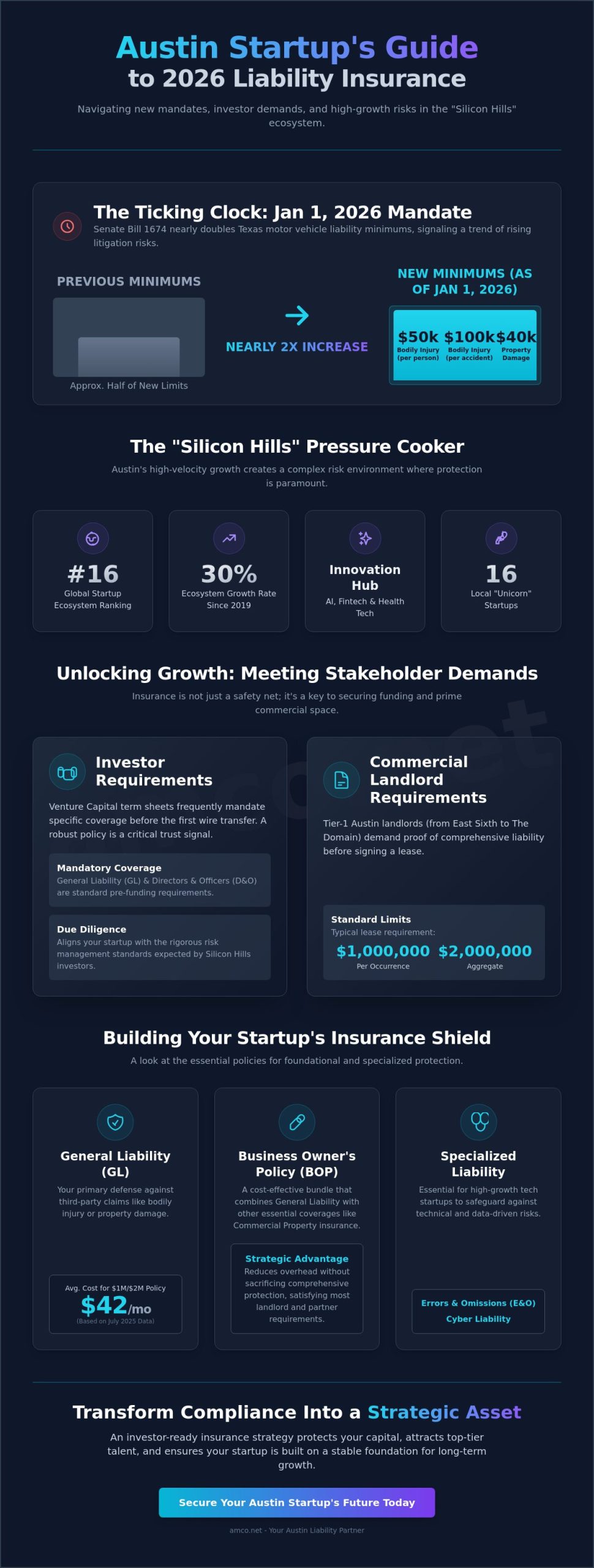
Silicon Hills startups often outgrow standard policies within their first year of operation. Once you transition from a prototype to a revenue-generating SaaS or consulting firm, General Liability alone is insufficient to protect your intellectual and financial interests. You need specialized layers of business liability insurance for startups in Austin to address the technical and administrative complexities of rapid scaling. This advanced protection includes Professional Liability (E&O) for your service delivery and Cyber Liability for your data infrastructure. These policies ensure that a single technical glitch or data mishap doesn't stall your momentum.
Understanding the common types of business insurance is vital for founders managing high-value B2B contracts. Professional Liability protects your firm if your software fails to meet performance benchmarks or if a consulting error causes financial loss for a client. In the age of AI-integrated platforms, the "failure to perform" risk is higher than ever. Without this coverage, you're personally liable for the financial damages your clients suffer due to your professional oversights.
Software developers in Travis County often confuse E&O with Cyber coverage. E&O covers the work you produce; Cyber covers the data you hold. If a bug in your code causes a client's system to crash, E&O responds to the claim. If a hacker steals your user database, Cyber Liability handles the notification costs and forensic legal fees. An uninsured data breach in Austin's competitive market can cost hundreds of thousands of dollars. This financial burden can effectively bankrupt a startup before it reaches its second anniversary.
As you hire your first local team, Employment Practices Liability Insurance (EPLI) becomes critical. It manages risks associated with wrongful termination, discrimination, or harassment claims. In Austin’s tight labor market, where small businesses account for 48% of employment, maintaining a protected workplace is essential for long-term stability. This coverage ensures that personnel disputes don't deplete your cash reserves or damage your reputation during a hiring surge.
Balancing a lean burn rate with comprehensive protection is a constant challenge for Austin founders navigating the transition from Seed to Series A. Choosing the right limits for business liability insurance for startups in Austin requires an honest assessment of your risk tolerance versus your available capital. While it’s tempting to opt for the lowest possible premium to preserve cash, your coverage must satisfy the rigorous due diligence of institutional investors. A policy that looks good on paper but fails to meet the specific "Additional Insured" requirements of a venture capital firm can delay your funding by weeks.
Understanding the difference between "Claims-Made" and "Occurrence" policy forms is a technical necessity for high-growth firms. Occurrence policies cover incidents that happen during the policy period, regardless of when the claim is eventually filed. In contrast, claims-made policies only provide coverage if both the event and the claim occur while the policy is active. For tech startups with long-tail risks, such as latent software bugs or delayed data breach discoveries, this distinction determines whether your insurance actually pays out when you need it most.
When you receive an insurance quote, the premium is only one part of the equation. You must evaluate the financial strength of the carrier by checking their A.M. Best rating; an "A" rating or higher is the industry standard for reliability. Closely examine the deductibles and endorsements to identify hidden exclusions that could leave your intellectual property or physical assets vulnerable. Selecting the cheapest premium often leads to the most expensive financial outcome if a critical exclusion leaves your startup unprotected during a lawsuit. High deductibles might lower your monthly costs, but they increase your immediate out-of-pocket exposure during a crisis.
Generic national call centers often lack the localized insight required to navigate the Travis County legal environment. Working with an independent agency allows you to access multiple carriers simultaneously, ensuring you find startup-friendly rates that a single-carrier agent cannot offer. When searching for an Insurance Company Near Me, prioritize partners who understand the specific needs of the Silicon Hills ecosystem. A local broker acts as your advocate during a claim, leveraging their professional relationships to ensure a fair and timely resolution. To ensure your coverage aligns with your growth milestones, you can request a professional liability assessment from our team of experts.
Since 1987, AMCO.NET LLC has provided a foundation of stability for Texas entrepreneurs navigating volatile market cycles. We understand that a startup’s needs in the Silicon Hills differ from established industrial firms, yet both require a partner who prioritizes technological continuity and professional precision. Whether you are scaling operations in Travis County or seeking insurance houston, our team delivers industrial-grade solutions tailored to your specific operational scale. Securing business liability insurance for startups in Austin through an agency with deep local roots ensures you aren't just another policy number in a generic national database.
Our "Growth-First" methodology ensures your business liability insurance for startups in Austin remains cost-effective without creating dangerous coverage gaps as your headcount increases. We recognize that 37 Austin-area companies were featured on the fastest-growing regional lists in 2026, and such rapid expansion requires an agile insurance strategy that moves at the speed of venture capital. Busy founders can manage their entire portfolio through our streamlined mobile app and online quote system, allowing you to focus on hitting your next product milestone while we manage the technical details of your risk mitigation.
Transitioning from a basic Business Owner's Policy to a complex commercial package is a milestone every successful founder eventually reaches. If your business model evolves to include physical distribution, warehousing, or specialized logistics, we can seamlessly integrate commercial trucking insurance Houston into your existing portfolio. Managing your entire risk profile through a single agency reduces administrative friction and ensures that your liability limits remain consistent across all subsidiaries. This holistic approach prevents the "coverage silos" that often lead to denied claims during a crisis.
Protecting your venture shouldn't be a bureaucratic hurdle that stalls your momentum. We’ve refined our onboarding into a simple 3-step process: a technical risk assessment, a multi-carrier comparison to find the best market rates, and immediate policy activation. Acting now is vital because the January 1, 2026, liability minimums are already being scrutinized by landlords and investors across Central Texas. Any lapse in coverage could disqualify you from upcoming funding rounds or lucrative B2B partnerships. Secure your Austin startup’s future with a custom liability quote from AMCO and gain the peace of mind that comes from nearly four decades of Texas insurance expertise.
Building a successful venture in the world's 16th ranked startup ecosystem requires a focus on both innovation and institutional stability. As established in this guide, the January 1, 2026, legislative updates and the rising scrutiny from Series A investors mean that your risk management strategy must be as scalable as your software. Securing robust business liability insurance for startups in Austin ensures that a single technical oversight or third-party claim doesn't jeopardize the capital you have worked so hard to raise. By bundling coverage through a Business Owner's Policy or adding specialized Cyber and D&O riders, you position your company as a mature, professional partner for landlords and venture capitalists alike.
AMCO has been a cornerstone of the Texas business community since 1987, offering founders access to top-rated national carriers and local expertise that national call centers simply cannot match. Our agents understand the unique pressures of the Austin tech scene and are ready to help you optimize your burn rate while maximizing your protection. Don't let a coverage gap stall your momentum during your next critical growth phase. Get a Fast & Professional Business Liability Quote for Your Austin Startup and move forward with the confidence that your assets are in expert hands. Your vision deserves a foundation that is built to last.
Texas law does not mandate general liability insurance for most private businesses, but specific requirements apply to other areas. For instance, if your startup utilizes vehicles, Senate Bill 1674 requires you to meet new commercial auto liability minimums as of January 1, 2026. While the state may not require general liability, nearly all Austin commercial landlords and venture capital firms will mandate it as a contractual obligation before you can sign a lease or receive funding.
Most small businesses in Texas pay between $40 and $150 per month for a standard $1M/$2M general liability policy. According to industry data published in July 2025, the average cost is approximately $42 per month. Your specific premium for business liability insurance for startups in Austin depends on variables such as your industry risk classification, annual revenue, and the number of employees on your payroll.
General Liability covers physical risks, specifically third-party bodily injury and property damage. Professional Liability, often called Errors and Omissions (E&O), protects your startup against financial losses caused by your professional mistakes or negligence. If a visitor trips in your office, General Liability responds; if a bug in your code causes a client to lose $100,000 in revenue, Professional Liability is the relevant coverage.
Yes, almost all Austin coworking hubs, such as Capital Factory or WeWork, require members to provide a Certificate of Insurance (COI) for General Liability. These facilities must protect themselves from damages caused by your business activities or employees. Having your own policy also ensures that your company's physical assets, like high-end servers or prototypes, are protected beyond the limited scope of the coworking space’s master policy.
Your personal auto policy typically excludes any accidents that occur while the vehicle is being used for commercial purposes. Relying on personal insurance for business deliveries creates a dangerous gap that could leave you personally liable for damages. To comply with the Texas liability limits effective January 1, 2026, you must secure a commercial auto policy that meets the new $50,000/$100,000/$40,000 minimum requirements for business-related transit.
Without insurance, your startup must pay for all legal defense fees, court costs, and settlement amounts using its own cash reserves. These costs can easily reach six figures, which often leads to the immediate liquidation of early-stage companies. Furthermore, if a court decides to "pierce the corporate veil," your personal savings and assets could be seized to pay for the judgment if the business lacks sufficient funds.
You should conduct a formal insurance review annually or whenever your business hits a major growth milestone. Specific triggers for an immediate update include closing a new funding round, increasing your headcount by 20%, or launching a new product line. Regularly updating your business liability insurance for startups in Austin ensures that your coverage limits keep pace with your increasing valuation and operational risks.
Yes, most modern insurance agencies provide digital portals where you can generate a Certificate of Insurance (COI) instantly once your policy is active. This is a critical feature for Austin founders who need to move quickly to secure competitive office space in the Silicon Hills. Having immediate access to your COI prevents administrative delays that could otherwise stall your move-in date or the final execution of a vendor contract.