


Did you know that property crime in Texas is 15.9% higher than the national average? For the 37% of households renting in the Lone Star State, this statistic makes protecting personal belongings a technical necessity rather than an option. As of May 2026, the average renters insurance cost Austin residents pay is approximately $22 per month for $30,000 in personal property coverage. While this price point remains stable, many tenants still face confusion regarding what their landlord actually covers versus their own liability during a major weather event.
It's understandable to feel overwhelmed by the rising cost of living and the fine print in modern insurance contracts. This guide promises to show you exactly how to secure a reliable policy for under $20 per month while ensuring you're fully protected against theft and storm damage. We'll examine the impact of the January 1, 2026, HB 2067 law, clarify the difference between replacement cost and actual cash value, and provide a methodical approach to optimizing your 2026 insurance rates.
Austin's rental market remains one of the most dynamic in the country. For 2026, the renters insurance cost Austin tenants should budget for ranges from $15 to $28 per month for standard coverage. This investment protects against losses that the average landlord's policy won't touch. While a $5 monthly premium might seem attractive on a smartphone app, it often creates a "Value Gap" where the coverage limit is insufficient to replace a modern professional's entire household inventory after a total loss event.
Understanding what renters insurance covers is the first step in evaluating these costs. A standard policy provides three primary layers of protection: personal property, personal liability, and additional living expenses. In Austin, where property crime rates are 15.9% higher than the national average according to 2024 FBI data, the theft protection alone justifies the annual premium for most residents.
To better understand this concept, watch this helpful video:
Compared to the Texas statewide average of $172 to $264 per year, Austin residents pay a slight premium due to higher localized property values. However, these rates remain more favorable than those in Houston, where hurricane exposure drives up costs, or parts of Dallas with higher storm frequency. The stability of Austin's rates in 2026 is bolstered by new transparency laws like HB 2067, which require insurers to provide clear documentation for policy decisions.
Insurance carriers in Central Texas generally categorize their offerings into three distinct tiers to match different lifestyle needs:
The financial logic is straightforward. Replacing a single high-end laptop or a designer sofa out of pocket would cost more than ten years of standard premiums. For a typical Austin professional, the return on investment is realized the moment a single covered event, such as a localized pipe burst or a theft during a festival, occurs. Landlords in high-density areas like the Domain or Mueller now recognize this risk management necessity, frequently making a minimum liability policy a mandatory condition of the lease agreement.
Identifying specific variables is crucial for price optimization. The renters insurance cost Austin residents face isn't a flat fee; it's a calculated risk assessment based on multiple data points. Factors like building age and local crime statistics play a primary role. For instance, a concrete high-rise downtown offers superior fire resistance compared to a vintage wood-frame bungalow in Hyde Park. This distinction directly impacts the technical risk profile of the unit. Carriers analyze the structural integrity and fire suppression systems of each building before finalizing a quote.
Austin's diverse geography introduces varying risks. High-density areas like East Austin may see slightly elevated premiums due to historical theft data. Conversely, suburban pockets in North Lamar might benefit from proximity to municipal fire hydrants and stations. In West Austin, insurers look closely at wildfire risk zones. Areas with dense vegetation and limited access roads present higher loss potential, which is reflected in the premium. Proximity to a primary fire station within a five-mile radius is a standard metric used to determine these localized rates.
The choice between Actual Cash Value (ACV) and Replacement Cost Value (RCV) is a critical decision point. ACV only pays the depreciated value of your items. For a tech-heavy household in Austin's silicon hills, this is often insufficient. RCV ensures you can purchase a brand-new equivalent of your stolen or damaged gear. While RCV adds a few dollars to your monthly bill, it prevents a significant financial gap during a claim. You can find more detailed Texas renters insurance information through the Department of Insurance to help weigh these options.
Adjusting your deductible is the most direct way to manipulate your premium. Shifting from a $250 deductible to a $1,000 deductible can slash monthly costs by 15% to 25%. This choice essentially means you're assuming more of the initial risk in exchange for long-term savings. Additionally, Texas allows the use of credit-based insurance scores. A stable financial history signals lower risk to carriers, often resulting in more competitive rates. Understanding these mechanics helps you move beyond generic estimates. If you want to see how these factors apply to your specific situation, you can evaluate your options with a professional broker who understands the local landscape.
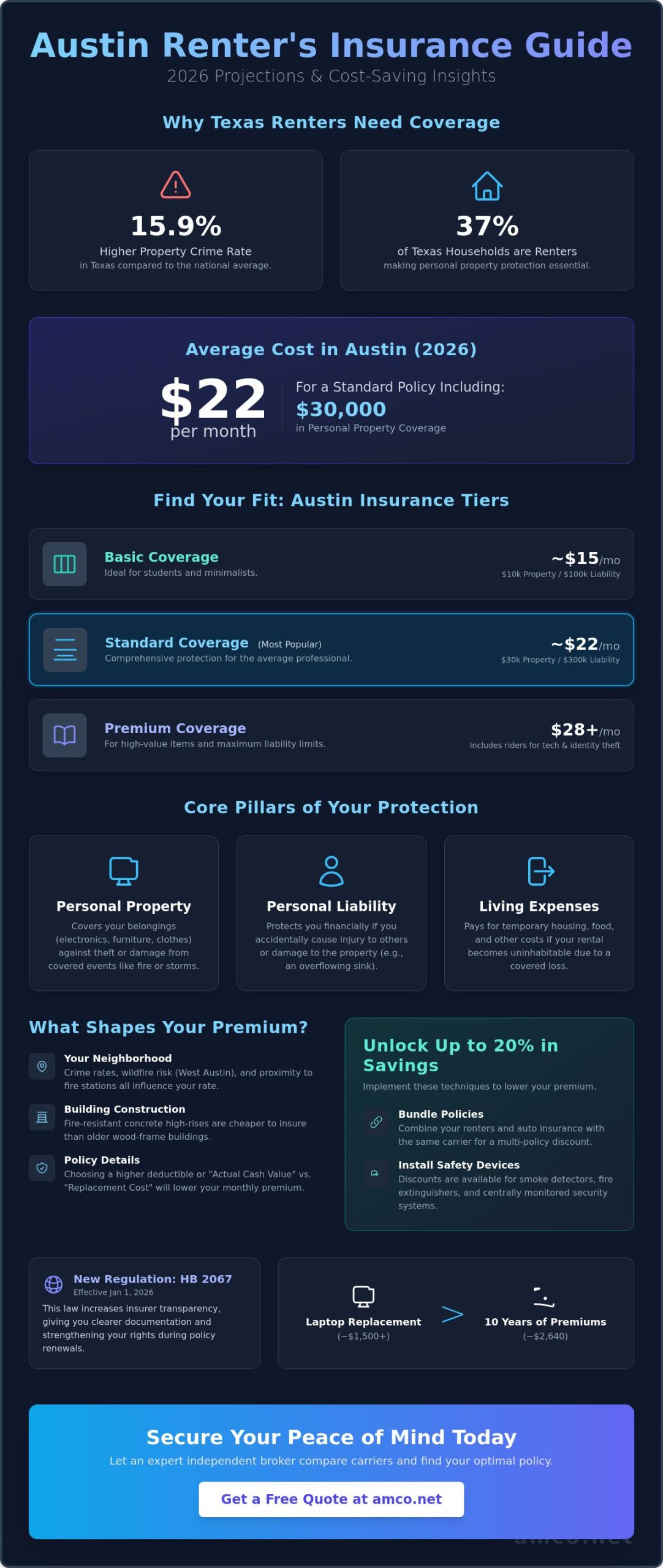
Renters often view insurance as a simple protection for furniture. However, the technical scope is much broader. It functions as a tripartite shield covering assets, legal liability, and temporary housing. When assessing the renters insurance cost Austin residents pay, it's vital to realize that this coverage extends beyond the physical walls of the apartment. For instance, if your laptop is stolen from your vehicle during a crowded event like SXSW 2026, the personal property component of your policy typically provides reimbursement, minus your deductible. This "off-premises" protection is a standard feature that many tenants overlook until a loss occurs.
Personal liability coverage remains a cornerstone of professional risk management. It protects you if a guest is injured within your residence or if you accidentally cause damage to the property, such as a kitchen fire. Complementing this is medical payments coverage, which handles small-scale medical bills for guests regardless of who is at fault. This prevents minor incidents from escalating into expensive legal disputes. For a comprehensive overview of these categories, the Texas Department of Insurance guide to renters insurance provides an official framework for policyholders to evaluate their specific needs.
There is a critical distinction regarding water damage that every Central Texas resident must understand. While your policy covers internal pipe bursts, it strictly excludes external flooding. Given Austin's flash flood history in areas near Shoal Creek or Onion Creek, residents in these zones should consider a separate policy through the National Flood Insurance Program. This exclusion is a common point of technical confusion that can lead to significant financial exposure if not addressed during the initial policy setup.
Infrastructure challenges, such as the severe winter freezes experienced in the mid-2020s, have highlighted the importance of "Loss of Use" coverage. If a pipe burst renders your apartment uninhabitable, this provision covers the cost of hotel stays, laundry services, and the increased cost of food while you're displaced. Loss of Use is the essential lifestyle protector for Austin tenants that prevents a physical property crisis from becoming a financial catastrophe.
Austin's reputation as a dog-friendly city makes pet liability a necessary consideration for most households. Most policies include coverage for dog bites or property damage caused by pets, but technical exclusions often apply to specific breeds. When evaluating the renters insurance cost Austin agencies quote, always disclose your pet's breed to ensure the liability shield is active. Failure to do so could result in a denied claim, leaving you personally responsible for medical or legal costs arising from a pet-related incident.
Optimizing your insurance portfolio involves more than just selecting the lowest quote. By implementing specific administrative and physical safeguards, you can drive down the annual renters insurance cost Austin residents typically pay. These strategies focus on reducing the carrier's exposure while streamlining your own policy management for the 2026 term.
Consolidating your coverage under a single carrier is the most effective way to trigger immediate discounts. There's a significant synergy between car insurance Houston and renters policies for Texas residents. When you link these accounts, most insurers apply a multi-policy credit that reduces the total premium across both lines. Managing these assets through the AMCO.NET LLC mobile app allows you to view all policy documents and payment schedules in one centralized interface, effectively reducing administrative friction.
Insurance carriers reward proactive risk mitigation with specific premium credits. Installing smart locks, smoke detectors, and fire extinguishers provides a measurable decrease in loss probability. Modern Austin developments in high-growth areas like North Burnet or Mueller often feature gated access and 24-hour monitored alarm systems. These technical safeguards reduce the statistical likelihood of theft or fire damage, allowing insurers to offer "new building" or "secured community" discounts. It's advisable to confirm these features with your property manager to ensure every available credit is applied.
Adjusting your deductible remains a powerful lever for monthly savings. By increasing your out-of-pocket responsibility from $250 to $1,000, you demonstrate a higher level of risk retention, which carriers reward with lower premiums. This is a calculated trade-off that benefits tenants who maintain a stable emergency fund. Additionally, opting for annual payments rather than monthly installments eliminates the recurring service fees that many insurers charge. This single upfront payment for the 2026 term can save you a significant percentage in administrative costs over the course of the year.
The most efficient way to navigate this complex market is to consult an independent agency. Unlike captive agents who represent a single brand, an independent broker shops multiple carriers simultaneously to find the best local rate. This professional approach ensures your coverage reflects the specific risks of your neighborhood without unnecessary markups. If you're ready to optimize your household budget, you can get a professional rate comparison to identify the most cost-effective solutions for your specific needs.
Selecting a carrier shouldn't be an automated gamble. AMCO.NET LLC operates as an independent broker, which means we aren't tied to a single insurance provider. We analyze the market to find the best renters insurance cost Austin has to offer by comparing multiple A-rated carriers simultaneously. This consultative approach ensures that your specific risk profile, whether you're in a downtown high-rise or a suburban duplex, is matched with the most efficient policy. Our role is to serve as your technical advisor, identifying coverage gaps that a standard smartphone app might miss during a quick sign-up process.
Since 1987, our team has developed a deep understanding of the Texas insurance landscape. We recognize that Austin's 2026 market presents unique challenges that require more than just a generic algorithm. By moving beyond simple digital templates, we provide personalized service that helps tenants avoid being underinsured during a total loss event. We combine the speed of modern digital tools with the reliability of a human expert who understands the nuances of the local market.
Our presence in the state is defined by professional stability and long-term partnership. As a local insurance agency, we don't just sell policies; we manage the lifecycle of your protection. This includes providing direct support during the claims process to ensure you're treated fairly by the carrier. When a disaster strikes, having a partner who understands Texas law, including the transparency requirements of HB 2067, provides a level of security that automated platforms cannot replicate. We bridge the gap between complex technical specifications and the practical needs of Central Texas renters.
Securing comprehensive protection is a methodical process that starts with accurate data. We recommend the following steps to ensure your quote is as precise as possible:
This data-driven approach allows us to calculate a renters insurance cost Austin residents can rely on without the fear of hidden fees or insufficient limits. Our digital platform provides the efficiency you expect, while our experienced agents remain available for deep-dive consultations. Protect your Austin apartment today with a fast quote from AMCO.NET LLC.
Managing your 2026 living expenses in Central Texas requires technical foresight. While the renters insurance cost Austin tenants pay is influenced by neighborhood density and building construction, the stability provided by a tailored policy outweighs the monthly expense. You've seen how Replacement Cost Value and Loss of Use coverage protect your professional lifestyle against the unexpected, from theft at a crowded festival to infrastructure failures during a winter freeze. These aren't just line items; they're essential safeguards for your financial continuity.
AMCO.NET LLC has served the Texas community since 1987, offering a stable alternative to impersonal, algorithm-only platforms. By providing access to multiple top-rated insurance carriers, we ensure your protection is both comprehensive and cost-effective. You can manage your policy 24/7 with the AMCO.NET LLC mobile app, giving you the technical flexibility needed in a fast-paced urban environment. Our decades of local experience mean we understand the specific risks facing Austin renters today.
Get a Fast Renters Insurance Quote for Your Austin Home from AMCO.NET LLC. Secure your future today and ensure your assets are protected by local experts who understand the unique challenges of the Austin landscape. It's time to move forward with the confidence that your home is in professional hands.
Texas state law does not require tenants to carry insurance, but most Austin landlords make it a mandatory condition of the lease agreement. Over 90% of modern apartment complexes in high-growth areas require proof of at least $100,000 in liability coverage before move-in. While the state remains hands-off, the private market has standardized this requirement to protect property owners from accidental damage caused by tenants.
Standard policies cover damage to your personal belongings caused by sudden and accidental water discharge, including pipes that burst during extreme winter weather. This protection typically includes "Loss of Use" benefits to cover temporary housing costs if your unit becomes uninhabitable. It's critical to maintain adequate heat in your apartment during freezes to ensure you meet the policy's "due diligence" requirements for claim approval.
Your coverage limit should equal the total cost to replace all your belongings at today's market prices rather than their original purchase price. Most Austin tenants find that a $20,000 to $30,000 limit is sufficient for a standard one-bedroom apartment. Tech-heavy households often underestimate the total renters insurance cost Austin residents face when replacing specialized equipment, so a room-by-room inventory is highly recommended.
Generally, roommates are not covered under a single policy unless they are related by blood or marriage or specifically named as additional insureds. Most insurance professionals recommend that each tenant carries an individual policy. This prevents legal complications during a claim and ensures that one person's claim history doesn't negatively impact the other's future insurance scores or monthly premiums.
Your renters insurance covers the personal items stolen from your vehicle, but it does not cover the physical damage to the car itself. For example, if a thief steals your laptop, your renters policy handles the replacement cost. However, repairing a broken window or a damaged ignition requires a comprehensive auto insurance policy. This distinction is why many residents choose to bundle these two coverages for full protection.
Yes, you can obtain coverage with a lower credit score, though your monthly premium will likely be higher than the city average. Texas law allows insurers to use credit-based insurance scores as a significant factor in determining risk and rate setting. Opting for a higher deductible can help offset the increased renters insurance cost Austin carriers might charge for profiles with less established financial histories.
The premium is the fixed amount you pay monthly or annually to keep your policy active, while the deductible is the specific amount you pay out-of-pocket before the insurance company covers a loss. A lower premium usually results in a higher deductible, meaning you assume more initial risk. Balancing these two figures is a fundamental component of professional cost optimization for long-term financial management.
Obtaining a comprehensive quote through a professional broker typically takes less than ten minutes. Modern digital platforms and specialized mobile apps have streamlined the data entry process for Central Texas residents. Once you provide your address and basic inventory details, you can receive an immediate comparison of rates from multiple carriers, allowing for same-day coverage activation if your lease requires it.