
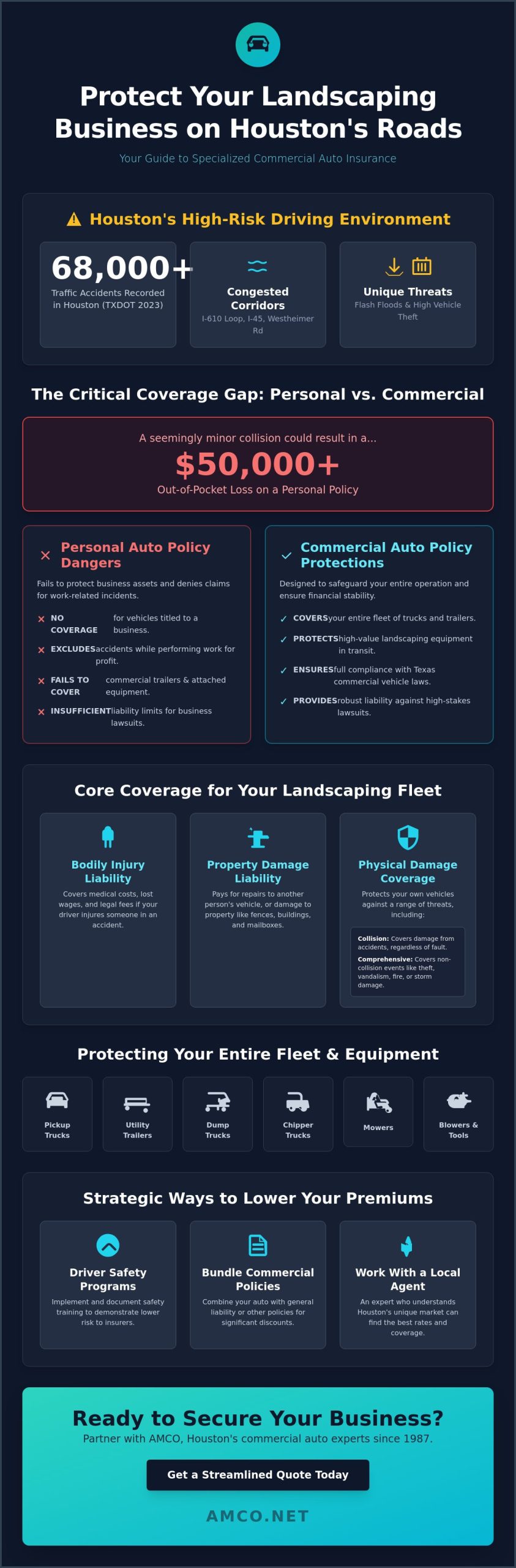
What if a single minor collision on the I-610 Loop resulted in a $50,000 out-of-pocket loss because your personal insurance policy excluded the commercial trailer attached to your truck? In 2023, the Texas Department of Transportation recorded over 68,000 traffic accidents in Houston, making it one of the most volatile environments for professional drivers in the state. You likely recognize that your daily operations involve more than just driving; they involve transporting high-value assets through some of the nation's most congested corridors. Finding the right commercial auto insurance for landscapers in Houston is no longer just about meeting minimum legal standards; it's about ensuring your business survives a legal or mechanical crisis.
You're right to feel that the line between personal and professional coverage is often dangerously thin. This guide explains how to secure your entire fleet, from heavy-duty pickups to utility trailers, while maintaining full compliance with Texas law. We'll show you how to lower your insurance costs by working with a local agent who understands the specific risks of the Houston market. We'll also examine the technical details of coverage for your mowers and blowers, providing you with a clear strategy for the 2026 season.
Commercial auto insurance for the landscaping sector is a specialized form of Vehicle insurance designed to cover trucks, trailers, and equipment used for business purposes. In Houston, where landscaping fleets often transport heavy machinery like zero-turn mowers and industrial blowers, standard coverage is rarely sufficient. Most personal policies explicitly exclude accidents that occur while performing work for profit. This means a claim could be denied entirely if an accident happens while traveling between job sites in Sugar Land or The Woodlands.
The intensity of Houston's traffic infrastructure demands more than the Texas state minimum liability requirements. On high-volume corridors like the I-45 or the 610 Loop, the probability of a multi-vehicle collision is significantly higher than in less congested regions. For a professional contractor, relying on basic minimums is a risk that could lead to corporate insolvency. Securing robust commercial auto insurance for landscapers in Houston is a necessary step for maintaining long-term business stability.
To better understand how these coverage types function in a real-world business setting, watch this helpful overview:
Operating a landscaping business in Harris County involves unique logistical pressures. High-density urban areas require drivers to navigate narrow residential streets with long trailers, which increases the likelihood of property damage claims. Additionally, Houston's history of flash flooding poses a constant threat to vehicles and expensive equipment caught in transit. The litigation environment in the region is also a factor; a single road accident involving an employee can lead to legal demands that far exceed personal policy limits.
Many owner-operators believe a "business use" endorsement on a personal policy provides adequate protection, but these often fail during complex claims. If a vehicle is registered to a business or used primarily for hauling heavy commercial equipment, it requires a dedicated commercial policy. This coverage ensures that both the vehicle and the specialized tools are protected against theft or damage. Since 1987, AMCO has served as a technical partner for Houston contractors, helping them bridge these gaps with precision and professional insight.
Effective risk management for a landscaping enterprise begins with identifying the specific liabilities inherent in transporting industrial machinery. While basic liability is a legal requirement, comprehensive commercial auto insurance for landscapers in Houston must address the high-value assets attached to your vehicles. A standard policy typically includes three primary pillars: bodily injury liability, property damage liability, and physical damage coverage for your own fleet. In the event of a collision on a busy thoroughfare like Westheimer Road, these components work together to prevent a single incident from depleting your company's cash reserves.
The Texas Department of Insurance provides the framework for commercial requirements, but professional landscapers often need limits that exceed these baselines. Physical damage coverage is particularly vital; it includes collision coverage for accidents and comprehensive coverage for non-collision events such as theft, vandalism, or storm damage. Given that Houston experienced a 15% increase in vehicle-related thefts in certain districts during 2023, protecting your trucks against more than just road accidents is a technical necessity. If you are unsure about your current limits, you can consult with a specialist at AMCO to evaluate your fleet's specific needs.
Uninsured and underinsured motorist protection is another critical element for the Houston metro area. Data from the Texas Department of Transportation suggests that a significant portion of drivers in Harris County operate without sufficient coverage. If one of these drivers strikes your landscaping truck, this protection ensures your business isn't left holding the bill for repairs or medical expenses. It provides a secondary layer of financial stability that keeps your crew on the job even when other drivers fail their responsibilities.
A significant gap in many standard policies involves the equipment trailers and custom racks that define a landscaping fleet. Liability coverage usually extends to a trailer while it's hitched to a covered auto, but physical damage to the trailer itself often requires a separate schedule. We recommend adding Inland Marine insurance to your portfolio to cover the specialized tools, such as zero-turn mowers and high-end trimmers, that are frequently moved between sites. This ensures that your investment is protected whether the equipment is on the trailer, in the truck bed, or being operated on a client's property.
Protecting your employees is as important as protecting your machinery. Personal Injury Protection (PIP) is a standard offering in Texas that covers medical expenses and a portion of lost wages for your crew, regardless of who caused the accident. While some contractors rely solely on Workers Compensation, PIP provides immediate, no-fault relief that can be critical in the hours following a collision. Our advisors help you structure these benefits so they integrate seamlessly with your existing B2B insurance package, providing a complete safety net for your workforce.
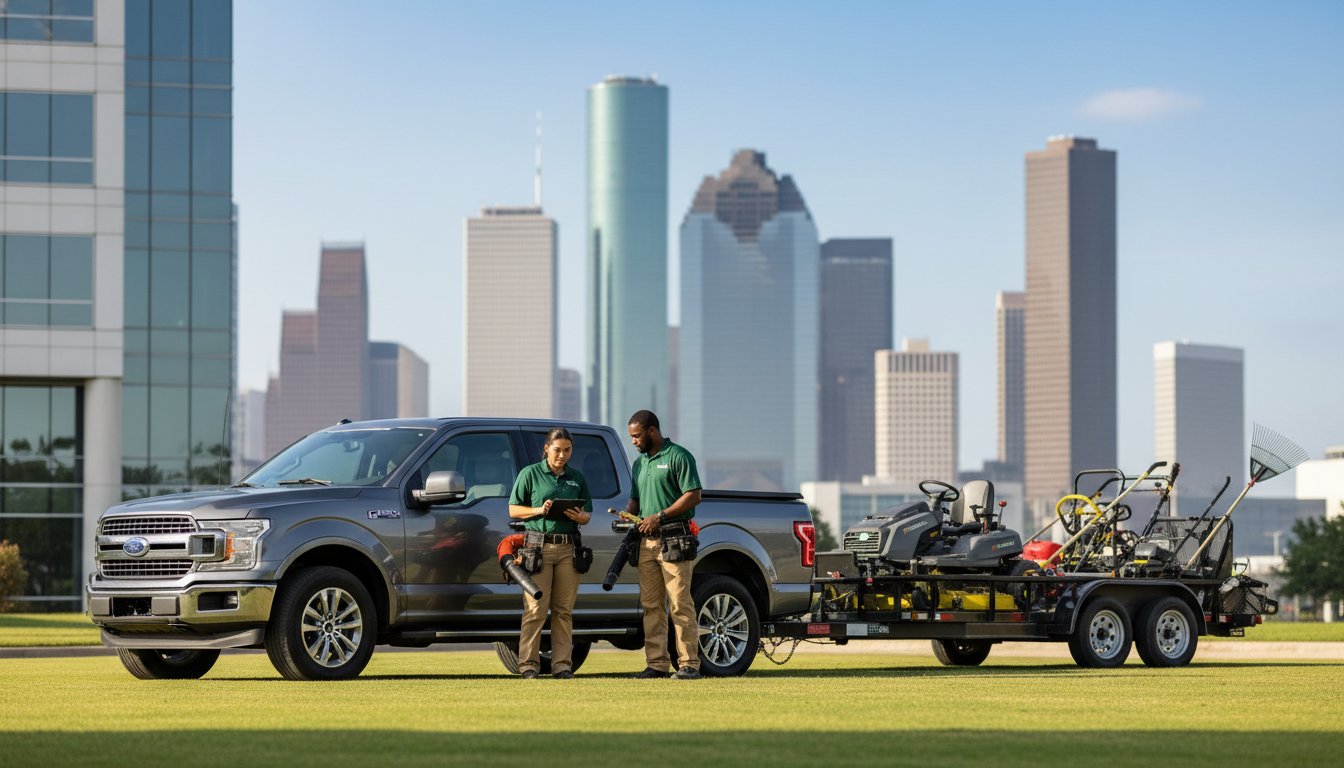
Landscaping operations in the Houston area utilize a diverse range of vehicles, each presenting a unique risk profile that requires technical evaluation. From the standard Ford F-150 used for site visits to heavy-duty dump trucks hauling tons of mulch, the scope of commercial auto insurance for landscapers in Houston must be broad enough to encompass every asset. It's not just about the vehicle's market value; it's about the specific functions these machines perform on the road and at the job site. A policy that doesn't distinguish between a passenger van and a flatbed hauling a skid steer leaves significant gaps in your protection.
Most small to mid-sized fleets rely on light-duty pickups like the Chevrolet Silverado or Ram 1500. While these are common, their use in towing heavy trailers changes their classification for insurance purposes. When your business scales to include dump trucks or flatbeds for debris removal, the complexity of the policy increases. These larger vehicles often fall into higher weight classes, requiring specialized liability limits to account for the increased damage potential in a collision. We analyze your fleet's composition to ensure that every unit, from the smallest utility truck to the largest hauling vehicle, is correctly categorized and covered.
Vehicles such as bucket trucks and wood chippers represent a significant technical investment and a distinct liability category. Insurance providers categorize these by their Gross Vehicle Weight Rating (GVWR), with vehicles over 26,001 pounds often requiring drivers to hold a Commercial Driver's License (CDL). In Houston, maintaining these specialized hydraulic systems is a safety requirement that impacts your insurability. A failure in a bucket truck's stabilization system or a chipper's intake can lead to catastrophic liability claims. It's essential that your policy accounts for the high replacement cost and the specific operational risks of this heavy machinery.
A common oversight for many business owners is the risk associated with employees using their personal vehicles for company errands. If a crew member uses their own car to pick up fuel or supplies and causes an accident, your business could be held liable for damages exceeding their personal policy limits. Hired and Non-Owned Auto (HNOA) coverage provides a vital safety net in these scenarios. It protects the company's assets when vehicles not owned by the business are used for professional tasks, ensuring that a simple errand doesn't result in a devastating lawsuit against your firm.
Optimizing your operational expenses is a fundamental requirement for maintaining a competitive edge in the Houston landscaping market. One of the most effective ways to improve your bottom line is by strategically managing your commercial auto insurance for landscapers in Houston. Insurance carriers don't just look at the number of trucks you own; they evaluate the technical quality of your risk management. Bundling your auto policy with General Liability or Workers Compensation is a proven method for securing multi-policy discounts. Carriers view these integrated accounts as more stable, which often results in more favorable underwriting terms.
Adjusting your deductible is another practical lever for cost control. By increasing a deductible from $500 to $1,000, you can lower your monthly premium payments, provided your business maintains a sufficient cash reserve to handle the higher out-of-pocket cost during a claim. Furthermore, the adoption of telematics and GPS tracking has become a standard for professional fleets. In 2024, industry data indicated that fleets using active driver monitoring saw a reduction in accident-related costs by nearly 20%. Many insurers now offer specific credits for businesses that use these technologies to monitor speeding and hard braking.
Proactive risk management starts with a rigorous driver screening process. We recommend conducting Motor Vehicle Record (MVR) checks for every crew member before they get behind the wheel. A single driver with multiple citations in the last 36 months can significantly inflate your fleet's premium. Additionally, road debris claims are a frequent issue on Houston's highways. Implementing a strict policy for securing loads with industrial-grade tarps and tie-downs prevents these claims and protects your brand's reputation. Keeping detailed maintenance logs for every vehicle also demonstrates to insurers that your equipment is in safe, operable condition.
An independent agent provides a level of market access that a single-carrier agent cannot match. Because Houston's risk profile is unique, you need a partner who can compare multiple carriers to find the most competitive rate for your specific vehicle mix. A local agency understands the logistical challenges of the Energy Corridor and the high-traffic zones of Harris County better than a national call center. AMCO performs annual policy reviews to ensure your coverage scales with your business and remains cost-effective. Request a comprehensive policy review from AMCO to identify potential savings for your landscaping business today.
Since 1987, AMCO has operated as a technical partner for the Texas business community, providing specialized risk management solutions that prioritize long-term stability. For nearly four decades, we've refined our approach to commercial auto insurance for landscapers in Houston, evolving alongside the city's infrastructure and regulatory changes. We don't simply offer off-the-shelf products; we analyze your fleet's technical requirements to ensure cost-efficiency and full legal compliance. Our advisory role focuses on creating a complete protection package for your landscaping business, whether you operate a single truck or a complex fleet of specialized hauling vehicles.
Our commitment to professional excellence means we provide more than just a policy. We offer a partnership based on decades of market experience and a deep understanding of the B2B sector's unique challenges. By providing access to top-rated commercial carriers, we ensure that your business benefits from the most reliable underwriting in the industry. Our digital infrastructure, including a dedicated mobile app and online portal, allows you to manage your policy and access certificates of insurance (COIs) instantly from any job site in the Greater Houston area.
Our deep roots in Houston, San Antonio, and Dallas provide us with a granular understanding of the Texas insurance market. We leverage our extensive experience in commercial trucking insurance Houston to benefit landscaping contractors who face similar road risks and regulatory scrutiny. Every client receives a dedicated account manager and access to bilingual support, ensuring that technical details are always communicated clearly. We understand that your time is a valuable resource, so we focus on providing calm, expert guidance that removes the complexity from the insurance process.
Securing a professional-grade policy shouldn't be a hurdle to your daily operations. To provide a fast and accurate quote, we typically require your vehicle identification numbers (VINs), driver's license information for all crew members, and a brief history of your prior coverage. Our team works with a select group of carriers to find the precise balance of protection and price for your 2026 budget. We promise reliable coverage backed by local expertise that national call centers simply can't replicate. Take the next step in protecting your business assets and Get a Landscaping Insurance Quote Now to ensure your fleet remains protected on every Houston highway.
Maintaining a competitive landscaping business in 2026 requires more than technical skill; it demands a robust financial shield against the unpredictable nature of Houston's traffic corridors. We've explored how a specialized approach to commercial auto insurance for landscapers in Houston protects your trailers, heavy machinery, and employees from the gaps found in personal policies. By implementing rigorous driver safety programs and utilizing telematics, you can actively lower your risk profile and optimize your long-term insurance costs.
AMCO has provided A+ rated local expertise to the Texas business community since 1987, ensuring that contractors have the technical support needed to thrive. Whether you require bilingual support or a detailed analysis of your fleet's unique liability needs, our team is prepared to serve as your long-term insurance partner. Don't leave your equipment and reputation to chance on the 610 Loop or I-10.
Get a Fast Commercial Auto Quote for Your Houston Landscaping Business and ensure your crew remains on the road with total confidence.
No, personal auto policies typically exclude coverage for trailers used for business purposes. While a personal policy might cover a small utility trailer for occasional residential use, it won't protect a dual-axle landscaping trailer carrying professional machinery. You require a commercial policy to ensure that both the trailer and the liability associated with towing it are fully covered during your daily operations.
Costs vary based on technical factors such as your fleet size, the weight of your vehicles, and the driving records of your crew. Houston's high accident rate, which saw over 68,000 incidents in 2023, often results in higher regional premiums compared to rural Texas. We focus on finding the most competitive commercial auto insurance for landscapers in Houston by analyzing these specific risk variables for your business.
Texas law requires all vehicles to maintain liability insurance, but vehicles registered to a business or used primarily for commercial tasks must have a commercial policy. Even if you're a sole proprietor, a personal insurance carrier will likely deny a claim if an accident occurs while you're hauling commercial equipment. Proper commercial coverage ensures you remain in full compliance with state financial responsibility laws.
Hired and Non-Owned Auto (HNOA) insurance protects your company when employees use their own vehicles for business errands, such as picking up fuel or parts. If an employee causes a collision in their personal car while on the clock, your business could be held liable for damages. This coverage is an essential safety net that protects your corporate assets from lawsuits arising from these common scenarios.
Yes, most commercial carriers offer fleet discounts when you insure multiple vehicles under a single policy. Consolidating your trucks into one account simplifies your administrative tasks and usually reduces the per-vehicle premium. We also look for opportunities to bundle your auto coverage with other industrial solutions to further optimize your long-term costs.
Your driving record is a critical data point that underwriters use to determine your premium. A history of citations or accidents within the last 36 months indicates a higher risk level, which leads to increased costs. Maintaining a clean Motor Vehicle Record (MVR) for yourself and your crew is the most direct way to keep your insurance expenses manageable.
Standard commercial auto policies protect the vehicle and provide liability coverage, but they don't typically cover loose tools or equipment. To protect your mowers, blowers, and trimmers, you need an Inland Marine endorsement. This specialized coverage ensures your technical assets are protected against theft or damage while they're in transit or stationed at a job site.