

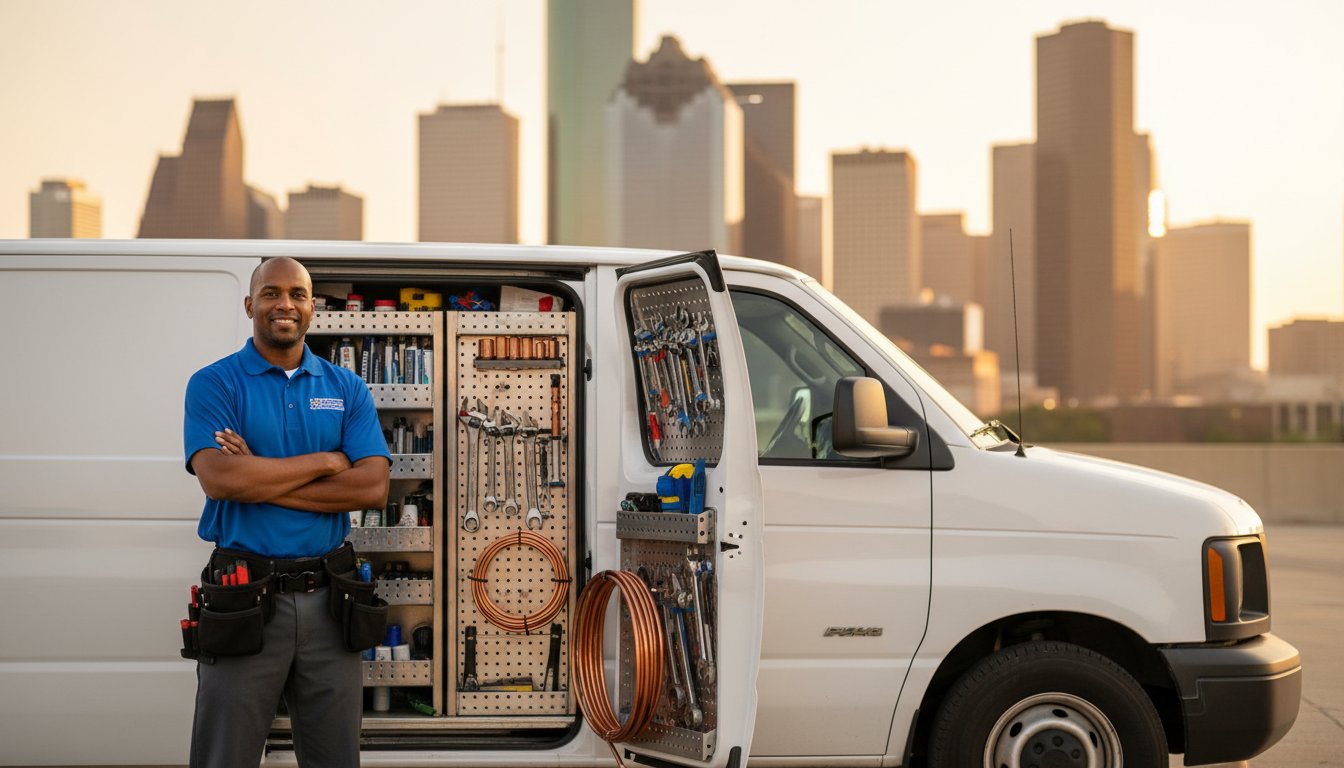
Did you know that even with a spotless driving record, Houston plumbing contractors are seeing renewal increases between 8% and 25% in 2026? This surge is largely driven by the rise of "nuclear verdicts" in Texas courts, making it harder than ever to find affordable commercial auto insurance for plumbers in Houston. Your van isn't just a vehicle. It's a mobile warehouse and the vital backbone of your daily operations.
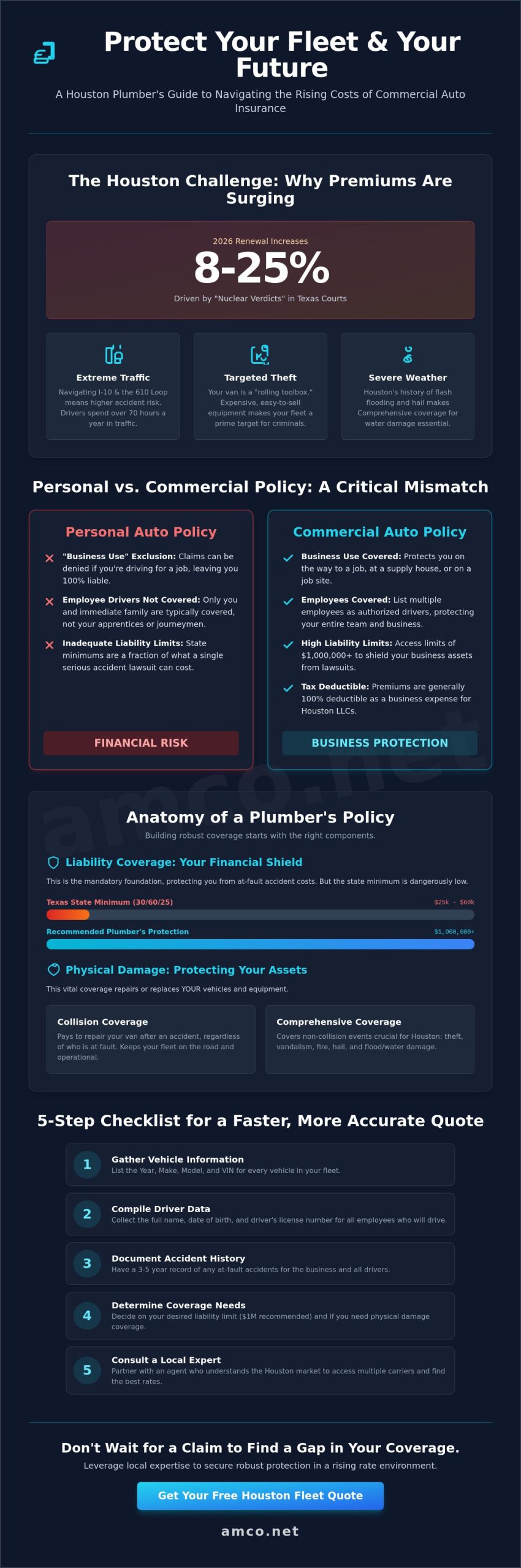
You're likely already feeling the pressure of rising premiums and the constant threat of tool theft while navigating I-10 or the 610 Loop. We understand that you need a policy that does more than just meet the state's 30/60/25 minimum liability requirements. This guide will show you how to secure a policy that protects your expensive equipment, leverages Houston-specific discounts, and ensures you remain compliant with the Texas State Board of Plumbing Examiners. We'll break down the essential coverages for your fleet, explain the difference between mandatory and recommended limits, and provide a roadmap to lowering your premiums without sacrificing protection.
Many plumbing contractors in Southeast Texas begin their journey by using a personal van for service calls. While this might seem like a cost-effective starting point, it creates a massive gap in your professional protection. Most personal policies contain a strict "business use" exclusion. If you're involved in a collision while traveling to a job site on the 610 Loop, your insurer can legally deny the claim. This isn't just a minor inconvenience; it's a financial catastrophe that can lead to the total loss of your business assets. When an insurer sees a vehicle loaded with pipe cutters, PEX tubing, and commercial-grade wrenches, they'll likely categorize the trip as commercial. Without the right coverage, you're left paying for repairs and medical bills out of pocket.
The regulatory environment for Vehicle insurance in the United States distinguishes clearly between individual and professional risks. For a plumbing business, the liability goes far beyond a simple dented bumper. Commercial policies are designed to handle the weight and risk profile of service vehicles, which are significantly higher than the average commuter car. To better understand how professional coverage scales with your business, watch this helpful video:
The most significant difference lies in who is covered behind the wheel. A personal policy typically limits coverage to the owner and immediate family members. In contrast, commercial auto insurance for plumbers in Houston allows you to list multiple employees as authorized drivers. This ensures that your apprentices and journeymen are protected while operating company property. Additionally, commercial policies offer much higher liability thresholds. While the Texas state minimum is 30/60/25, a single lawsuit from a multi-car accident can easily exceed $300,000. Professional policies provide the necessary buffer to protect your company's bank account. There's also a clear tax advantage: for Houston LLCs, these premiums are generally 100% deductible as a legitimate business expense.
Driving in Houston presents challenges that contractors in smaller cities simply don't face. Corridors like I-45 and I-10 are consistently ranked among the most dangerous in the country due to high traffic density and constant construction. Recent data suggests Houston drivers spend over 70 hours per year idling in traffic, which significantly increases the risk of distracted driving accidents. Beyond the road, theft is a critical concern. Plumbing vans are often viewed as "rolling toolboxes" by local criminals. Specialized equipment is expensive and easy to resell, making theft coverage a non-negotiable part of your policy. Finally, you must consider the climate. With Houston's history of flash flooding, having a policy that includes comprehensive coverage for water damage is the only way to ensure your fleet remains operational after a major storm.
Building a robust defense for your business requires more than just meeting the legal minimums. While Texas law mandates liability coverage of at least $30,000 for bodily injury per person, $60,000 per accident, and $25,000 for property damage, these figures are often insufficient for professional operations in a major metro area. Liability insurance serves as the foundation of commercial auto insurance for plumbers in Houston, shielding your company from the financial fallout of at-fault accidents that cause injury or damage to third parties. Given the rising frequency of high-value jury awards in Texas, many contractors now opt for limits of $1,000,000 or more to ensure long term stability.
Physical damage coverage is equally vital for maintaining your operational continuity. Collision coverage handles repairs to your own vans after an accident, while comprehensive coverage protects against non-collision events. In the Houston region, this must include weather-related events like hail or the flash flooding common during hurricane season. Additionally, Uninsured and Underinsured Motorist (UM/UIM) coverage is a critical layer. Data from the Texas Department of Insurance highlights that a significant percentage of drivers lack adequate coverage. If one of your journeymen is hit by an uninsured driver on the Westpark Tollway, UM/UIM ensures your business isn't left holding the bill for medical costs or vehicle repairs.
A common misconception is that a standard auto policy covers everything inside the van. In reality, most policies exclude items that aren't permanently attached to the vehicle. This is why Inland Marine insurance is a technical necessity for plumbing contractors. It provides specific protection for equipment while it's in transit to a job site or stored temporarily in a vehicle. For high-value items, such as $10,000 specialized drain cameras or leak detection kits, you should use "scheduled property" listings to ensure full replacement value. Smaller hand tools and supplies can typically be covered under an unscheduled property limit. This specialized rider closes the gap that leaves many plumbers vulnerable after a vehicle break-in.
Risk often extends beyond the vehicles you own. Many plumbing businesses occasionally ask an employee to pick up parts from a supplier using their personal truck. This creates "vicarious liability." If that employee causes an accident during a work-related errand, your business could be held legally responsible for the damages. Hired and Non-Owned Auto Insurance (HNOA) provides an extra layer of defense in these scenarios. It also extends coverage to rented equipment or temporary replacement vans if one of your primary vehicles is in the shop for repairs. Working with a professional insurance partner allows you to identify these hidden risks and secure a policy that scales with your fleet's needs.
Determining the financial commitment for commercial auto insurance for plumbers in Houston requires looking beyond a single quote. In 2026, the average monthly cost for a plumber sits between $220 and $225, though this fluctuates based on several operational variables. For instance, a solo contractor with one to three employees typically pays between $5,000 and $10,000 annually. Mid-sized operations with four to ten employees should budget between $10,000 and $25,000. These figures reflect the vehicle's role as a heavy-duty asset. A standard Sprinter van carries a different risk profile than a heavy-duty truck equipped with specialized jetting equipment or heavy machinery.
Your Motor Vehicle Report (MVR) acts as a primary price regulator. Every journeyman or apprentice you hire brings their driving history into your premium calculation. Even a single speeding ticket can push you toward the higher end of the 8% to 25% renewal increases seen this year. Location also dictates costs. A shop based in a high-traffic or high-crime zip code near the Energy Corridor will likely face higher rates than one in a quieter suburb like Sugar Land. Adjusting your deductible is a common strategy to manage these costs; however, you must balance lower monthly payments with the ability to cover a $1,000 or $2,500 out-of-pocket expense if an accident occurs.
Choosing between a Combined Single Limit (CSL) and Split Limits is a technical decision that impacts your total exposure. CSL provides a lump sum of coverage for all injuries and property damage in an accident, which often simplifies protection during complex multi-car collisions. In 2026, many carriers are also offering discounts for companies that implement GPS tracking and telematics. These systems provide real-time data on braking and speed, allowing safe fleets to prove their lower risk profile. Remember that even minor "fender benders" are costly. A history of small claims suggests a lack of safety oversight, which insurers penalize during the renewal process.
Efficiency in insurance often comes from consolidation. Bundling your auto policy with General Liability Insurance typically triggers multi-policy discounts that lower your overall overhead. Since Houston's market is highly competitive, performing an annual policy review is a professional necessity. Shopping your coverage every 12 months ensures you aren't paying "loyalty taxes" while newer, more competitive rates emerge. For smaller shops, managing cash flow is paramount. Most carriers now offer flexible payment plans, allowing you to spread the annual premium across monthly installments rather than facing a large upfront hit to your operating capital.
Securing commercial auto insurance for plumbers in Houston in 2026 requires a methodical approach to data collection. Carriers have become increasingly data-driven, meaning the accuracy of your application directly impacts your final premium. Your first step is a comprehensive fleet audit. You must compile a list of all Vehicle Identification Numbers (VINs), makes, models, and current market values. This prevents over-insuring older vehicles while ensuring high-value assets have adequate physical damage protection. Second, perform a rigorous review of driver records. Every employee operating a company vehicle must hold a valid Texas driver's license with a manageable Motor Vehicle Report (MVR). Since Houston accident rates remain high, even one driver with a recent major violation can jeopardize your entire fleet's eligibility.
The third step involves defining your equipment value. As previously established, standard auto policies don't protect the contents of your van. Calculate the total replacement cost of the tools and plumbing supplies carried in each vehicle to set your Inland Marine limits. Fourth, you must verify that your coverage aligns with the latest Texas auto insurance requirements. This includes ensuring your liability limits are sufficient for the professional contracts you hold. Finally, compare local agencies rather than generic national call centers. Seek out a trucking insurance agency with deep roots in the Houston market. Local experts understand the nuances of Harris County traffic risks and theft patterns, which allows them to advocate more effectively for your business during the underwriting process.
When you receive a quote, look beyond the monthly premium. Examine the "fine print" for exclusions that might limit your protection during specific plumbing tasks, such as industrial pipework or high-rise service calls. It's also vital to check the carrier's financial stability through their AM Best rating. You should prioritize carriers with an "A" rating or higher to ensure they have the capital to handle significant claims. Ask your agent about "Loss Control" services. Many professional agencies provide safety training resources or telematics consultations that help you reduce accidents and lower your long-term costs. If you're ready to see how these factors apply to your business, you can request a professional fleet insurance review to compare your current coverage against 2026 market standards.
Underwriters require specific documentation to finalize your policy. You'll need your Business Tax ID (EIN) and proof of your years in operation. If you're looking to switch providers, have your current policy declarations page ready for a direct comparison. Providing a copy of your written safety policy or employee driver handbook can also work in your favor. These documents demonstrate to the insurer that you're a "preferred risk," which often unlocks more competitive pricing tiers and better coverage terms.
Since 1987, AMCO.NET LLC has served as a dedicated resource for the Southeast Texas trade community, providing technical risk management that goes beyond basic policy issuance. We recognize that commercial auto insurance for plumbers in Houston is a specialized requirement rather than a one-size-fits-all product. By leveraging our established network of A+ rated carriers, we identify the most efficient coverage structures to offset the 8% to 25% premium increases currently trending in the 2026 market. Our objective is to ensure your fleet remains a productive asset rather than a liability burden.
Our advisory approach is rooted in professional stability and localized expertise. We understand the logistical challenges of managing a mobile workforce across Harris County, from the Energy Corridor to the Port of Houston. AMCO.NET LLC provides a streamlined, digital intake process designed for the demanding schedules of professional contractors. We don't just process renewals; we act as a long-term partner, helping you implement the safety protocols and telematics strategies necessary to maintain a preferred risk profile in a volatile insurance landscape.
A national provider often lacks the granular data needed to assess risks on specific local routes like the Grand Parkway or the Sam Houston Tollway. AMCO.NET LLC provides direct access to advisors who understand these local variables and their impact on your premiums. Our deep expertise in commercial trucking insurance in Houston allows us to scale fleet solutions for plumbing contractors of any size. When a claim arises after a local storm or collision, our proximity ensures your business receives immediate, hands-on support rather than waiting in a national call center queue.
We've optimized our quoting process to deliver precision without the friction of outdated paperwork. AMCO.NET LLC offers both digital application paths and direct consultations to suit your operational needs. Our advisors can also assist in integrating your fleet protection with Surety Bonds and general liability to maintain full regulatory compliance with the TSBPE. To secure a policy that balances cost-efficiency with technical depth, Get a Fast Commercial Auto Quote for Your Houston Plumbing Business and partner with a local expert committed to your long-term operational safety.
The 2026 insurance market requires a technical, data-driven approach to fleet management. You've seen that relying on personal policies or state minimums leaves your business exposed to significant financial gaps during accidents on Houston's congested corridors. By auditing your fleet and integrating specialized riders like Inland Marine, you transform your insurance from a mandatory expense into a robust asset protection plan. Selecting the right commercial auto insurance for plumbers in Houston is a strategic decision that ensures your journeymen stay on the road and your expensive equipment remains protected against theft and climate risks.
Partnering with a consultant who understands the local landscape is the final step in securing your company's future. AMCO.NET LLC has served as a trusted partner for the Houston plumbing community since 1987, offering deep expertise and access to A+ rated insurance carriers. Our specialized contractor programs are designed to optimize your premiums while providing the high liability limits necessary in today's litigation environment. Don't let rising market rates compromise your business stability. Secure Your Houston Plumbing Fleet with an AMCO.NET LLC Quote and experience the reliability of a partner who understands your industry's unique challenges. We're here to help you navigate every mile of your business journey.
Yes, Texas law mandates that all vehicles used for business purposes carry liability coverage. The state requires minimum limits of $30,000 for bodily injury per person, $60,000 for bodily injury per accident, and $25,000 for property damage. While these are the legal minimums, most professional plumbing companies opt for higher limits to protect their business assets from the rising cost of litigation in 2026.
No, personal auto policies almost always exclude coverage for professional tools and equipment. If your drain cameras or specialized wrenches are stolen from your van, your personal insurer will likely deny the claim based on the business use exclusion. You need a commercial policy with an Inland Marine rider to ensure your professional gear is protected while parked at a Houston job site.
The average cost for commercial auto insurance for plumbers in Houston is approximately $220 to $225 per month in 2026. For a small shop with one to three employees, annual premiums typically range from $5,000 to $10,000. These rates vary based on your specific fleet size, the types of vehicles you operate, and the driving records of your employees.
Yes, it's possible to secure coverage with an SR-22, but it signifies a higher risk level to insurance carriers. This requirement usually results in higher premiums and may limit your access to certain preferred carriers. You'll need to work with a specialized agency that understands the high-risk market to find a policy that meets Texas Department of Public Safety requirements without bankrupting your business.
Inland Marine insurance is a specialized rider that protects your tools, equipment, and materials while they're in transit or stored at a temporary job site. Standard commercial auto policies only cover the vehicle itself, not the contents. Plumbers need this coverage to protect high-value assets like leak detection systems and pipe threading machines, which are frequently targeted for theft in metro areas.
Yes, a commercial policy is specifically designed to cover multiple drivers, including your journeymen and apprentices. To ensure full protection, you must list every employee who operates your vehicles on the policy. This centralized approach is a primary reason to invest in commercial auto insurance for plumbers in Houston, as it provides consistent liability protection across your entire mobile workforce.
You can lower your premiums by implementing safety programs and using GPS telematics to monitor driver behavior. Bundling your auto policy with general liability insurance often triggers a multi-policy discount. Maintaining a clean claims history is also vital, as Houston businesses are seeing renewal increases of 8% to 25% in 2026 for fleets with frequent minor accidents or speeding violations.
If an employee causes an accident while using their personal vehicle for a work errand, your business can be held legally responsible for the damages. A standard commercial auto policy doesn't cover this "vicarious liability" automatically. You must add Hired and Non-Owned Auto (HNOA) insurance to your policy to protect your business assets when vehicles you don't own are used for company business.