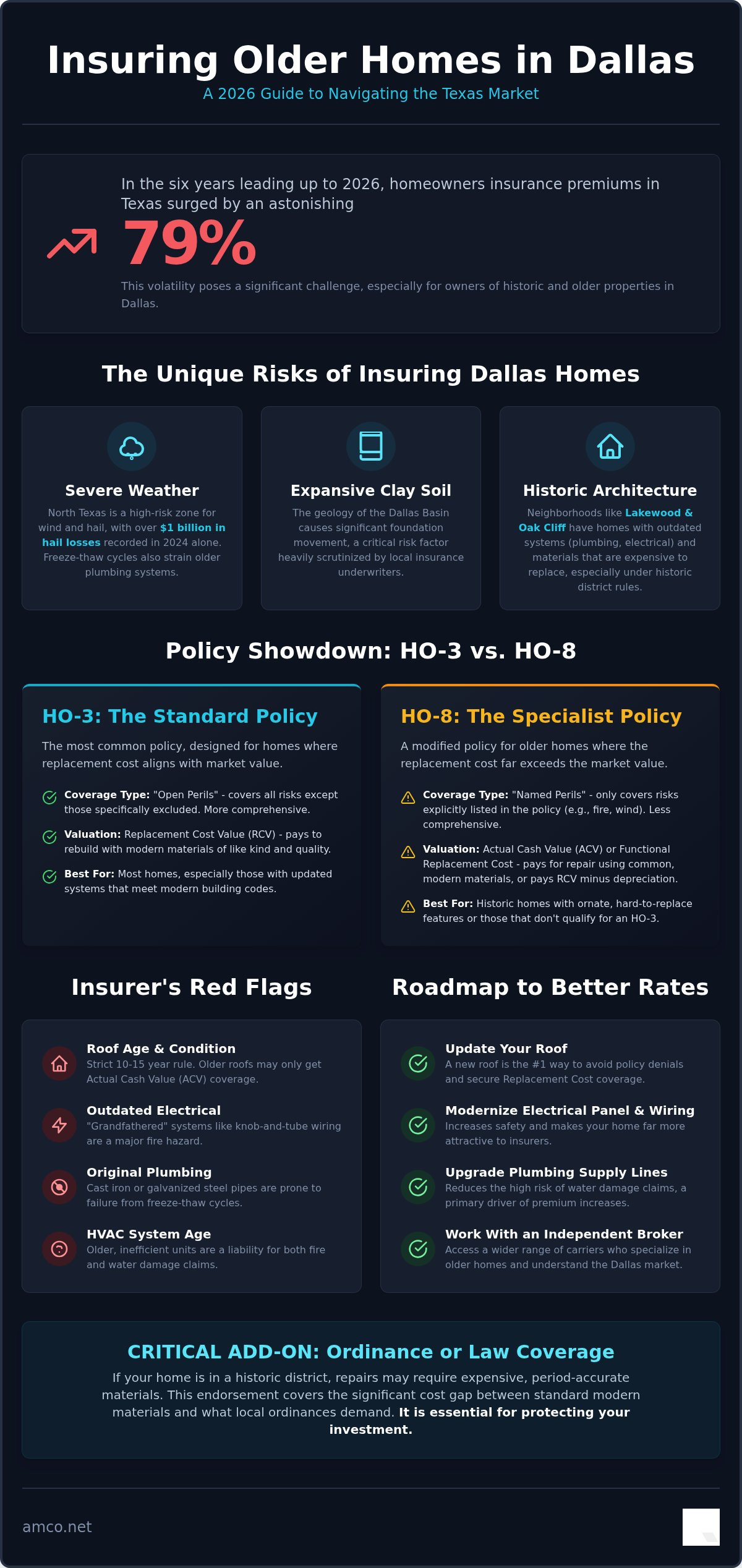
Did you know that homeowners insurance premiums in Texas surged by 79 percent in the six years leading up to 2026? For those seeking homeowners insurance for older homes in Dallas, this volatility is often compounded by the unique structural risks of historic architecture and the region's severe hail patterns. You likely recognize the frustration of maintaining a vintage property only to face coverage denials or exorbitant premiums due to outdated systems. Market conditions have shifted. It's a complex environment where standard policies often fall short of protecting the true value of your investment.
This guide provides a professional analysis of the 2026 insurance market to help you secure a policy that respects your home's heritage without compromising your financial stability. We'll examine the technical differences between HO-3 and HO-8 policy types, discuss the latest Texas Department of Insurance regulations regarding age-based denials, and outline specific modernization strategies that can effectively lower your premiums. By the end of this article, you'll have the expert insights needed to find a carrier that understands the intricacies of Dallas's established neighborhoods and ensures your home is protected for its full rebuilding cost.
Securing comprehensive homeowners insurance for vintage properties in North Texas requires a specialized risk assessment that accounts for more than just the age of the structure. Dallas presents a unique set of geographic and regulatory variables that can complicate a standard application. Neighborhoods such as Oak Cliff, Lakewood, and the M-Streets are defined by their architectural heritage, but these same features often trigger red flags for national carriers. Beyond the aesthetics, the underlying geology of the region plays a critical role. The expansive clay soil prevalent across the Dallas Basin causes significant foundation movement, a factor that local underwriters scrutinize far more heavily than those in other markets.
To better understand the complexities of the Texas insurance landscape, watch this helpful video:
When seeking homeowners insurance for older homes in Dallas, property owners must also contend with historic district designations. If your home is located within a protected area, local ordinances may mandate the use of specific, period-accurate materials for any repairs. This requirement often drives the replacement cost significantly higher than the market value. Without an "Ordinance or Law" endorsement, you could be left responsible for the massive price gap between modern building materials and the specialized masonry or woodwork required by the city.
The architectural diversity of Dallas creates localized risk profiles. Insuring a 1920s Craftsman in the M-Streets involves different technical considerations than a mid-century modern home in North Dallas. Older properties often feature "grandfathered" elements, such as lath-and-plaster walls or original lead plumbing. While these are charming, they rarely comply with modern building codes. Most carriers will require these systems to be modernized before they offer a standard replacement cost policy. Failure to update these features often results in a "functional replacement cost" valuation, which provides materials that are functionally equivalent but lack the original aesthetic value.
North Texas is a high-risk zone for wind and hail, with the DFW metroplex recording over $1 billion in hail losses in 2024 alone. This history of severe weather has led many insurers to implement a strict 10 to 15 year rule for roofs. If your roof exceeds this age, you may be limited to Actual Cash Value (ACV) coverage, which accounts for depreciation and drastically reduces your claim payout. Furthermore, the 2026 climate trends for Dallas show an increase in extreme temperature swings. These freeze-thaw cycles put immense pressure on original cast iron or galvanized steel plumbing, making water damage claims a primary concern for insurers and a major driver of premium volatility.
The selection of a policy form is a pivotal decision for any Dallas property owner. In the local market, where real estate values have fluctuated, the gap between a home's market value and its actual replacement cost can be vast. For those seeking homeowners insurance for older homes in Dallas, this discrepancy often dictates whether a carrier offers an HO-3 or an HO-8 policy. An HO-3 policy provides "open perils" coverage and replacement cost valuation, meaning the insurer pays to restore the home using modern materials of like kind and quality. The Texas Department of Insurance provides a foundational overview of these policy standards, yet historic properties require a more nuanced approach.
One critical component often overlooked is the "Ordinance or Law" endorsement. This coverage is vital for historic Dallas neighborhoods because it pays for the increased costs associated with meeting current building codes during a repair. If a 1930s home requires a complete electrical overhaul to meet 2026 standards after a fire, a standard policy without this endorsement only covers the cost to return the home to its previous, non-compliant state. This leaves the owner to fund expensive mandatory upgrades out of pocket.
An HO-3 policy remains the preferred choice for owners of well-maintained historic homes. To secure this coverage, carriers typically require documented updates to the electrical, HVAC, and plumbing systems. The primary advantage is the replacement cost provision. If a storm damages original white oak flooring or specialized masonry, an HO-3 policy aims to replicate those features. AMCO.NET LLC specializes in helping clients navigate these underwriting requirements to ensure their vintage assets receive full replacement value rather than depreciated payouts.
An HO-8 policy is a specialized coverage form designed for Dallas homes built before 1950 where the cost to replicate historic details exceeds the market value by a significant margin. Instead of replacement cost, these policies typically provide Actual Cash Value (ACV). This means payouts are adjusted for depreciation, which can be a financial hurdle if a major claim occurs. While HO-8 covers essential perils like fire, lightning, and smoke, it offers less comprehensive protection than an HO-3. If you're unsure which path fits your property, you can consult with a licensed broker to evaluate your home's specific risk profile and explore all available carrier options.
Insurance companies in the DFW metroplex have refined their underwriting models to account for the specific failure points of aging infrastructure. When evaluating homeowners insurance for older homes in Dallas, carriers focus on the "Big Four" systems: the roof, electrical wiring, plumbing, and HVAC. While state regulations prevent denial based solely on age, the technical condition of these systems determines both eligibility and premium pricing. Understanding how insurance carriers scrutinize older homes allows property owners to address vulnerabilities before a formal inspection occurs.
Certain legacy technologies are now classified as high-risk or uninsurable by most standard carriers. Knob-and-tube wiring, which lacks a grounding wire, and aluminum wiring, known for overheating at connection points, are primary fire hazards. Similarly, Federal Pacific breaker panels are frequently blacklisted due to documented failure rates. In the plumbing sector, galvanized steel and cast iron pipes are flagged for their tendency to corrode from the inside out. These materials lead to catastrophic water losses that carriers are increasingly unwilling to subsidize in the 2026 market.
Modern electrical demands require a minimum of 100-amp service to handle contemporary appliances and technology. Carriers in 2026 often mandate this as a baseline for any standard replacement cost policy. For homes built or renovated in the 1970s and 1980s, the presence of polybutylene plumbing remains a significant hurdle due to its history of spontaneous failure. To mitigate these risks, homeowners should consider installing automatic leak detection systems. These smart technologies provide the technological continuity and safety margins that professional underwriters value when calculating a risk profile for homeowners insurance for older homes in Dallas.
The frequency of North Texas hail events has forced a shift in roofing requirements. Most carriers now enforce a strict 10 to 15 year age limit for replacement cost coverage on standard asphalt shingles. Upgrading to Class 4 impact-resistant shingles can serve as a long term cost saving strategy by qualifying for premium credits of 10 to 35 percent. Exterior maintenance also includes managing tree overgrowth; branches overhanging a historic roof increase the risk of structural damage and accelerated shingle decay. For a 50 year old Dallas roof, insurers will typically require a certified professional inspection to verify structural integrity and the absence of granular loss before considering any form of coverage.
Transitioning from property maintenance to securing a formal policy requires a methodical approach to documentation. For those evaluating homeowners insurance for older homes in Dallas, the underwriting process is strictly data-driven. You should compile a comprehensive portfolio including recent four-point inspection reports, roofing permits, and itemized receipts for electrical or plumbing modernizations. These documents serve as technical proof that your vintage property meets 2026 safety standards, allowing brokers to advocate for lower risk scores with third-party carriers.
The choice between a captive agent and an independent broker like AMCO significantly impacts your coverage options. Captive agents are restricted to a single company's risk appetite, which often leads to automatic denials for homes with older infrastructure. As an independent agency serving Texas since 1987, AMCO brokers policies across multiple carriers. This carrier-agnostic approach is essential for vintage Dallas architecture. It allows for specialized shopping among regional insurers that prioritize structural integrity over chronological age. When comparing these options, always verify the A.M. Best financial strength rating to ensure the carrier has the capital reserves to handle North Texas's high claim frequency.
A thorough analysis of the Declarations Page is necessary to identify hidden sub-limits that often affect older structures. You must look beyond the premium to check for Dallas-specific endorsements, such as sewer backup and foundation water damage. These are rarely included in basic policies but are critical due to the region's expansive clay soil. If standard carriers deny coverage, the Texas FAIR Plan serves as a last resort. However, this should be a temporary solution. A professional broker can help you implement targeted upgrades to transition your property back into the standard market, where coverage is more comprehensive and cost-effective. You can request a comprehensive market review to see which carriers currently have the highest appetite for Dallas historic districts.
Financial efficiency in the 2026 market relies on utilizing every available credit. Installing a Class 4 impact-resistant roof can reduce annual premiums by 10 to 35 percent, depending on the carrier's specific North Texas guidelines. Another significant strategy involves bundling your home policy with auto insurance in Houston or Dallas. This multi-policy discount often provides the largest single reduction in total insurance costs. Given that many Texas carriers have filed rate increases for 2026, the traditional loyalty model is no longer sufficient. Annual policy reviews are now a technical necessity to ensure your coverage remains aligned with both current rebuilding costs and evolving market discounts.
Protecting a historic property in North Texas requires a partner who understands the architectural evolution of the region. AMCO.NET LLC has served the Texas market since 1987, providing the stability and specialized knowledge necessary to protect established assets. While national algorithms often struggle to categorize the unique risk profiles of vintage properties, our independent status allows us to broker solutions that prioritize technical accuracy over generic age brackets. We don't rely on automated "one size fits all" models. Instead, we use our decades of local data to find insurers that value the structural integrity of your specific home.
Our local expertise extends to the specific ZIP codes that define the cultural landscape of Dallas. We recognize that a property in Lakewood has different structural considerations than one in North Dallas; we use this data to advocate for our clients. When a carrier questions the integrity of a 60-year-old foundation or a legacy electrical system, we provide the expert bridge needed to secure coverage. This personalized advocacy is the cornerstone of our service. It ensures that homeowners insurance for older homes in Dallas remains accessible and comprehensive, even as the 2026 market becomes increasingly restrictive.
As an independent agency, we have access to regional carriers that specialize in established Texas neighborhoods. These companies often have a higher appetite for well-maintained older structures than their national counterparts. For unique architectural gems that fall outside standard underwriting guidelines, we have the expertise to access surplus lines. These specialized policies offer the flexibility needed for irreplaceable materials and historic district requirements. Our commitment is to provide policy placement that is fast, affordable, and technically sound. We focus on technological continuity and long-term security, ensuring your policy can withstand the volatility of the North Texas insurance climate.
Securing the right coverage starts with a professional assessment of your current risks. We recommend a comprehensive review of your existing older home policy to identify gaps in replacement cost or ordinance coverage. Our local experts are available for personalized consultations to discuss your property's specific modernization history and how it affects your current premium. You can request a fast quote through our mobile app or website, where we consolidate options from multiple third-party carriers to find the most efficient fit. Don't wait for the next severe hail season to discover the limitations of your coverage. Contact us today to ensure your Dallas legacy is protected by a policy that understands its true value.
Securing homeowners insurance for older homes in Dallas requires a technical approach that balances architectural preservation with modern risk mitigation. You've seen how policy selection and proactive system updates are essential for maintaining coverage in a volatile market. By addressing the specific vulnerabilities of your property, you can bridge the gap between historic charm and modern safety requirements. Success in this environment isn't about finding the cheapest rate; it's about securing a policy that understands the structural realities of North Texas.
AMCO.NET LLC serves as your expert partner in this process. Since 1987, we've provided Texas residents with the calm, reliable guidance needed to navigate complex insurance environments. We shop over 20 different carriers to find the most efficient fit for your specific neighborhood, accounting for Dallas-specific foundation concerns and North Texas weather patterns. Don't leave your historic legacy to a generic online portal. You can secure your property's future today by requesting a professional market analysis. Get a Fast Homeowners Insurance Quote for Your Dallas Home and ensure your investment remains a stable asset for years to come.
Yes, replacement cost coverage is available for 1920s homes if the primary mechanical and structural systems are modernized. Carriers typically require proof of updates to the electrical, plumbing, and HVAC systems before issuing an HO-3 policy. If your home retains original features like knob-and-tube wiring, you may be limited to actual cash value coverage. AMCO.NET LLC leverages over 35 years of Texas experience to help homeowners document these upgrades and secure comprehensive replacement cost valuations.
The primary difference lies in how claims are paid and which perils are covered. An HO-3 policy provides comprehensive replacement cost coverage for most risks. An HO-8 policy is a modified form for older homes where the cost to rebuild exceeds the market value. HO-8 policies typically pay actual cash value, which accounts for depreciation. This choice is a critical factor when evaluating homeowners insurance for older homes in Dallas neighborhoods like Lakewood or Oak Cliff.
Standard policies usually exclude foundation damage resulting from the natural expansion and contraction of North Texas clay soil. However, coverage may be available through a specific endorsement if the damage is caused by an accidental discharge of water from a plumbing system. Given the geological risks in Dallas, it's advisable to add foundation water damage coverage to your policy. This technical addition provides an essential layer of protection against the region's unique soil-related structural challenges.
Yes, most standard insurance carriers consider knob-and-tube wiring an uninsurable risk due to the high probability of electrical fires. If an inspection reveals this legacy wiring, you will likely face a policy denial or non-renewal. In these cases, the Texas FAIR Plan can provide temporary coverage. AMCO.NET LLC works with homeowners to find carriers that offer bridge policies while they complete the necessary electrical modernizations to return to the standard insurance market.
Roof age significantly impacts your policy's payout structure and annual cost. In Dallas, many carriers now limit full replacement cost coverage to roofs that are less than 15 years old. If your roof is older, the insurer may only offer Actual Cash Value (ACV), which deducts depreciation from your claim payment. Because North Texas experienced over $1 billion in hail losses in 2024, maintaining a modern, impact-resistant roof is a vital strategy for premium stability.
If a standard carrier denies your application, you should consult an independent agency that brokers for multiple third-party providers. Independent brokers have access to regional insurers and surplus lines that possess a higher appetite for older structures. AMCO.NET LLC can shop your profile across 20+ carriers to find a specialized fit. If private options remain unavailable, the Texas FAIR Plan acts as a last resort, providing basic coverage for homes that meet minimum safety standards.
Yes, homes in historic districts like the M-Streets can be more expensive to insure due to city-mandated repair standards. Local ordinances often require the use of specific, period-accurate materials rather than modern equivalents. This increases the replacement cost and requires a specialized Ordinance or Law endorsement. When shopping for homeowners insurance for older homes in Dallas, it's important to verify that your policy accounts for these increased construction costs to avoid significant out-of-pocket expenses.
You can lower your premium by modernizing the Big Four systems and installing safety technology like monitored alarms or leak detectors. Upgrading to a Class 4 impact-resistant roof is particularly effective in Dallas, often qualifying you for substantial discounts. Additionally, bundling your home and auto policies through an independent broker can provide significant savings. Since Texas insurance rates are rising in 2026, conducting an annual review of your policy is a professional necessity to capture new credits.