

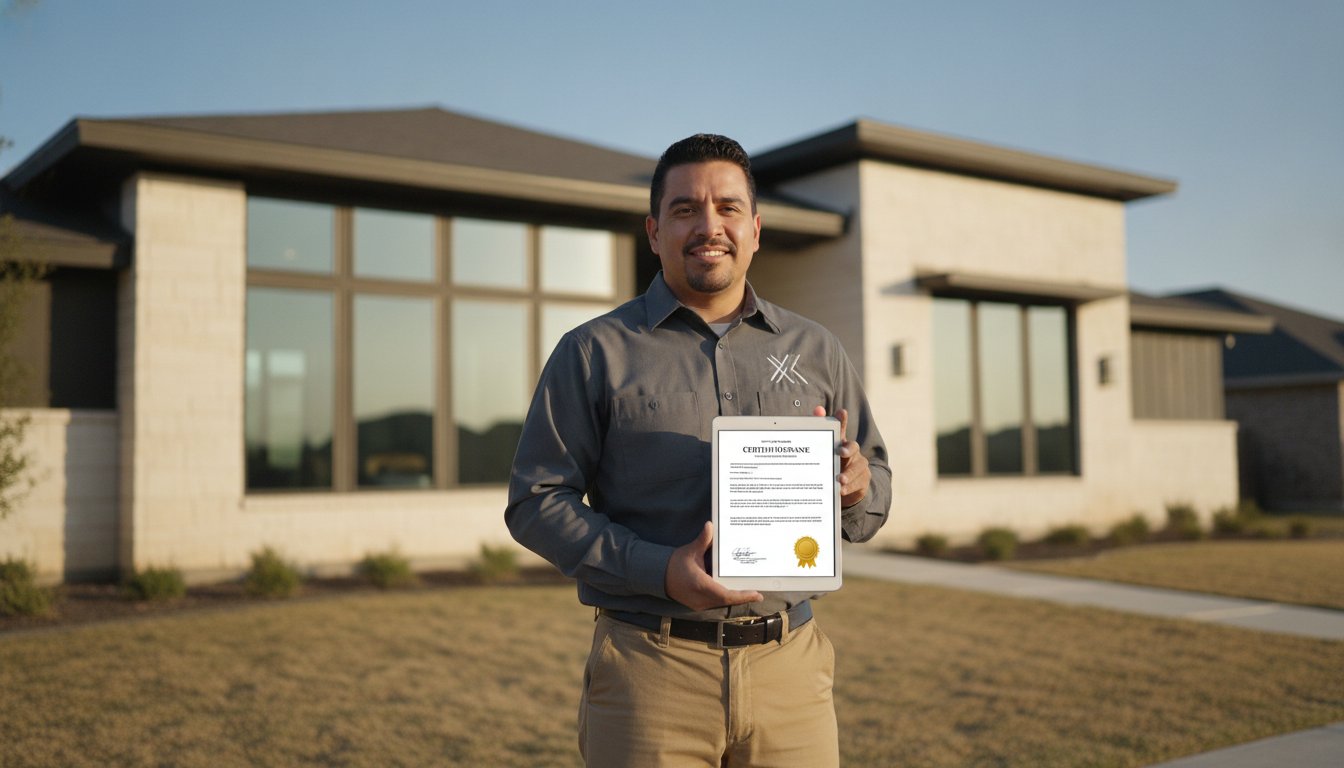
In the Texas construction market, the absence of a statewide handyman license often creates a dangerous illusion of total deregulation. While it's true that the state doesn't mandate a general license for basic repairs, failing to meet specific handyman insurance requirements Texas cities and specialty trades demand can lead to immediate contract disqualification or severe financial exposure. You've likely felt the frustration of losing a lucrative project simply because you couldn't produce a Certificate of Insurance on short notice. It's a common operational hurdle that separates established professionals from temporary labor.
We understand that navigating the intersection of TDLR mandates and local municipal codes feels like a full-time job in itself. This guide provides a methodical breakdown of the legal and contractual obligations you'll face in 2026. We'll examine the specific liability thresholds required for specialty work, clarify where local city ordinances override state silence, and identify the precise coverage structures needed to protect your equipment and income. By the end of this analysis, you'll have a clear roadmap to maintain compliance and secure your business's long-term stability.
Texas operates under a decentralized regulatory framework for general contractors. Many professionals fall into the trap of believing that because the Texas Department of Licensing & Regulation (TDLR) doesn't issue a specific "handyman license," they're exempt from all oversight. This is a costly misconception. While the state doesn't mandate a license for minor repairs, the actual handyman insurance requirements Texas professionals encounter are dictated by city ordinances and contractual obligations.
To better understand this concept, watch this helpful video:
Local governments fill the regulatory void left by the state. In Houston, the city's building codes and permit processes often require proof of General Liability Insurance before any work can begin on structural modifications or significant repairs. Similarly, Dallas and Austin have implemented registration programs for home improvement contractors. These registrations aren't mere formalities; they often require proof of financial responsibility to protect local residents.
San Antonio maintains a particularly structured approach to contractor oversight. To obtain a home improvement contractor license there, you must provide proof of liability insurance with specific minimums. These include $300,000 per occurrence for property damage and bodily injury, $600,000 aggregate, and $300,000 for products and completed operations. These local mandates ensure that the public is protected from substandard work and financial loss, making insurance a prerequisite for legal operation.
A COI is your most powerful marketing and legal document. It's a single-page summary of your active policy, proving you have the backing of a reputable insurer. In the competitive Texas market, having a COI immediately differentiates you from uninsured competitors who often underbid jobs by cutting corners on protection. It provides the peace of mind that sophisticated clients demand before allowing a contractor onto their property.
Most Texas homeowners and small business owners now expect professional standards that exceed the bare minimum. While local laws might set lower floors, it's standard for clients to request coverage limits between $500,000 and $1,000,000. Providing this documentation proactively builds trust and positions your business as a stable, long-term partner rather than a temporary service provider. It's the professional standard for doing business in the Lone Star State.
While local registrations provide the legal right to operate, the commercial viability of your business depends on your insurance portfolio. General Liability Insurance stands as the foundational layer of this protection. It addresses the most common risks encountered in field operations: property damage and third-party bodily injury. General Liability Insurance serves as the primary risk mitigation tool for Texas general contractors because it provides immediate financial recourse for onsite accidents.
Consider a scenario in a Houston suburb where a routine shelf installation accidentally punctures a hidden water line. Without coverage, the resulting water damage to the client's flooring and drywall becomes a direct out-of-pocket expense that could bankrupt a small operation. A robust policy includes coverage for "Completed Operations." This ensures that if a leak or structural failure occurs weeks after you've left the site, you remain protected. Standard liability policies also encompass advertising injury and personal injury, shielding you from claims related to libel or copyright issues during your marketing efforts.
Texas maintains a unique position in the United States regarding employee protection. According to the Texas Department of Insurance, private employers can choose whether or not to carry workers' compensation insurance. Businesses that opt out are known as "non-subscribers." While this might seem like a cost-saving measure, it removes the legal protections that limit an employer's liability. If an employee or sub-contractor is injured on the job, a non-subscriber can be sued for the full extent of damages without the benefit of standard legal defenses.
Even for a one-man shop, carrying a policy is a strategic advantage. Many Texas general contractors and government entities refuse to hire any sub-contractor who cannot provide proof of Workers' Compensation, regardless of whether they have employees. They do this to avoid the risk of being held responsible for your injuries on their job site. Meeting the specific handyman insurance requirements Texas professionals face doesn't have to be a financial burden. We focus on helping small businesses secure Workers Compensation Insurance that aligns with their specific operational scale and budget. Protecting your income against a sudden injury is a prerequisite for long-term growth in this industry.
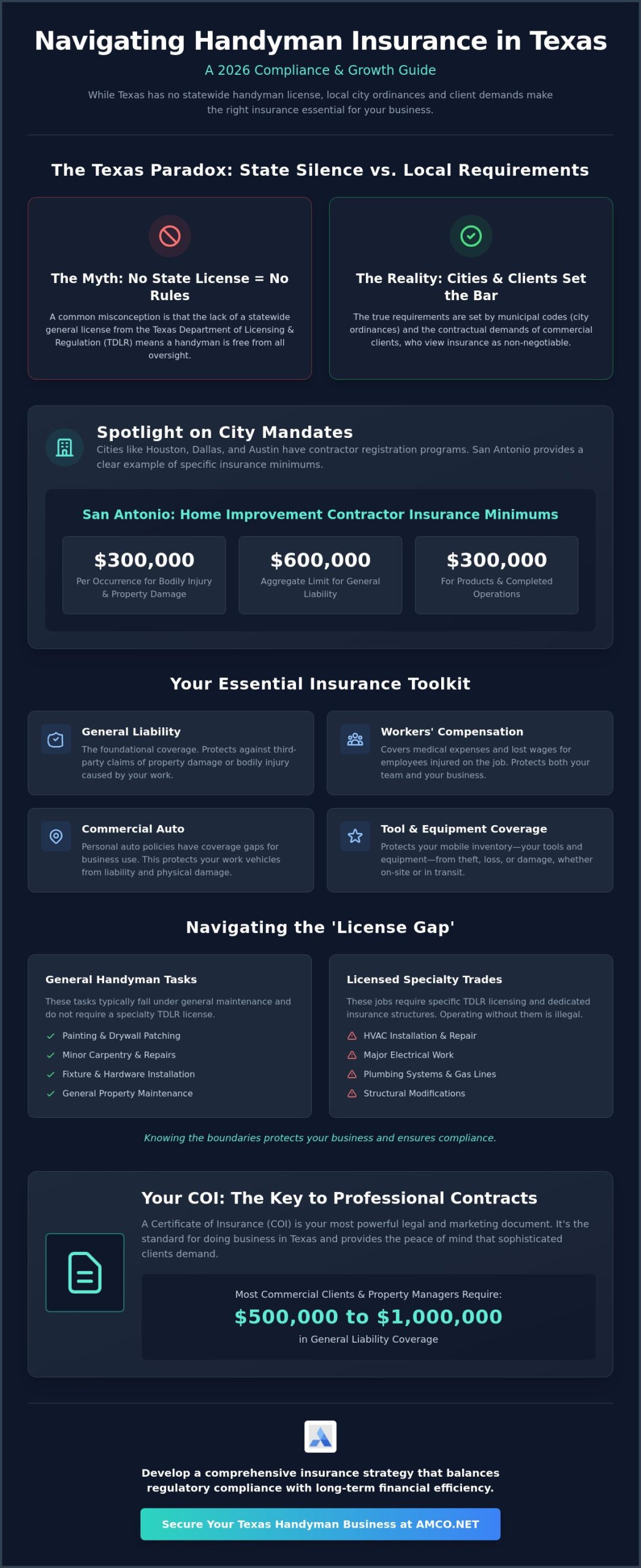
Texas law allows handymen to perform a wide variety of cosmetic and minor maintenance tasks without a state-issued license. This scope typically includes painting, drywall patching, and basic fence repair. However, the boundary becomes rigid once the work involves systems regulated by the Texas Department of Licensing and Regulation. Crossing this line without the proper credentials creates a "License Gap" that can invalidate your coverage. If a fire starts because of an unpermitted panel modification, your carrier will likely deny the claim, citing that the work performed fell outside the legal Electrician's license requirements.
Performing out-of-scope work is the fastest way to lose your business. Standard handyman policies are underwritten based on low-risk maintenance activities. When a handyman attempts HVAC or plumbing installations, they're engaging in high-hazard trades that require specific endorsements and higher limits. The TDLR mandates that licensed plumbing contractors carry at least $300,000 in commercial general liability insurance. Attempting these jobs under a basic policy leaves you personally liable for any catastrophic failures. Understanding the specific handyman insurance requirements Texas trade boards enforce is vital for your risk management strategy.
For those transitioning into specialty trades, the insurance landscape shifts significantly. Class A HVAC contractors must maintain $300,000 per occurrence and a $600,000 aggregate limit to remain compliant. If your business moves into complex remodeling, you might also face requirements for Surety Bonds. These bonds act as a financial guarantee that you'll complete the work according to local codes and contractual obligations. Always verify that any sub-contractor you hire meets these state-mandated minimums to prevent their liability from rolling onto your policy.
Hiring a helper for a weekend project introduces the concept of "Vicarious Liability." In Texas, you can be held responsible for the actions or negligence of anyone working under your direction. This makes collecting a COI from every sub-contractor non-negotiable. You shouldn't assume your handyman insurance requirements Texas policy automatically covers independent contractors. We help our clients review their policies to ensure they have the correct "Independent Contractors" coverage, preventing a single mistake by a helper from destroying years of hard work. Implementing these verification steps ensures your professional reputation remains intact.
Your work truck and the equipment inside represent the physical infrastructure of your business. While the previous sections focused on liability and licensing, the logistical reality of the trade involves high-value assets in constant motion. Many professionals mistakenly assume their personal vehicle policy provides a safety net for their professional activities. However, the Commercial Auto Insurance landscape in Texas is strictly divided between private use and business operations. Standard personal policies often contain specific exclusions for vehicles used to transport tools, materials, or employees to worksites.
Understanding these distinctions is a core component of meeting the broader handyman insurance requirements Texas business owners face. Failing to secure the correct classification can lead to a total loss of coverage after a collision. Beyond the vehicle itself, you must account for the specialized tools that are targets for theft at jobsites or from trailers in transit. This requires a shift from standard property coverage to specialized inland marine solutions.
An accident while navigating the heavy traffic of Dallas or Houston can be catastrophic for an uninsured business. If you're involved in a collision while driving between jobs, a personal insurance carrier will likely investigate the nature of your trip. If they discover you were engaged in commercial activity, they may deny the claim entirely. This leaves you personally responsible for medical bills and vehicle repairs. For most professionals, a Commercial Auto Insurance policy with a Combined Single Limit (CSL) is the most efficient choice. Unlike split limits, CSL provides a single lump sum that can be applied to both bodily injury and property damage as needed. If you occasionally use a personal sedan for administrative tasks, adding 'Hired and Non-Owned' coverage provides an extra layer of security without the cost of a full fleet policy.
Standard commercial property insurance is designed for stationary assets like a warehouse or office. Because your ladders, power tools, and diagnostic equipment move from site to site, they require Inland Marine Insurance. This policy protects your inventory while it's in transit, on a trailer, or stored at a client's property. When selecting coverage, the debate between 'Replacement Cost' and 'Actual Cash Value' is critical. We recommend replacement cost coverage to ensure you can purchase brand-new equipment immediately after a theft, rather than receiving a depreciated payout that doesn't cover current market prices. Protecting your mobile inventory is just as vital as protecting your reputation. To secure your equipment and vehicle today, get a personalized quote from AMCO.NET and ensure your business stays on the road.
Establishing a resilient business in the Texas construction sector requires more than technical skill; it necessitates a partnership with a risk management specialist who understands the local regulatory climate. AMCO.NET has spent over 35 years serving the specific needs of businesses in Houston, San Antonio, and Dallas. We've built our reputation on professional stability and a deep understanding of the operational challenges faced by independent contractors. Meeting the multifaceted handyman insurance requirements Texas cities enforce is a streamlined process when working with a local independent agency rather than a national digital aggregator.
National platforms often rely on automated algorithms that fail to account for the nuances of Texas municipal codes or the specific demands of local property managers. We take a systems-based approach by helping you bundle General Liability and Commercial Auto insurance. This strategy doesn't just simplify your administrative tasks; it maximizes your financial efficiency through multi-policy discounts. Our team focuses on providing the specialized documentation you need to secure contracts. We understand that in the fast-paced Texas market, a delay in receiving your Certificate of Insurance (COI) can mean the difference between landing a job and losing it to a competitor. Our internal processes are optimized for fast COI issuance, ensuring you have the proof of coverage required to start your projects today.
Securing your business is a straightforward process. You can obtain an accurate quote online, over the phone, or by visiting our Houston office for an in-person consultation. To ensure the most precise assessment, have your basic business details, estimated annual revenue, and employee or sub-contractor counts ready. We'll analyze your specific risk profile to build a policy that meets every legal and contractual obligation. Our goal is to provide a solution that fits your budget without compromising on the quality of your protection. Get a fast, affordable handyman insurance quote from AMCO today!
Professional stability in the Lone Star State requires a shift from viewing insurance as an expense to seeing it as a strategic asset. By aligning your operations with the specific handyman insurance requirements Texas municipalities demand, you protect your business from the "License Gap" and the financial fallout of onsite accidents. We've explored how General Liability, Workers' Compensation, and Commercial Auto policies form a comprehensive shield for your tools, your vehicle, and your reputation.
Since 1987, AMCO.NET has provided Houston-based expertise to help local businesses navigate these complex regulatory landscapes. We partner with A-rated insurance carriers to ensure your coverage is as reliable as the work you perform for your clients. Whether you're a solo operator or managing a growing crew, having the right paperwork ready allows you to bid on larger contracts with confidence. Don't let a lack of coverage hold your business back from its full potential.
Secure Your Handyman Business with a Fast Texas Insurance Quote
Take the next step in professionalizing your trade. Our team is ready to build a policy that grows with you, ensuring you remain compliant and competitive in the 2026 market.
Texas does not have a statewide legal mandate requiring general liability insurance for basic handyman work. However, meeting the handyman insurance requirements Texas municipalities and specialty trade boards enforce is a practical necessity. If your work involves plumbing, electrical, or HVAC systems, the Texas Department of Licensing and Regulation (TDLR) requires specific insurance minimums to maintain your professional license and legal standing.
The cost of a policy depends on several variables, including your annual revenue, the size of your crew, and the specific limits you select. A solo operator performing low-risk maintenance will face different premium structures than a small firm with several employees and heavy equipment. We recommend requesting a personalized quote to determine the most efficient coverage plan for your specific business model and risk exposure.
There is no universal "handyman license" at the state level for general repairs like painting or minor carpentry. While the state is deregulated for general maintenance, you must hold specialty licenses for any work involving structural, electrical, plumbing, or mechanical systems. Furthermore, many Texas cities require contractors to register locally and provide proof of insurance before they can pull permits for residential projects.
Personal auto policies almost always exclude coverage for accidents that occur during business operations. If you are involved in a collision while transporting tools or materials to a jobsite, your personal carrier will likely deny the claim. To protect your assets and maintain compliance, you should secure a commercial auto policy that specifically accounts for the professional use of your vehicle on Texas roads.
While the state doesn't set a minimum for general handymen, the industry standard for professional contracts is typically between $500,000 and $1,000,000. Specialty trades regulated by the TDLR have specific legal minimums, often starting at $300,000 per occurrence for electrical or HVAC contractors. Carrying at least $1,000,000 in coverage is a strategic move that allows you to qualify for more lucrative commercial and residential contracts.
You can perform basic maintenance and cosmetic repairs in Houston without a state-issued contractor's license. However, the City of Houston has its own set of registration requirements and building codes that you must follow. For projects that require permits, the city will often ask for proof of liability insurance and local registration to ensure that the work is performed by a legitimate, insured professional.
Performing unlicensed electrical work is a serious violation that can lead to heavy fines from the TDLR and potential legal action. Beyond the administrative penalties, doing work outside your legal scope will void your insurance coverage. If an electrical fire or injury occurs, your insurance carrier will likely deny the claim because the activity was illegal, leaving you personally responsible for all resulting damages and legal fees.
You can obtain a COI by contacting your insurance agency and providing the name and address of the person or company requesting the document. At AMCO.NET, we understand that speed is critical for landing new jobs, so we offer fast COI issuance through our office and mobile app. Once requested, the certificate is typically generated and sent via email, allowing you to provide proof of coverage to your client immediately.