
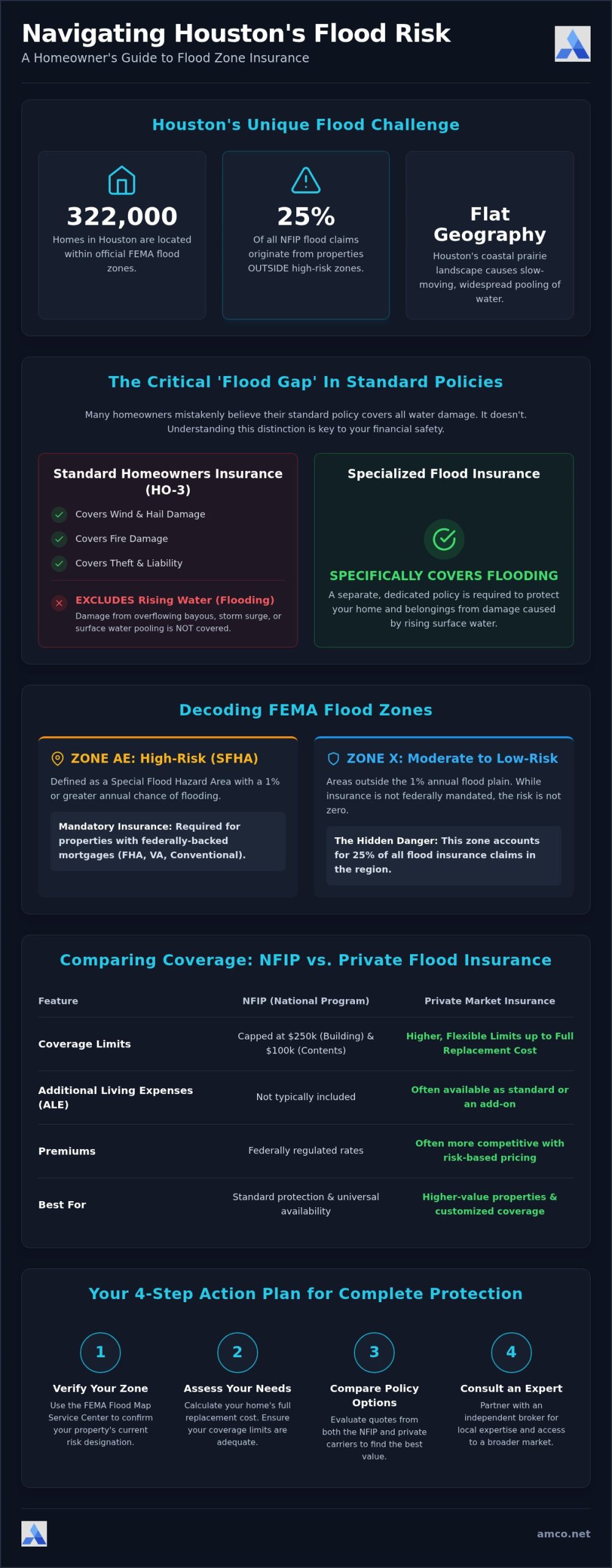
Did you know that 25% of all National Flood Insurance Program claims come from properties located outside of designated high-risk zones? In a city like Houston, where 322,000 homes sit within FEMA flood zones, the distinction between "safe" and "at-risk" is often thinner than a curb's height. If you're searching for homeowners insurance for flood zone properties in Houston, you've likely encountered the frustration of shifting FEMA maps and the anxiety of rising premiums. It's a complex environment where standard policies leave dangerous gaps; relying on outdated data can lead to catastrophic financial exposure.
We understand that balancing mortgage lender requirements with actual environmental risk feels like a moving target. This 2026 guide provides a clear roadmap to help you secure comprehensive coverage while optimizing your total cost of risk. You'll learn how to interpret the latest Harris County flood designations, compare NFIP limits against private market alternatives, and leverage the expertise of an independent broker. Our goal is to provide the technical clarity needed to protect your assets against both hurricanes and the sudden flash floods that define our region's climate reality.
In Harris County, a Special Flood Hazard Area (SFHA) is defined as land with a 1% annual chance of flooding, commonly known as the 100-year floodplain. Houston's coastal prairie geography is notoriously flat, which means water often moves slowly or pools during heavy rain events. This unique topography makes homeowners insurance for flood zone properties in Houston a critical component of any risk management strategy. The Harris County Flood Control District works to manage the region’s massive network of bayous, yet the specific flood zone designation of your parcel ultimately determines your legal and financial obligations.
To better understand how these designations impact your coverage and costs, watch this helpful video:
Distinguishing between Zone AE and Zone X is the first step in protecting your investment. Zone AE indicates high-risk areas where the base flood elevation has been determined. Zone X represents moderate to low risk areas. While the risk level varies, the physical reality of Houston's drainage capacity means that flood lines on a map don't always stop the water at your doorstep. Professional risk assessment considers both the map designation and the specific elevation of the structure.
Property owners can verify their current status through the FEMA Flood Map Service Center or local county portals. Recent map revisions in 2026 have shifted many Houston neighborhoods into higher-risk categories, directly impacting property values and insurance costs. Historical data indicates that homes in Zone X are far from immune. In fact, roughly 25% of all flood claims in the Houston area occur in these moderate risk zones. This trend highlights the necessity of maintaining coverage even when it isn't legally required by a mortgage provider.
Federal law requires flood insurance for homes with federally backed mortgages, such as FHA, VA, or conventional loans, when the property sits in an SFHA. Most residents secure this through the National Flood Insurance Program (NFIP). Letting a policy lapse is a significant risk. If coverage drops, your lender may initiate "lender-placed" insurance. This forced coverage is often significantly more expensive than a standard policy and typically only protects the lender's interest, not your personal property or equity. Selecting your own homeowners insurance for flood zone properties in Houston allows you to maintain control over your coverage limits and deductibles.
Many Houstonians mistakenly assume a standard HO-3 policy provides universal protection against all water-related disasters. It doesn't. Texas insurance law clearly distinguishes between different types of water damage, and a standard homeowners policy explicitly excludes damage caused by "rising water" or "surface water." This means if a nearby bayou overflows or intense rainfall pools on the ground and enters your living room, your base policy will not pay for the repairs. This fundamental gap is the primary reason why securing specific homeowners insurance for flood zone properties in Houston is a technical necessity rather than an optional upgrade.
Since 1987, the insurance market has moved toward extreme specialization in how it handles regional risks. Early policies were often less rigid in their exclusions, but modern carriers strictly define surface water as any water on the surface of the ground that hasn't entered a defined watercourse. During a hurricane, you might face a complex claim where wind-driven rain enters through a damaged roof while ground-level flooding enters through the foundation. These are two separate perils. One is covered by your homeowners policy, and the other requires a dedicated flood policy to ensure you aren't left with a massive financial shortfall.
The distinction rests entirely on the source of the water. Homeowners insurance typically covers "sudden and accidental" internal discharge, such as a burst copper pipe or a failing water heater. Conversely, the FloodSmart.gov definition of a flood requires a general condition of partial or complete inundation of two or more acres of normally dry land or of two or more properties. Houston storms frequently create "mixed peril" events where both types of damage occur simultaneously. If you're unsure how these definitions apply to your specific risk, you can consult with an independent specialist to review your current policy language for potential vulnerabilities.
Valuation methods differ significantly between these policy types. Most standard homeowners policies provide replacement cost coverage for the dwelling, meaning they pay to rebuild at 2026 construction prices. However, many flood policies, particularly through the NFIP, apply actual cash value to personal property. This means your furniture and electronics are valued at their depreciated price, not what it costs to buy them new. In Houston, where labor and material costs have risen sharply, this distinction is critical. If your coverage doesn't account for 2026 construction reality, you'll face significant out-of-pocket expenses when trying to restore your home after a loss.
Selecting the appropriate insurance vehicle requires an objective analysis of both federal and private market offerings. While the National Flood Insurance Program remains the primary source of coverage for many, the private sector has matured significantly by 2026. This evolution provides more sophisticated options for homeowners insurance for flood zone properties in Houston, particularly for residents whose property values exceed federal coverage caps. Deciding between these paths depends on your specific risk tolerance, property value, and the urgency of your coverage needs.
The federal program offers government-backed stability and standardized rates across different carriers. However, its structural limitations are rigid. Coverage is capped at $250,000 for the dwelling and $100,000 for personal contents. With the full implementation of FEMA's Risk Rating 2.0, premiums are now calculated based on individual property variables like distance to water and rebuilding costs. Property owners should utilize the Harris County Flood Education Mapping Tool to understand how their specific location's risk profile influences these federal premium assessments.
Operational timing is another critical factor. The NFIP typically enforces a 30-day waiting period before a policy becomes active. If a storm system is already developing in the Gulf, it's often too late to secure federal protection. For properties that require more than the $250,000 federal limit, "excess flood insurance" must be purchased through the private market to bridge the gap between the NFIP cap and the actual 2026 cost of reconstruction.
Private insurers often provide more comprehensive terms than the federal alternative. One significant benefit is the inclusion of Additional Living Expenses (ALE), which covers hotel and meal costs if a flood makes your home uninhabitable. The NFIP does not offer ALE, leaving many families to pay these costs out of pocket during a recovery. Private markets also tend to offer shorter waiting periods, sometimes as brief as 10 to 14 days, providing faster compliance for pending real estate closings.
As an independent agency founded in 1987, AMCO.NET LLC specializes in shopping both the NFIP and private markets. We don't serve a single insurance company; we act as a broker to match your specific property data with the carrier offering the best financial value. This professional oversight is vital for securing homeowners insurance for flood zone properties in Houston that provides full financial restoration rather than just meeting the bare minimum of lender requirements.
Securing homeowners insurance for flood zone properties in Houston requires a methodical approach to data collection. Carriers don't just look at a map; they analyze the structural characteristics of your home. You'll need to gather your property's prior loss history, as previous flood claims can impact your eligibility for certain private market policies. If you're purchasing a new home, ensure you request a disclosure notice that details any past inundation events, as this transparency is vital for accurate underwriting.
The "Inches of Water" rule is a sobering reality for many local residents. Just one inch of water can cause over $25,000 in damage to a mid-sized home because drywall, flooring, and electrical systems near the slab must be replaced. When selecting a deductible, you must balance your monthly premium savings against this immediate out-of-pocket risk. While a $5,000 or $10,000 deductible lowers your fixed costs, it requires you to have significant liquid reserves ready for the next flash flood event.
Bundling your homeowners and flood insurance with the same carrier isn't always possible since many flood policies are serviced through the NFIP. However, using an independent broker allows you to manage both policies through a single point of contact. This alignment ensures there are no gaps between your windstorm and flood coverage, which is a common point of failure in Houston claims when multiple adjusters disagree on the cause of damage.
An Elevation Certificate (EC) compares your building’s elevation to the height floodwaters are expected to reach. While FEMA's Risk Rating 2.0 has reduced the mandatory requirement for an EC in some cases, having one can still lead to significant premium reductions if your home is built well above the floodplain. The Base Flood Elevation (BFE) serves as the benchmark that dictates your specific insurance rate based on how many feet your lowest floor sits above or below that level.
Before finalizing your coverage, verify if your property qualifies for "grandfathered" rates. This provision allows older Houston homes to maintain lower risk ratings if they were built in compliance with the flood maps in effect at the time of construction. Additionally, ensure your policy extends to detached structures like garages or sheds, as these aren't always automatically covered. Finally, confirm that debris removal and mitigation costs are included to prevent massive out-of-pocket cleanup expenses. To ensure your policy meets these technical standards, you should request a professional coverage audit from AMCO.NET LLC today.
Since 1987, AMCO.NET LLC has provided technical insurance guidance to the Houston metro area. As an independent brokerage, our loyalty remains with the client rather than any specific insurance carrier. This distinction is vital when securing homeowners insurance for flood zone properties in Houston, as it allows us to objectively compare policies from multiple providers like Progressive and Travelers alongside specialized flood underwriters. We don't just sell policies; we design risk mitigation systems that ensure your financial continuity after a major weather event.
Our tenure in the region has allowed us to develop deep localized knowledge of the drainage patterns in Harris, Fort Bend, and Montgomery Counties. We understand that a property in Conroe faces different environmental challenges than one in the heart of the city. To support our clients during high-stress periods, we provide streamlined claims support and modern policy management through the AMCO mobile app. This technology ensures you have instant access to your coverage details when you need them most.
Our agents conduct detailed block-level analysis to understand your home's specific flood history. We look beyond basic FEMA maps to identify localized risks that digital-only platforms often overlook. By integrating your Homeowners Insurance with specialized flood protection, we eliminate the coverage gaps that frequently lead to denied claims. This consultative approach ensures your assets are protected by a cohesive strategy rather than a collection of unrelated policies.
Securing homeowners insurance for flood zone properties in Houston shouldn't be a source of anxiety. Our team is committed to finding affordable, fast coverage that meets all lender requirements without sacrificing protection quality. We invite you to request a comprehensive quote through our office to see how our independent model can reduce your total insurance spend. Additionally, you can explore our guide to Car Insurance in Houston to learn about multi-policy discounts that further improve your household's financial efficiency.
Protecting a residence in Harris County requires more than just meeting lender mandates; it demands a technical understanding of the evolving 2026 flood landscape. We've explored how standard policies leave significant gaps and why distinguishing between federal and private market options is essential for full financial recovery. Securing homeowners insurance for flood zone properties in Houston is a strategic investment that balances regulatory compliance with the physical reality of our region's geography.
AMCO.NET LLC has served the Houston community since 1987, providing the stable expertise needed to navigate complex Harris County flood regulations. As an independent agency, we offer access to over 40 top-rated insurance carriers to ensure your coverage is both comprehensive and cost-effective. Don't leave your property's safety to chance or outdated maps. Professional oversight ensures that your policy limits reflect the current cost of construction and the specific elevation of your home.
Protect your Houston home today with a custom quote from AMCO.NET LLC and gain the peace of mind that comes from professional risk management. Our team is ready to help you build a resilient future for your home and family.
Standard homeowners insurance does not cover damage from rising ground water or surface water inundation. While your base policy typically handles internal water discharge from burst pipes or failing appliances, it explicitly excludes flood events as defined by federal guidelines. Securing homeowners insurance for flood zone properties in Houston requires a dedicated flood policy to ensure the structure and its contents are protected against hurricane storm surges or localized flash flooding.
Flood insurance is mandatory if you have a federally backed mortgage and your property sits within a Special Flood Hazard Area. Loans through FHA, VA, or conventional lenders require this coverage to protect the underlying asset. If you own your home outright, no law requires coverage; however, given that 25% of claims originate outside high-risk zones, maintaining a policy is a critical component of professional risk management for any Houstonian.
A flood map identifies the general risk level of a neighborhood, while an Elevation Certificate provides specific data about your individual structure. FEMA flood maps designate zones like AE or X based on regional drainage patterns. Conversely, an Elevation Certificate records the exact height of your home's lowest floor relative to the Base Flood Elevation. This technical document allows carriers to price your risk more accurately, often resulting in lower annual premiums.
The National Flood Insurance Program generally enforces a 30-day waiting period from the date of application before coverage becomes effective. This rule prevents property owners from securing insurance only when a storm is imminent. Private market providers often offer shorter windows, typically ranging from 10 to 14 days. Exceptions exist for new home purchases where coverage is required for a loan closing, in which case protection begins immediately upon funding.
You can absolutely obtain coverage even if your property has a history of prior inundation. While previous claims may disqualify you from certain preferred private market programs, the NFIP is designed to provide access to insurance regardless of loss history. It's important to disclose all prior events accurately during the application process, as failure to do so can lead to claim denials or policy rescission when a future event occurs.
Comprehensive flood insurance includes protection for both the physical structure and your personal belongings, though these are often listed as separate coverage parts. Under standard NFIP terms, building coverage is capped at $250,000, while personal property coverage is limited to $100,000. It's vital to note that contents coverage is usually valued at actual cash value, meaning depreciation is subtracted from the payout, unlike the replacement cost terms found in many homeowners policies.
If your property's replacement value exceeds the $250,000 federal limit, you must secure excess flood insurance through the private market. Lenders for high-value homes often require coverage that matches the full loan amount or the total cost of reconstruction. An independent broker can bridge this gap by layering a private policy on top of your primary NFIP coverage, ensuring your homeowners insurance for flood zone properties in Houston provides total financial restoration.
Several factors can reduce your total cost of risk. Properties in communities that participate in the Community Rating System may receive automatic premium reductions based on local mitigation efforts. Additionally, providing a current Elevation Certificate can trigger discounts if your home is built above the Base Flood Elevation. Working with an independent broker like AMCO.NET LLC allows you to compare these various discount structures across multiple carriers to find the most efficient rate.