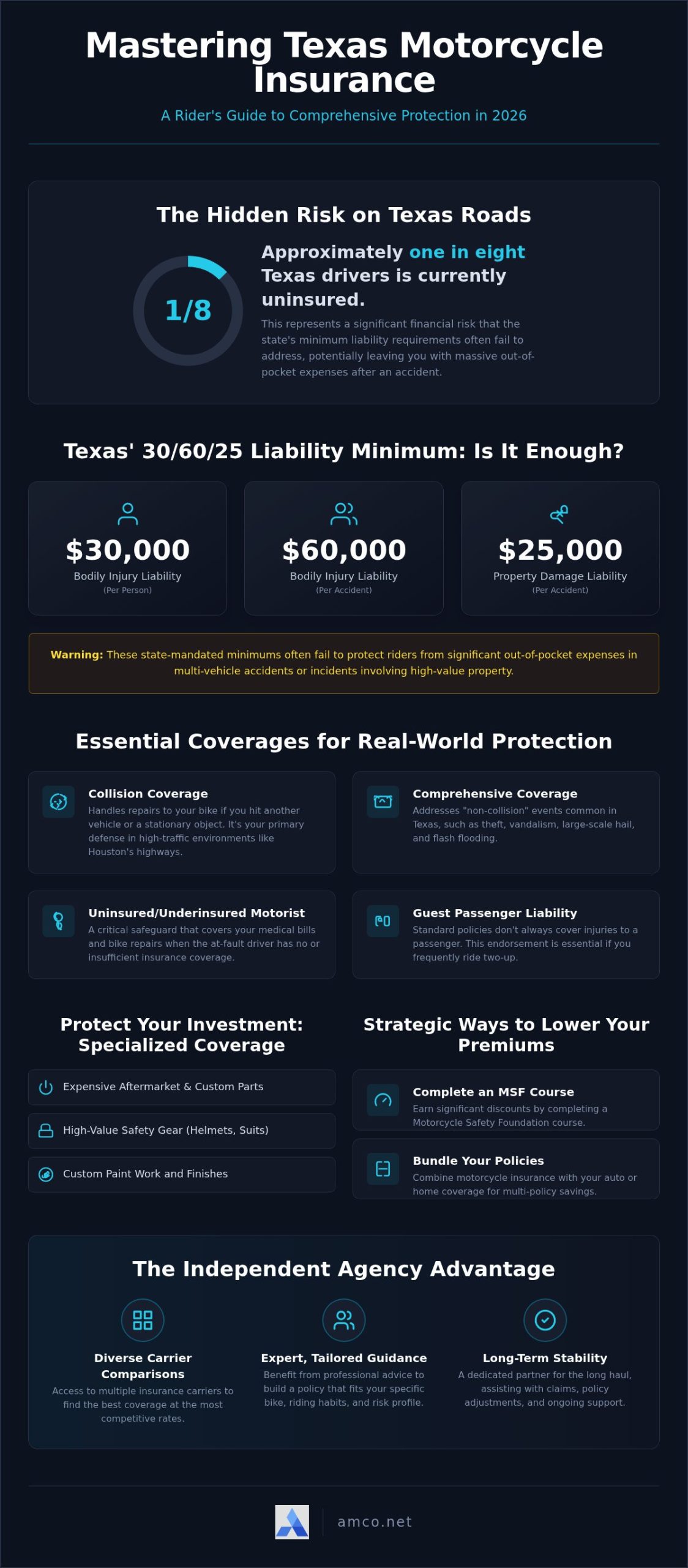
Approximately one in eight Texas drivers is currently operating without any coverage at all. For a rider on the streets of Houston or the highways of Dallas, this statistic represents a significant financial risk that the state's minimum liability requirements simply don't address. You likely understand that having Motorcycle Insurance is a legal necessity, but the standard 30/60/25 limits often leave a gap between basic compliance and true asset protection. It's a common concern for urban riders who face higher premiums and uncertainty regarding whether their custom modifications or expensive safety gear are actually covered under a standard policy.
This guide will help you master the complexities of the Texas insurance market to ensure your bike, gear, and financial future are protected on every ride. We'll examine the specific legal mandates for 2026, including why the fault-based system in Texas makes uninsured motorist coverage a critical component of your risk management strategy. You'll also learn how to secure specialized coverage for aftermarket parts and identify local discounts that lower your monthly costs without compromising your security. From understanding helmet law exemptions to the technical details of policy bundling, this professional analysis provides the clarity needed for informed decision-making.
Texas operates under a fault-based system, which dictates that the party responsible for an accident bears the full financial burden of the resulting damages. The Texas Department of Insurance (TDI) oversees the regulations governing vehicle insurance policies, ensuring that all Motorcycle Insurance products meet baseline standards for public safety. While the law requires a specific level of coverage, these figures represent a floor rather than a ceiling. Relying solely on the state-mandated minimum often leaves riders exposed to litigation if an accident involves multiple vehicles or high-value property. Building a policy that fits your specific risk profile requires looking past basic compliance toward comprehensive asset protection.
The shorthand "30/60/25" describes the maximum amount an insurer will pay for a covered claim. In 2026, these figures translate to $30,000 for bodily injury per person, $60,000 for bodily injury per accident, and $25,000 for property damage. Liability coverage serves as a financial shield that protects your personal assets and future earnings from being seized to satisfy a judgment if you're found at fault in a collision. One frequently overlooked component in Texas is Guest Passenger Liability. Standard policies don't always automatically cover injuries to someone riding on the back of your bike. If you frequently ride two-up, verifying this specific endorsement is essential. Without it, you may be personally responsible for a passenger's medical expenses and lost wages after a crash.
Operating a motorcycle without valid coverage carries severe professional and financial consequences. Law enforcement officers utilize the TexasSure database, a real-time verification system that links vehicle registrations with insurance policy data. If the system shows a lapse during a routine stop, you face immediate fines, potential vehicle impoundment, and the suspension of your license. For riders with a history of certain traffic convictions, the state may require an SR-22 filing. This isn't a separate type of Motorcycle Insurance, but a certificate of financial responsibility that an agency must file with the Department of Public Safety (DPS). It serves as a guarantee that you're maintaining the required coverage levels. Any lapse in a policy attached to an SR-22 triggers an immediate notification to the state, often resulting in the swift revocation of driving privileges.
Legal compliance is merely the starting point for a professional risk management strategy. While liability coverage protects others, it does nothing to repair your motorcycle or cover your personal medical bills after an incident. According to motorcycle safety statistics, riders face a higher degree of vulnerability in traffic, making physical damage and personal injury coverages central to any robust Motorcycle Insurance policy. Selecting the right combination of collision and comprehensive options ensures that your capital investment remains secure regardless of the circumstances on the road.
Collision coverage handles repairs to your bike if you hit another vehicle or a stationary object. It's the primary defense against the high-traffic environment of Houston's highway system. Conversely, comprehensive coverage addresses "non-collision" events. In Texas, this includes theft, vandalism, and frequent weather-related hazards such as large-scale hail or flash flooding. Riders must decide between Actual Cash Value (ACV), which pays out the market value at the time of loss, or Stated Value, which is often more appropriate for classic or highly customized bikes. Balancing your monthly premium with a manageable deductible is a strategic choice. A higher deductible lowers your ongoing costs but requires more liquidity if you need to file a claim. If you're unsure which valuation method fits your bike, consulting with a local agent can provide the necessary clarity.
The statistical reality in Texas is sobering. Approximately one in eight drivers on our roads operates without any insurance. In major metropolitan areas like Houston and Dallas, the density of uninsured motorists creates a significant gap in the fault-based recovery system. Uninsured/Underinsured Motorist (UM/UIM) coverage is designed specifically to fill this void. It steps in to pay for your medical expenses and bike repairs when the at-fault party either has no policy or carries limits too low to cover your total damages. Uninsured and Underinsured Motorist coverage acts as a vital financial buffer by stepping in to pay for your losses when the person responsible for the crash lacks the necessary policy limits to do so. This coverage is technically optional in Texas, but for a rider, it's a non-negotiable component of a secure policy.
Finally, riders must choose between Personal Injury Protection (PIP) and Medical Payments (MedPay). PIP is the broader option, covering medical bills, lost wages, and even essential services you can't perform while injured. MedPay is more limited, focusing strictly on medical and funeral expenses. Given the potential for high-cost recovery after a motorcycle accident, PIP offers a more comprehensive safety net for those concerned with long-term financial stability.
Standard insurance policies typically focus on the base model of a vehicle. For a Texas rider, the base model is often just the canvas. Accessories such as performance exhausts, custom chrome, intricate paint work, and specialized saddlebags can easily add thousands of dollars to a bike's total value. Without specific endorsements, these additions might not be covered in the event of a total loss. Professional Motorcycle Insurance planning involves auditing these modifications to ensure the policy reflects the actual replacement cost of the machine and its components. This specialized approach is equally important whether you operate a high-torque cruiser, a precision sportbike, or a stable three-wheeled trike; each requires a different risk assessment.
Safety apparel, including high-end helmets, technical leathers, and reinforced boots, represents a significant capital outlay. Many carriers offer safety gear coverage that treats these items as separate from the bike's physical damage limits. This is particularly important for riders who utilize advanced airbag vests or communication systems. Roadside assistance and trip interruption coverage also provide a critical safety net for long-distance Texas tours, covering expenses like towing and emergency lodging if a mechanical failure occurs far from home.
Standard accessory limits are often fixed at a low threshold, sometimes as low as $3,000. For custom builds or vintage restorations, an Agreed Value policy is superior to Actual Cash Value. This ensures that the payout matches a pre-determined amount rather than a depreciated market figure. Proper documentation is the foundation of a successful claim. We recommend maintaining a digital folder containing high-resolution photographs of all bolt-on modifications and copies of all installation invoices to provide clear evidence of the bike's enhanced value.
Texas offers diverse riding environments, from the Big Bend trails to Gulf Coast touring. Dirt bikes and dual-sports require specific off-road liability and physical damage protections that differ from street-legal requirements. For those who transport their bikes across the state, reviewing your RV Insurance is vital. It's a common mistake to assume a toy-hauler policy automatically covers the motorcycles inside. Often, you need a specific Motorcycle Insurance endorsement to protect the bikes while they are in transit or parked at a campsite. This integrated approach ensures that specialized electronics and the bikes themselves are protected under a unified risk management strategy.
Optimizing the cost of Motorcycle Insurance requires a methodical approach to risk assessment. Insurance carriers reward riders who demonstrate a lower statistical probability of filing a claim through proactive safety measures and precise policy structuring. In the Texas market, where urban traffic density in cities like Houston increases risk profiles, identifying these cost-saving levers is essential for maintaining high-level protection without unnecessary expenditure. A professional review of your policy often reveals discounts that go overlooked during standard automated sign-ups.
Completing a Texas Department of Insurance (TDI) approved safety course provides a dual benefit. It refines technical riding skills for the street while triggering a mandatory premium discount with most major carriers. Maintaining a clean riding record over a three-year period remains the most effective way to stay in the lowest possible rating tier. Carriers also offer specialized discounts for members of recognized organizations like the Harley Owners Group (HOG) or the Gold Wing Road Riders Association (GWRRA). These memberships signal to underwriters that the rider is part of a community that prioritizes safety and responsible operation.
Strategic bundling is a powerful tool for premium reduction. Combining your bike coverage with Car Insurance in Houston or a homeowners policy can lead to significant multi-policy savings. Hardware-based safety features also influence the bottom line. Anti-lock Braking Systems (ABS) and professionally installed anti-theft devices directly lower the comprehensive and collision portions of your bill.
The "lay-up" policy is a common myth among Texas riders. While riders in northern climates may pause coverage during winter, doing so in Texas often results in higher long-term costs. Our temperate climate allows for riding year-round; more importantly, insurance companies view gaps in coverage as a high-risk indicator. Continuous coverage ensures you don't lose your loyalty or "prior insurance" discounts.
Managing your deductible also plays a role in monthly costs. Transitioning to a higher deductible reduces your premium, provided you have the liquidity to cover the out-of-pocket expense during a claim. Choosing to pay your annual premium in full rather than in monthly installments typically removes administrative fees and secures an additional discount. Finally, garaging your motorcycle in a secure, low-crime zip code can positively influence your rate. If you're looking to optimize your current rates, contact AMCO for a comprehensive carrier comparison to ensure you're receiving every available discount.
Selecting the right intermediary is as critical as the policy itself. Most riders encounter "captive" agents who work for a single insurance brand. These agents are limited to one set of underwriting guidelines and a single pricing structure. If your specific profile, perhaps due to a unique custom bike or a history of high-risk filings, doesn't fit their narrow criteria, they simply can't help. An independent agency operates differently. By representing multiple A-rated carriers, we prioritize the rider's requirements over a single corporate agenda. This flexibility is the cornerstone of professional Motorcycle Insurance procurement.
The primary benefit of the broker model is market access. Instead of submitting multiple applications to different direct insurers, a single inquiry with AMCO reaches dozens of providers simultaneously. This efficiency is particularly valuable for riders who may have been rejected by direct-to-consumer platforms due to specialized bike types or past traffic violations. Our expertise in Texas-specific filings, including SR-22 requirements, allows us to match high-risk individuals with carriers that specialize in those segments. Finding a reliable Insurance Company Near Me isn't just about proximity; it's about finding a partner who understands the local liability landscape and the specific risks of Houston traffic.
Experience provides the stability needed in the volatile insurance market. Established in 1987, AMCO has spent over 35 years navigating the legislative changes and urban growth of the Houston and Texas metropolitan areas. We've seen how regional shifts impact premiums and coverage availability. This longevity means we're not just selling a product; we're providing a long-term system solution for your protection. While our roots are deep in Texas history, our service model is built for the future. Riders can manage their policies and access digital proof of insurance via our mobile app, combining traditional stability with modern convenience.
When an incident occurs, having a local advocate makes a measurable difference. We provide personalized claim support, acting as the bridge between you and the carrier to ensure a fair and timely resolution. We understand the technical details of Motorcycle Insurance and how to present them to adjusters for a successful outcome. Don't settle for a generic, one-size-fits-all policy. Get your personalized Texas motorcycle insurance quote today and experience the difference that independent expertise brings to your ride.
Mastering the Texas insurance landscape requires balancing legal compliance with comprehensive risk management. We've explored why the standard 30/60/25 liability limits often fall short in high-traffic urban centers like Houston. Protecting your specialized gear and custom modifications through tailored policies ensures that your financial investment remains secure. By utilizing strategic bundling and safety course discounts, you can maintain superior protection while optimizing your monthly premiums. Professional Motorcycle Insurance is about more than just a policy; it's a system for ensuring long-term financial stability on the road.
Navigating these choices is more efficient with an experienced partner by your side. AMCO has been serving the Texas riding community since 1987, providing the stability and expertise needed to handle complex claims and high-risk filings. As an independent agency, we shop over 20 different carriers to find the most competitive rates for your specific bike. Our A+ rated local customer service team is dedicated to acting as your advocate through every mile of your journey. Get a Fast & Affordable Motorcycle Insurance Quote from AMCO today to secure your bike and your future. Ride with the confidence that comes from professional-grade protection.
Yes, Motorcycle Insurance is mandatory for all operators in Texas for 2026. State law requires you to carry at least the minimum liability limits to prove financial responsibility. Law enforcement officers verify this coverage in real-time using the TexasSure database during traffic stops. Operating without a valid policy leads to immediate legal consequences, including substantial fines and the potential suspension of your driving privileges. It's a critical requirement for legal road operation.
Policy costs fluctuate based on your location, bike type, and chosen coverage level. In high-traffic metros like Houston, average rates for full coverage often reach approximately $52 per month. Liability-only plans are more affordable but offer no protection for your own bike. Factors such as your driving record and the installation of anti-theft devices also influence the final premium. Comparing multiple carriers is the most effective way to secure a competitive rate.
Standard liability policies don't automatically include coverage for passengers. You must typically add a Guest Passenger Liability endorsement to your Motorcycle Insurance to protect someone riding with you. Without this specific protection, you could be held personally liable for their medical expenses and lost wages if you're found at fault in an accident. Always verify your policy declarations page to ensure your passengers are fully accounted for before riding two-up.
The current legal minimum in Texas is the 30/60/25 liability structure. This provides $30,000 for bodily injury per person, $60,000 total per accident, and $25,000 for property damage. While these limits satisfy state law, they're often inadequate for serious collisions involving multiple vehicles or modern luxury cars. Professional risk management strategies often involve increasing these limits to protect your personal assets from being targeted in a potential civil lawsuit.
Yes, most insurance providers offer a premium reduction for riders who complete a state-approved safety course. These courses, often managed by the Motorcycle Safety Foundation (MSF), demonstrate to underwriters that you're a lower-risk operator. The discount typically applies for three years after the course completion date. Beyond the financial savings, these programs provide technical skills that are vital for navigating the complex traffic patterns found throughout the Houston metropolitan area.
Standard policies usually provide a small amount of accessory coverage, often capped at $3,000. If your custom paint, chrome, or performance exhausts exceed this value, you need additional accessory protection. An Agreed Value policy is often the best choice for highly modified bikes to ensure you receive the full worth of your investment. Maintaining detailed receipts and high-resolution photos of all modifications is a standard best practice to simplify the claims process.
Riding without coverage triggers immediate penalties under the Texas Financial Responsibility Law. First-time offenders face fines and the requirement to maintain an SR-22 filing for three years. Subsequent violations can lead to vehicle impoundment and the permanent revocation of your license. Beyond legal fines, an uninsured rider is personally responsible for all medical and property damages caused in an accident, which can lead to long-term financial ruin and asset seizure.
Choosing a deductible is a balance between your monthly budget and your available cash reserves. A $1,000 deductible reduces your monthly premium but requires you to pay more out-of-pocket if an accident occurs. Conversely, a $500 deductible increases your monthly cost but provides better protection for smaller claims. If you have the savings to cover a higher amount, the long-term premium savings of a $1,000 deductible often provide better overall value.