With 8,943 motorcycle crashes recorded across Texas in 2025, the transition from a routine ride to a legal and financial crisis can happen in an instant. For many operators in metropolitan hubs like Dallas or San Antonio, the primary challenge isn't just finding Motorcycle Insurance; it's securing a policy that addresses the specific risks of urban theft and high-performance machinery without suffering from inflated premiums. You've likely found that rates for younger riders remain high, while the nuances of passenger liability laws often stay frustratingly vague.
It's understandable to worry if your current coverage truly protects your investment in custom parts and specialized gear. This guide provides a professional analysis of the 2026 Texas requirements, moving beyond the mandatory 30/60/25 liability limits to help you build a resilient safety net. We'll examine how to navigate regional risk factors, ensure full compliance with state law, and leverage an independent perspective to find the most efficient rates for your ride. By understanding these technical details, you can ensure peace of mind during your next long road trip across the state.
At its core, Motorcycle Insurance operates as a specialized financial contract designed to mitigate the significant risks associated with operating a two-wheeled vehicle. By transferring the potential cost of accidents, theft, or liability to a carrier, riders protect their personal assets from the volatility of modern litigation and medical expenses. This form of vehicle insurance is not merely a suggestion; it's a mandatory regulatory requirement for anyone operating on public roadways in the Lone Star State.
The technical framework governing these policies is rigorous. Understanding the specific limits and exclusions is the first step toward achieving operational compliance and long-term financial stability for your riding activities.
To better understand why these coverage levels vary and how they impact your protection, watch this helpful video:
Texas law, specifically under the Transportation Code §601, mandates the "30/60/25" rule. This requires $30,000 for bodily injury per person, $60,000 for total bodily injury per accident, and $25,000 for property damage. While these figures represent the legal baseline for 2026, they're often insufficient. Given that nearly 30% of fatal motorcycle crashes in 2025 occurred at intersections, a single multi-vehicle incident can easily exceed $25,000 in property damage alone. Relying solely on state minimums leaves you vulnerable to personal lawsuits once those limits are exhausted.
The consequences of non-compliance are severe. Riding uninsured is classified as a Class C misdemeanor in Texas. First-time offenders face fines between $175 and $350. Subsequent violations can result in fines up to $1,000, vehicle impoundment, and the suspension of your operating privileges. Maintaining continuous coverage is the only way to avoid these operational disruptions.
Guest liability is a critical, yet frequently misunderstood, component of a Texas policy. Unlike standard auto policies, some motorcycle contracts don't automatically include coverage for passengers. Texas law requires specific provisions to protect the person riding pillion. If you frequently transport guests, you must verify that your policy explicitly includes passenger liability. Without it, you are personally responsible for their medical bills in an at-fault accident, a risk that's particularly high for sportbike and touring cruiser owners.
Legal requirements depend heavily on the vehicle's classification and its intended use. Any bike operated on public highways, including street-legal motorcycles, autocycles, and mopeds, must carry proof of insurance. Off-road dirt bikes are generally exempt while on private property, but the moment they cross a public road, they fall under state mandates. Texas also treats autocycles as motorcycles for insurance purposes, requiring the same 30/60/25 limits. Always carry a digital or physical insurance card; Texas law enforcement strictly enforces this during routine stops.
Selecting the right Motorcycle Insurance requires a strategic approach that goes beyond legal minimums. Liability coverage serves as your primary defense against litigation. Since Texas utilizes a "fault-based" system, the operator determined to be at cause is financially liable for all damages. Without adequate limits, your personal savings and property remain at risk if a settlement exceeds your policy caps.
Physical damage protection is divided into two distinct categories: collision and comprehensive. Collision coverage handles repairs after a crash, regardless of fault. Comprehensive coverage addresses non-collision events such as theft, fire, or weather damage. This is particularly vital in major Texas cities where motorcycle theft remains a persistent operational risk for owners of high-value bikes. For many riders, the peace of mind knowing their bike is protected against environmental factors is worth the additional premium.
In the congested traffic corridors of Houston and Dallas, Uninsured/Underinsured Motorist (UM/UIM) coverage is indispensable. Data suggests that many drivers carry only the minimum legal limits, which are often exhausted quickly in a serious accident involving a motorcycle. UM/UIM steps in to cover the deficit. It ensures your medical bills and bike repairs are funded even when the other party lacks sufficient resources. This is perhaps the most critical coverage for protecting your own financial health.
Medical Payments (MedPay) provides immediate reimbursement for medical expenses resulting from a riding accident. Unlike liability, it pays out regardless of who caused the incident. It offers a crucial layer of liquidity for initial hospital visits or deductible costs. It's a pragmatic addition for those who want to ensure medical bills are handled without waiting for a lengthy fault investigation.
Texas riders often invest heavily in performance and aesthetics. Standard policies frequently cap accessory payouts at a low fixed amount, often leaving custom paint, high-end chrome, or performance upgrades underinsured without a specific endorsement. Safety apparel coverage is equally important. It replaces expensive helmets, leathers, and boots damaged during a slide. Without these specific riders, you might find yourself paying out of pocket to replace thousands of dollars in specialized equipment.
Standard towing services often lack the specialized equipment, such as soft straps and wheel chocks, required to transport a motorcycle safely. Specialized roadside assistance ensures your bike is handled by professionals who understand its unique balance. This service can be integrated into your Specialty Vehicle Insurance in Houston to provide support for fuel delivery or mechanical failure on remote backroads. To ensure your specific bike configuration is fully protected, you should consult with an independent agent who understands the local landscape.
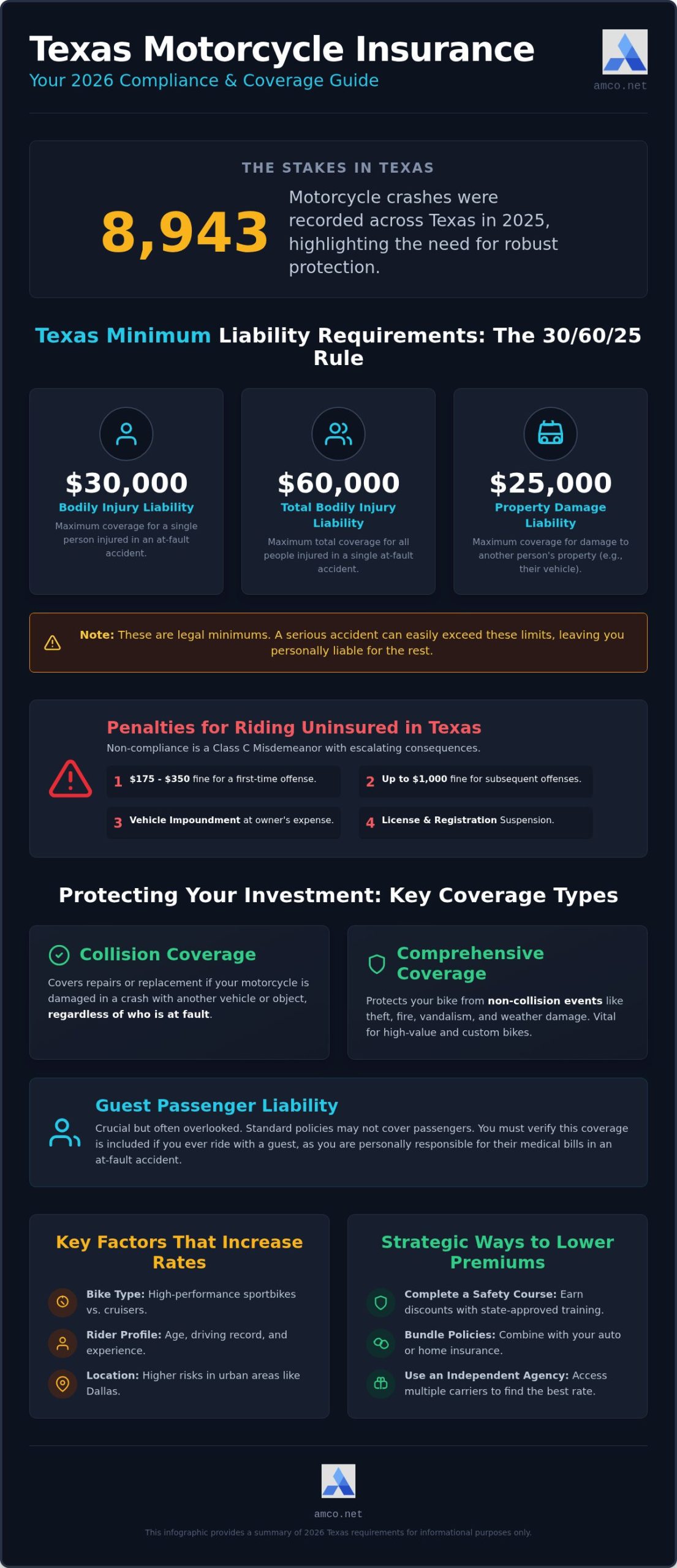
Actuarial data dictates Motorcycle Insurance premiums by assessing the probability of a claim based on a complex array of variables. The "Bike Factor" remains a primary driver of these costs. Sportbikes typically command higher premiums because they're statistically involved in more high-speed incidents and have higher recovery costs following a theft. Conversely, touring cruisers or standard bikes often see lower rates. These models are generally operated by more experienced riders and are less likely to be targeted by professional theft rings in metropolitan hubs.
Rider demographics provide carriers with a statistical blueprint of potential risk. Age and years of licensed experience are weighted heavily within the Texas market. Younger operators, specifically those under 25, face the highest costs, reflecting the statistical frequency of accidents in this age bracket. Beyond personal history, Texas insurers utilize credit-based insurance scores to refine their calculations. This practice is based on the industry-wide correlation between financial stability and responsible vehicle operation. It allows carriers to offer more competitive rates to those with proven records of fiscal responsibility.
Geography significantly influences your comprehensive coverage costs. In San Antonio and Austin, higher theft rates for specific models can drive up premiums compared to the relatively low-risk environments of Midland or Lubbock. Houston riders often face higher liability costs due to the sheer density of traffic and the increased probability of multi-vehicle collisions. Coastal riders in areas like Galveston must account for hurricane surge and salt-air corrosion risks, factors that are non-existent for riders in the Panhandle. Your primary garaging zip code tells an insurer exactly which environmental and social hazards they're underwriting, making local expertise vital when selecting a carrier.
Your Texas driving record serves as a permanent ledger of your operational risk. Speeding tickets, at-fault accidents, or prior insurance claims stay on your record for several years, directly impacting your ability to secure preferred rates. Maintaining a clean slate is the most effective long-term strategy for lowering costs. Earning lower rates requires consistent, violation-free operation over time. In Texas, insurance carriers typically utilize a three-year to five-year look-back period when evaluating your motorcycle accident and violation history. This window means that one mistake can have financial repercussions for years, highlighting the value of defensive riding.
Optimization of Motorcycle Insurance costs requires a systematic evaluation of available discounts and policy structures. One of the most effective methods involves demonstrating a commitment to operational safety. Completing a Texas Department of Public Safety (DPS) approved safety course not only enhances your technical riding skills but also qualifies you for a significant premium reduction with most carriers. This discount typically remains active for three years, providing a sustained return on the initial investment in training.
Consolidating your risk management under a single carrier provides a "Multi-Policy" advantage that few standalone policies can match. By bundling your bike with your Car Insurance in Houston, you create a more attractive profile for insurers, often resulting in double-digit percentage savings across both policies. For owners of high-value machinery, installing anti-theft and GPS recovery systems serves a dual purpose. It mitigates the high risk of urban theft and triggers specific equipment discounts that lower your monthly overhead.
Adjusting your deductible remains a direct lever for controlling premium costs. By opting for a higher deductible, you assume more of the initial financial burden in the event of a claim, which in turn reduces the carrier's risk and your monthly bill. This strategy is most effective for riders with emergency savings who can comfortably cover a $1,000 or $2,500 deductible if an incident occurs.
Texas weather often dictates riding patterns. "Lay-up" periods allow you to reduce coverage during months when the bike is not in operation, such as during extreme summer heat or winter cold. During these times, maintaining comprehensive-only coverage protects the bike from theft or garage fires while eliminating the cost of liability and collision. It's vital to maintain some form of continuous coverage, as insurance gaps often lead to higher rates when you attempt to re-establish full protection later.
The traditional model of staying loyal to a single large brand often leads to price stagnation. AMCO serves as an independent broker, utilizing a systematic approach to shop multiple carriers for Motorcycle Insurance simultaneously. This ensures your profile is always matched with the carrier offering the most competitive rate for your specific demographics and bike type. Annual policy reviews are a cornerstone of this service, allowing you to capture new discounts as your bike ages or your riding record improves. To see how these variables impact your specific costs, you should get a personalized quote today.
The efficacy of a Motorcycle Insurance policy is fundamentally tied to the expertise of the agency managing it. While national providers often rely on decentralized call centers, a Texas-based agency understands the specific regional risks mentioned earlier, from the intersection hazards in Houston to the theft patterns in San Antonio and Dallas. Local knowledge ensures that when you file a claim, your agent isn't just reading from a script; they're applying decades of experience within the Texas regulatory environment.
AMCO has provided this level of specialized oversight since 1987. Over 35 years of operational history allows for a more nuanced approach to risk management. Instead of the "one-size-fits-all" model favored by national giants, personalized service focuses on the specific needs of the individual rider. Whether you're managing your policy through the mobile app or visiting a local office, the emphasis remains on technological continuity and professional reliability. This stability is the cornerstone of our reputation among Texas riders.
Choosing an independent agency provides a significant strategic advantage. Rather than being restricted to a single carrier’s underwriting appetite, we compare multiple top-tier providers like Progressive, Foremost, and Dairyland in a single session. This process ensures you aren't overpaying for a brand name when your specific bike type might be better suited for a different carrier's risk profile. Having an Insurance Company Near Me means you have a dedicated partner to advocate for your interests during the claims process, providing the technical background and follow-up necessary for a fair settlement.
Securing an optimized quote requires minimal but precise preparation. You'll need your vehicle identification number (VIN) and a detailed summary of your riding history to ensure the highest level of accuracy in your rate calculation. This is also an ideal time to review your current Homeowners Insurance for potential cross-policy advantages. As discussed, bundling these coverages can yield substantial logistical and financial benefits, streamlining your entire insurance portfolio under one reliable provider.
Professional risk management is about more than just legal compliance; it's about securing long-term stability for your lifestyle. Our team is ready to analyze your requirements and provide a system-level solution that protects your ride and your assets. Get your personalized Texas motorcycle insurance quote today to experience the difference that 35 years of local expertise provides.
Achieving full legal compliance is only the initial step toward responsible motorcycle operation. While the Texas 30/60/25 mandate provides a baseline, the complexity of urban traffic and rising medical costs necessitate a more robust strategy. By prioritizing Uninsured Motorist coverage and leveraging professional safety course discounts, you protect both your physical well-being and your financial stability. The technical nuances of Motorcycle Insurance require a partner who understands the specific environmental and social risks present on Texas roads.
Since 1987, our agency has served as a reliable advisor for riders across the Lone Star State. Our independent model allows us to compare rates from top-tier carriers instantly, ensuring you don't overpay for the coverage you need. You'll benefit from local agents who know the specific challenges of riding in Houston, Dallas, or San Antonio. It's time to transition from basic liability to a comprehensive system-level solution that offers genuine peace of mind. Get a Fast & Affordable Texas Motorcycle Insurance Quote and ride with the confidence that comes from professional oversight. We look forward to helping you protect your journey.
Yes, Texas law mandates that all motorcycle operators carry a minimum level of liability insurance to operate on public roadways. The current 2026 legal requirement follows the 30/60/25 rule, which provides coverage for bodily injury and property damage. Failure to maintain this coverage is a violation of the Texas Transportation Code and can lead to significant legal penalties.
The premium for a policy in Houston is determined by several technical variables, such as the rider’s age, the motorcycle’s displacement, and the specific garaging zip code. Because Houston is a high-density metropolitan area with increased traffic risks, rates are often higher than in rural parts of the state. We recommend a personalized consultation to evaluate your specific risk profile and find the most efficient rate.
Yes, riders must have a provision for guest liability to protect passengers in the event of an at-fault accident. While some Motorcycle Insurance policies include this by default, others require a specific endorsement to ensure the person riding pillion is covered. It's a critical component of a comprehensive safety net that prevents you from being personally liable for a passenger's medical bills.
Yes, AMCO offers integrated multi-policy solutions that allow you to combine your motorcycle coverage with your auto or homeowners insurance. This consolidation typically results in a multi-policy discount and simplifies your administrative oversight by placing your risk management under a single independent agency. Our team can review your current policies to identify the most effective bundling opportunities.
Standard liability policies do not cover your personal gear, but you can add accessory and safety apparel coverage to your policy. This endorsement protects your investment in high-end helmets, leathers, and boots if they are damaged during a covered incident. Without this specific addition, standard payouts for accessories are often limited and may not reflect the actual replacement cost of professional-grade gear.
Riding without insurance is classified as a Class C misdemeanor in Texas and results in immediate financial and legal consequences. First-time offenders face fines up to $350, while repeat violations can lead to fines of $1,000 and the suspension of your driver’s license. Additionally, your vehicle may be impounded, and you'll likely be required to maintain an SR-22 filing, which increases your long-term costs.
Insurance isn't legally required for dirt bikes that are operated exclusively on private property. However, if you intend to ride on public roads or within certain state-regulated areas, the bike must be street-legal and insured. Many owners still choose to carry comprehensive coverage for off-road bikes to protect against the persistent risk of theft or fire during storage and transport.
New riders can lower their Motorcycle Insurance premiums by completing a safety course approved by the Texas Department of Public Safety. Choosing a motorcycle with a smaller engine displacement or a touring-style frame rather than a sportbike also reduces your risk profile in the eyes of carriers. Maintaining a clean driving record and working with an independent agent to compare multiple carriers are the most reliable ways to secure a competitive rate.