


In Houston, property crime affects approximately 45 out of every 1,000 residents annually, with more than 105,000 incidents reported citywide. For a student living near Cullen Boulevard or in a Midtown apartment, these statistics represent the real risk of losing a $1,200 laptop or an $800 smartphone. While the university recommends coverage, securing the right renters insurance for University of Houston students is about more than just following a suggestion. It's about protecting your financial stability against theft and Houston's specific weather risks, such as flooding and hurricanes, which can disrupt your education in an instant.
You probably understand that your landlord's policy doesn't cover your personal gear, yet finding a plan that balances cost and utility feels overwhelming. This guide explains how to find policies with premiums averaging $22 to $25 per month while focusing on low deductibles that actually make sense for student life. We'll explore how to satisfy off-campus lease requirements and why a $100 deductible is often the smartest choice for protecting high-value electronics throughout the 2026 academic year.
Understanding the technical scope of protection is the first step for any student settling into campus life. At its core, What is Renters Insurance? refers to a specialized contract providing coverage for personal property, personal liability, and additional living expenses. For those pursuing a degree, this isn't just a financial product; it's a strategic risk mitigation tool. In 2026, the density of campus housing and the specific climatic conditions of the Gulf Coast make renters insurance for University of Houston students an essential component of a stable academic career.
Residence halls like Cougar Village experience high foot traffic, which statistically correlates with an increased risk of opportunistic theft in communal areas. While the University of Houston provides a secure environment, the institution is not legally or financially responsible for the loss of your personal belongings due to theft, fire, or accidental sprinkler discharge. Off-campus housing in the Third Ward and East End presents a different set of variables. Most professional property management firms in these areas now mandate a minimum of $100,000 in liability coverage. This requirement protects the building's structural integrity, but it doesn't cover your electronics or furniture unless you have a personal policy in place.
The financial impact of a total loss is often underestimated by the student population. When you calculate the replacement cost of a modern "tech stack," including a high-performance laptop, tablet, and smartphone, the numbers escalate quickly. The average value of a University of Houston student's personal belongings typically exceeds $5,000 when accounting for textbooks, apparel, and specialized gear. Beyond property, the liability aspect is arguably more critical. If an unattended candle or a kitchen mishap causes fire or water damage to your unit or neighboring apartments, you could be held personally liable for damages reaching tens of thousands of dollars. Renters insurance acts as a buffer against these catastrophic out-of-pocket expenses, ensuring that a single accident doesn't derail your long-term financial health.
Houston's geographical position also introduces weather-related risks that students from other regions might overlook. Hurricane season brings the potential for windstorm damage and localized flooding. While a standard policy has specific exclusions for rising water, it often covers damage from rain entering through a wind-damaged roof or window. Having this coverage ensures that even if a storm disrupts your living situation, you have the resources to replace your essential gear and maintain your productivity. This methodical approach to protection allows you to focus on your studies with the confidence that your technological and financial assets are secure.
Selecting the right coverage involves more than just checking a box on a lease agreement. Many students assume they are automatically protected under their parents' homeowners insurance. This assumption often leads to the "Parental Coverage Trap." While a home policy might technically extend to a dorm room, the deductibles are typically set for major structural losses, often ranging from $1,000 to $2,500. For a student, this means a stolen phone or a damaged tablet falls entirely below the deductible, rendering the coverage ineffective for high-frequency student losses.
When evaluating these choices, it's vital to understand Key Coverage Features Every UH Student Should Look For, such as how specific carriers treat student-specific risks differently than standard residential markets. GradGuard offers a $100 deductible, which is a significant advantage for University of Houston students. However, local independent agencies provide a different level of value. We can shop multiple carriers to find the most competitive rates for off-campus apartments in the Third Ward or Midtown. Unlike some large national apps, a local agency understands the nuances of the Houston market. We also recognize that many students haven't established a robust credit history. Fortunately, many specialized policies place less emphasis on credit-based insurance scoring, focusing instead on the specific risks of the collegiate environment.
Consider a scenario where a student’s $1,500 MacBook is stolen from a study lounge. Under a parent’s policy with a $1,000 deductible, the payout would only be $500. If the deductible is $2,000, the student receives nothing. Conversely, dedicated renters insurance for University of Houston students with a $100 deductible provides a $1,400 reimbursement. This difference alone justifies the modest monthly premium. Frequent small claims on a homeowners policy can also lead to premium hikes for the parents, whereas a separate renters policy keeps these risks isolated.
University of Houston students participating in study abroad programs need protection that travels with them. Standard homeowners policies often limit coverage for property located away from the primary residence. Dedicated student renters insurance typically includes worldwide coverage. This means your gear is protected whether it's in a dorm, a library, or even stolen from your vehicle while parked on campus. If you need assistance comparing these technical details, you can consult with a local expert to find the right fit. This ensures your coverage remains active during internships or international programs without the geographic limitations found in basic residential policies.
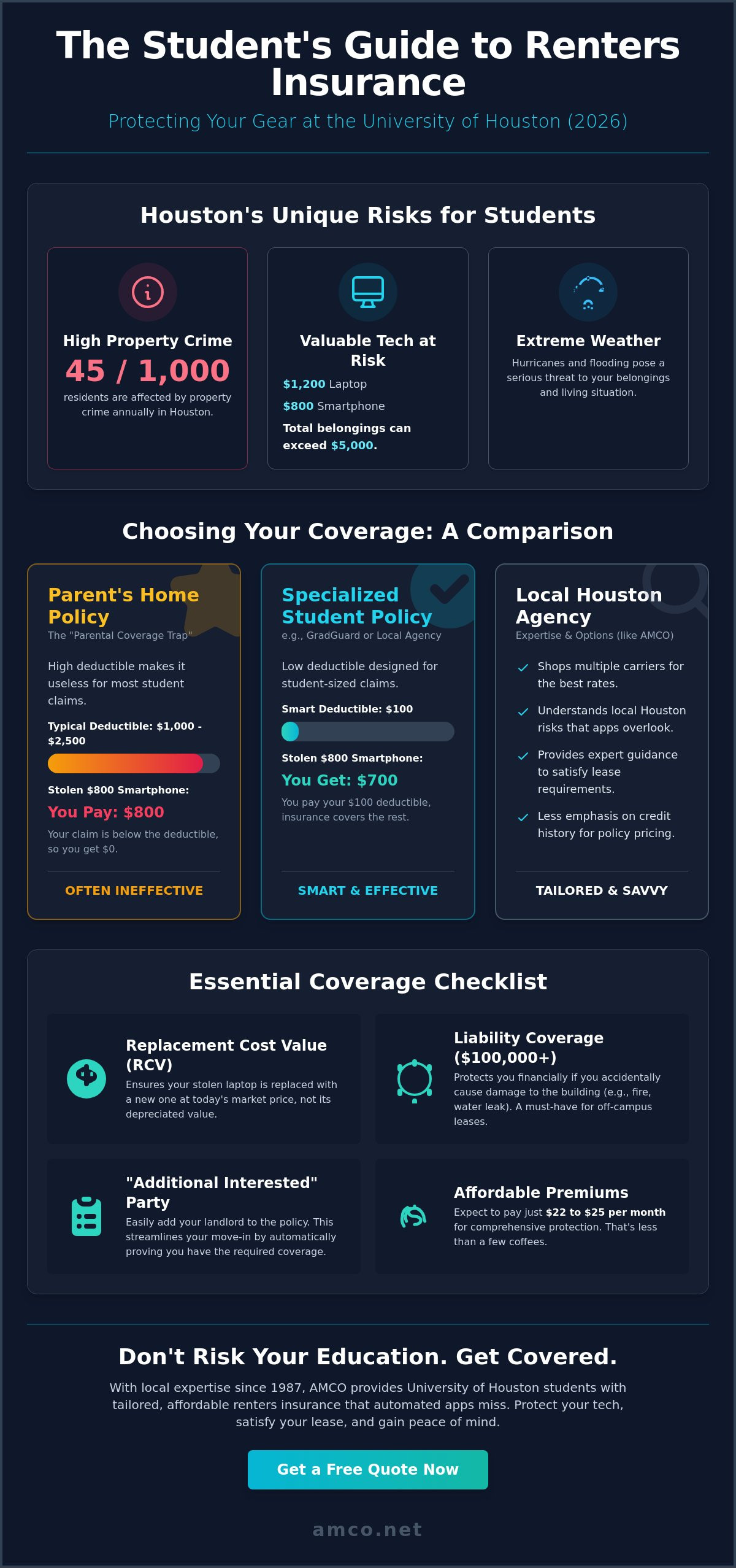
Selecting a policy requires a technical understanding of how claims are settled. The most critical distinction you'll face is between Replacement Cost Value (RCV) and Actual Cash Value (ACV). For technology-dependent students, RCV is the only viable choice. If a three-year-old laptop is stolen, an ACV policy only pays the current depreciated market value, which might be a fraction of what you originally paid. RCV provides the funds necessary to purchase a new, equivalent model at 2026 retail prices. While the University of Houston's official recommendation confirms that students should carry their own protection, the specific details of that protection determine whether a claim actually solves your problem.
Personal liability coverage acts as a safeguard for your future professional earnings. If a guest trips in your apartment or you accidentally cause a kitchen fire that damages the building, the legal and repair costs could be astronomical. Most professional landlords near the university insist on $100,000 in liability as a baseline requirement. Additionally, Loss of Use coverage provides a stipend for hotel stays and increased meal expenses if a covered peril makes your residence uninhabitable. This ensures your education isn't interrupted by a sudden housing crisis.
For those with specialized equipment, "Scheduled Property" endorsements are necessary. Standard renters insurance for University of Houston students has "sub-limits" for specific categories. If you're a Moores School of Music student with a $4,000 instrument or a cyclist with a high-end racing bike, these items likely exceed the standard theft limit. Adding a floater or scheduling these items ensures they're covered for their full appraised value without a deductible.
In the aging off-campus housing surrounding the Third Ward, fire and lightning protection is paramount. Theft and vandalism remain the most frequent claims in high-density student areas. However, water damage requires precise definition. Standard policies cover sudden events like burst pipes or a neighbor's overflowing bathtub. They don't cover rising water from the street. Students in low-lying areas near Brays Bayou should understand that protection against regional flooding requires a separate flood insurance policy, as renters insurance focuses on internal building mishaps and wind-driven rain.
Liability is not just about major lawsuits; it also includes Medical Payments to Others. This "no-fault" coverage handles small medical bills if a friend is injured in your space, regardless of who's to blame. It's a pragmatic way to handle minor incidents before they escalate into legal disputes. Maintaining the $100,000 industry standard for liability ensures you meet lease requirements while protecting yourself from the financial fallout of accidental property damage or personal injury claims on campus or off.
Securing optimal rates for renters insurance for University of Houston students requires a methodical approach to risk assessment and policy structure. Cost-optimization begins with a precise valuation of your assets. Start by creating a digital inventory; use your smartphone to document serial numbers and capture high-resolution photos of your electronics and furniture. This documentation serves as technical proof during the claims process and ensures you're paying for the exact level of coverage you need rather than an inflated estimate.
Before finalizing any agreement, you must verify the specific requirements of your lease. Many off-campus apartments in areas like Midtown or the East End require the landlord to be listed as an "Additional Interested Party." This designation doesn't grant them coverage but ensures they receive notification if the policy is canceled or modified. To achieve the most competitive pricing, evaluate the benefits of multi-policy discounts. Bundling your property protection with your car insurance in Houston is often the most effective way to reduce your total monthly expenditure while maintaining comprehensive liability limits.
Adjusting your deductible is the final lever for balancing your budget. A higher deductible, such as $500, will lower your monthly premium but requires you to have that cash readily available in the event of a loss. For students with limited emergency funds, a $100 deductible remains the more stable choice, even if the monthly cost is slightly higher. If you're looking for a personalized quote that accounts for your specific housing situation, you can request a professional rate analysis here to find the most cost-effective solution for your needs.
Insurers often reward academic performance and preventative safety measures. Maintaining a GPA of 3.0 or higher can qualify you for a "Good Student" discount with several major carriers. Additionally, living in a gated community or a building with 24-hour security and monitored smoke detectors can further depress your rates. These safety features reduce the statistical likelihood of theft and fire claims, allowing providers to offer lower premiums to students residing in modern off-campus complexes.
Technical exclusions can leave you vulnerable if you don't review the policy language carefully. Most standard forms exclude damage from bed bugs, specific high-risk dog breeds, and geological events like earthquakes. It's also vital to maintain an individual policy rather than sharing one with a roommate. Sharing a policy with a roommate can lead to legal and financial complications, as claim payments are often issued to all named parties simultaneously, regardless of who owned the stolen or damaged item. Maintaining your own policy ensures your claim history and payouts remain entirely under your control.
Since 1987, AMCO has operated within the Houston market, providing a level of stability and local insight that digital-only platforms cannot replicate. While a generic app uses generalized data, our team understands the specific security variables of the Third Ward and the precise drainage patterns near the University of Houston campus. This localized expertise allows us to recommend renters insurance for University of Houston students that's technically sound and precisely matched to the risks of the 2026 academic year. We don't just sell a policy; we offer a partnership based on nearly four decades of professional reliability.
International students often face significant barriers when attempting to secure coverage through automated systems, particularly regarding a lack of U.S. credit history. We specialize in assisting these students by navigating the requirements of multiple carriers to find accessible, high-quality options. Our advisors provide the technical support needed to ensure your policy meets both university and private landlord standards without unnecessary delays or administrative friction. By choosing a local agency, you gain access to a real person who understands the Houston rental market and can advocate for your specific needs.
Efficiency and cost-optimization are central to our advisory approach. Students who own vehicles can achieve significant savings by pairing their property protection with auto insurance in Houston. This integrated strategy simplifies your monthly financial management and often results in a lower total premium than maintaining separate standalone policies. For a broader perspective on how to protect your assets in this specific market, you should consult our comprehensive guide to insurance in Houston. This resource details the full spectrum of coverage options available to residents, from motorcycles to high-value specialty gear.
The process of securing coverage is designed to be methodical yet rapid, typically requiring less than five minutes of your time. You'll need to have your apartment address, the estimated replacement value of your belongings, and any specific liability limits required by your lease ready for the application. Once the policy is active, we provide immediate digital proof of insurance. This documentation is essential for completing your move-in requirements on the UH housing portal or at professional off-campus complexes. Get your affordable UH student renters insurance quote today! Our team is ready to ensure your academic year is built on a foundation of professional security and financial stability.
Securing a resilient financial foundation for your studies requires more than just meeting a landlord's minimum liability requirement. As we've analyzed, the technical difference between a standard homeowners deductible and a specialized student policy can determine whether your $1,500 laptop is actually replaced after a theft. Choosing renters insurance for University of Houston students with a low, $100 deductible provides a level of stability that national apps often fail to deliver. This strategic approach ensures that common collegiate risks don't translate into significant out-of-pocket expenses during your degree program.
Since 1987, AMCO has provided expert guidance to Houston residents, maintaining an A+ rated commitment to customer service and local market precision. We understand that your needs often extend beyond property protection; therefore, we offer the ability to bundle and save by pairing your renters coverage with our comprehensive auto insurance options. This one-stop approach optimizes your monthly costs while reinforcing your personal security. Secure your gear and get a fast renters insurance quote now to ensure your focus remains entirely on your academic success and professional future.
Renters insurance is not a mandatory requirement for students living in on-campus housing, though University of Houston Student Housing and Residential Life officially recommends obtaining a policy. Conversely, most off-campus apartment complexes near the university require tenants to maintain at least $100,000 in liability coverage as a condition of the lease agreement. This ensures that accidental damage to the property is financially covered by a professional carrier.
While some homeowners policies extend limited coverage to a student's dorm, they often carry high deductibles of $1,000 or more. This makes it difficult to file a claim for common losses like a stolen $800 smartphone. A dedicated policy for renters insurance for University of Houston students typically offers much lower deductibles, such as $100, which is far more practical for the typical risks faced in a collegiate environment.
The average cost for renters insurance in Houston is approximately $22 to $25 per month, which totals between $268 and $300 annually. This pricing typically includes $40,000 in personal property coverage and $300,000 in liability protection with a $1,000 deductible. Students can often find lower premiums by adjusting their coverage limits or by utilizing specialized providers that offer student-specific endorsements and lower deductible options.
Yes, standard policies include "off-premises" coverage that protects your personal property anywhere in the world. This means your technological gear is covered if it is stolen from a campus library, a local coffee shop, or even from your vehicle. It is important to ensure your policy is set to "Replacement Cost Value" to receive the full amount needed to purchase a new device at 2026 market prices.
You can technically list a roommate on a policy, but insurance professionals generally advise against it. Sharing a policy can lead to significant complications during a claim because the insurance check is usually issued to both parties. Maintaining separate policies ensures that your individual claim history remains clean and that you have full control over the valuation and reimbursement of your own personal belongings.
You can typically update your existing policy with your new address without needing to cancel or restart your coverage. Your insurance provider will adjust the premium based on the risk profile of the new location, such as its proximity to fire hydrants or local crime statistics. This transition is usually handled through a simple policy endorsement, ensuring that your protection remains continuous throughout the academic year.
Standard policies cover windstorm damage and rain that enters through a storm-damaged roof, but they specifically exclude damage from rising floodwater. Because Houston experiences significant property crime and weather-related risks, students should verify their specific policy exclusions. If you live in a low-lying area near campus, you may need a separate flood insurance policy to protect your property from street-level flooding during hurricane season.
You provide proof by submitting a "Certificate of Insurance" or the "Declarations Page" from your policy to the landlord's leasing office or online portal. Most professional property managers will require you to list them as an "Additional Interested Party." This designation ensures the landlord is automatically notified if the policy is canceled or if there are significant changes to the liability limits required by your lease.