


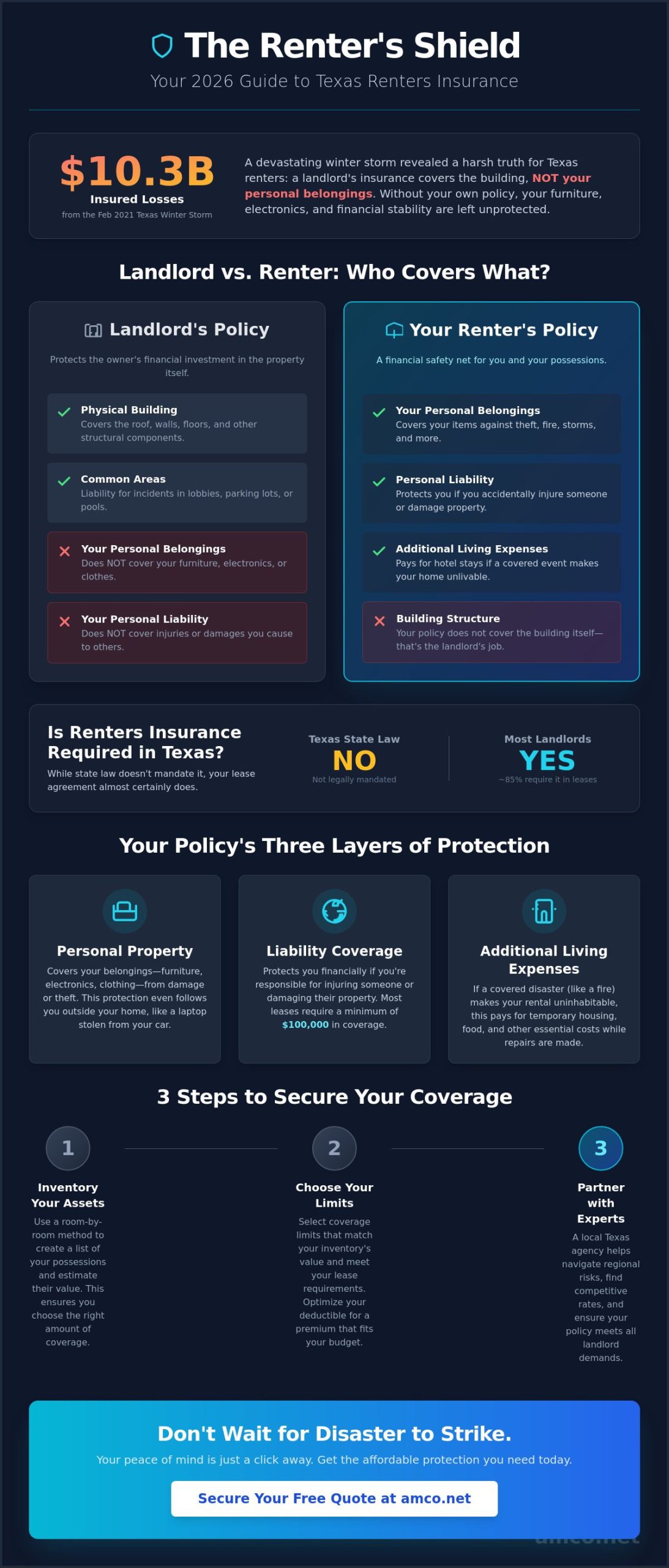
In February 2021, the Texas winter storm generated more than $10.3 billion in insured losses, yet a significant portion of displaced tenants discovered their landlord's policy provided zero coverage for their personal belongings or temporary lodging. It's a frustrating reality when you realize the building structure is protected, but your electronics, furniture, and peace of mind are not. You likely want a reliable way to mitigate these risks without deciphering complex jargon or paying for coverage you don't need.
Securing a robust Renters Insurance policy is a fundamental step in your long term financial planning and risk management. This 2026 guide offers a professional analysis of how to protect your assets against Houston's coastal risks, Dallas's storm cells, and urban theft in San Antonio. We'll provide a clear framework for understanding coverage limits and meeting lease requirements at a price that respects your budget. You will learn how to identify the specific policy features that ensure your household remains stable even during the most severe Texas weather events.
Renters insurance is a specialized financial product designed to protect individuals who occupy a residential property without owning the title. A foundational understanding of What is Renters Insurance? reveals that it functions differently than standard homeowners policies because it excludes the physical structure itself. Instead, it focuses on the assets and risks associated with the tenant. Renters insurance serves as a three-part financial safety net for tenants that includes personal property protection, liability coverage, and additional living expenses.
To better understand this concept, watch this helpful video:
Many tenants in Texas operate under the "Landlord Myth," assuming that the building owner's insurance policy provides a blanket of protection for everyone on the premises. This is a costly misconception. A landlord's policy is designed to protect the investor's interest, specifically the roof, walls, and common areas. It does not extend to your electronics, furniture, or clothing. If a fire or weather event destroys the complex, the landlord receives funds to rebuild the apartment, but you receive nothing for your lost belongings without your own policy.
The division of responsibility in a Texas rental is clear and strictly defined. Landlord coverage handles the physical structure and the liability of common areas like parking lots or lobby spaces. Tenant coverage applies to everything inside the four walls of your unit and your personal actions. For instance, if a pipe bursts in a Houston high-rise, the landlord's insurance pays for the plumbing repair and the drywall replacement. However, if that water ruins your $3,000 workstation or your designer sofa, the landlord is not responsible. Your Renters Insurance policy is the only mechanism that compensates you for those personal losses.
Texas state law does not mandate that tenants carry insurance. However, the legal landscape in cities like Houston, Dallas, and San Antonio is dictated by private contracts. By 2026, approximately 85 percent of professional property management firms in these metropolitan areas require a minimum of $100,000 in liability coverage as a condition of the lease. This requirement protects the property owner if your negligence, such as leaving a stove on, causes damage to the building.
Failure to maintain this coverage can result in a lease violation, which often carries the risk of eviction or mandatory fees. AMCO assists tenants in meeting these rigorous lease requirements through precise policy placement. We provide the technical documentation property managers demand, ensuring your coverage is active the moment you receive your keys. This professional approach eliminates the friction often found during the move-in process in competitive Texas markets.
A standard Texas Renters Policy Cover provides a multi-layered defense against financial loss. While many tenants assume their landlord's insurance protects them, that coverage only applies to the building's physical structure. Your policy focuses on three core areas: your belongings, your legal liability, and your temporary housing needs if disaster strikes. Renters Insurance ensures that a single kitchen fire or a break-in doesn't result in total financial insolvency.
Your personal property coverage applies to more than just the items inside your apartment. It follows you wherever you go. If a thief breaks into your vehicle and steals your laptop or gym gear, your renters policy typically covers the loss. This off-premises protection is a vital feature for residents in high-traffic areas of Dallas or San Antonio who frequently commute with expensive electronics.
Texas presents unique environmental challenges that require specific insurance considerations. Standard policies cover damage from fire, lightning, and windstorms, which are frequent occurrences during the Gulf Coast hurricane season. However, you must understand that rising water is almost always excluded. If a flash flood hits Houston, a standard policy won't cover your ruined furniture. You'll need to add a flood insurance rider or a separate policy to bridge this gap. The February 2021 winter storm highlighted the necessity of pipe-burst coverage. Professional policies in 2026 now emphasize protections against water damage caused by frozen plumbing, provided you took reasonable steps to maintain heat in your unit.
If a fire or severe storm makes your Austin apartment uninhabitable, the "Loss of Use" provision becomes your most valuable asset. This coverage, also known as Additional Living Expenses (ALE), manages the financial burden of displacement. It pays for hotel stays, restaurant meals, and even the increased fuel costs associated with a longer commute from your temporary residence. During major disasters, these out-of-pocket costs can easily exceed $3,000 within the first two weeks. ALE ensures your family maintains a stable standard of living while your primary residence undergoes repairs.
Liability is often the most critical component for urban renters. It protects your assets if you're sued for causing accidental injury or property damage. If a guest slips on a loose rug in your Dallas loft or your dog bites a neighbor at a local park, your policy covers legal fees and settlement costs. While liability handles large-scale litigation, Medical Payments coverage provides a smaller, no-fault limit for guest injuries. This allows for quick payment of medical bills without the need for a lawsuit. To maximize your financial security, consider how this fits with your Car Insurance in Houston, TX for a unified approach to risk management. If you're seeking a more robust strategy for asset protection, exploring comprehensive industrial-grade solutions can provide the professional stability your household requires.
Texas residents often overestimate the financial commitment required to protect their belongings. In reality, Renters Insurance remains one of the most accessible financial tools available in the Lone Star State. Data from industry reports suggests that the average policy in Texas costs between $15 and $20 per month. This means most tenants in Houston or Dallas pay less for comprehensive protection than they do for a single monthly streaming subscription or a couple of takeout meals. Despite this low entry point, the level of security provided is substantial, covering everything from fire damage to theft and personal liability.
Several variables dictate your specific premium. Location plays a major role; a high-rise apartment in Downtown Dallas may carry different risk profiles than a single-family rental in Houston's Energy Corridor. Beyond geography, your choice between Actual Cash Value (ACV) and Replacement Cost coverage is vital. An ACV policy only pays the depreciated value of your items. If a three-year-old laptop is stolen, you might only receive a fraction of its original price. Conversely, Replacement Cost coverage provides the funds to buy a brand-new equivalent. To ensure you Choose the Right Coverage, you must evaluate the total value of your assets against your risk tolerance.
Reducing your monthly expenses is a matter of strategic planning rather than luck. Insurance carriers prioritize policyholders who demonstrate lower risk profiles. You can achieve immediate savings through several methods:
The deductible is the amount you pay out-of-pocket before your insurance coverage begins. There's a direct, inverse relationship between your deductible and your monthly premium. A higher deductible, such as $1,000, will lower your monthly bill. A lower deductible, like $500, will increase it. For Houston residents, this is a critical decision. You must select a deductible that you can afford to pay immediately in an emergency. If a $1,000 expense would cause a financial crisis, paying a few extra dollars each month for a $500 deductible is the more responsible technical choice for long-term stability.
Determining the appropriate level of Renters Insurance requires a systematic evaluation of your personal assets and potential liability exposure. A "Room-by-Room" inventory serves as the most reliable foundation for this calculation. Walk through each space in your Houston or Dallas apartment, documenting furniture, clothing, and kitchenware. Most tenants underestimate the aggregate value of these items, often by as much as 35 percent. To ensure a smooth claims process, take clear photos of your receipts and store them in a secure cloud service immediately.
Standard policies often impose sub-limits on specific categories. Jewelry, firearms, and high-end professional electronics frequently exceed these basic thresholds. If your engagement ring or specialized camera gear represents a significant investment, you should utilize "scheduled" coverage. This ensures these items are protected for their full appraised value rather than a capped amount. Your liability limits should reflect your total net worth and lifestyle risks. If you host frequent gatherings or own a pet, increasing your liability coverage from the standard $100,000 to $300,000 provides a necessary buffer against legal costs. Professional tenants don't leave their financial stability to chance; they align their limits with their actual risk profile.
Selecting the right valuation method impacts your financial recovery after a loss. Actual Cash Value (ACV) pays the depreciated value of your belongings. For instance, a five-year-old television might only yield 20 percent of its original purchase price. Replacement Cost coverage pays the current market price to buy a brand-new equivalent today. AMCO generally recommends Replacement Cost for long-term security. It eliminates the "out-of-pocket" gap that occurs when trying to rebuild your lifestyle after a fire or theft.
Texas geography introduces specific environmental variables that require precise policy language. In coastal regions or North Texas, pay close attention to wind and hail deductibles. These are often structured as a percentage of your total coverage rather than a flat dollar amount. Sewer backup endorsements are another vital consideration, especially in older rental homes in San Antonio or Houston's historic districts. This add-on protects against water damage from failing municipal infrastructure, which standard Renters Insurance policies typically exclude. If you find your assets growing as you prepare for property ownership, explore our guide on Homeowners Insurance in Texas to understand the next phase of asset protection. As a future homeowner, you'll also want to review strategies for securing cheap homeowners insurance in Houston, especially given the significant premium increases Texas property owners have faced in recent years.
Selecting a local partner for your Renters Insurance ensures that your policy aligns with the specific risks of your Texas zip code. AMCO operates with a distinct broker advantage. We shop multiple carriers simultaneously to find the most competitive rates, which means you don't have to spend hours comparing individual quotes yourself. This objective approach focuses on finding the best value for your specific coverage needs while maintaining high standards of protection.
Our team provides deep local expertise. We understand the unique challenges faced by residents from Conroe to Laredo. Whether it is a concern about windstorm damage in Houston or theft protection in a Dallas urban center, our agents know the landscape. This regional knowledge allows us to recommend coverage limits that are practical and effective for your specific neighborhood. We don't guess; we use our understanding of Texas property trends to guide your decisions.
AMCO has focused on providing reliable coverage for individuals and businesses across the state for over 37 years. Since 1987, our mission has centered on stability and professional service. We've modernized our approach to meet the needs of today's renters without losing our personal touch. Our mobile app makes managing your Renters Insurance policy and making payments simple. This tool allows you to access your digital ID cards or update your personal property inventory at any time. We remain committed to delivering fast, affordable solutions for the diverse communities that make Texas thrive.
The quoting process at AMCO is designed to be thorough yet efficient. We analyze your data to ensure there are no gaps in your liability or personal property protection. One of the most significant benefits of working with us is having a local advocate during the claims process. If an incident occurs, we help you navigate the paperwork and communication with the carrier to ensure a fair and timely resolution. Protect your belongings with AMCO today and experience the difference of a professional Texas agency that puts your security first.
Protecting your lifestyle in Texas requires more than just a signed lease agreement. As we look toward 2026, the necessity of Renters Insurance remains a fundamental component of financial stability for residents in Houston, Dallas, and San Antonio. You've seen how these policies provide critical layers of protection for personal property and liability, ensuring that a single incident doesn't derail your long-term goals. Navigating policy limits is simpler when you rely on a consultant-led approach rather than a generic online form.
AMCO has served Texas drivers and renters since 1987, maintaining a physical presence with local offices across the state's major hubs. Our A+ rated independent brokerage functions as your technical partner, shopping multiple carriers to identify the specific coverage structures that match your lifestyle. We focus on long-term security and professional reliability so you can focus on your career and family. It's time to transition from uncertainty to a verified plan of protection.
Get a Fast Renters Insurance Quote from AMCO Today
Your peace of mind is built on decades of local expertise and a commitment to professional excellence.
Your policy doesn't cover a roommate's belongings unless they're explicitly named as an additional insured on the document. Each individual should maintain their own coverage to ensure asset protection. According to the Texas Department of Insurance, policies are legal contracts between the named individual and the carrier. Sharing a policy can complicate claims processes and lead to insufficient limits for combined assets. It's safer to have separate accounts to avoid disputes during a total loss.
You must notify your provider when moving from Dallas to Houston because location is a primary rating factor. Your coverage doesn't automatically transfer without an address update. Zip codes in Houston often carry higher windstorm risks than North Texas. Failing to update your address within 30 days of moving can result in a denied claim if an incident occurs at the new residence. This step ensures continuous protection across different Texas municipalities.
Renters insurance covers personal items stolen from your vehicle, but it doesn't pay for damage to the car itself. If a thief breaks your window to steal a laptop, your auto policy handles the glass repair while your renters policy covers the electronics. Data from the FBI's Uniform Crime Reporting program shows that theft from motor vehicles accounts for over 25% of all larceny-theft incidents annually. This distinction is vital for accurate claim filing.
Your liability coverage extends to dog bites that happen away from your home, such as at a public park. This protection handles legal fees and medical expenses if your pet injures someone. The Insurance Information Institute reports that dog bite claims cost an average of $64,555 in 2023. Check your policy for breed restrictions, as some carriers exclude specific high-risk animals from coverage. This liability shield is essential for responsible pet ownership.
Food spoilage is covered if the power failure results from a specific peril like a lightning strike or fallen tree. Most standard policies provide up to $500 for lost refrigerated items. During the February 2021 winter storm, thousands of Texans utilized this provision after prolonged grid failures. Documentation of the power outage and photos of the spoiled inventory are required for successful claim processing. This coverage helps mitigate financial losses during extreme weather events.
You can receive a quote and digital proof of coverage in less than 15 minutes. Most modern insurance platforms provide an instant PDF certificate via email immediately after the first premium payment is processed. This efficiency allows tenants to meet lease requirements on the same day they sign their rental agreement. Real-time digital delivery has replaced traditional paper mailing for 90% of major Texas carriers. It's a streamlined process for the modern market.
Standard renters insurance excludes damage caused by flooding or earthquakes. You must purchase separate policies or endorsements to protect against these specific geological and hydrological events. FEMA data indicates that 20% of flood claims come from moderate-to-low risk areas. In coastal cities like Houston, securing a standalone flood policy through the National Flood Insurance Program is a critical step for comprehensive risk management. This ensures total asset protection during hurricane season.
You need a policy even if you're only renting a single room in a house to protect your personal liability and belongings. The homeowner's insurance policy won't cover your property or your legal responsibility if you're negligent. A 2022 survey by the Insurance Information Institute found that only 55% of renters carry insurance. Having your own policy ensures you're not left without resources if a fire or theft occurs in the shared residence.