

In the competitive Dallas dining landscape, treating your insurance policy as a mere line item on a balance sheet is a gamble that most modern operators can't afford. Securing the right restaurant liability insurance Dallas requires more than just checking a box; it's about building a defensive perimeter around your capital. We understand that balancing the high costs of litigation in the DFW metroplex against razor-thin margins requires a surgical approach to risk management. You're likely already feeling the pressure of the June 30, 2026, TABC compliance deadline and the increased scrutiny surrounding the upcoming FIFA World Cup.
This guide provides the expert insights necessary to manage these complexities, ensuring your establishment remains fully compliant with Texas state and Dallas local regulations. We'll examine the nuances of the Texas Dram Shop Act, the strategic benefits of liquor liability coverage, and how to structure a policy that protects against foodborne illness and slip-and-fall claims. By the end of this analysis, you'll have a clear roadmap for selecting a predictable insurance partner that supports your long-term growth and operational stability.
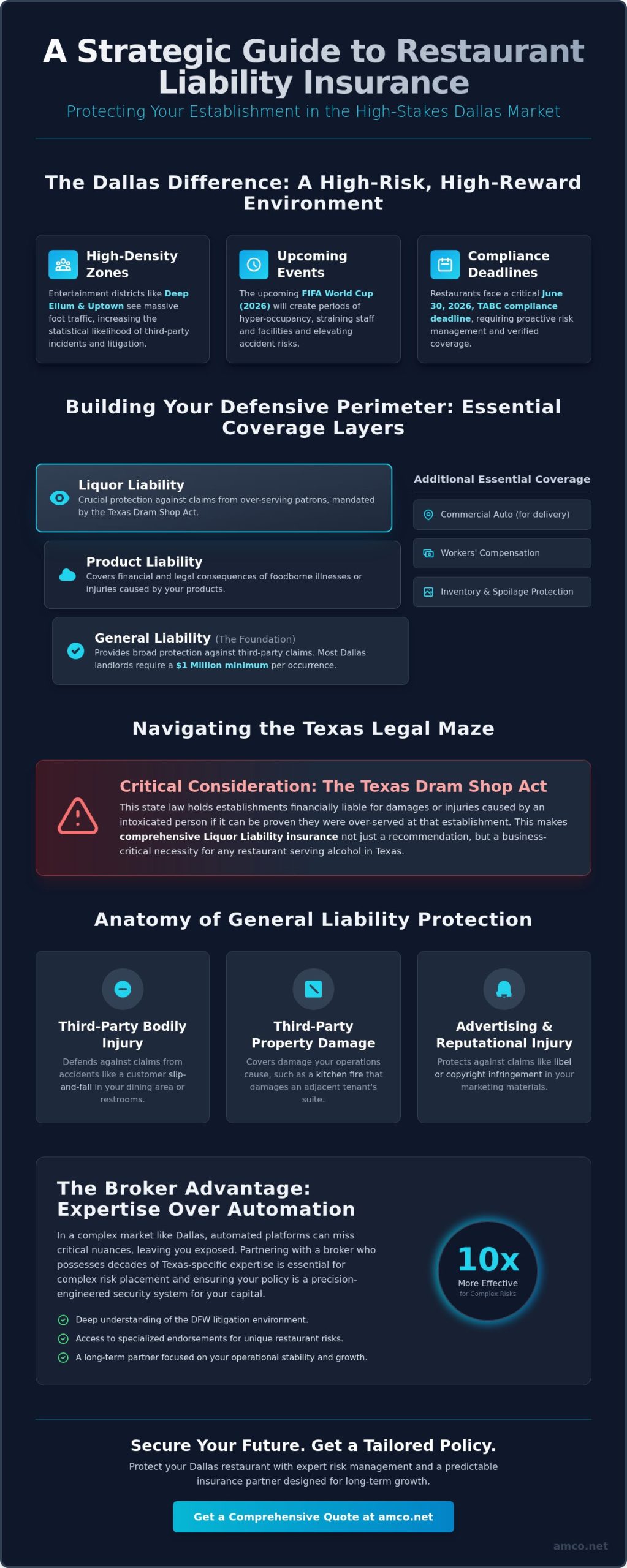
Restaurant liability insurance Dallas serves as a multi-layered shield, protecting business owners from the financial fallout of accidents, legal disputes, and operational errors. In the competitive North Texas market, a standard policy isn't just about risk mitigation; it's a prerequisite for growth. Most Dallas commercial landlords require a minimum of $1 million per occurrence in Liability insurance before they'll hand over the keys to a space in a high-traffic development. This coverage creates a buffer between your restaurant's liquid assets and the high cost of legal defense in the Dallas-Fort Worth metroplex.
While General Liability provides the foundation, Dallas operators must distinguish between basic plans and industry-specific endorsements. These endorsements address the precise exposures of food service, such as product liability for foodborne illness or specialized liquor-related incidents. Without these layers, a standard policy may leave significant gaps in your defensive strategy. It's the difference between having a general safety net and a precision-engineered security system for your capital.
To better understand the fundamental components of this coverage, watch this helpful video:
This protection addresses three primary areas of concern for the modern restaurateur. First, it defends against third-party bodily injury claims, which are frequently triggered by slip-and-fall accidents in dining areas or restrooms. Second, it covers property damage caused by your operations, such as a kitchen fire that damages an adjacent tenant's suite. Finally, it provides a defense against advertising injuries and reputational damage, including claims of libel or copyright infringement in your digital marketing materials. These risks are constant, and the cost of defending even a meritless claim can disrupt your cash flow.
For the 2026 Dallas market, restaurant liability insurance is defined as a strategic risk-transfer mechanism that integrates regulatory compliance, lease-mandated protection, and specific endorsements tailored to the high-density litigation environment of North Texas.
Constructing a robust insurance portfolio requires a granular understanding of how different policies interact to cover specific operational vulnerabilities. General Liability Insurance serves as the foundational pillar for any Dallas food service establishment. It provides broad protection against third-party claims of bodily injury and property damage; however, it's rarely sufficient on its own. For comprehensive protection, operators must layer product liability coverage. This specific component addresses the financial and legal consequences of foodborne illnesses or injuries caused by the products you serve, which is a critical aspect of restaurant liability insurance Dallas in a high-volume dining market.
Inventory protection is another vital consideration. Food contamination and spoilage coverage protects your financial interest in raw materials and prepared stock. In North Texas, where extreme weather can lead to unpredictable power grid fluctuations, the risk of refrigeration failure is a tangible threat to your margins. This coverage ensures that a localized equipment failure doesn't result in a total loss of high-value inventory like wagyu beef or fresh seafood. For a precise evaluation of your current exposure, a consultation with the advisory team at AMCO.NET LLC can identify hidden gaps in your existing policy structure.
For establishments serving alcohol, liquor liability isn't just an add-on; it's a necessity for survival under the Texas Dram Shop Act. It's important to distinguish between Host Liquor Liability, which covers incidental service, and Commercial Liquor Liability, which is required for businesses where alcohol sales are a primary revenue stream. Texas law holds establishments civilly liable for damages caused by patrons who were served while obviously intoxicated. Maintaining a "safe harbor" defense is crucial. This involves ensuring all servers hold a TABC certification, which typically costs between $10 and $35 and remains valid for two years. This documentation serves as a primary defense during litigation, often influencing the premium rates set by carriers monitored by the Texas Department of Insurance.
The modern Dallas restaurant operates as much in the digital space as it does in the physical dining room. Cyber liability insurance has become essential as POS systems and online ordering platforms collect sensitive customer data. A data breach can lead to significant notification costs and regulatory fines that traditional policies won't cover. Additionally, Employee Practices Liability Insurance (EPLI) protects your business against claims related to wrongful termination, discrimination, or harassment. Given the staffing-heavy nature of the hospitality industry, EPLI provides a necessary safeguard for your management team and long-term business continuity.
Texas presents a regulatory environment unlike any other state, particularly regarding how employers handle workplace injuries and vehicle-related liabilities. When structuring restaurant liability insurance Dallas, operators must decide whether to participate in the state-regulated workers' compensation system or operate as a "nonsubscriber." This choice significantly impacts your legal exposure in Dallas courts. Beyond employee safety, the local climate and the rise of delivery services introduce additional layers of risk that require specialized policy structures and higher-than-mandatory limits.
The Texas Alcoholic Beverage Commission (TABC) also influences your overall risk profile. Their strict enforcement of financial responsibility under the Dram Shop Act makes liquor liability a practical necessity for any permit holder. While the state focuses on alcohol service, you must also consider the property side of your Business Owner’s Policy (BOP). Dallas is prone to severe hail and wind events that can cause sudden, significant damage to roofs and signage. Ensuring your policy includes replacement cost coverage rather than actual cash value is a vital step in maintaining operational continuity after a North Texas storm.
Texas is currently the only state where private employers can opt out of workers' compensation insurance. Choosing "nonsubscriber" status can reduce immediate premium costs, as rates for participants typically range from $0.80 to $3.00 per $100 of payroll. However, this path removes critical common-law defenses. If an injured employee files a lawsuit, the business can't argue that the employee's own negligence contributed to the accident. Many Dallas restaurants use Occupational Accident Insurance as a middle-ground alternative, providing limited benefits to staff while managing costs. If you choose to opt out, you're required to file DWC Form-005 annually with the Texas Department of Insurance to maintain legal compliance.
The shift toward in-house delivery has increased the need for Hired and Non-Owned Auto (HNOA) coverage. If your staff uses personal vehicles to deliver orders in the DFW metro, your general liability policy won't cover accidents during those trips. Texas law mandates minimum liability limits of $30,000 for bodily injury per person and $25,000 for property damage. These state minimums are often insufficient for the high-density traffic of North Texas. Most institutional lenders and specialized brokers recommend at least $1 million in coverage to protect against catastrophic litigation. For businesses with larger distribution needs or heavy fleets, specialized Commercial Trucking Insurance provides the necessary limits for long-haul or high-volume transport.
Effective risk management transforms insurance from a fixed expense into a manageable variable that protects your bottom line. For those evaluating restaurant liability insurance Dallas, the calculation of risk begins by identifying specific operational "hot zones." In the kitchen, grease accumulation and high-pressure cooking environments are primary sources of fire and injury claims. In the dining room, high-traffic corridors and entryways become liability centers, especially during the flash flooding or heavy rain events common to North Texas. A single bodily injury claim in a Dallas court can result in legal fees and settlements that exceed the annual net profit of a small establishment; this makes mitigation a financial imperative rather than a luxury.
Carriers reward proactive operators who implement rigorous safety protocols. By demonstrating a lower risk profile through documented training and physical safeguards, you can influence the long-term cost of your premiums. Documentation is your most effective defense against fraudulent claims. A well-maintained set of logs proves that your business exercised reasonable care, shifting the burden of proof in your favor. This move from reactive to proactive management ensures that your restaurant liability insurance Dallas remains a safety net rather than a source of financial strain.
Implementing rigorous floor inspection and cleaning logs is the first line of defense against slip-and-fall litigation. These records should include the time, location, and staff member responsible for each check. Standardized training for food handling and temperature control remains essential to prevent product liability claims related to foodborne illness. Additionally, high-definition security cameras in both the front and back of the house provide objective evidence that can quickly dismiss meritless claims. When a claimant alleges a hazard that didn't exist, video footage often ends the dispute before it reaches the litigation stage.
Annual risk assessments conducted in partnership with your broker help identify "hidden" liabilities that may have developed as your business evolved. Outdoor seating areas and patios are frequently overlooked but present unique risks, such as uneven pavement or unsecured furniture during high-wind events. These audits ensure that your coverage limits match your current operational reality. In 2026, many operators are integrating IoT-enabled floor sensors and automated temperature monitoring systems to provide real-time data on environmental hazards and compliance. To begin your professional risk assessment and secure a policy tailored to your specific footprint, contact the specialists at AMCO.NET LLC today.
While automated online platforms promise speed, they often lack the contextual awareness required for the complex risk profiles of the North Texas food service industry. Securing restaurant liability insurance Dallas through a specialized broker ensures that your policy isn't just a generic template but a precision-engineered solution. Algorithms frequently overlook the specific TABC compliance nuances and local litigation trends we've discussed in previous sections. A local expert understands how the 2026 FIFA World Cup will impact your foot traffic and risk exposure; they provide a level of foresight that digital-only interfaces cannot match.
AMCO.NET LLC has been a fixture in the Texas insurance market since 1987, providing the stability and continuity that business owners require for long-term planning. Over these decades, we've developed a deep understanding of the operational challenges unique to the Dallas-Fort Worth metroplex. Our role isn't merely to sell a product; we act as a strategic partner. We analyze your specific footprint, from kitchen layout to delivery radius, to ensure every potential vulnerability is addressed by a third-party carrier that specializes in hospitality risks.
The process of matching your establishment with the right carrier involves more than just comparing premiums. We evaluate the financial strength and claims-handling reputation of each provider to ensure they'll be there when you need them most. Ongoing policy management is a core component of our service. As your revenue grows or your service model changes, we conduct annual reviews to adjust your coverage limits. This proactive approach prevents the coverage gaps that often leave maturing businesses underinsured as they expand into new Dallas neighborhoods.
Our advisory model focuses on delivering fast and affordable solutions without compromising the depth of your protection. By maintaining access to a diverse portfolio of carriers, we can secure competitive rates that reflect your specific safety protocols and TABC certification records. We don't believe in one-size-fits-all policies. Instead, we leverage the extensive history of AMCO.NET LLC to build a comprehensive system of coverage that supports your operational resilience and fiscal health.
Preparing for a quote requires a clear picture of your current and projected operations. You'll need to gather your annual gross revenue projections, total payroll data, and details regarding your alcohol-to-food sales ratio. Evaluating your current policy for gaps, such as missing liquor liability or insufficient HNOA limits, is the first step toward a more secure future. To transition from a generic policy to a tailored risk management strategy, get a specialized restaurant liability quote from AMCO.NET LLC and ensure your business is protected for the 2026 season and beyond.
Managing a successful establishment in North Texas requires a transition from reactive problem-solving to a proactive risk management strategy. By integrating rigorous safety protocols and ensuring full TABC compliance, you protect your capital from the high costs of local litigation. Securing the right restaurant liability insurance Dallas ensures that your business remains stable even during high-pressure events like the upcoming World Cup. It's about building a system that allows you to focus on growth rather than legal vulnerabilities. Every layer of protection you add today serves as a foundation for your future expansion.
Since 1987, we've focused on providing Texas business owners with fast and affordable personalized insurance solutions. Our access to A+ rated third-party carriers allows us to match your specific operational footprint with the industry's most reliable protection. Don't leave your legacy to chance in a complex regulatory environment. Secure Your Dallas Restaurant with a Custom Liability Quote today. We look forward to helping you build a more secure and prosperous future for your dining establishment.
Texas state law doesn't mandate general liability insurance for restaurants, but operating without it is nearly impossible in the professional landscape. Most commercial landlords and lenders require a minimum of $1 million in coverage before approving a lease or loan agreement. Additionally, the Texas Alcoholic Beverage Commission expects permit holders to demonstrate financial responsibility, making liability coverage a standard requirement for any legitimate food service operation in the city.
Premiums for a Dallas establishment vary based on gross sales, square footage, and specific risk factors. Industry data suggests that a standalone general liability policy typically ranges between $900 and $2,800 annually for many operators. Many owners opt for a Business Owner's Policy to bundle coverage, which often results in a more cost-effective monthly rate. Factors like high-traffic locations in Uptown or Deep Ellum can also influence these final figures.
General liability focuses specifically on third-party claims of bodily injury or property damage caused by your operations. A Business Owner's Policy is a comprehensive package that integrates general liability with commercial property insurance. This bundle protects your physical assets, such as kitchen equipment and furniture, alongside your liability exposures. For most small to mid-sized restaurants, a BOP provides a more integrated and economical solution for managing multiple risks under a single policy.
Yes, any establishment that sells or serves alcohol in Texas needs liquor liability insurance to mitigate risks under the Texas Dram Shop Act. This law doesn't distinguish between high-proof spirits and beer or wine. If a patron is served while obviously intoxicated and subsequently causes damage or injury, your business can be held civilly liable. Liquor liability provides the necessary legal defense and settlement funds to manage these high-stakes claims.
Texas law makes workers' compensation insurance optional for most private restaurant owners in the state. Businesses that choose not to carry it are known as nonsubscribers and must file DWC Form-005 annually with the Texas Department of Insurance. While opting out can reduce immediate costs, it exposes the business to personal injury lawsuits from employees without the protection of common-law defenses. Many Dallas operators choose to carry coverage to ensure predictable financial outcomes.
If a customer alleges foodborne illness, your product liability coverage within your restaurant liability insurance Dallas policy manages the claim process. This includes covering the costs of legal defense, medical expenses, and any court-ordered settlements. Proper documentation, such as temperature logs and supplier records, is essential for your defense. Having this coverage in place ensures that a single incident doesn't lead to a catastrophic financial loss for your business.
You can integrate commercial property insurance with your liability coverage by utilizing a Business Owner's Policy. This structure allows you to protect your physical location, inventory, and kitchen technology alongside your liability protections. In the North Texas market, this is a standard practice that simplifies administrative tasks and often reduces the total premium cost. It ensures that both your legal responsibilities and your tangible assets are secured under one professional framework.
Selecting appropriate limits for restaurant liability insurance Dallas typically starts with an industry-standard $1 million per occurrence and $2 million aggregate limit. Your specific choice should reflect your lease requirements, projected volume, and the complexity of your operations. Higher-risk features, such as valet parking or late-night alcohol service, may necessitate an umbrella policy for additional protection. Consulting with a broker who understands the Dallas litigation environment helps ensure your limits are sufficient.