
Did you know that SR-22 insurance Texas isn't actually a type of insurance policy? It's a common misconception that causes many drivers to panic when they face a strict DPS deadline for license reinstatement. You're likely feeling the pressure of meeting state mandates while worrying about how this certificate will impact your monthly budget. It's frustrating to deal with complex legal requirements when you just want to get back to your daily routine and maintain your professional commitments.
This guide provides the expert clarity you need to secure your certificate and restore your driving privileges without the typical stress of high-risk labels. We'll examine the 2026 filing protocols, the mandatory 30/60/25 liability requirements, and the critical steps to ensure your two-year maintenance period remains uninterrupted. By following a structured approach to compliance, you can manage your coverage costs and satisfy the state's demands with confidence and technical precision.
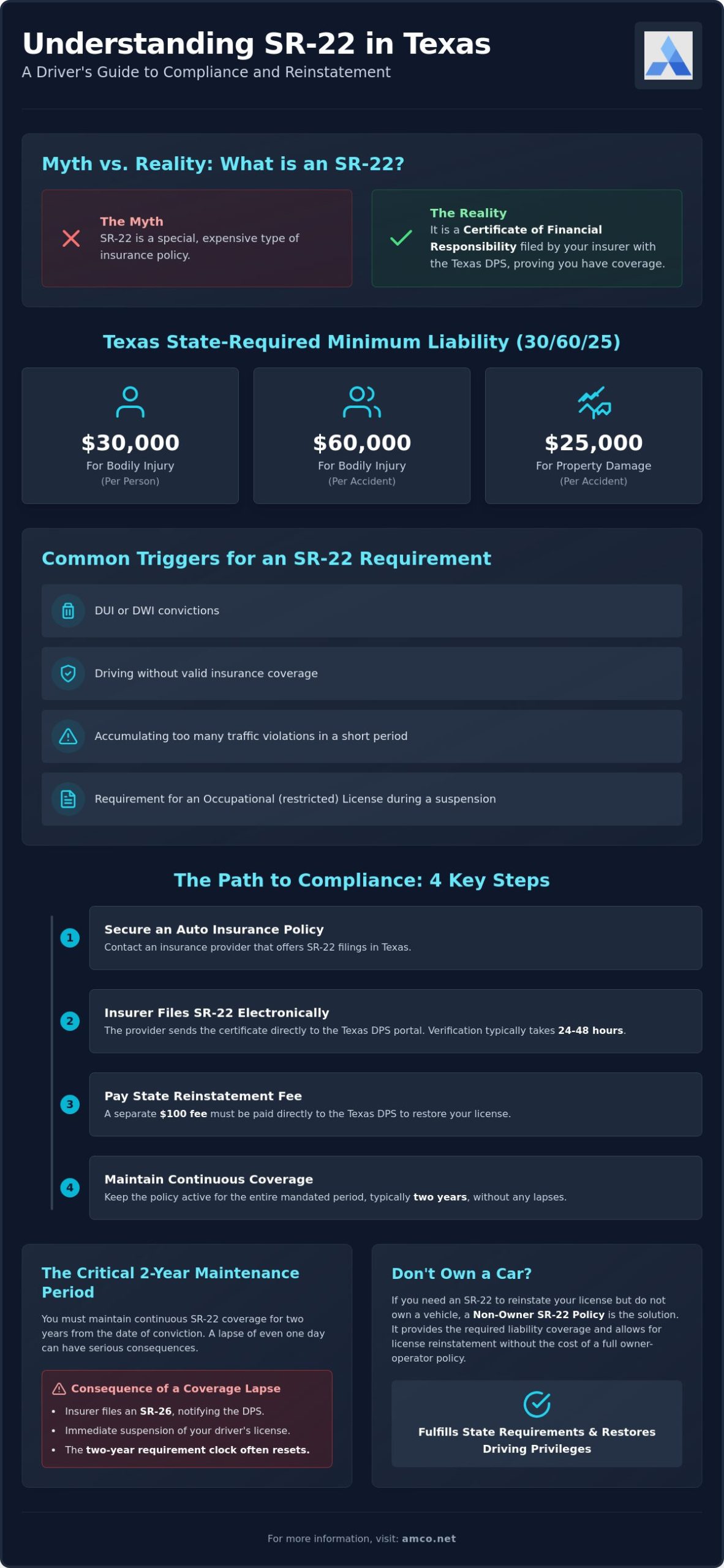
The term "SR-22 insurance" is technically a misnomer that often leads to administrative confusion for drivers. In legal terms, an SR-22 is a Certificate of Financial Responsibility. It's a document that your insurance provider files with the Texas Department of Public Safety (DPS) to verify that you maintain the state's required minimum liability coverage. While many people search for SR-22 insurance Texas as if it were a specific product, it's actually an endorsement attached to a standard auto insurance policy.
The Texas DPS mandates this filing to ensure that drivers who've had certain legal issues remain financially accountable. This certificate acts as a bridge between your private insurance coverage and the state's licensing records. It proves you carry the 30/60/25 minimums: $30,000 per person for bodily injury, $60,000 per accident, and $25,000 for property damage. For a broader perspective on how this mechanism works across different jurisdictions, you can review the general definition of SR-22 (insurance).
The requirement isn't arbitrary. It's triggered by specific events that the state deems high-risk. These situations represent a failure to maintain standard safety or financial protocols on Texas roadways. Common triggers include:
When establishing SR-22 insurance Texas protocols, the modern filing process is almost entirely digital. When you secure a policy through a professional agency, the provider sends an electronic notification to the Texas DPS portal. This system allows for rapid verification, often updating your status within 24 to 48 hours. You can check your compliance status directly on the Texas DPS website using your driver's license number and date of birth.
Continuity is vital. If your policy cancels for any reason, the insurance company is legally obligated to file an SR-26. This form notifies the DPS that your financial responsibility has ended. This usually triggers an immediate license suspension. Maintaining your policy without gaps is the only way to satisfy the two-year requirement and avoid restarting the entire process from day one.
Achieving full compliance with state mandates requires a systematic approach to documentation and fee settlement. To begin the reinstatement process, you must first verify your current standing through the official online portal. The Texas Department of Public Safety maintains a Driver License Eligibility system where you can view your specific requirements; including any outstanding fines or necessary documents. Once you've identified your needs, you'll need to provide your agent with your driver's license number and Social Security number to initiate the SR-22 insurance Texas filing.
In addition to securing the certificate, the state requires a $100 reinstatement fee. This is a separate administrative cost paid directly to the DPS, distinct from any insurance premiums or carrier filing fees. Processing times have improved significantly due to recent portal upgrades. Electronic filings are often recognized by the state system within 24 to 48 hours, though you should always verify the update on the eligibility website before returning to the road. It's a precise process that leaves little room for error if you want to avoid further delays.
Most mandates in Texas require a continuous filing for two years from the date of conviction or judgment. This isn't just a suggestion; it's a strict regulatory clock. If your policy lapses for even a single day, the insurance carrier is legally bound to notify the state. This notification typically results in an immediate license suspension and, more critically, the two-year requirement often restarts from the beginning. Monitoring your policy's expiration date is essential to avoid unnecessary premium extensions. You can consult with our specialists to ensure your compliance timeline is tracked accurately and professionally.
To satisfy the state mandate, your policy must meet the Texas Minimum Auto Insurance Requirements. This standard, known as the 30/60/25 rule, ensures you have $30,000 for bodily injury per person, $60,000 per accident, and $25,000 for property damage. While these are the legal minimums for SR-22 insurance Texas, many high-risk drivers opt for higher limits. Increasing your coverage can provide a necessary safety net for your personal assets in the event of a future accident, offering a layer of security that the bare minimums simply don't provide.
The financial implications of an SR-22 requirement involve two distinct components: the administrative filing fee and the subsequent adjustment to your underlying policy premium. It's a common mistake to view these as a single expense. While the filing fee is a nominal one-time charge, the long-term impact on your rates depends heavily on the severity of the incident that triggered the state's intervention. A Forbes Advisor analysis on SR-22 costs suggests that the primary expense isn't the certificate itself, but the high-risk classification assigned to your profile by the carrier's underwriting department.
The nature of your violation plays a decisive role in determining your SR-22 insurance Texas costs. For instance, a first-time citation for driving without insurance typically results in a lower premium increase compared to a DWI conviction. Geography also influences these figures. Urban centers like Houston or Dallas often see higher baseline rates due to traffic density and accident frequency, which naturally amplifies the surcharges associated with a high-risk filing. The SR-22 filing fee itself is usually under $50, while the premium impact varies based on your specific risk profile and history.
Actuarial models consider several variables beyond the violation that led to the mandate. Your age and the type of vehicle you drive remain standard pricing factors that don't disappear just because a certificate is required. For example, a sports car with a high-risk filing will command a significantly higher premium than a standard sedan. Daily mileage also matters; lower road exposure can sometimes mitigate the perceived risk. Even with a high-risk status, certain safety-based discounts might still be accessible depending on your carrier's specific guidelines and the technology installed in your vehicle.
Securing affordable SR-22 insurance Texas requires a strategic approach to policy management. Working with an independent agency like AMCO.NET LLC allows you to compare multiple specialized carriers rather than being locked into a single provider's rigid pricing structure. Bundling your auto coverage with other essential protections, such as Renters Insurance, can often unlock multi-policy discounts that help offset high-risk surcharges. Additionally, maintaining a stable credit score remains a powerful tool for improving your insurance tier over time. This long-term focus on financial stability helps you transition back to standard rates once the two-year filing period concludes.
For individuals who don't own a vehicle but face a state-mandated license suspension, a non-owner policy is often the most pragmatic solution. This specific financial instrument allows you to satisfy the Texas DPS requirement for SR-22 insurance Texas without the overhead of a full auto policy. It essentially provides liability coverage that follows the driver rather than being tied to a specific VIN. This ensures that the state receives the necessary verification of financial responsibility while you remain in compliance with the law.
From a technical standpoint, non-owner coverage is significantly more cost-effective than standard policies. Since the insurer assumes you'll drive less frequently than a vehicle owner, the premiums are adjusted to reflect this reduced risk. This makes it a strategic choice for those who rely on public transportation or ride-sharing but need to clear their driving record. It's a professional way to manage your legal obligations while keeping your fixed costs manageable during the reinstatement phase.
Selecting a non-owner policy is particularly beneficial if you're applying for an occupational license. The state requires proof of financial responsibility before granting these restricted driving privileges. Additionally, maintaining a non-owner policy prevents a lapse in your insurance history. Insurance carriers often penalize drivers who have gaps in their coverage records; so keeping this policy active preserves your standing for future, lower rates. It's an investment in your long-term insurability that pays dividends once you're ready to return to standard market tiers.
Accuracy regarding policy limitations is paramount to avoid coverage denials. A non-owner policy does not cover vehicles owned by anyone in your household. It also excludes any vehicle you have regular access to or use frequently. It's designed strictly for the occasional use of borrowed vehicles from individuals outside your residence. In these scenarios, the policy acts as secondary coverage, meaning it only pays out after the vehicle owner's primary insurance limits are exhausted. If you purchase a vehicle or move into a home with a car you intend to drive, you must contact AMCO.NET LLC immediately to transition to a standard policy and ensure your filing remains valid.
Securing a certificate of financial responsibility involves more than a simple transaction; it requires a partner with a deep understanding of the Texas Transportation Code. Since our founding in 1987, AMCO.NET LLC has specialized in the technical nuances of SR-22 insurance Texas compliance. Our longevity in the market provides us with the historical perspective needed to manage complex reinstatement cases that newer agencies might overlook. We don't just issue documents. We ensure that your filing remains in good standing with the state to protect your operational continuity and driving privileges.
Efficiency is a cornerstone of our service model. AMCO.NET LLC utilizes direct electronic filing with the Texas Department of Public Safety (DPS) to minimize the administrative delays that often plague the reinstatement process. For drivers in Houston, San Antonio, Dallas, Austin, and across the state, this means your compliance status is updated in the state's system with professional speed. By maintaining a robust network of specialized high-risk carriers, we can analyze multiple data points to identify the most cost-effective coverage options for your specific risk profile.
Our deep roots in the Texas market allow AMCO.NET LLC to offer a consultative approach that prioritizes your long-term financial stability. We understand the local regulatory environment and the specific challenges faced by drivers in major metropolitan areas like Laredo and Conroe. Rather than providing a generic product, we focus on comprehensive system solutions that address both your immediate reinstatement needs and your future insurability. You can learn more about our local Texas expertise and how our experience translates into better outcomes for our clients. We treat every filing as a critical step toward restoring your professional and personal mobility.
Initiating the quote process is straightforward through our digital platforms or mobile application. To ensure a fast turnaround, please have your driver's license number, social security number, and any specific case documentation from the DPS ready for our team. Our specialists at AMCO.NET LLC will review your information to find the most competitive rates for SR-22 insurance Texas currently available in the 2026 market. We provide the technical background and follow-up support necessary to ensure your certificate remains active throughout the entire mandatory period. When you're ready to resolve your suspension and return to the road, contact AMCO.NET LLC for a fast SR-22 quote and experience the reliability of a seasoned industry leader.
Restoring your driver's license requires a disciplined approach to state regulations and insurance documentation. By understanding that the SR-22 is a certificate of financial responsibility rather than a standalone policy, you can better manage your underlying coverage needs. Maintaining continuous compliance for the full 24-month period remains the most critical factor in successfully resolving your suspension without administrative setbacks. It's a structured process that rewards consistency and technical accuracy.
Finding the right SR-22 insurance Texas solution doesn't have to be a source of financial strain or confusion. Our team has served Texas drivers since 1987, providing the technical expertise necessary to navigate high-risk mandates with absolute clarity. We prioritize electronic filing to ensure your data reaches the Texas DPS portal without unnecessary delays. This professional oversight helps you avoid the common pitfalls that lead to license suspension restarts.
Get a Fast & Affordable SR-22 Quote from AMCO.NET and let our expert agents handle the complex filing details for you. You've done the research; now let's get you back behind the wheel safely and legally.
The total expense is divided into a one-time administrative filing fee and a subsequent adjustment to your base premium. While the filing fee is a nominal administrative charge, the premium impact depends on your specific violation and driving history. Drivers with a single non-insurance citation typically see smaller increases than those with a DWI conviction.
Most mandates require you to maintain the certificate for two continuous years from the date of the conviction. If your SR-22 insurance Texas lapses for even one day, the carrier must notify the state. This notification usually results in a license suspension and can cause the state to restart your two-year compliance period from the beginning.
You can secure a non-owner SR-22 policy if you don't own a vehicle but need to reinstate your license. This policy provides the necessary proof of financial responsibility to the DPS at a lower premium than a standard owner policy. It's a technical solution for drivers who use public transit or borrowed vehicles occasionally.
If your coverage terminates, your insurance provider is legally required to file an SR-26 form with the Texas DPS. This document cancels your proof of financial responsibility, leading to an immediate suspension of your driving privileges. You'll need to secure a new filing and pay additional reinstatement fees to the state to resolve the matter.
Filing is handled electronically by your insurance agency directly through the Texas DPS portal. Once you purchase the policy, the agent submits the certificate to the state's database. Modern digital systems have reduced the processing time, often reflecting your updated status in the state's records within 24 to 48 hours.
No, an SR-22A is a separate requirement often mandated for drivers with repeat traffic violations or multiple insurance lapses. While the standard SR-22 verifies minimum liability, the SR-22A may require you to pay your policy premium in full upfront. You should check your DPS eligibility status to confirm which specific form is required for your case.
Your ability to drive various vehicles depends on whether you have an owner or non-owner policy. An owner policy covers specific vehicles listed on the document, while a non-owner policy only covers you when driving cars you don't own or have regular access to. Driving a household vehicle with only a non-owner SR-22 can lead to a denial of coverage during a claim.
You can verify the status of your filing by visiting the Texas DPS Driver License Eligibility website. By entering your driver's license number and date of birth, you can view a real-time list of compliance requirements. This portal will show whether your SR-22 insurance Texas certificate has been processed and if your license is currently eligible for reinstatement.