

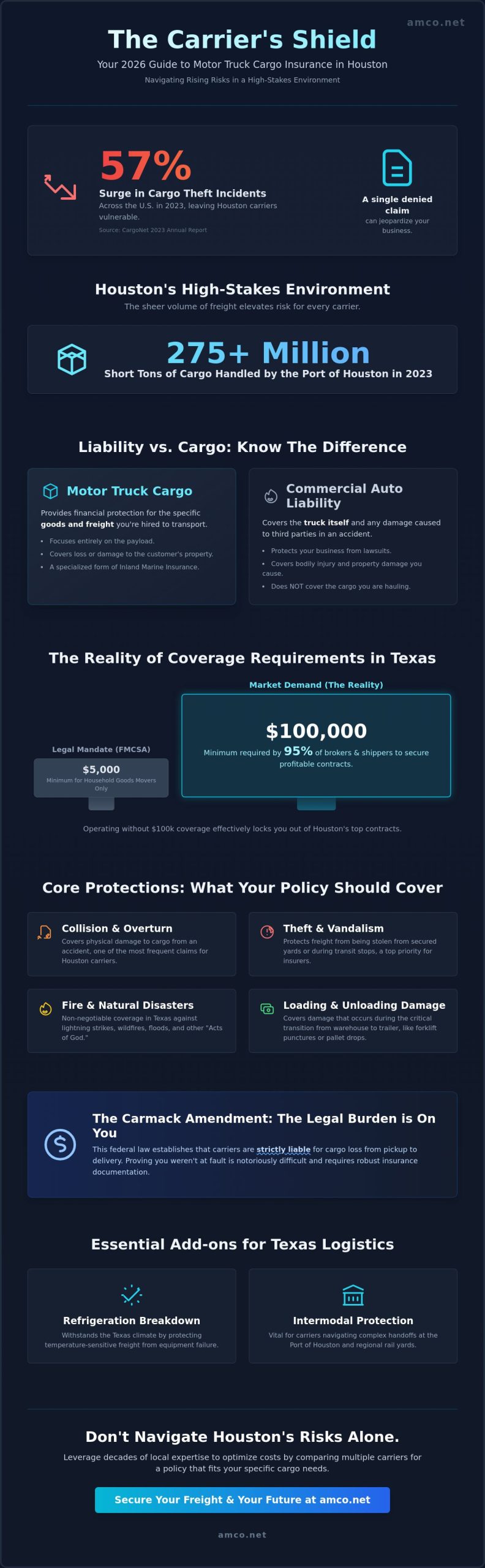
According to CargoNet's 2023 annual report, cargo theft incidents across the United States surged by 57% in a single year, leaving carriers in trade hubs like Houston increasingly vulnerable to catastrophic financial loss. You already know that hauling high-value freight through the Port of Houston or along the I-10 corridor carries immense responsibility. Without the right motor truck cargo insurance, a single equipment failure or a sophisticated theft can jeopardize your business's technical continuity and long-term stability. It's a high-stakes environment where a single error in paperwork can lead to a denied claim when you need support the most.
We understand that navigating the technical specifications of broker contracts and shipper requirements often feels like a full-time job. This 2026 guide provides a professional breakdown of how motor truck cargo insurance protects your livelihood while ensuring you meet every contractual obligation. You'll learn the difference between standard inclusions and the fine-print exclusions that often catch carriers off guard. We'll also examine the specific steps needed to secure your freight across Texas trade corridors and protect your operation from the financial impact of cargo loss.
Motor truck cargo insurance provides financial protection for the specific goods and freight you're hired to transport. It's a specialized policy that focuses entirely on the payload, which distinguishes it from commercial auto liability. While liability insurance covers the truck itself and any damage caused to third parties, cargo insurance addresses the loss of the customer's property. In the technical hierarchy of the industry, this coverage is a specialized branch of Inland marine insurance, a category designed to protect property that's constantly in transit over land or temporarily stored at various terminals.
To better understand how this coverage fits into your daily operations, watch this expert overview:
For-hire carriers in Texas, who transport goods owned by others, face higher operational risks than private carriers hauling their own products. Private fleets often rely on standard property policies, but for-hire operators must secure specific motor truck cargo insurance forms to meet the stringent demands of modern logistics chains. In the Houston metro area, where the Port of Houston handled over 275 million short tons of cargo in 2023, the complexity of these shipments requires a professional approach to risk management.
The legal foundation of freight transport rests on the Carmack Amendment of 1906. This federal law establishes that carriers are strictly liable for loss or damage to goods from the moment they receive them until delivery is complete. The Bill of Lading serves as the primary legal contract, and any discrepancy noted upon delivery can trigger a claim. Texas truckers often find that proving they weren't at fault is notoriously difficult. Under the Carmack Amendment, carriers must prove that damage resulted from one of five specific exceptions, such as an "act of God" or "public enemy." Without robust insurance, a single damaged shipment can jeopardize a carrier's entire capital reserve.
The legal landscape depends on what you're hauling. The FMCSA mandates cargo insurance only for "household goods" (HHG) movers, requiring a minimum of $5,000 per vehicle. For general freight, federal law doesn't strictly mandate it, but the market does. The Texas Department of Insurance (TDI) follows similar patterns for intrastate carriers. However, Houston's logistics hub operates on private standards. Approximately 95% of freight brokers and shippers in the region require a minimum of $100,000 in motor truck cargo insurance before they'll sign a contract. Operating without this level of coverage effectively locks a carrier out of the most profitable local contracts.
Motor truck cargo insurance provides a financial safety net for the freight you transport, but its effectiveness depends on the specific perils listed in your policy. For Houston carriers, the most frequent claims involve collision and overturn. If a rig jackknifes on the 610 Loop, the policy covers the physical damage to the cargo resulting from that impact. Fire and natural disasters also represent significant risks in Texas. With lightning strikes and wildfires causing millions in property damage annually, having explicit coverage for these events is a non-negotiable requirement for regional stability.
Theft and vandalism coverage protects freight from secured yards or transit stops. According to standards outlined by the Inland Marine Underwriters Association (IMUA), cargo theft remains a top priority for inland marine insurers. Additionally, protection during loading and unloading is vital. Damage often occurs when a forklift pierces a crate or a pallet falls during the transition from the warehouse to the trailer. Professional policies ensure these handling errors don't erode your profit margins.
You won't find universal coverage for every type of freight. Most standard policies exclude high-risk "target commodities" like jewelry, live animals, and explosive materials unless you've secured a specific rider. Claims involving employee dishonesty or "inside job" thefts are typically rejected under standard cargo forms. Similarly, if a shipper uses substandard packaging that leads to shifting or breakage, the carrier's motor truck cargo insurance won't cover the loss. It's often beneficial to consult with experts on industrial packaging solutions to ensure your clients are following best practices that reduce your liability.
Beyond the basics, specialized endorsements provide critical support during major incidents. Debris removal is a prime example; clearing a spill on I-10 or I-45 can cost upwards of $10,000 in labor and equipment fees. Pollution cleanup is equally essential for those hauling chemicals through Houston’s industrial zones. Finally, earned freight coverage reimburses you for the shipping charges you lose when cargo is damaged and cannot be delivered. These layers of protection ensure that a single accident doesn't lead to a total business shutdown. Using a comprehensive motor truck cargo insurance policy allows you to operate with the confidence that your technical and financial interests are guarded.
Houston remains the heartbeat of American logistics, with the Port of Houston handling over 275 million tons of cargo annually. For carriers operating in the Energy Corridor, the risks are as massive as the specialized equipment they haul. Motor truck cargo insurance isn't just a regulatory checkbox; it's a financial shield against the volatility of the Gulf Coast. The 'Laredo Connection' adds another layer of complexity. As the busiest land port in North America, Laredo funnels thousands of cross-border shipments through the I-35 corridor into Houston. Without ironclad motor truck cargo insurance, a single incident involving high-value electronics or automotive parts from Mexico can bankrupt a small fleet.
Securing work with Tier-1 brokers and local distributors depends on your ability to prove reliability. While the FMCSA insurance requirements establish the legal baseline for operating authority, they rarely meet the standards of modern shippers. Most Houston-based distributors now demand proof of coverage before allowing a truck onto their dock. This coverage builds the professional trust necessary to maintain long-term partnerships in a competitive 2026 market.
Texas highways are notoriously congested, with the I-10 and I-35 corridors seeing some of the highest accident rates in the nation. Cargo heave occurs when freight shifts violently forward due to inertia during a sudden stop, often resulting in total loss of the load or structural damage to the trailer. Beyond traffic, Southeast Texas weather presents a constant threat. With 2026 climate models predicting more frequent flash floods and tropical disturbances, carriers must account for water damage and transit delays that standard liability policies don't cover.
Fortune 500 shippers in Houston, particularly those in the oil and gas sector, typically won't engage carriers with less than $100,000 to $250,000 in cargo limits. This coverage is a critical component of your commercial trucking insurance Houston strategy. Instead of viewing your certificate of insurance (COI) as a cost, use it as a marketing tool. Presenting a comprehensive COI during the bidding process signals to shippers that your fleet is financially stable and prepared for the high-stakes environment of Texas logistics.
Houston serves as a massive logistics hub, with the Port of Houston handling over 284 million tons of cargo annually. This volume introduces diverse risks that a standard motor truck cargo insurance policy might not cover without specific endorsements. Carriers must move beyond basic coverage to address the technical realities of Texas transit, from extreme heat to the complexities of intermodal transfers at Barbours Cut or Bayport terminals.
Texas summers are brutal. When temperatures exceed 100 degrees, refrigeration units work at maximum capacity, increasing the risk of mechanical failure. Carriers hauling perishables need a "Reefer Breakdown" endorsement to protect against thermal shock. This coverage isn't automatic; adjusters strictly review maintenance logs before paying claims. If your logs don't show service at the manufacturer's recommended intervals, typically every 1,500 hours, the insurer might deny the claim. It's also vital to distinguish between mechanical failure and driver error. Most policies cover a compressor failing, but they won't cover a driver who sets the thermostat to 35 degrees instead of -5 degrees.
Risk profiles vary significantly based on the equipment and the industry served. For those supporting the energy sector, hot shot trucking insurance is essential for hauling high-value drill bits or specialized machinery to the Permian Basin. These loads often require higher cargo limits due to the concentrated value of oilfield tools.
Managing a growing fleet requires a choice between blanket and scheduled vehicle coverage. Scheduled coverage requires you to list every VIN, which is cost-effective for small operations. However, for fleets with more than 10 units, blanket motor truck cargo insurance provides the flexibility to swap trailers and power units without notifying the broker for every minor change. This prevents coverage gaps during busy peak seasons. You should also evaluate your deductible strategy. Moving from a $1,000 deductible to a $5,000 deductible can reduce monthly premiums by 15% to 20%, but it requires a cash reserve to handle small claims out of pocket.
Review your specific risk profile with a specialist to optimize your cargo coverage and ensure your limits match your actual exposure.
AMCO has operated as a specialized Texas agency since 1987, providing a stable foundation for carriers navigating the complex logistics environment. We don't just sell policies; we deliver technical partnerships built on nearly four decades of local market data. Our team understands the specific risks associated with the Port of Houston and the Interstate 10 corridor. We leverage this expertise to compare multiple A-rated carriers, ensuring you secure affordable trucking insurance that precisely fits your cargo profile.
Efficiency is a core requirement for modern fleet management. Waiting for a Certificate of Insurance (COI) can result in missed loads and stalled revenue. We've optimized our internal workflows to provide fast COI turnaround times, often delivering documentation within minutes of a request. This responsiveness keeps your drivers moving through the gate without administrative delays. While generic 1-800 numbers offer automated scripts, our Houston-based experts provide direct, professional consultation tailored to the Texas B2B sector.
Obtaining a precise quote for motor truck cargo insurance requires detailed operational data. You'll need to provide your specific cargo types, the average replacement value per load, and your primary radius of operation. These factors determine the baseline risk. Your safety score, governed by the Compliance, Safety, Accountability (CSA) program, also plays a critical role in premium calculations. High violation rates for vehicle maintenance or hours-of-service will drive costs upward. AMCO helps Texas truckers optimize their risk profile by identifying safety trends that, when corrected, lead to more favorable underwriting terms and lower annual rates.
Our advisors are available through our digital platform, our dedicated mobile app, or for face-to-face consultations at our Houston and San Antonio offices. We specialize in comprehensive policy audits, where we examine your current motor truck cargo insurance for hidden exclusions or inadequate limits that could threaten your company's solvency. We focus on long term stability rather than short term fixes. Get your motor truck cargo insurance quote from AMCO now to ensure your fleet is protected by a partner that understands the demands of the Texas road.
The logistics landscape in 2026 demands more than just basic compliance. Houston’s status as a primary global trade hub means carriers face complex liability risks every day. Protecting your business requires a precise understanding of motor truck cargo insurance to cover potential losses from theft, damage, or transit delays. Since 1987, AMCO has provided Texas truckers with the technical expertise needed to navigate these industry shifts. With local offices established in Houston, Dallas, San Antonio, and Laredo, we provide direct access to top-rated commercial trucking carriers. This local presence ensures your policy aligns with the specific regional requirements of the Texas Department of Motor Vehicles and federal regulations.
Professional risk management isn't just about avoiding a loss; it's about maintaining the operational continuity your clients expect. Our team focuses on cost optimization and long-term stability so you can stay focused on the road ahead. You've built your reputation on reliability, and your insurance coverage should reflect that same standard of excellence. We're here to help you secure a strategy that scales with your growth.
Secure your freight with a custom Motor Truck Cargo quote from AMCO today
Texas state law doesn't mandate motor truck cargo insurance for most intrastate commercial carriers, though federal law creates specific exceptions. The FMCSA requires household goods movers to carry a minimum of $5,000 per vehicle under regulation 49 CFR Part 387.303. Even when it's not legally required, nearly all Houston shipping contracts demand proof of coverage before you're allowed to load.
You'll typically need a $100,000 limit to secure work with the majority of freight brokers and shippers in 2026. While federal minimums are significantly lower, 95% of industry standard contracts won't accept carriers with less than six figures in coverage. This baseline ensures you're eligible for a wide range of dry van and refrigerated freight opportunities across the Gulf Coast.
No, this policy doesn't provide any protection for your physical equipment or vehicle. Motor truck cargo insurance is designed exclusively to cover the financial value of the goods you're transporting for others. To protect your tractor and trailer from collision or fire damage, you'll need to maintain a separate physical damage insurance policy.
The outcome depends on your policy's specific unattended vehicle clauses and security requirements. Many 2026 policies won't pay a claim if the theft occurs at an unsecured lot or if the driver didn't use a kingpin lock. You've got to follow every security protocol listed in your documents, as 40% of cargo theft claims are denied due to preventable negligence during overnight stops.
Yes, you can add a reefer breakdown endorsement to protect against cargo loss caused by mechanical failure of the cooling unit. This is a critical addition for Houston carriers hauling temperature-sensitive goods where a 10-degree variance can spoil an entire shipment. It's important to remember that these endorsements usually require proof of regular maintenance to remain valid during a claim.
Standard policies don't cover environmental cleanup, so you'll need a pollution liability endorsement to handle hazardous spills. If a leak occurs on a Texas highway, the carrier is often liable for remediation costs that can exceed $75,000 for even minor chemical incidents. This specialized coverage pays for debris removal and the professional restoration of the accident site to meet state environmental standards.
Annual premiums for carriers in the Houston area generally range from $500 to $1,500 per vehicle based on 2024 industry data. Your final rate is determined by your safety score, the commodities you haul, and your chosen deductible. High-risk loads like electronics or heavy machinery will push your costs toward the upper end of that spectrum.
Cargo insurance protects the carrier's liability for the goods, while freight insurance is typically a first-party policy purchased by the shipper. Carriers use motor truck cargo insurance to pay for damages they're legally responsible for during transit. Freight insurance, often called shipper's interest insurance, covers the owner's investment regardless of whether the trucking company is at fault for the loss.