
While the federal legal minimum for general freight remains $750,000, nearly every major broker in 2026 now mandates a $1,000,000 limit before you can even book a load. This gap between regulation and reality, combined with the rising costs of vehicle repairs and nuclear verdicts, has made finding affordable trucking insurance feel like a constant struggle for Texas fleet owners. You likely feel the pressure of skyrocketing premiums and the lack of transparency from national carriers who don't understand the nuances of our local logistics corridors.
We recognize that your priority is maintaining a stable, profitable operation while meeting complex requirements like the Non-Domiciled CDL rule that took effect on March 16, 2026. This guide will show you how to secure comprehensive coverage that fits your budget without compromising on the specialized protection your business requires. We will explore strategic ways to lower your monthly premiums, ensure fast certificate of insurance issuance, and navigate Texas-specific filings with the technical precision your fleet deserves.
In the 2026 fiscal year, the definition of affordable trucking insurance has evolved. It isn't just about finding the absolute lowest premium on a quote sheet. Instead, true affordability is found by balancing immediate operational costs with the long term protection of your fleet's solvency. Texas carriers are currently navigating a market where the freight and logistics sector has reached a valuation of USD 144.23 billion. This growth brings increased competition and higher scrutiny from insurance underwriters who are reacting to rising vehicle repair costs and the trend of nuclear verdicts in liability cases.
Distinguishing between a "cheap" policy and a "cost-effective" professional solution is vital for any fleet manager. A policy that saves a few hundred dollars monthly but leaves you vulnerable to a denied cargo claim or an uncovered liability gap isn't affordable; it's a structural risk to your business. Understanding vehicle insurance in the U.S. provides the necessary context for how these risks are structured at both the state and federal levels.
To better understand how to approach your first policy or renewal, watch this helpful video:
A professional insurance package consists of several layers, each serving a specific role in your risk management strategy. Primary Liability is the non-negotiable foundation, providing coverage for bodily injury and property damage to third parties. Physical Damage coverage protects your investment in tractors and trailers against collision, fire, and theft, which is essential as equipment costs continue to climb. Finally, Motor Truck Cargo insurance ensures your freight is covered, a critical requirement for maintaining relationships with high-quality shippers who demand documented security protocols.
Texas-based fleets must navigate a dual regulatory environment. While the FMCSA mandates a $750,000 minimum for interstate general freight, the reality of the 2026 market is that most brokers and shippers contractually require a $1,000,000 limit. For those operating strictly within state lines, TXDOT requirements are different. For example, motor carriers over 26,000 lbs must maintain a $500,000 combined single limit. Balancing these legal mandates while seeking affordable trucking insurance requires an agent who understands the local economic drivers. Securing Commercial Trucking Insurance in Houston or Dallas involves more than just meeting the 30/60/25 state minimums; it's about positioning your fleet to be eligible for the best loads in the state.
Insurance underwriters in 2026 don't rely on guesswork; they use a data-driven approach to quantify the risk your fleet represents. Understanding these variables is the first step toward securing affordable trucking insurance that actually protects your assets. Your USDOT safety profile and SAFER scores act as a digital resume for your business. Carriers scrutinize your history of roadside inspections and violations to determine if you're a safe bet or a liability. A high score in the Safety Management System (SMS) categories can lead to automatic premium hikes, while a clean record suggests operational stability.
Driver qualification remains a critical pillar of your premium calculation. In 2026, the standards for Motor Vehicle Records (MVR) have tightened. Underwriters look for drivers with at least two years of verifiable experience and zero major violations. With the national truck driver shortage reaching approximately 82,000 drivers this year, the temptation to hire less experienced operators is high. However, doing so often triggers a significant increase in your liability costs. Maintaining a strict hiring standard is one of the most effective ways to keep your overhead manageable.
Insurers use real-time data from roadside inspections to adjust your rates dynamically. A single clean inspection can lower premiums by up to 15% because it demonstrates a commitment to compliance. Beyond just passing inspections, you must maintain a low out-of-service (OOS) rate. If your trucks or drivers are frequently pulled off the road for safety violations, carriers view it as a precursor to a major accident. Proactive management of your FMCSA insurance requirements and safety data ensures you remain eligible for the most competitive market rates.
The distance your trucks travel and the goods they carry significantly impact your risk profile. Local hauling within a 100-mile radius generally carries lower premiums than long-haul interstate routes because the exposure to high-speed highway fatigue is reduced. Similarly, your cargo classification dictates your cargo insurance costs. Hauling hazardous materials or high-value electronics requires specialized riders and higher limits, whereas general dry van freight is more straightforward to cover. If you're unsure how your current routes affect your bottom line, you can consult with an independent agent to analyze your specific footprint.
The physical state of your fleet matters just as much as your safety scores. Late-model trucks often qualify for better physical damage rates because they're equipped with modern safety technology like collision mitigation and lane-departure warnings. There's also a direct correlation between detailed preventive maintenance records and lower insurance claims. If you can prove that your equipment is serviced regularly, underwriters are more likely to offer favorable terms. Be aware that specialized equipment, such as reefers or car haulers, will always command higher premiums due to the increased complexity of potential claims.
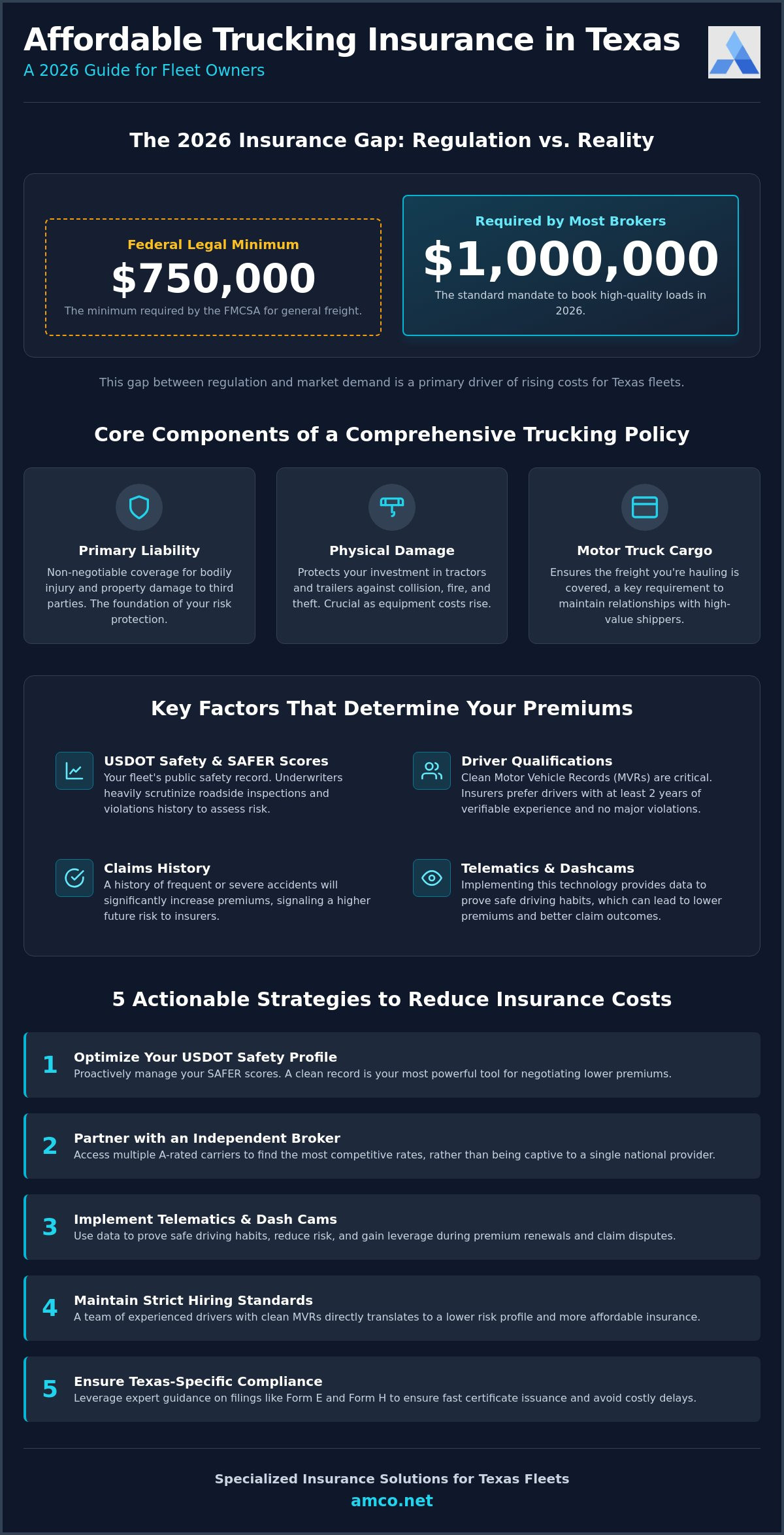
A fundamental distinction exists between direct writers and independent brokers that directly impacts your bottom line. Direct writers represent the insurance company, offering a limited range of internal products. In contrast, an independent broker represents you, the carrier. This structural difference is the primary driver for securing affordable trucking insurance. By acting as a market aggregator, we analyze multiple A-rated carriers to find the specific provider whose current risk appetite aligns with your fleet's operational profile.
Local Texas expertise isn't just a convenience; it's a functional necessity for professional fleets. Understanding the specific requirements for port access in Houston or the regional filings required by TXDOT requires a level of specialization that national call centers often lack. When you face a complex claim or a sudden request for a certificate of insurance (COI) from a high-value broker, having a dedicated advocate who understands the Texas logistics environment ensures that your trucks stay on the road rather than sitting idle due to paperwork delays.
The insurance market is highly segmented. Some carriers focus exclusively on new authorities, while others prioritize established fleets with long histories of safety compliance. Working with an Insurance Company Near Me gives you access to these niche markets that don't advertise to the general public. We often identify specialized discounts for industries like oil field hauling or aggregate transport, where specific safety protocols can be leveraged to lower premiums. This targeted approach ensures you aren't paying a generic rate for a specialized risk.
A proactive renewal strategy is the most effective way to manage long-term costs. We begin shopping your renewal 60 days in advance to create a competitive environment among carriers. This timeline allows us to present your most recent safety data and roadside inspection results to underwriters, often freezing or lowering rates that would otherwise increase. Managing your primary liability alongside Federal Motor Carrier Safety Administration (FMCSA) requirements through a single point of contact provides the technological continuity and professional oversight necessary for a stable business operation.
Securing affordable trucking insurance in the 2026 market requires a shift from passive shopping to active risk management. While external factors like inflation and repair costs are beyond your control, several operational levers can directly influence your premium. One of the most effective financial moves is the "Paid in Full" discount. Carriers often charge significant administrative fees and interest for monthly installments. By paying your annual premium upfront, you can save thousands of dollars and simplify your accounting for the fiscal year.
Radius restriction offers another path to substantial savings. If your business model allows it, limiting your operations to a 500-mile radius can move your fleet into a lower risk tier. Underwriters view regional hauling as inherently safer than long-haul interstate travel due to reduced driver fatigue and more predictable routes. If you're ready to see how these adjustments impact your specific bottom line, you can request a customized fleet quote to explore your options.
In 2026, data transparency is the most powerful tool for negotiation. Insurers now use Electronic Logging Device (ELD) data to reward fleets that demonstrate consistent safety and compliance. Implementing forward-facing dashcams is equally critical; they provide the objective evidence needed to exonerate your drivers in the event of an accident. Without this footage, "he-said, she-said" scenarios often lead to at-fault designations that trigger massive premium spikes. Telematics-based pricing is the future of affordable trucking insurance.
Your business structure and policy choices should reflect your actual usage. For low-utilization fleets or seasonal operations, "Per-Mile" insurance can be a cost-effective alternative to traditional fixed-rate policies. You should also consider the benefits of packaging. Combining your General Liability and Commercial Trucking Liability into a single package often yields a lower total cost than maintaining separate policies with different carriers. This bundled approach also streamlines the claims process by providing a single point of contact for all incidents.
Finally, consider the strategic use of higher deductibles. For experienced owner-operators with strong cash reserves, increasing a deductible from $1,000 to $2,500 or $5,000 can result in an immediate and significant reduction in monthly premiums. This approach allows you to "self-insure" for minor incidents while keeping your primary coverage affordable for major losses. When combined with a strict hiring process that only accepts drivers who fit within a carrier's "underwriting box," these strategies create a stable, cost-effective insurance foundation.
Maintaining your Texas trucking authority requires more than just paying a premium. It involves the precise execution of state and federal filings that keep your USDOT and TXDOT numbers active. We specialize in the expert handling of Form E, Form H, and MCS-90 filings. These documents are the technical backbone of your legal compliance. For carriers in Laredo, Houston, and Dallas, the speed of certificate of insurance (COI) issuance determines how quickly a truck can get under a load. Since 1987, we've provided the professional back-office support that allows fleets to focus on logistics rather than regulatory hurdles.
Launching a new authority in 2026 is a capital-intensive venture. Many national carriers refuse to quote businesses with less than two years of verifiable experience, leaving new operators with limited choices. We take a different approach by shopping our network of A-rated carriers to find affordable trucking insurance for new ventures. We understand that every day your truck isn't moving, you're losing revenue. Our brokerage model is designed to navigate these initial barriers efficiently, providing a path to market for safe, professional start-ups.
Accessing intermodal hubs like the Port of Houston or Port of Galveston requires adherence to strict Uniform Intermodal Interchange Association (UIIA) standards. Our team ensures your policy meets these specific insurance requirements, preventing costly delays at the gate. For those involved in cross-border trade through Laredo or Brownsville, we provide specialized coverage that addresses the unique risks of international logistics. You can find more detail on these regional nuances in our Comprehensive Guide to Insurance in Houston. This local knowledge is what separates a specialized broker from a generic national call center.
To receive an accurate 2026 quote, you should have your USDOT number, driver list (with MVRs), and equipment schedule ready for review. Our process is methodical and thorough, ensuring no eligible discounts are overlooked. Once we identify the optimal carrier for your specific risk profile, the timeline for binding coverage and submitting your filings is streamlined to minimize operational downtime. We've built our reputation on stability and professional humbleness, acting as a long-term partner for your fleet's growth. Ready to lower your overhead? Get a fast, affordable trucking insurance quote from AMCO.NET today!
Maintaining a competitive edge in the 2026 Texas logistics market requires more than just meeting minimum filing requirements. It demands a proactive approach to safety data management and a strategic partnership with a broker who understands the local economic landscape. By leveraging telematics, optimizing driver hiring, and selecting the right coverage radius, you can actively drive down your operational overhead. True affordable trucking insurance isn't found by chance; it's the result of methodical risk assessment and accessing multiple A-rated carriers through a trusted intermediary.
Since 1987, our Houston-based team has supported Texas truckers with specialized expertise and a commitment to operational stability. We understand the specific pressures of port access and cross-border trade that national agencies often overlook. Our independent model ensures we work for your fleet, not the insurance carrier. This professional objectivity allows us to prioritize your financial interests while ensuring your business remains fully compliant with both state and federal mandates.
Ready to optimize your coverage and secure your authority? Request Your Affordable Trucking Insurance Quote Today and let our experienced advisors find the system solution that fits your unique business needs. We look forward to helping you keep your trucks moving safely and profitably across the Lone Star State.
Commercial trucking insurance costs in 2026 are influenced by a combination of inflationary pressures and the increasing frequency of large liability settlements. While rates vary based on your specific risk profile, factors such as your operating radius, cargo type, and the age of your equipment are the primary drivers of the final premium. Obtaining a customized quote is the only way to determine the exact cost for your unique fleet operations in the current Texas market.
The most competitive rates for a new authority are typically found through a brokerage model that has access to specialized niche carriers. While "cheap" is often the goal, you must ensure the policy still meets the $1,000,000 liability baseline required by most modern brokers. Securing affordable trucking insurance for a start-up involves demonstrating a commitment to safety protocols from day one to offset the lack of verifiable operating history.
Increasing your deductible is a direct lever to lower your monthly premium, but it requires careful financial planning. This strategy effectively shifts a portion of the risk from the insurer to your business, which can result in affordable trucking insurance for fleets with stable cash flow. You should only consider this option if your business can comfortably cover the higher out-of-pocket cost in the event of a physical damage claim.
An MCS-90 filing is an endorsement added to your primary liability policy by your insurance provider. This document serves as proof to the FMCSA that your business maintains the required financial responsibility for public liability, including environmental restoration. Your agent handles the submission of this filing to the federal authorities as part of the binding process, ensuring your authority remains in good standing.
Implementing forward-facing dashcams and telematics systems is one of the most effective ways to negotiate lower rates in 2026. Insurers use this data to verify safe driving habits and exonerate your drivers during accident investigations. By providing objective evidence of professional conduct on the road, you reduce the carrier's perceived risk, which often leads to premium credits or more favorable renewal terms.
Bobtail insurance provides liability coverage for a tractor when it's operated without a trailer attached, regardless of dispatch status. Non-Trucking Liability (NTL) is more restrictive, covering the vehicle only for personal, non-business use when the driver is not under dispatch. Understanding this distinction is vital for owner-operators who need to bridge the gap between their permanent lease coverage and their personal liability exposure.
Premiums in 2026 have been impacted by rising vehicle repair costs and the overall tightening of the insurance market. Beyond these macro-economic factors, your specific rate might increase due to a decline in your SMS scores or an increase in your out-of-service (OOS) rates. Regular monitoring of your safety data allows you to address these issues before they result in a significant hike during your annual renewal cycle.
We prioritize the rapid issuance of certificates of insurance to ensure your trucks stay under load. Our local expertise and streamlined digital systems allow us to process requests quickly, often within the same business day. We understand that in the fast-paced Texas logistics environment, a delay in paperwork translates directly into lost revenue for your fleet.