
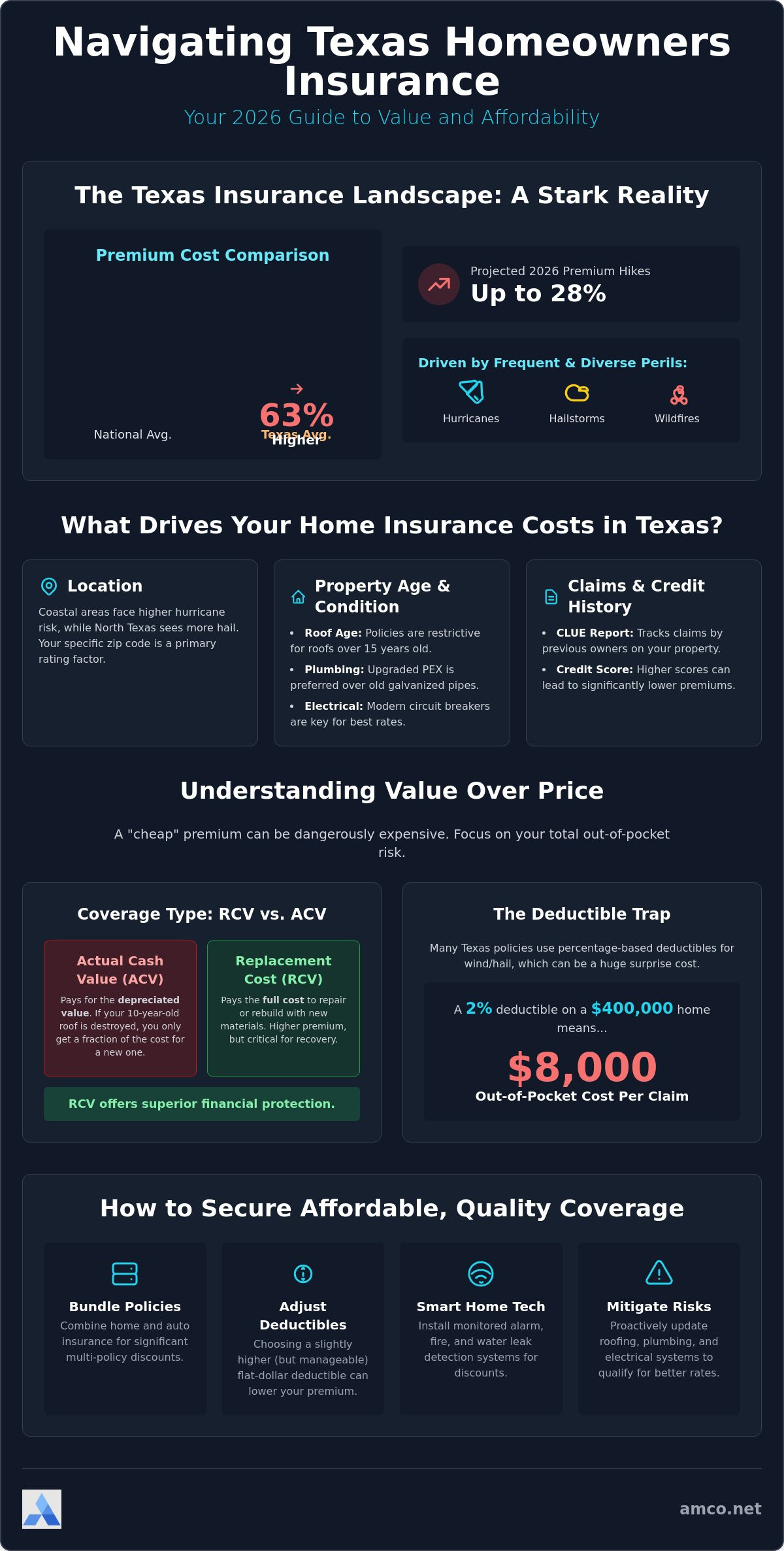
With Texas homeowners insurance rates now sitting 63% higher than the national average, finding a balance between protection and price has never been more critical. In 2026, many residents face premium hikes as high as 28% due to increasing climate events and market shifts. It's easy to feel frustrated when searching for cheap homeowners insurance while trying to decipher confusing policy jargon or manually comparing dozens of quotes. You shouldn't have to choose between a manageable monthly payment and the security of your most valuable asset.
We recognize that the current market feels restrictive, but you can still secure comprehensive coverage for wind, hail, and fire at a competitive price. This article provides a clear roadmap to navigating the 2026 Texas insurance landscape. You'll learn how to leverage new state regulations like House Bill 2067 to your advantage and understand why the most efficient policy isn't always the one with the lowest initial quote. We will also explore how strategic deductibles and professional risk mitigation can lower your costs while keeping your property fully protected.
Securing cheap homeowners insurance in the 2026 Texas market requires a shift from looking at the monthly premium to evaluating the Total Cost of Ownership (TCO). In a professional context, TCO represents the sum of your annual premiums plus the potential out-of-pocket expenses you must cover during a claim. A policy with a low sticker price often shifts the financial burden back to the property owner through high deductibles or limited coverage scopes. This approach can be fiscally dangerous in a state where severe weather events are frequent and repair costs are rising.
True value in a homeowners insurance policy depends heavily on the method of loss settlement. Most "bare-bones" options utilize Actual Cash Value (ACV), which pays out based on the depreciated value of your property. For example, if a ten-year-old roof is destroyed, an ACV policy only covers its current worth, not the cost of a new one. Conversely, Replacement Cost Value (RCV) covers the full expense of rebuilding or repairing your home with materials of like kind and quality. While RCV policies carry a higher premium, they offer far superior long-term value by preventing massive capital outlays after a disaster.
Your deductible structure also dictates how "cheap" a policy actually is. Texas insurers frequently utilize percentage-based deductibles for wind and hail, often ranging from 1% to 5% of the home's insured value. A 2% deductible on a $400,000 home results in an $8,000 initial expense for the owner. Choosing a flat-dollar deductible or a lower percentage might increase the monthly rate, but it significantly reduces the financial shock during a crisis.
The Texas insurance environment is uniquely volatile. Rates here are approximately 63% more expensive than the national average because of the state's exposure to diverse perils, including Gulf Coast hurricanes, Panhandle wildfires, and North Texas hailstorms. Beyond weather, local building codes in metropolitan areas like Houston or Austin have evolved to require more resilient materials. While these codes improve safety, they also increase the "rebuild cost" that insurers must account for in their underwriting models.
Coastal property owners face additional layers of complexity regarding specialized perils. The Texas Windstorm Insurance Association (TWIA) acts as the state’s insurer of last resort, providing essential wind and hail coverage to property owners in designated coastal counties who are unable to obtain insurance through the private market. Understanding how these state-backed entities interact with your primary policy is vital for maintaining a balanced and cost-effective protection plan.
Geographic variables play a disproportionate role in the Texas insurance market. While a property in Midland or Odessa faces specific risks like wildfire or hail, coastal homes require significantly higher premiums due to hurricane exposure. This regional variance is why a quote for cheap homeowners insurance in one zip code can't be compared directly to another. Carriers also look closely at your financial responsibility score. In Texas, a higher credit rating often translates to lower risk tiers, which can unlock better pricing than standard market rates.
It isn't just your personal history that matters. Insurance companies utilize Comprehensive Loss Underwriting Exchange (CLUE) reports to track claims filed on a property by previous owners. If a home has a history of water damage or foundation repairs, new owners may face higher premiums regardless of their own clean record. Understanding these background factors is one of the most effective ways to lower your homeowners insurance over the long term. Beyond the roof, 2026 underwriting standards place heavy emphasis on plumbing and electrical updates. Homes with galvanized piping or outdated electrical panels are often excluded from the most competitive rate classes. Upgrading to PEX plumbing or modern circuit breakers isn't just a safety measure; it's a prerequisite for accessing the most affordable carrier tiers in the state.
Infrastructure age is a primary underwriting hurdle in 2026. In cities like San Antonio, carriers are increasingly restrictive regarding roofs older than 15 years. Some insurers may even refuse coverage for roofs exceeding 20 years without a certified inspection. Conversely, installing Class 4 impact-resistant shingles can lead to savings between 15% and 35%. For North Texas residents, the expansive clay soil makes foundation coverage a critical, albeit expensive, addition. Without it, the structural integrity of the home remains a significant financial liability that many "budget" policies simply ignore.
Public Protection Class (PPC) ratings further refine your rate. These scores evaluate the efficacy of local fire departments and the proximity of fire hydrants. In the suburbs of Houston and Dallas, a high PPC rating can lower the fire portion of your premium. Urban areas also face higher scrutiny regarding crime statistics. High-theft zip codes naturally see elevated rates for personal property protection. If you're looking to optimize your policy, consult with an expert at AMCO to identify which local variables are impacting your specific premium and where you might qualify for additional credits.
Consolidating your risk profile under a single carrier remains the most effective strategy for reducing premiums. In the current market, bundling your property coverage with car insurance in Houston, TX can yield savings between 15% and 25%. This multi-policy approach provides carriers with a more comprehensive view of your risk, often leading to preferred tier pricing. Loyalty also plays a role. Many insurers offer a "claims-free" reward for policyholders who maintain their coverage without filing a claim for three to five years. While shopping around is necessary, these tenure-based credits can make staying with a reputable carrier more cost-effective than switching for a marginally lower quote.
The 2026 insurance market prioritizes proactive risk management over reactive payouts. Smart water leak detectors have become the primary tool for preventing internal water damage, which remains a leading cause of non-weather-related claims. By installing these sensors, homeowners can often secure a 5% to 15% discount on their premiums. To qualify, you must provide your agent with a monitoring certificate from the service provider. Additionally, green home credits are available for properties with LEED certification or substantial energy-efficient upgrades, reflecting the lower operational risks associated with modern, sustainable building practices.
Texas carriers frequently offer specialized rate classes for individuals in public service or specific professional organizations. Teachers, first responders, and active or retired military personnel often have access to affinity discounts that aren't advertised to the general public. Membership in certain alumni associations or professional groups can also unlock group-rated pricing. For retirees in San Antonio, many insurers provide "Age 55+" credits, recognizing that mature homeowners often maintain their properties more consistently and are present more frequently to mitigate emerging issues. These specialized adjustments are essential for those seeking cheap homeowners insurance without sacrificing the quality of their underlying coverage.
Market volatility means premiums fluctuate significantly between carriers. Comparing at least three distinct providers allows you to identify market outliers that may be aggressively seeking new business in your specific zip code. However, a low premium is only one metric of a policy's viability. You must verify the financial stability of any low-cost provider by checking their A.M. Best rating. A carrier with a rating below "A-" might lack the capital reserves necessary to handle large-scale claims after a major Texas weather event. Financial strength ensures that the company will remain solvent when you need them most.
Captive agents are contractually bound to a single brand's pricing and underwriting guidelines. This limitation often prevents them from offering the most competitive rates if your home falls outside their narrow risk appetite. Independent agencies utilize a broker model to access dozens of carriers simultaneously. This professional intermediary approach saves you hours of manual data entry and ensures you are not overpaying for a brand name. For a comprehensive market analysis, you can request a quote from AMCO to see how different carriers value your specific property risk.
Scrutinize the exclusions before finalizing any policy. Many policies marketed as "budget" options in coastal Texas may exclude wind and hail damage entirely. This forces you to purchase a separate, expensive rider that negates any initial savings. Condo owners in high-density areas like Austin must verify their Loss Assessment coverage. This protection is vital if the homeowners association levies a fee for damage to common areas after a fire or storm. Finally, perform a 2026 inventory of your personal property. Standard policies usually cover belongings at 50% to 70% of the dwelling limit. If your assets have increased in value, you might need to adjust these limits to ensure full recovery.
Since 1987, AMCO has operated as a stabilizing force for families seeking reliable protection in an increasingly volatile market. Our position as an independent intermediary allows us to bypass the limitations of single-carrier agencies. We don't represent the insurance companies; we represent you. This distinction is critical when searching for cheap homeowners insurance, as it empowers our team to prioritize your financial interests and coverage requirements over carrier-specific quotas.
Our operational footprint across Houston, San Antonio, and Dallas provides us with granular insights into localized risk factors. We understand how specific neighborhood characteristics and regional weather patterns influence underwriting decisions. This local expertise, combined with our 35 years of market experience, enables us to identify efficiencies that national "big box" brands often overlook. To streamline the administrative process, we offer a robust mobile app that facilitates digital quote requests and secure payment management, ensuring your policy remains as accessible as it is affordable.
The brokerage model is built on the principle of optimization. We analyze your specific risk profile, from the age of your property's infrastructure to your history of claims, and match it with the 2026 carrier best suited for that data set. This personalized approach ensures you aren't paying a premium for risks your property doesn't possess. While larger corporations rely on automated algorithms, we emphasize professional consultation to uncover hidden savings, such as specific professional affiliations or modern mitigation credits that might otherwise go unclaimed. Our commitment to high-touch service means you have a dedicated partner to navigate the complexities of the Texas market.
Understanding the nuances of the state-wide market is the first step toward long-term savings. For a more detailed analysis of regional requirements and policy structures, explore our comprehensive guide on Homeowners Insurance. We invite you to utilize our mobile app to experience a fast, data-driven quoting process that prioritizes accuracy without the typical wait times. When you're ready to secure your property with a policy that balances cost and quality, get your free Texas homeowners insurance quote today and let our experts handle the market comparison for you.
Navigating the Texas insurance market in 2026 requires more than just a search for the lowest number on a screen. You've seen how balancing Replacement Cost Value with strategic deductibles ensures your property remains protected without draining your capital. By leveraging modern smart-home discounts and bundling your policies, you can effectively lower your overhead while maintaining high-quality coverage. Finding cheap homeowners insurance isn't about cutting corners; it's about using data and expert comparison to find the most efficient policy for your specific risk profile.
AMCO has provided Houston-based local expertise to Texas families since 1987. We offer access to multiple A-rated carriers, ensuring that your protection is backed by financial stability. Our independent brokerage model means we work for you, not the insurance companies. You don't have to navigate these rising premiums alone. Secure Your Home with an Affordable Quote from AMCO. Taking a proactive approach to your coverage today provides the stability and peace of mind your property deserves.
The average annual cost for a homeowners policy in Texas with $300,000 in dwelling coverage is approximately $4,085. This results in a monthly premium of about $340, though your specific rate will depend on factors like your home's age, construction materials, and the county where you reside.
You can still find competitive rates for your primary structure, but standard homeowners policies never cover flood damage. Living in a Houston flood zone requires a separate flood insurance policy through the National Flood Insurance Program or a private carrier. This additional requirement will increase your total insurance expenditure regardless of how affordable your base policy is.
Increasing your deductible is a direct way to reduce your monthly premium. For example, raising your deductible from $1,000 to $2,500 can save you between 10% and 20% on your annual costs. You must ensure you have the liquid capital available to cover this higher out-of-pocket amount if you need to file a claim.
Your credit score is a primary factor used by Texas carriers to determine your risk tier and final premium. Insurance companies use credit-based insurance scores to predict the likelihood of future claims. Policyholders with higher scores generally qualify for more favorable rates, while lower scores often lead to higher premiums due to perceived risk.
New homeowners in Dallas and Austin can qualify for substantial discounts by choosing properties with modern safety features. Installing Class 4 impact-resistant shingles can reduce premiums by 15% to 35%, while smart-home monitoring systems often provide a 5% to 15% credit. Carriers also offer "new home" discounts for structures built within the last few years.
A policy marketed as cheap homeowners insurance may be insufficient for a total loss if it settles claims based on Actual Cash Value (ACV). ACV only pays the depreciated value of your home, which is rarely enough to rebuild. To survive a hurricane financially, you need Replacement Cost Value (RCV) coverage to ensure the insurer pays the full current cost of reconstruction.
Homeowners insurance covers the physical structure of the building, personal property, and liability, whereas renters insurance only protects personal belongings and liability. Because renters aren't responsible for the dwelling itself, their policies are significantly less expensive. Homeowners must carry more comprehensive coverage to protect their equity and the physical asset.
You should review your coverage limits and shop for cheap homeowners insurance every 12 months. With Texas rate increases reaching up to 28% in 2026, an annual comparison ensures you aren't overpaying as carriers adjust their pricing models. Regular audits also allow you to update your agent on home improvements that might qualify you for new discounts.