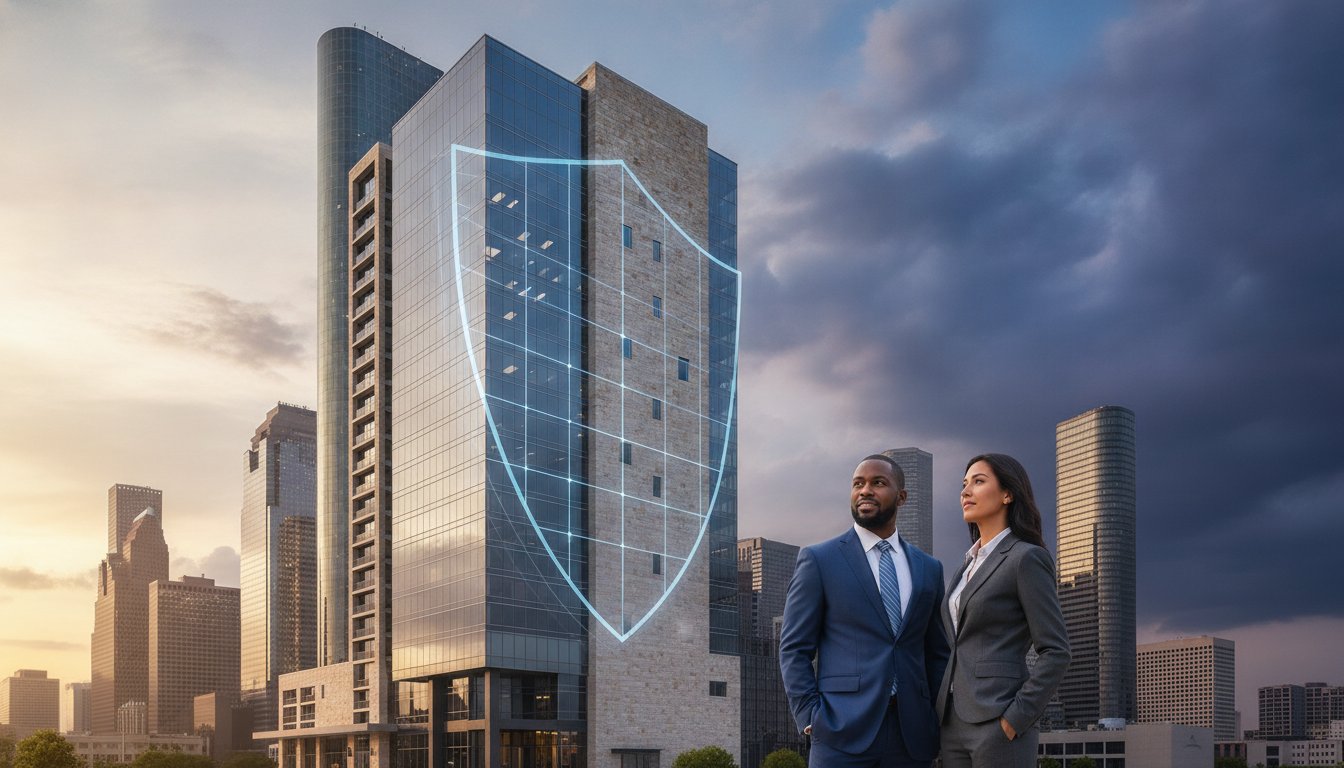
While national insurance trends show signs of stabilization, Texas business owners continue to face a unique set of challenges, often paying nearly 30% more for coverage than the national average. Securing reliable Commercial Property Insurance in 2026 requires more than just a standard policy; it demands a strategic understanding of how regional risks like Gulf Coast hurricanes and stricter roof underwriting standards affect your bottom line.
You're likely concerned about the persistent volatility of premiums in the Houston area or whether your current valuation will actually cover a total loss after a major storm. It's frustrating to navigate the technical nuances of replacement cost versus actual cash value when the continuity of your business is on the line.
This expert guide clarifies the complexities of the Texas market to help you protect your assets and maintain compliance with strict lease or loan requirements. We'll examine the latest Texas Department of Insurance reporting mandates, the critical importance of ordinance or law coverage, and the specific steps you can take to ensure your property remains resilient against evolving weather patterns and shifting carrier requirements.
Commercial Property Insurance serves as a fundamental risk management tool for Texas enterprises, providing the financial capital necessary to repair or replace physical assets when damaged by covered perils. Whether the cause is a localized fire or a significant windstorm, this coverage addresses both the building itself and the business personal property housed within it. Conceptually, Property insurance is designed to restore an organization to its pre-loss state, ensuring that a single catastrophic event doesn't lead to permanent insolvency.
To better understand how these policies function in a real-world setting, watch this helpful video:
Many owners focus solely on the exterior walls, but the scope of protection is significantly broader. It extends to fixed assets such as HVAC systems, outdoor signage, and even the landscaping that defines your professional presence. Inside the facility, the policy covers operational assets including specialized machinery, computer networks, and essential business records. Inventory protection is equally vital, encompassing raw materials and finished goods awaiting shipment. Whether the property is owned outright or is simply in your care, custody, or control, a well-structured policy accounts for the full spectrum of your physical investments.
A common error among tenants is assuming the landlord's policy covers their internal interests. While a property owner insures the building's shell, they aren't responsible for your Tenant Improvements and Betterments (TIB). If you've invested in custom flooring, specialized lighting, or wall partitions, you must insure these yourself to avoid a total loss. Additionally, it's vital to distinguish between different types of risk. While General Liability Insurance addresses third-party injuries or property damage, it won't protect your own inventory from a fire. Relying on liability coverage for property protection creates a dangerous gap in any risk management strategy.
Selecting the right tier of coverage is a technical decision that determines how your policy responds during the claims process. Most policies fall into three distinct categories based on the language used to define covered events. According to data from the Insurance Information Institute, commercial lines represent a massive portion of the insurance market, yet many owners don't realize that the specific form they choose dictates the "burden of proof." In a named peril policy, the policyholder must prove the damage was caused by a listed event. Conversely, in an open peril policy, the insurer must prove the event is specifically excluded to deny the claim. This distinction is critical for maintaining financial stability after a loss.
The Basic Form is the most restrictive tier of Commercial Property Insurance. It generally provides protection against a limited list of primary risks, such as fire, lightning, and internal explosions. The Broad Form expands this list slightly, adding coverage for falling objects and the weight of ice or snow. While snow-related risks might seem less relevant in coastal regions, they're essential for North Texas operations facing increasingly volatile winter storms. These forms are often utilized for high-risk properties where premiums for comprehensive coverage are prohibitive, or for low-value storage facilities where the overall risk profile is limited. Choosing these forms requires a high tolerance for risk, as any event not explicitly named remains your financial responsibility.
The Special Form is the industry standard for modern Texas enterprises. It flips the script on traditional coverage by protecting everything except for items specifically excluded in the policy text. This "Open Peril" approach provides the highest level of security because it accounts for unforeseen accidents that a named peril list might miss. For Houston-area businesses exposed to complex weather patterns and local operational hazards, this broad protection is indispensable. However, it's not a "catch-all" solution. Standard Commercial Property Insurance forms still exclude certain events like nuclear hazards, war, and gradual "wear and tear" resulting from poor maintenance.
Even with a Special Form, you must account for major gaps like flood and earth movement. These are almost never included in standard policies and require separate endorsements or standalone coverage to ensure full protection. Navigating these technical tiers requires a professional eye to ensure your assets aren't left exposed by a simple paperwork oversight. If you're unsure which form currently governs your assets, you can consult with an independent broker to review your existing policy language and identify potential vulnerabilities before a claim occurs.
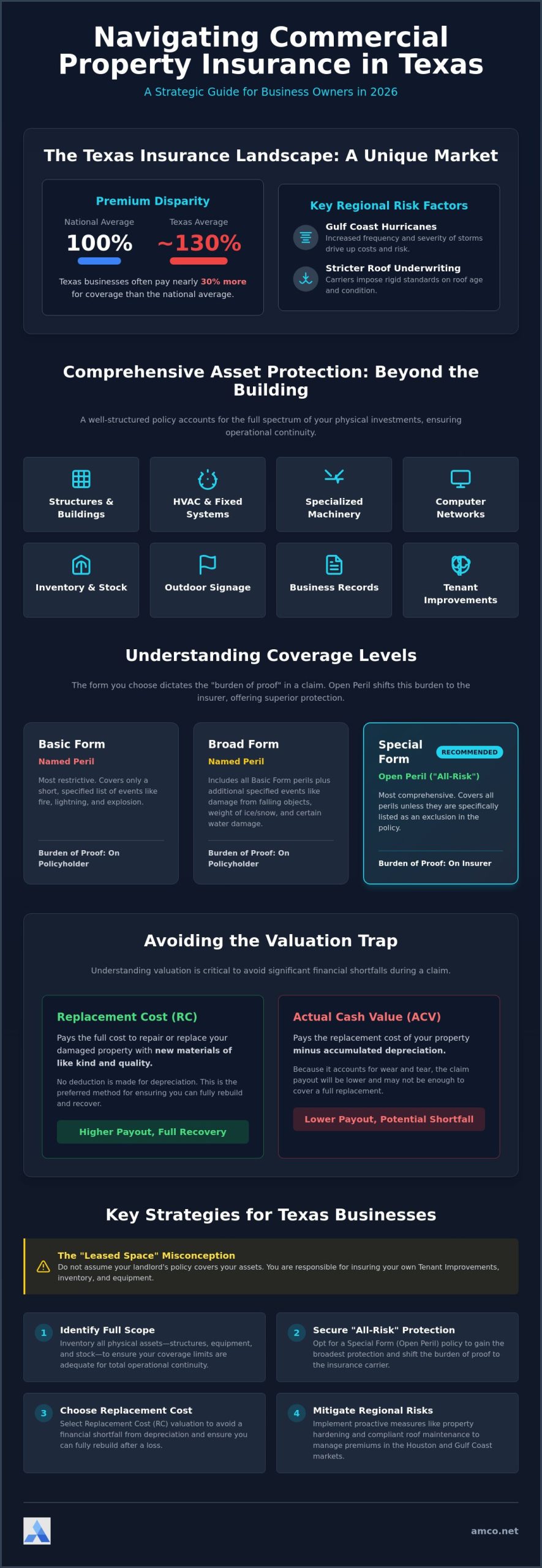
Determining the appropriate valuation method is perhaps the most consequential financial decision you'll make when structuring your Commercial Property Insurance. The choice between these two methods dictates how much capital will be available to your business following a loss. Actual Cash Value (ACV) represents the depreciated value of your property at the time of the incident. In contrast, Replacement Cost (RC) provides the funds necessary to purchase new equipment or rebuild your facility at current market prices. Understanding the technical nuances of Replacement Cost vs. Actual Cash Value is essential for avoiding significant out-of-pocket expenses during a recovery period.
A frequent oversight in policy management is the "Co-insurance Clause." This provision acts as a safeguard for insurers but often becomes a trap for under-insured businesses. Co-insurance is a requirement to insure property to at least 80% of its total value to avoid significant financial penalties during a claim. If your reported values fall below this threshold, the carrier may apply a pro-rata penalty to your payout. This means you could receive only a fraction of your loss, even if the damage is well below your total policy limit. Maintaining accurate, up-to-date valuations isn't just a best practice; it's a requirement for full policy performance.
Choosing a valuation method depends on your specific asset lifecycle. Replacement Cost is vital for critical technology and specialized machinery. You simply can't replace a damaged 2026 server with the cash value of a 2018 model; the operational gap would be too great. ACV might be appropriate for older, non-critical structures where the premium savings outweigh the risk of a lower payout. It's also important to distinguish between market value and insurance value. Your tax appraisal or the price you could sell the building for today isn't your insurance limit. Insurance value focuses strictly on the cost of labor and materials required to rebuild from the ground up.
The economic climate of 2026 has introduced significant volatility into construction and labor costs across Texas. Rising material prices directly affect your Total Insurable Value (TIV), making old policy limits obsolete. We recommend an annual valuation review with your trucking insurance agency or local broker to ensure your limits reflect current reality. To mitigate this risk, many businesses now include inflation guard endorsements. These endorsements automatically increase your coverage limits by a set percentage throughout the year, providing a layer of protection against unexpected spikes in rebuilding costs.
Operating a business in the Houston area requires a sophisticated approach to cost management, particularly as regional weather patterns continue to drive premium volatility. Commercial Property Insurance in Texas is often more expensive than in other states, making risk mitigation a financial necessity rather than an optional safeguard. By implementing advanced security systems and certified fire suppression technologies, you can demonstrate a lower risk profile to underwriters, which often results in more favorable premium rates. Additionally, specialized endorsements like equipment breakdown and spoilage coverage are essential for businesses relying on climate-controlled inventory or complex machinery, ensuring that mechanical failures don't lead to catastrophic financial leaks.
Texas policies typically distinguish between an "All Other Perils" (AOP) deductible and a specific "Wind/Hail" deductible. While your AOP might be a manageable flat fee, the Wind/Hail deductible is often calculated as a percentage of the property’s total value, frequently ranging from 1% to 5%. For businesses in Tier 1 coastal counties, the Texas Windstorm Insurance Association (TWIA) remains a vital resource for securing coverage that private carriers might decline. Beyond insurance, structural investments play a significant role in long-term savings. Installing impact-resistant roofing or storm shutters can significantly reduce your exposure, allowing brokers to negotiate better terms with top-tier carriers.
For small to mid-sized enterprises, the Business Owner’s Policy (BOP) represents the most efficient way to secure essential protections. A BOP bundles property coverage with general liability, providing a streamlined solution that's typically more cost-effective than purchasing separate policies. To create a truly holistic defense, many owners choose to integrate their Workers Compensation Insurance with their property and liability package. This integrated approach simplifies administrative oversight and ensures there are no gaps in your operational security.
The primary advantage of working with an independent agency is the ability to leverage a diverse carrier portfolio. We don't represent a single insurance company; we act as consultants who shop the market on your behalf to find the best alignment between your risk profile and available rates. If you're looking to optimize your current coverage or explore more competitive pricing, you can request a comprehensive policy review to identify where your premiums could be better allocated.
Selecting the right Commercial Property Insurance is a high-stakes technical decision that requires more than just a digital algorithm or a national call center. Based in Houston, AMCO has operated as an independent agency since 1987, providing the deep regional expertise necessary to navigate the volatile Texas market. Our role as an independent agency allows us to act as consultants rather than salesmen. We leverage our extensive carrier relationships to filter through diverse portfolios, ensuring that your specific risk profile is matched with the most competitive rates and robust coverage terms available in 2026.
When disaster strikes, having a local advocate makes a quantifiable difference in the recovery process. National providers often struggle to grasp the specific nuances of a Gulf Coast hurricane claim or a localized North Texas hailstorm. We provide direct claims support, acting as your liaison with the carrier to ensure that the valuation methods and coverage forms discussed in previous sections are applied correctly. This local advocacy ensures your business continuity isn't delayed by administrative friction or a lack of regional context.
Modern risk management also requires digital efficiency. We've integrated advanced technology into our professional service model, allowing you to manage your insurance houston needs directly through the AMCO mobile app. Whether you need to review policy documents, update your asset inventory, or initiate a claim, our digital platform provides the transparency and speed required by modern enterprises without sacrificing the personalized touch of a dedicated broker.
Our firm has spent nearly four decades refining its approach to Texas commercial risk. We've seen the insurance landscape shift through regulatory changes and evolving weather patterns, giving us the historical perspective needed to anticipate future market trends. We reject "one-size-fits-all" mentalities. Instead, we focus on system-level solutions that address your specific operational challenges, providing fast and affordable coverage that never compromises on depth. This commitment to professional stability and technical accuracy has made us a trusted partner for businesses across the state.
The process of securing a tailored quote is straightforward and data-driven. To provide the most accurate assessment of your property, we recommend having the following information ready for our consultants:
Don't leave your business continuity to chance in an unpredictable market. Get your free commercial property insurance quote from AMCO today.
Securing your physical infrastructure requires a proactive approach to risk management that accounts for the specific economic and environmental conditions of the Texas market. By navigating the technical nuances of valuation methods and selecting the appropriate coverage form, you ensure that your enterprise remains resilient against unforeseen disruptions. Whether you're managing complex deductibles in the Houston area or aligning your policy with strict lease requirements, the right strategy is built on precision and local expertise.
Since 1987, AMCO has provided Texas business owners with the professional advocacy needed to secure robust Commercial Property Insurance through a diverse portfolio of A+ rated independent carriers. Our Houston-based team understands the operational challenges you face and offers the technical support necessary to protect your long-term investment. You don't have to navigate these complexities alone when you have a local partner focused on your stability.
Request a Personalized Commercial Property Quote from Our Houston Experts and gain the confidence of a partner dedicated to your business continuity. We look forward to helping you build a more secure future for your organization.
Texas state law doesn't legally mandate that businesses carry this coverage. However, it's virtually impossible to secure a commercial mortgage or lease professional office space without it. Landlords and financial institutions require proof of insurance to protect their underlying collateral and ensure your business can recover from physical damage without defaulting on your contractual obligations.
Deductibles vary based on the specific peril and your property's location. For general incidents like fire or theft, you'll typically see a flat dollar amount. In storm-prone regions of Texas, however, wind and hail deductibles for Commercial Property Insurance are often percentage-based, ranging from 1% to 5% of the building's total insured value. This means a property insured for $1 million could have a $50,000 deductible for hurricane damage.
Standard commercial policies do not cover flood damage, which is a critical distinction for business owners in the Houston area. Because flood is an excluded peril, you must purchase a separate flood insurance policy through the National Flood Insurance Program or a private carrier. This ensures your inventory and structure are protected from rising water, which is technically different from wind-driven rain damage.
Insurance value is calculated using either Replacement Cost or Actual Cash Value, rather than the property's current real estate market price. Replacement Cost estimates the labor and material expenses required to rebuild your facility from scratch at 2026 rates. Actual Cash Value takes that rebuilding cost and subtracts depreciation based on the age and condition of the assets at the time of the loss.
You can integrate your property coverage with other essential lines, including commercial trucking insurance. Bundling these policies under a single independent agency simplifies your administrative oversight and often qualifies your business for multi-policy discounts. This comprehensive approach ensures that both your fixed terminal assets and your mobile fleet are managed within a unified risk management framework.
If your coverage limits are insufficient to cover a total loss, you'll be responsible for the financial gap between the policy payout and the actual rebuilding costs. If you haven't met the co-insurance requirements specified in your policy, the insurer may also apply a penalty that reduces your payout even for partial losses. This makes accurate annual valuations essential for avoiding severe out-of-pocket expenses during recovery.
You can reduce your Commercial Property Insurance premiums by implementing verified risk mitigation strategies, such as installing monitored fire alarms or impact-resistant roofing. Increasing your deductible is another effective way to lower monthly costs, provided your business maintains enough liquidity to cover the higher initial expense during a claim. Consistently reviewing your policy with an independent broker helps identify more competitive carrier options as the market shifts.
Standard property insurance typically covers equipment only while it's located at the insured premises. For tools or specialized machinery stolen from a vehicle, you generally need an Inland Marine endorsement or a separate policy. This specialized coverage follows your equipment wherever it goes, providing protection during transit or while stored at off-site project locations across Texas.