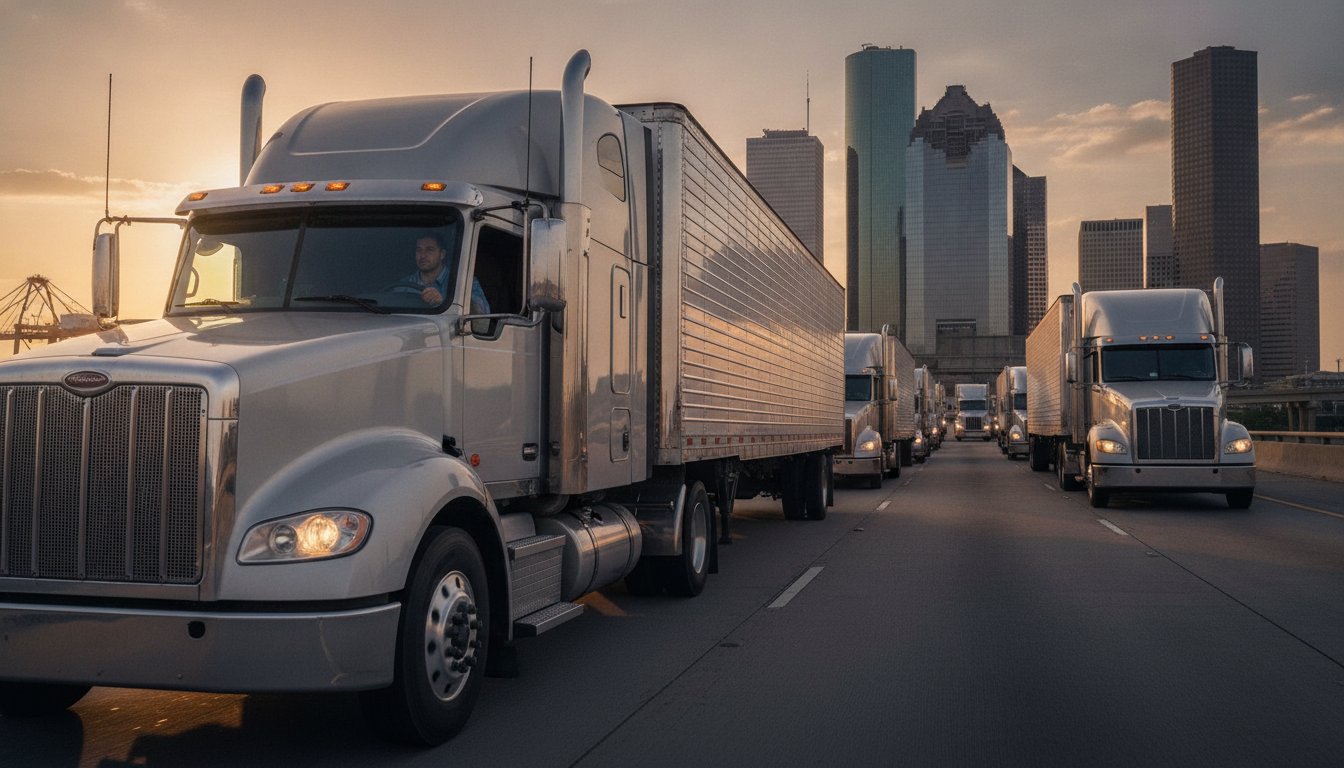
In 2025, Port Houston processed a record 4,303,345 TEUs, fueling a logistics boom that has turned the Texas Triangle into a high-stakes arena for motor carriers. While the volume of cargo is at an all-time high, so is the complexity of protecting your assets. You likely recognize that securing commercial trucking insurance Houston requires more than just meeting a minimum filing. It's about surviving a market defined by rising premiums and the persistent risk of nuclear verdicts in Texas courts.
We understand that managing a fleet or operating as an owner-operator in this environment feels like a constant balancing act between regulatory compliance and financial viability. You're dealing with a dual regulatory system where intrastate and interstate rules often overlap and confuse even seasoned operators. This definitive guide will help you master the technical nuances of the 2026 landscape. We'll examine the new March 2026 non-domiciled CDL rules, clarify the differences between TxDMV and FMCSA requirements, and show you how to leverage SAFER scores to access more competitive rates. By the end of this guide, you'll have a clear roadmap to secure comprehensive, cost-effective coverage that protects your business's longevity.
Commercial trucking insurance in Houston is far more than a regulatory box to check; it's a sophisticated, multi-layered protection strategy essential for motor carrier longevity. Understanding Essential Coverage Types is the first step toward building a resilient business. In a city where Port Houston handled over 4.3 million TEUs in 2025, the sheer volume of freight creates a unique pressure cooker for transportation companies. High-density logistics hubs naturally attract higher risk profiles, which makes a standard, generic policy insufficient for your bottom line.
Operating a fleet here means facing some of the most congested freight corridors in the nation. Your commercial trucking insurance Houston premiums aren't just based on your safety record. They're heavily influenced by the constant exposure on I-10, I-45, and the 610 Loop. These routes see millions of trucks annually. Carriers must account for the increased probability of accidents and litigation in these high-traffic zones. In 2026, insurers are scrutinizing route data more closely than ever to calculate these specific local risk factors.
To better understand this concept, watch this helpful video:
National call centers often lack a granular understanding of Houston’s complex geography. A local advisor knows that hauling out of the Barbours Cut Terminal involves different risks than local distribution within the Energy Corridor. This proximity to the Port of Houston is vital for correctly assessing cargo insurance needs. Local agents analyze specific route-based risks to help you avoid overpaying for coverage that doesn't fit your actual operational footprint. They understand the nuances of local terminal requirements and the specific liability limits required by major Houston-based shippers.
The 2026 regulatory environment is shifting as the Texas Department of Insurance (TDI) responds to the state's rapid industrial growth. We're seeing a trend where insurers prioritize carriers with documented safety cultures and advanced telematics. Houston's expansion as a logistics powerhouse means your insurance requirements will likely evolve as your fleet grows. To navigate these changes, many carriers rely on AMCO.NET LLC's long-standing presence in Houston. Since 1987, this expertise has helped Texas-based companies maintain stability despite fluctuating market cycles and rising litigation costs.
Primary Liability serves as the legal foundation for every motor carrier. For those operating interstate with non-hazardous freight, the FMCSA requires a $750,000 minimum limit. If your operations are strictly intrastate, the Texas Department of Motor Vehicles mandates a $500,000 combined single limit. Physical Damage coverage functions as asset protection. It covers your tractors and trailers against collision, fire, or theft regardless of fault, ensuring your capital isn't wiped out by a single highway incident.
General Liability covers risks that happen away from the steering wheel. This includes third-party injuries at your terminal or contractual liabilities during loading and unloading. It's a critical layer for businesses looking to secure commercial trucking insurance Houston that covers the full scope of their professional footprint. Without it, a simple slip-and-fall claim at a delivery site could threaten your company’s financial stability.
Owner-operators often face confusion regarding Bobtail and Non-Trucking Liability (NTL). Bobtail insurance provides coverage when the tractor is operated without a trailer, regardless of whether it's under dispatch. NTL, conversely, applies strictly when the vehicle is used for personal, non-business purposes like running errands on a day off. Misidentifying these can lead to significant gaps in protection during a claim process. Choosing the wrong one might leave you personally liable for damages occurring during "deadhead" miles.
Maintaining your authority requires strict adherence to FMCSA and Texas Department of Insurance Standards. The MCS-90 endorsement is essential for interstate commerce. It acts as a guarantee that the public is protected even if an incident isn't covered by the underlying policy. For intrastate work, Form E and Form H filings must be submitted to the state to prove you meet Texas financial responsibility laws. Professional management of these filings by AMCO.NET LLC ensures your trucks stay on the road without administrative interruptions. If you're unsure about your current filing status, consulting with an expert at amco.net can provide the necessary clarity.
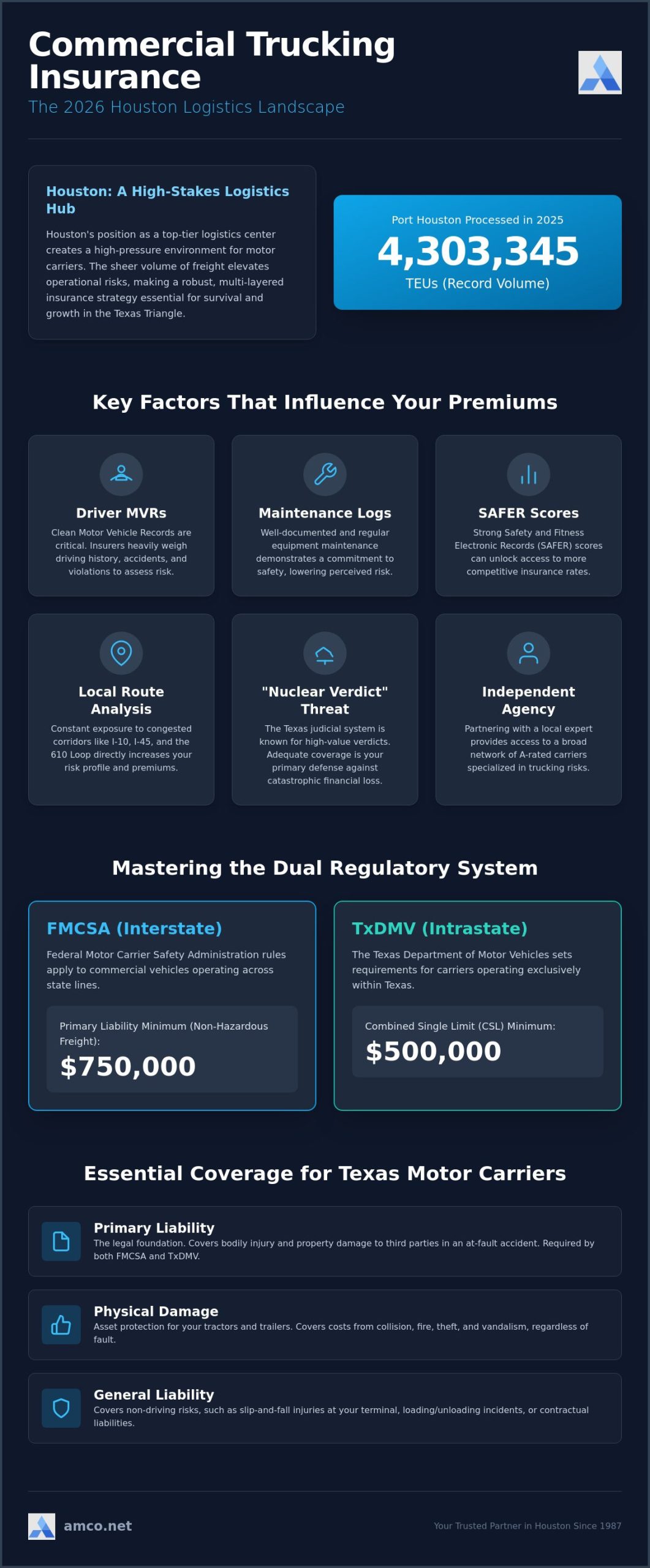
Underwriters prioritize the Motor Vehicle Record (MVR) above almost all other variables when calculating fleet rates. For Houston-based operations, a driver with less than two years of CDL experience or multiple moving violations represents a heightened liability. Insurance carriers typically look for a clean five-year history to offer the most competitive pricing. This isn't just about safety; it's about the actuarial probability of a claim in the congested Houston metro area, where traffic density increases the likelihood of minor incidents turning into major litigation.
The age and condition of your tractor and trailer units also play a central role in your insurability. Newer equipment outfitted with advanced safety features, such as lane-departure warnings and automatic emergency braking, often qualifies for lower premiums. However, the hardware is only part of the equation. Detailed maintenance logs prove to underwriters that your fleet is managed with professional rigor. Consistent upkeep reduces the risk of mechanical failure-related accidents, which is a major concern for insurers providing commercial trucking insurance Houston.
Your radius of operation dictates the specific risk pool you fall into. Local haulers operating within a 100-mile radius face different exposures than long-haul carriers crossing state lines. While interstate carriers must strictly adhere to FMCSA insurance requirements, local operations often have more flexibility in their premium structures. In a B2B context, the choice between high and low deductibles is a strategic financial decision. A higher deductible can significantly lower your fixed monthly costs, but it requires a robust cash reserve to cover out-of-pocket expenses for the first-dollar loss during an incident.
By 2026, Electronic Logging Device (ELD) data has become a standard tool for risk assessment. Underwriters analyze this data for patterns of Hours of Service (HOS) violations or frequent hard braking. Integrating telematics and dash cams provides a vital layer of defense against fraudulent "staged" accident claims, which are unfortunately common in large urban centers. Clean, verifiable data acts as a digital resume. It can lead to significant premium discounts for Houston fleets that demonstrate a commitment to technological transparency and safety.
The Safety and Fitness Electronic Records (SAFER) system is essentially your public report card. Every roadside inspection conducted in the Houston district contributes to this score. A high Out-of-Service (OOS) rate can cause traditional insurance markets to close their doors to your business, forcing you into expensive high-risk pools. Maintaining audit readiness through regular self-inspections and driver training is the most effective way to keep your insurance accessible. A favorable SAFER score ensures that multiple A-rated carriers remain willing to compete for your business.
Establishing a safety culture isn't just about avoiding fines; it's a financial necessity. In the Texas judicial climate, "nuclear verdicts" often exceed $10 million, making risk management a top priority for underwriters. Carriers that go beyond the bare minimum are rewarded with more stable rates. Regular driver training that focuses on defensive driving and situational awareness can help lower long-term costs for commercial trucking insurance Houston. Securing commercial trucking insurance Houston at favorable rates depends on your ability to prove that safety is an operational priority.
Timely renewals are non-negotiable for professional motor carriers. A single day's gap in coverage can lead to an automatic suspension of your operating authority, triggering a cascade of administrative headaches. For new carriers, the FMCSA New Entrant Safety Audit is the first major hurdle. Preparation involves organizing driver qualification files, drug and alcohol testing records, and hours-of-service documentation long before the inspector arrives. Success in this audit proves to insurers that your business is built on a foundation of professional compliance.
Maintaining an active DOT number requires more than just a one-time registration. You must update your MCS-150 every two years or whenever your fleet size changes significantly. Your Unified Carrier Registration (UCR) must also be paid annually to stay compliant with interstate regulations. The MCS-90 is a public protection guarantee, not a direct insurance for the carrier. It ensures third parties are compensated even if the carrier's policy has exclusions that might otherwise deny a claim. Failing to manage these filings accurately can result in your trucks being placed out of service during a roadside inspection.
Hiring the right drivers is your best defense against rising premiums. Implementing Pre-Employment Screening Program (PSP) reports allows you to see a driver’s five-year crash and three-year inspection history. This data is often more telling than a standard MVR. A proactive maintenance schedule also reduces liability exposure by preventing mechanical failures that lead to roadside out-of-service orders. Consulting with local Houston insurance experts to audit your current safety protocols can identify gaps before they become costly claims.
Staying compliant in a shifting regulatory landscape requires constant vigilance. Whether you are a new entrant or an established fleet, professional guidance ensures your filings are accurate and your risk profile remains attractive to top-tier insurers. For a comprehensive review of your current coverage and compliance status, visit amco.net to speak with a transportation specialist today.
Longevity in the insurance sector is a primary indicator of reliability and expert competence. AMCO.NET LLC has served the Texas transportation industry since 1987, providing a stable foundation for carriers through nearly four decades of market shifts. This 39-year history allows us to offer more than just a policy; we provide deep institutional knowledge of the local landscape. We recognize that commercial trucking insurance Houston is a dynamic component of your business's financial health rather than a static expense.
Our approach moves beyond the limitations of automated, one-size-fits-all digital quotes often found on generic direct-to-consumer platforms. We focus on customized risk management that aligns with your specific operational goals. This comprehensive support extends from the initial consultation through meticulous claims handling and proactive certificate management. By treating insurance as a complex system, AMCO.NET LLC ensures that your fleet remains protected against both common road risks and the broader economic pressures of the logistics industry.
Working with an independent agency provides a significant competitive advantage for motor carriers. While some providers are limited to their own proprietary underwriting guidelines, AMCO.NET LLC maintains relationships with multiple A-rated carriers. This grants you access to niche markets that specialize in high-risk or high-value cargo. This flexibility is vital as your fleet grows. If your risk profile changes or a specific carrier raises rates, we have the agility to pivot your coverage to a more cost-effective provider without interrupting your authority. During complex claims, we act as your professional advocate, ensuring that the insurer fulfills its contractual obligations to your business.
Precision during the onboarding phase prevents costly coverage gaps. To secure an accurate commercial trucking insurance Houston quote, you should have your current Motor Vehicle Records (MVRs), a detailed equipment list, and at least three years of loss runs ready for review. We also analyze your safety protocols to present your business in the best possible light to underwriters. This thorough initial consultation identifies potential vulnerabilities before they become financial liabilities. Our goal is to streamline your compliance so you can focus on the road. Secure your fleet today with a customized Houston trucking insurance quote from AMCO.NET LLC and experience the stability of a partner who understands the Texas trucking industry from the inside out.
The 2026 Houston logistics landscape offers immense opportunity but requires a disciplined approach to risk management. Successfully navigating this environment means moving beyond basic compliance to establish a culture of safety that protects your capital. By mastering the nuances of Texas filings and leveraging technology for ELD transparency, you position your business to thrive despite rising premiums and the threat of nuclear verdicts in state courts.
Securing the right commercial trucking insurance Houston isn't a task to be handled through automated portals alone. You need a partner with the historical depth to understand local operational challenges. Since 1987, AMCO.NET has provided this stability, offering access to multiple A-rated trucking carriers and dedicated local support for complex filings and claims management.
Don't leave your fleet's longevity to chance. Let our experts audit your current coverage and build a resilient system that supports your long-term growth. Get Your Competitive Houston Commercial Trucking Insurance Quote Now. Your business deserves a foundation built on professional expertise and decades of Texas transportation experience.
Texas intrastate carriers must maintain a minimum of $500,000 in liability coverage as mandated by the Texas Department of Motor Vehicles. Interstate carriers operating under FMCSA jurisdiction generally require a $750,000 minimum for non-hazardous freight. However, many Houston-based shippers and brokers contractually require $1,000,000 in liability and $100,000 in cargo coverage to ensure adequate protection during terminal operations and transit.
Estimated annual premiums for an established owner-operator with a clean record in Texas range from $9,000 to $19,000 in 2026. For a new motor carrier in their first year of operation, the typical range is between $13,000 and $22,000. These figures are industry averages and vary based on your specific safety scores, the value of your equipment, and the type of cargo you transport.
The MCS-90 is a mandatory federal endorsement for interstate motor carriers that serves as a public protection guarantee. It ensures that third parties receive compensation for injuries or property damage even if an incident isn't covered by the underlying policy. While it doesn't provide direct protection for the carrier, it's a vital component of commercial trucking insurance Houston for those operating across state lines.
You can secure insurance with a new authority, though underwriters view a lack of operational history as a higher risk factor. New entrants should expect to pay higher initial premiums and may have access to fewer insurance markets during their first year. Providing a documented safety plan and hiring drivers with at least two years of CDL experience can help make your new business more attractive to A-rated carriers.
Bobtail insurance provides coverage for the tractor when it is operated without a trailer, regardless of whether the driver is under dispatch. Non-Trucking Liability applies strictly to the personal use of a commercial vehicle when no business activity or dispatch is occurring. It's critical to select the correct coverage type to avoid claims denials during "deadhead" miles or personal transit between hauls.
High traffic density on major Houston corridors like I-10 and the 610 Loop increases the actuarial probability of accidents, which underwriters factor into your rates. Insurance carriers analyze geographic data to assess risk levels in your primary radius of operation. Maintaining a clean roadside inspection record within the Houston district is the most effective way to mitigate these location-based premium increases.
Yes, AMCO.NET provides specialized cargo insurance tailored for the high-value energy equipment and petrochemical components common in the Houston industrial sector. Our access to multiple A-rated carriers allows us to secure coverage for complex hauls, including reefer breakdown for food distribution and oversized industrial loads. We customize these policies to meet the specific liability requirements of major Texas shippers and port terminals.
Implementing advanced safety technology such as Electronic Logging Devices, dash cameras, and telematics can lead to significant premium discounts. Underwriters use this verifiable data to confirm Hours of Service compliance and defensive driving habits. By demonstrating a commitment to technological transparency, you reduce your overall risk profile and gain access to more competitive commercial trucking insurance Houston markets.