


If a 1099 contractor is injured on your job site tomorrow, do you know exactly who pays the medical bills, or are you betting your business on a handshake? You likely appreciate the flexibility of the Texas market, as it remains the only state where workers' compensation isn't strictly mandatory for most private employers. However, this freedom often creates significant confusion when you're trying to determine: do I need workers comp for 1099 employees in Texas to avoid a lawsuit?
It's a valid concern, especially when clients demand a Certificate of Insurance or when you consider the $200 penalty per misclassified worker for government contracts. This 2026 guide provides a clear look at the current legal landscape, including the latest medical reimbursement rates and non-subscriber reporting requirements. You'll learn how to distinguish between a true independent contractor and a "de facto" employee, ensuring your business remains protected from the high costs of civil litigation and administrative penalties. We will also outline the steps to secure a professional quote so you can maintain the stability and operational continuity your business requires.
Texas occupies a unique position in the American regulatory landscape. It's currently the only state that does not mandate workers' compensation insurance for the majority of private employers. When business owners ask, "do I need workers comp for 1099 employees in Texas," the answer depends on your specific industry and your tolerance for litigation risk. While the law grants you the freedom to opt out, this choice carries deep structural implications for your company's financial stability. In the eyes of the law, a "1099" is an independent contractor, a separate business entity that typically manages its own risks. However, labeling someone a contractor on a tax form doesn't automatically exempt your business from liability if an accident occurs on your job site.
The term "1099 employee" is a legal oxymoron that frequently triggers audits from the Texas Workforce Commission (TWC). A worker is either an employee or a contractor; they cannot be both. Understanding the Employee vs. Independent Contractor Distinction is essential for any decision-maker. If the state determines you've misclassified a worker to avoid insurance costs, you could face back taxes, unpaid overtime claims, and significant administrative fines. In 2026, the scrutiny on these classifications has intensified, making it vital to ensure your contracts match the daily reality of your operations.
To better understand how these insurance requirements apply to your specific business model, watch this helpful video:
Under the Texas Workers’ Compensation Act, private employers can choose to be "subscribers" or "non-subscribers." Choosing not to carry coverage makes you a non-subscriber. This status requires you to follow strict reporting protocols with the Texas Department of Insurance (TDI). Specifically, you must file DWC Form-005 every year between February 1 and April 30 to notify the state of your non-coverage. You're also required to post notices in your workplace and inform new hires in writing. While approximately 20% to 25% of Texas businesses operate without this insurance, they do so without the legal protections that shield subscribers from personal injury lawsuits. If a worker gets hurt, a non-subscriber can be sued for the full extent of damages without the benefit of standard common-law defenses.
Independent contractors are generally responsible for their own insurance and safety protocols. The TWC and Texas courts apply the "Right to Control" test to determine if a 1099 worker is truly independent. This test examines whether you control the specific details of how the work is performed, rather than just the final result. If you provide the equipment, set the specific daily schedule, and supervise the methods used, the state may view that worker as an employee. In that scenario, the question "do I need workers comp for 1099 employees in Texas" becomes a matter of urgent compliance. True contractors operate their own independent businesses, use their own tools, and often work for multiple clients, which justifies their exclusion from your policy.
The term "1099 employee" is a common industry phrase, but it represents a dangerous legal paradox. In regulatory terms, a worker is either an employee or an independent contractor. There is no middle ground. When managers ask, "do I need workers comp for 1099 employees in Texas," they are often trying to balance cost savings with operational safety. However, mislabeling a worker to avoid insurance premiums or payroll taxes can lead to severe financial consequences, including liability for back wages and unpaid overtime across your entire workforce.
Both the IRS and the state use specific criteria to determine a worker's true status. The Texas Workforce Commission Guidelines offer a framework to evaluate these relationships. If the state determines that you've maintained an employer-employee relationship while paying the worker as a contractor, your business becomes liable for unpaid unemployment taxes and potentially the full cost of any workplace injuries. Ensuring your contracts are precisely drafted is the first step in maintaining your company's professional integrity.
The primary factor in any classification dispute is who has the right to control the "when, where, and how" of the work. If your company dictates the specific sequence of tasks, provides the necessary tools, and sets a rigid daily schedule, the worker is likely an employee in the eyes of the law. True independent contractors typically bring their own specialized equipment and are paid per project rather than by the hour. They operate as separate business entities, assuming their own profit and loss risks. If you're unsure how these rules apply to your current team, consulting with a specialist at AMCO.NET LLC can help you identify potential gaps in your strategy.
Insurance carriers conduct annual audits to ensure the premiums you pay match your actual risk exposure. During these reviews, auditors examine your 1099 payments and general ledger. If they find contractors who don't have their own Certificate of Insurance (COI) or who appear to be under your direct control, they'll likely reclassify them. This results in a "surprise" bill for back-premiums that can disrupt your cash flow. To mitigate this risk, you should implement a rigorous vetting process:
By treating classification as a core business process rather than an afterthought, you protect your company from the volatility of sudden audits and legal challenges. This methodical approach ensures your business remains a stable partner in the Texas B2B sector.
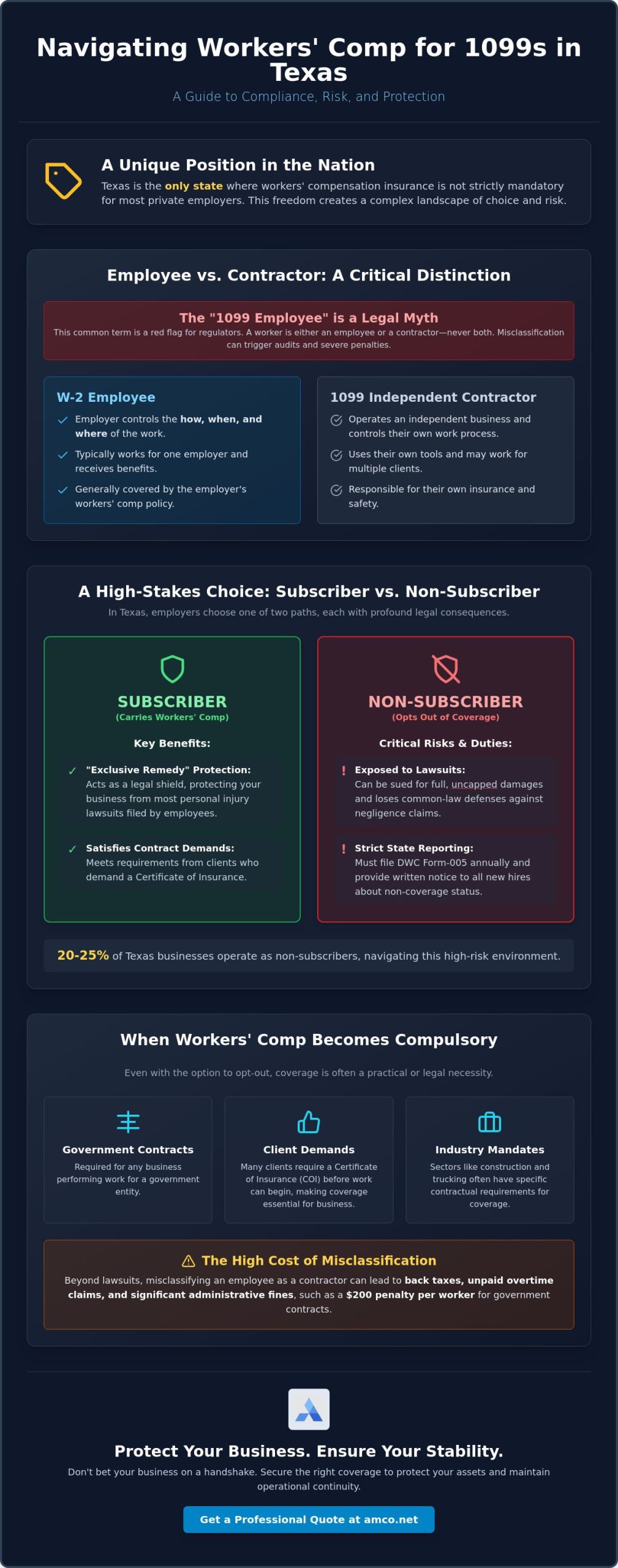
The flexibility of the Texas insurance market often leads to a dangerous misconception: that the absence of a mandate equals an absence of risk. While you can legally operate as a "non-subscriber," doing so removes the primary legal shield known as the Exclusive Remedy rule. Under this rule, businesses that carry workers' compensation are generally protected from personal injury lawsuits; the employee's only recourse is the benefits provided by the policy. When you ask, "do I need workers comp for 1099 employees in Texas," you're really asking if you're prepared to defend your company's assets in a civil court where damages are uncapped and unpredictable.
A 1099 contractor who suffers a workplace injury can still sue your business for negligence. If that contractor is later reclassified as an employee by a judge or the TWC, your status as a non-subscriber becomes a massive financial liability. The Texas Workers' Compensation Guide outlines that while coverage isn't mandatory, the state intentionally makes it difficult for non-subscribers to win in court. In 2026, with the maximum weekly temporary income benefit set at $1,271.05, the cost of medical care and lost wages adds up quickly. A single catastrophic accident could easily exceed the total premium costs of several years of coverage.
Texas law penalizes non-subscribers by stripping away three fundamental common-law defenses. First, you lose the defense of contributory negligence. Even if the contractor was 90% responsible for their own injury, you could be held liable for 100% of the damages. Second, the "assumption of risk" defense is barred; you can't argue that the contractor knew the job was inherently dangerous. Finally, you lose the "fellow servant" rule, meaning you're responsible even if the injury was caused by the actions of another contractor or employee. Without these defenses, winning a negligence lawsuit is statistically improbable for most businesses.
Relying solely on your business liability insurance to cover workplace injuries is a strategic error. Most General Liability (GL) policies contain explicit exclusions for bodily injury to any worker, including independent contractors. This creates a coverage gap that leaves your personal and business assets exposed. While some firms explore Occupational Accident insurance as a middle ground, it doesn't provide the same statutory immunity as workers' compensation. Given that the Texas Department of Insurance approved an average rate reduction of 11.5% in 2025, securing a formal policy is often the most cost-effective way to ensure technological and financial continuity for your operations.
Managing a fleet of subcontractors requires precise documentation and an understanding of how these state-specific forms interact with your overall risk profile. If you're navigating complex project requirements, you can request a consultation for your specific industry needs to ensure every worker on your site is properly accounted for. This methodical oversight prevents the "misclassification trap" and ensures your business remains a reliable partner for large-scale Texas developments.
Since 1987, AMCO.NET LLC has provided Texas business owners with the professional expertise required to manage complex insurance portfolios. When you evaluate the question, do I need workers comp for 1099 employees in Texas, you aren't just looking for a policy; you're looking for a strategic risk management partner. Our deep understanding of the local regulatory environment allows us to offer personalized assessments that distinguish between genuine 1099 independence and the types of relationships that invite state intervention. We focus on technological continuity and operational safety, ensuring your business isn't derailed by sudden litigation or administrative audit failures.
Our presence in the Houston market for nearly four decades has given us a unique vantage point on how the Texas Department of Insurance (TDI) manages its non-subscriber system. We recognize that every dollar spent on premiums must yield a tangible return in the form of asset protection and client trust. By securing a statutory policy through AMCO.NET LLC, you satisfy the requirements of major shippers and government entities while positioning your business as a stable, reliable partner in the B2B sector. We help you determine: do I need workers comp for 1099 employees in Texas to maintain my professional standing?
Our team brings decades of experience across diverse sectors, ranging from complex commercial risks to car insurance in Houston. This broad market perspective is critical because workers' compensation doesn't exist in a vacuum. It must integrate with your general liability and trucking policies to eliminate coverage gaps that could expose your personal assets. Because we maintain relationships with multiple carriers, we can shop the market to find rates that align with your production goals and ROI targets.
We also stand by our clients during the annual audit process. Auditors often look closely at 1099 payments, and without proper documentation, these can be reclassified as payroll. We help you organize your records and verify contractor COIs, ensuring you don't face unexpected bills at the end of the policy year. This level of support is what differentiates a professional agency from a mere vendor, providing you with the peace of mind needed to focus on your core operations.
Securing a policy is a methodical process that begins with a thorough review of your operational data. To provide an accurate quote, we'll need your estimated annual payroll, a description of your business activities, and the specific class codes relevant to your industry. This data-driven approach ensures your premiums are based on actual risk rather than generic estimates. You can take the first step toward securing your company's future today.
Request a Workers’ Comp Quote from AMCO.NET LLC
Maintaining a competitive edge in the Texas market requires a precise understanding of your liability exposure. The distinction between a true contractor and a "de facto" employee isn't just a tax detail; it's a structural boundary that dictates your company's legal safety. While non-subscription offers flexibility, it simultaneously strips away the common-law defenses that protect your assets in civil court. Successfully determining do I need workers comp for 1099 employees in Texas involves evaluating your specific contracts and industry mandates to ensure you aren't left vulnerable to sudden audits or litigation.
Get a Fast Workers’ Comp Quote for Your Texas Business
Workers' compensation isn't mandatory for most private employers in Texas, making it the only state with such a system. While you can choose not to carry it, this freedom doesn't apply to those working on government projects. For public works, every subcontractor and worker must be covered. Most businesses still choose to subscribe to ensure operational continuity and to satisfy the requirements of major B2B clients who demand proof of coverage.
Yes, a 1099 contractor can file a personal injury lawsuit against you if they're injured while performing work for your business. Because you're a non-subscriber, you're stripped of common-law defenses like contributory negligence. This means even if the contractor was partially at fault, you could still be held liable for the full amount of damages. This financial exposure is why many firms ask: do I need workers comp for 1099 employees in Texas?
The distinction rests on the "Right to Control" the details of the work performed. Employees are subject to your direction regarding their schedule, tools, and specific methods. Independent contractors operate their own separate business entities, provide their own equipment, and are responsible for the final result rather than the specific process. Misclassifying these workers can lead to significant penalties from the Texas Workforce Commission and unexpected insurance premium adjustments during a carrier's annual audit.
You should always require a Certificate of Insurance (COI) before any contractor begins work on your site. A valid COI provides documented proof that the contractor maintains their own workers' compensation or occupational accident policy. It's a standard professional practice to verify these documents annually. If a contractor cannot provide this proof, your insurance carrier will likely view them as an employee and charge you a premium for their coverage during your year-end audit.
A non-subscriber is a Texas employer who has opted out of the state's workers' compensation system. While this avoids premium costs, it's highly risky because it exposes the business to uncapped civil litigation. In a lawsuit, you cannot argue that the worker assumed the risk of the job or that a colleague's negligence caused the injury. This lack of legal protection can lead to settlements that far exceed the cost of a formal insurance policy.
You are generally responsible for covering subcontractors who don't maintain their own independent insurance policies. During a workers' compensation audit, the carrier will review your payments to 1099 contractors. If those contractors lack a COI, the auditor will add their compensation to your total payroll. This leads to a surprise bill for back-premiums. Ensuring every subcontractor has their own coverage is essential for maintaining your company's financial predictability and operational stability.
Texas utilizes specific forms to define the relationship between hiring companies and contractors. DWC Form-83 is a joint agreement to establish an independent contractor relationship for workers' compensation purposes. If you're a non-subscriber, you must also file DWC Form-005 with the state every year between February 1 and April 30. Filing these documents correctly helps clarify your legal standing and reduces the risk of reclassification during a state audit or a complex legal dispute.
Occupational Accident insurance is an option, but it's not a legal substitute for statutory workers' compensation. While it provides benefits for medical expenses and lost wages, it doesn't grant you the "exclusive remedy" protection that prevents workers from suing your business. For many owners wondering, "do I need workers comp for 1099 employees in Texas," the answer is that statutory workers' comp provides a much stronger legal shield against negligence claims than Occ Acc alone.