Driving in the Lone Star State in 2026 requires more than just a valid license; it demands a sophisticated approach to risk management as premiums reach historic highs. You've likely noticed that the cost of staying on the road has climbed, making it difficult to balance state compliance with your monthly budget. It's frustrating to see rates rise even when your driving record remains clean, especially when the distinction between state minimums and actual financial security feels increasingly blurred. We understand that finding reliable texas auto insurance shouldn't feel like a compromise between your bank account and your legal standing.
This guide provides the technical clarity you need to optimize your coverage for both cost efficiency and robust protection. We'll help you navigate the current 30/60/25 liability requirements while identifying the specific strategies that high-risk drivers and commuters can use to secure better rates. You will gain a clear understanding of how to leverage independent brokerage expertise and digital policy management to ensure your vehicle remains a tool for progress rather than a source of financial strain. From decoding full coverage myths to managing SR-22 filings, we have outlined a methodical path toward total road-side stability.
The regulatory framework for texas auto insurance has evolved to match the technological pace of 2026. Law enforcement now utilizes the TexasSure database, a real-time digital verification system that links vehicle registrations directly with active insurance policies. This system eliminates the delay in verifying coverage during traffic stops or after collisions, making it nearly impossible to operate an uninsured vehicle without detection. While this infrastructure increases public safety, it also places a higher burden on drivers to maintain uninterrupted coverage. Rising urban density in metros like Houston and Dallas, combined with volatile regional weather patterns, has forced a shift in how risk is assessed across the state.
It's vital to distinguish between liability coverage and physical damage protection. Liability insurance is a legal requirement that pays for damages you cause to others; however, it does not cover your own vehicle. In a state where hail damage and flash flooding are frequent, relying solely on liability may leave your assets financially exposed. Comprehensive and collision coverages, though not mandated by state law, are often essential components of a robust risk management strategy.
Texas law mandates a 30/60/25 liability structure. This provides $30,000 for bodily injury per person, $60,000 for total bodily injury per accident, and $25,000 for property damage. While these figures meet the legal threshold, they are often insufficient in 2026. With the average cost of modern vehicles and medical expenses rising, a $25,000 limit for property damage might not cover a mid-range collision. Failure to maintain this minimum can result in fines reaching $350 for first-time offenders, vehicle impoundment, and a suspended license. Consistent compliance is the only way to avoid the long-term costs associated with high-risk driver designations.
Under the Texas Transportation Code, financial responsibility is defined as the ability to respond in damages for liability that results from the ownership, maintenance, or use of a motor vehicle. While most drivers satisfy this through a standard insurance policy, the law allows for alternatives such as surety bonds or deposits with the state comptroller. Regardless of the method you choose, carrying proof is mandatory. The AMCO mobile app provides an immediate digital solution, ensuring you can present valid credentials to authorities without searching for physical documents. This digital-first approach aligns with the TexasSure infrastructure to prevent unnecessary citations and administrative delays.
While the state mandates liability, the true scope of protection involves selecting elective coverages that mitigate personal financial risk. In the context of texas auto insurance, liability remains the non-negotiable starting point. It functions as a shield for your assets by covering the medical and repair costs of others when you're at fault. For drivers with financed vehicles, lenders typically mandate 'full coverage,' which is a combination of comprehensive and collision insurance. These components protect the vehicle's physical value against events like theft, hail, or multi-car collisions, ensuring that the lender's collateral remains secure.
Texas law requires insurance providers to include Personal Injury Protection (PIP) in every quote. If you choose to exclude it, the rejection must be submitted in writing. PIP offers a broader scope of benefits compared to Medical Payments (MedPay). While MedPay focuses strictly on medical and funeral expenses, PIP extends to cover 80% of lost wages and non-medical costs like essential household services. For professionals whose income depends on their physical presence, PIP serves as a critical short-term disability bridge. You can evaluate these coverage tiers through an independent agent to find the balance that suits your specific risk profile.
High-density metropolitan areas present unique challenges for road safety. In 2026, the prevalence of uninsured motorists continues to be a concern for those commuting through major hubs. Uninsured/Underinsured Motorist (UM/UIM) coverage is designed to fill this specific gap. If an at-fault driver lacks sufficient policy limits to cover your damages, your own UM/UIM policy assumes the financial burden. This protection is especially vital for residents navigating the complex freeway systems detailed in our guide to Car Insurance in Houston, TX: The 2026 Complete Driver’s Guide. Without this safeguard, a single collision with an uninsured party could lead to significant out-of-pocket expenses for vehicle repairs and medical rehabilitation.
Insurance carriers in 2026 utilize sophisticated actuarial models to determine policy pricing. These models move beyond simple age and gender metrics to include complex variables like credit-based insurance scores. In Texas, regulations allow carriers to use these scores as an indicator of financial responsibility, which data suggests correlates with driving safety. While some may find this approach intrusive, it rewards drivers who maintain stable financial records with lower premiums. Your driving history remains the most influential factor. A single speeding ticket or at-fault incident can inflate your texas auto insurance costs for three to five years, making defensive driving a financial necessity rather than just a safety precaution.
The specific vehicle you operate also dictates your rate. 2026 models equipped with advanced AI-assisted braking and lane-correction systems may qualify for safety equipment discounts. However, these same technological advancements often lead to higher repair costs, which can offset the savings. Carriers also analyze regional theft data; certain high-demand models in metropolitan areas will naturally command higher comprehensive premiums due to the increased probability of a total loss claim.
Location is a primary risk determinant. Urban density in cities like Houston and Dallas leads to a higher frequency of collisions compared to the open roads of Midland or Lubbock. Beyond traffic patterns, Houston's unique environmental challenges, including recognized flood zones, necessitate higher comprehensive rates to account for potential water damage. Drivers in Austin often face higher premiums due to significant traffic congestion and the resulting increase in minor accidents. For a detailed breakdown of how regional factors influence policy costs, you can review our Insurance in Houston, TX: 2026 Industry Insights.
Achieving cost efficiency for your texas auto insurance requires a proactive approach to policy management. Bundling is the most reliable strategy for long-term savings. When you combine your vehicle coverage with Homeowners Insurance, you create a multi-line relationship that typically yields significant percentage-based discounts.
Usage-based insurance (UBI) has matured significantly by 2026. Telematics systems now provide precise data on braking, acceleration, and time of day, allowing for personalized rates that favor low-mileage or daytime drivers. Additionally, Texas drivers should look for the following credits:
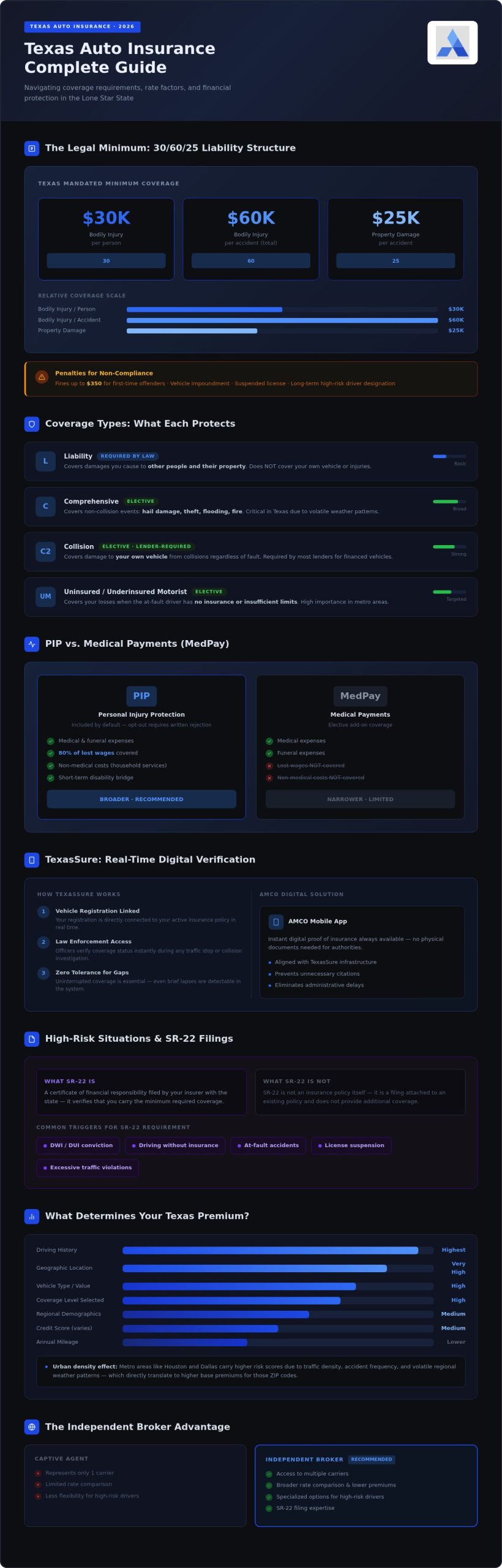
Drivers facing license suspensions or serious traffic convictions often encounter the requirement for an SR-22. It's a common misconception that an SR-22 is a specific type of policy; in reality, it's a certificate of financial responsibility that your insurance carrier files directly with the state. This document serves as a formal guarantee that you're maintaining the mandatory liability limits required for texas auto insurance compliance. The Texas Department of Public Safety (DPS) typically mandates this filing following a DUI, driving without valid insurance, or accumulating multiple at-fault accidents within a short timeframe.
In most instances, you'll need to maintain an active SR-22 filing for a continuous period of 2 years from the date of the conviction or the end of your suspension. For those who don't own a vehicle but must prove financial responsibility to reinstate their driving privileges, a 'Non-Owner' SR-22 policy is the appropriate solution. This specialized coverage provides the necessary liability protection when you're operating vehicles owned by others, ensuring you remain legally compliant without the overhead of a standard vehicle policy.
The technical integration between insurance providers and state databases means that compliance is monitored in real-time. If your policy lapses or is cancelled, the carrier is legally obligated to submit a Form SR-26 to the state, which results in the immediate suspension of your license. AMCO provides the professional oversight needed to prevent these administrative failures. We assist drivers in navigating the complex steps required after a suspension, focusing on technical continuity to get you back on the road legally. An SR-22 functions as a real-time communication link between your insurance provider and the Texas DPS to verify your ongoing financial responsibility.
High-risk drivers often find that 'big name' captive agents have rigid underwriting criteria that lead to automatic rejections or prohibitive premiums. The independent brokerage model offers a distinct advantage by providing access to a diverse network of third-party carriers that specialize in non-standard risk. Since 1987, AMCO has leveraged these relationships to compare multiple quotes, helping drivers find 'second chance' rates that are often more affordable than standard market offerings. You can request a specialized high-risk quote to compare options from carriers that understand the nuances of the Texas non-standard market.
Selecting an insurance partner is a strategic decision that affects your long-term financial stability. While captive agents are restricted to the products of a single carrier, independent brokers operate with a broader market perspective. This distinction is critical when searching for texas auto insurance that balances cost with comprehensive protection. By matching clients with multiple third-party carriers, we ensure that your policy is selected based on its technical merits and alignment with your specific risk profile rather than brand loyalty.
Since 1987, AMCO has maintained a presence in the Houston market, evolving from a local agency into a robust provider of complex coverage solutions. Our expertise extends beyond standard vehicles to include specialized sectors such as Motorcycle Insurance and commercial trucking. This multi-decade history provides us with the data and experience necessary to navigate shifting market conditions and regulatory updates in 2026. Stability is the foundation of our partnership model, ensuring that you have a reliable advocate when dealing with claims or policy renewals.
Modern policy management requires a hybrid approach that combines digital speed with expert oversight. The AMCO mobile app allows for immediate policy access and payments, yet this technology is backed by a team of professionals who understand regional nuances. Local expertise is indispensable when accounting for Texas-specific road risks and environmental factors that national, digital-only providers often overlook. If you're searching for an Insurance Company Near Me: Finding Local Expertise, our Houston-based team offers the stability and specialized knowledge required for professional risk management.
Securing an accurate quote for texas auto insurance is a streamlined process that requires specific data points to ensure precision. You should have your vehicle identification number (VIN), driver's license details, and current policy information ready for review. Our role as your intermediary means we handle the technical transition, ensuring there's no gap in coverage that could trigger a TexasSure notification or state penalties. Beyond the initial sale, we serve as your primary point of contact for claims processing and policy adjustments, providing a consistent layer of professional support. This methodical approach ensures that your insurance remains a functional asset rather than an administrative burden.
Managing your vehicle's protection in 2026 requires a transition from passive compliance to proactive risk management. As digital verification systems like TexasSure become more integrated, maintaining continuous coverage is no longer just a legal obligation but a prerequisite for administrative stability. You've seen how the 30/60/25 minimums may fall short of modern financial needs and how regional factors like urban density and weather patterns dictate your premium levels. By utilizing the expertise of an independent broker, you can navigate these complexities while ensuring your policy remains both affordable and robust.
Since 1987, our agency has specialized in matching drivers with A+ Rated carrier options that provide high-tier security. Whether you require standard texas auto insurance or specialized SR-22 filings, our team offers the professional continuity you need to stay protected. You can manage your policy and access instant digital proof of insurance via our mobile app at any time. Get a Fast & Affordable Texas Auto Insurance Quote from AMCO and experience the reliability of a partner that understands the specific challenges of the Lone Star State. We look forward to helping you drive with total confidence.
Texas law mandates 30/60/25 liability limits for all drivers. This requires $30,000 for bodily injury per person, $60,000 for total bodily injury per accident, and $25,000 for property damage. While these figures satisfy the legal threshold for texas auto insurance, they often prove insufficient for modern medical costs and high-value vehicle repairs. We recommend evaluating higher limits to protect your personal assets from litigation.
Premium costs vary significantly based on your specific risk profile, including location, driving history, and vehicle type. Metropolitan areas like Houston typically see higher rates than rural regions due to increased traffic density and higher claim frequencies. Instead of relying on broad averages, it's more effective to consult an independent broker who can compare multiple carriers to find a rate tailored to your operational needs and budget.
No, Texas operates as an at-fault state. This means the driver responsible for the collision is financially liable for the resulting damages and medical expenses. Because of this legal structure, carrying sufficient liability insurance is critical. If you're involved in an accident where the other party is at fault, their insurance provider is typically responsible for your repairs and healthcare costs up to their policy limits.
You can obtain a Non-Owner SR-22 policy if you don't own a vehicle but need to reinstate your driving privileges. This certificate proves to the state that you have the required liability coverage when operating vehicles owned by others. It's a standard solution for drivers who must satisfy Texas DPS requirements following a license suspension while they're between vehicle ownerships.
Standard liability policies don't cover flood damage. However, if your texas auto insurance policy includes comprehensive coverage, repairs or replacement costs for water damage from hurricanes and flash floods are generally covered. Given the regional climate risks in the Gulf Coast, comprehensive coverage is a vital component of a resilient risk management strategy for any Texas driver.
Driving without insurance results in immediate legal and financial consequences. First-time offenders face fines between $175 and $350; subsequent violations can lead to fines up to $1,000 and vehicle impoundment. Additionally, the state may suspend your driver's license and vehicle registration. You'll likely be required to file an SR-22 certificate for two years, which significantly increases your long-term insurance premiums.
Lowering your premiums in high-density areas like Houston requires a multi-faceted approach. Bundling your auto policy with homeowners or renters insurance is often the most effective way to secure a discount. You can also complete a state-approved defensive driving course or enroll in telematics programs that reward safe driving habits. Maintaining a clean driving record and improving your credit-based insurance score will also result in more competitive rates.
Yes, Texas law allows drivers to present digital proof of insurance during traffic stops or vehicle inspections. You can use the AMCO mobile app to display your current policy details directly on your smartphone. This digital-first approach ensures you're always prepared and eliminates the risk of being cited for failing to produce a physical insurance card when requested by law enforcement.