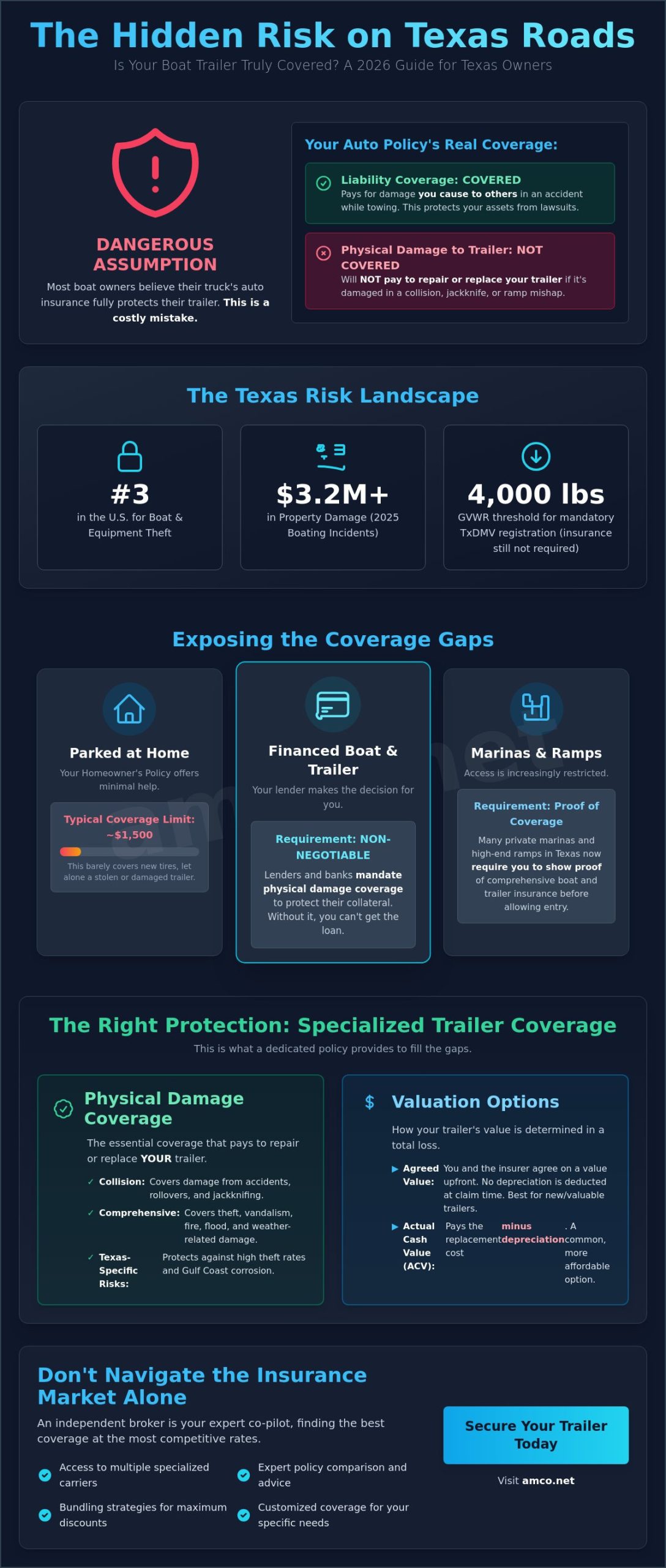
Most Texas boat owners assume their truck's insurance protects their trailer on the highway, but they're often one accident away from a denied claim. While your auto policy typically extends liability coverage to whatever you're towing, it rarely pays to repair or replace the trailer itself after a collision or a ramp mishap. Finding the right insurance for my boat trailer Texas requires understanding this specific gap in protection. Texas currently ranks third in the nation for boat and equipment theft, making specialized coverage more of a strategic necessity than a legal formality.
It's understandable if you feel frustrated by rising premiums and the complexity of overlapping policies. This 2026 guide provides the technical clarity you need to protect your investment on the road and at the marina. You'll learn the difference between agreed value and actual cash value, the nuances of TxDMV registration versus TPWD vessel titling, and how to secure affordable rates through expert local brokerage. We'll break down the specific risks of the Gulf Coast climate and provide a methodical path to ensuring your trailer is as secure as the vessel it carries.
Texas state law is surprisingly silent on the mandatory purchase of insurance for my boat trailer Texas. While the Texas Department of Motor Vehicles requires every trailer on public roads to be registered and titled if the Gross Vehicle Weight Rating exceeds 4,000 pounds, it doesn't force you to carry a specific insurance policy. This creates a common misconception among boaters. They assume that because their auto insurance provides liability coverage for the trailer while it's hitched, they're fully protected. In reality, that liability only covers damage you cause to others. It won't pay a cent to replace your trailer if it's stolen from a driveway or totaled in a highway jackknife.
Understanding the principles of Marine Insurance is vital for any owner moving a vessel across the state's highways. While the state doesn't mandate it, the financial risk of going without coverage is immense. Texas saw 178 boating incidents in 2025 alone, resulting in over $3.2 million in property damage. Relying solely on the tow vehicle's policy leaves the physical value of your trailer completely exposed to these operational hazards.
To better understand this concept, watch this helpful video:
The TDI provides the framework for how personal property is handled under standard policies. Many Texans believe their homeowners insurance covers their trailer while it's parked at home. While some policies include a small property floater for trailers, these limits are often capped at $1,500 or less. For a modern tandem-axle trailer designed for a saltwater center console, this amount doesn't even cover the cost of the tires and winch. In high-traffic areas like Houston or Dallas, the risk of a third party lacking sufficient insurance makes these low limits even more dangerous for your bottom line.
If you've financed your boat and trailer package, your lender will likely view insurance as a non-negotiable requirement. Banks require physical damage coverage to protect their collateral. If your trailer is stolen, and Texas ranks third in the nation for such thefts, the lender still expects payment in full. Finding the right insurance for my boat trailer Texas involves more than just checking a box for the DMV. Specialized policies also offer gap coverage, which is essential for new trailers that depreciate quickly. Additionally, many private marinas and high-end boat ramps in Texas now require proof of comprehensive coverage before allowing you to use their facilities.
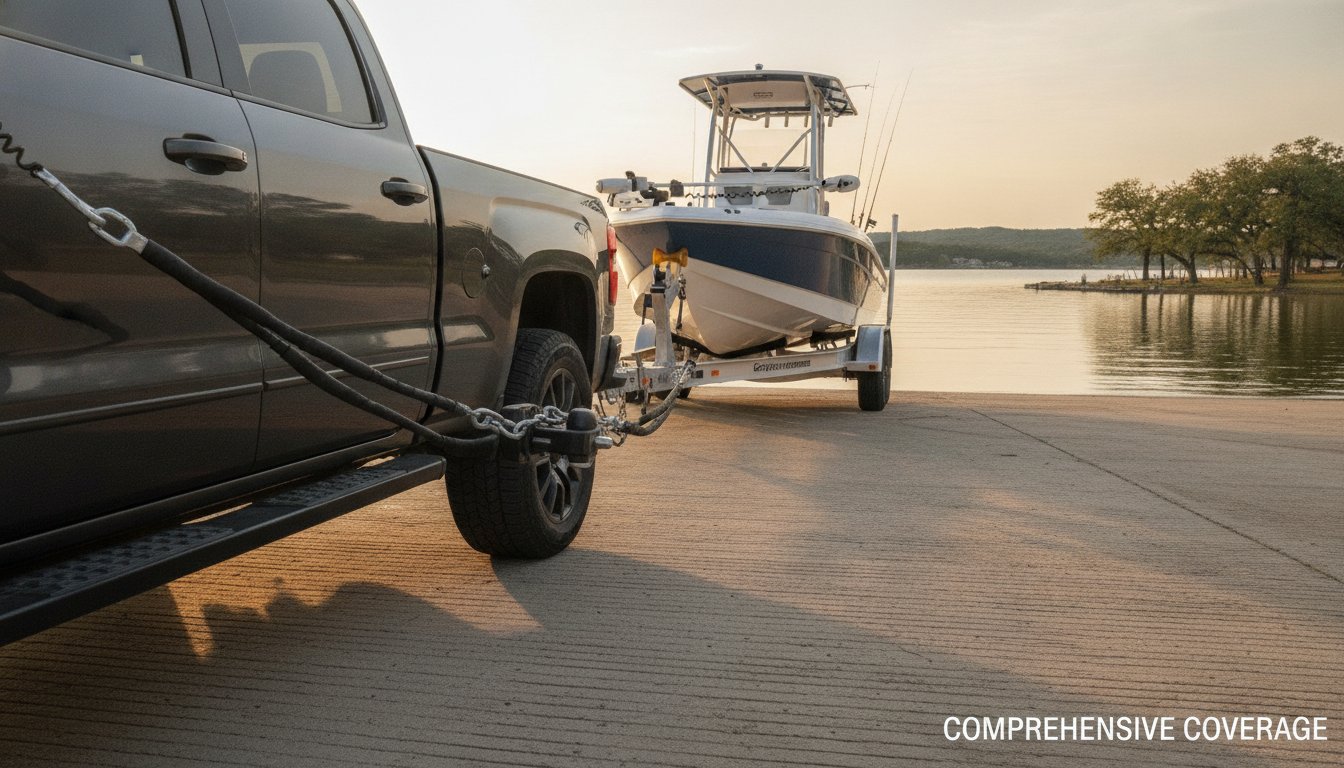
The transition between towing your vessel on a Texas highway and launching it at a public ramp represents a significant shift in insurance risk. Most operators assume a single policy covers the entire journey, but the reality is more fragmented. Understanding how liability and physical damage interact is the first step in securing proper insurance for my boat trailer Texas. When the trailer is attached to your truck, your auto policy’s liability coverage typically extends to the trailer. This means if you cause an accident, your auto insurer handles the damages to the other party's vehicle or property.
This protection stops at the trailer's own fenders. While liability follows the tow vehicle, the physical asset itself remains unprotected by the auto policy. To learn more about how boat trailer insurance works, you must recognize that "full coverage" on your truck doesn't translate to "full coverage" for the trailer. If a tire blowout causes the trailer to jackknife, destroying the frame and axle, your auto insurance will likely deny the claim for the trailer’s repair costs. This financial gap is where a specialized boat policy becomes essential.
Liability coverage is strictly designed to protect your assets from third-party claims. It doesn't provide any benefit for your own equipment. Physical damage coverage, which includes collision and comprehensive, is what actually pays to fix your trailer. In a typical Texas highway collision, the auto policy responds to the other driver's repair bills, but the boat policy is what addresses the wreckage of your trailer. Without a specific endorsement on your boat insurance, you are essentially self-insuring the trailer's value, which can often exceed $5,000 for high-capacity models.
The most dangerous "grey area" occurs at the boat ramp. Once you unhitch the trailer to park your truck, the liability extension from your auto policy often vanishes. If your trailer rolls away and strikes a bystander's vehicle while unhitched, you could be personally liable for those damages. Additionally, theft remains a primary concern at public Texas launches. Texas is consistently one of the top three states for trailer theft, with over 30,000 towable trailers reported stolen nationally in 2024. A dedicated policy ensures your investment is protected against theft and vandalism even when it's sitting idle and unattached. For a professional assessment of your current coverage gaps, speaking with an insurance specialist can provide the technical insight needed to avoid these common pitfalls.
Selecting the right insurance for my boat trailer Texas involves more than a basic liability extension. To truly protect your capital investment, you must evaluate physical damage coverage options that address specific road and storage risks. Comprehensive coverage is the primary defense against non-collision events. In Texas, where theft rates for towable equipment remain high, this component pays to replace your trailer if it's stolen from a driveway or damaged by vandalism. It also covers environmental hazards like fire or falling debris, which are common during the state’s volatile storm seasons.
Collision coverage serves a different but equally vital purpose. It addresses damages resulting from an impact with another vehicle or a stationary object, such as a guardrail or a dock pylon. While your auto policy might handle the damage to a third party's bumper, collision coverage on your boat policy is what funds the repairs for your trailer’s bent frame or broken winch post. Without these two pillars of physical damage protection, an owner is forced to absorb the full replacement cost out of pocket.
Standard roadside assistance plans often fail when a trailer is involved. Most basic auto memberships cover the truck but exclude the specialized equipment needed to recover a trailer with a seized wheel bearing or a broken axle. Specialized trailer roadside assistance is a critical add-on. It ensures that if a blowout occurs on a remote stretch of I-10, the dispatch service sends a technician capable of lifting a loaded trailer. There's a distinct difference between towing a disabled vehicle and recovering a trailer with a boat still mounted. Proper coverage accounts for both, preventing a mechanical failure from turning into a total loss of the vessel during transit.
The method used to calculate a claim payout can significantly impact your financial recovery. Most standard policies default to Actual Cash Value. Actual Cash Value is the market price minus wear and tear. While this keeps premiums lower, it rarely covers the cost of a new trailer if yours is totaled after several years of use. For owners of custom, heavy-duty, or galvanized trailers, an Agreed Value policy is often the superior choice. This approach locks in a specific payout amount at the start of the policy term. It ignores depreciation, ensuring that you have the necessary funds to purchase a comparable replacement without dipping into your savings. Choosing the right valuation method is a technical decision that stabilizes your long-term operating costs.
Operating a boat in Texas requires a specialized risk management strategy that accounts for the state’s unique environmental and urban challenges. From the hypersaline waters of the Laguna Madre to the high-density traffic corridors of the Texas Triangle, your equipment faces threats that standard national policies often fail to address with sufficient technical detail. Securing the right insurance for my boat trailer Texas means looking beyond basic road accidents and evaluating the long-term impact of coastal exposure and regional crime trends. In 2025, property damage from boating incidents in Texas exceeded $3.2 million, a figure that underscores the volatility of the local maritime landscape.
For boaters frequenting Galveston, Freeport, or the Gulf Coast, saltwater corrosion is a constant operational concern. It's vital to understand that insurance policies typically categorize rust, oxidation, and general corrosion as "wear and tear," which are standard exclusions in almost every marine contract. However, specialized endorsements can provide coverage for sudden losses resulting from storm surges or saltwater immersion during a hurricane. Maintaining meticulous service records is essential for the claims process. If a trailer failure occurs, an adjuster will look for evidence of preventative maintenance to ensure the loss wasn't a result of neglected corrosion. Owners in Southeast Texas should prioritize policies that recognize the difference between gradual salt air degradation and sudden environmental damage.
Hurricane and tropical storm preparation is another critical factor for Texas owners. While many focus on the vessel, the trailer is often the most vulnerable asset during high-wind events. Wind-borne debris can easily total a trailer frame even if the boat remains secure. You should verify that your comprehensive coverage remains active during "layup" periods, which are the months you might not be using the boat. Some policies offer a premium discount during these rare Texas winter months, but it is a dangerous gamble to strip away physical damage protection while the trailer sits in a storage yard exposed to winter storms or falling trees.
Texas consistently ranks among the top three states for boat and trailer theft, with urban centers like Houston and San Antonio serving as primary hotspots. National data from 2024 showed over 30,000 towable trailers reported stolen, and the recovery rate for these assets is notoriously low. Most insurers require the use of specific security hardware, such as coupler locks or wheel boots, for a theft claim to be considered valid. Integrating your trailer protection with a broader Auto Insurance Houston strategy can often trigger multi-policy discounts while ensuring that your theft limits are high enough to cover both the vehicle and the towed equipment. To ensure your specific trailer model is fully protected against these regional threats, you can request a professional policy review from an agent who understands the Texas market.
Securing the most effective insurance for my boat trailer Texas requires more than a generic policy from a national carrier. While direct insurers offer a single path to coverage, AMCO.NET LLC functions as an independent agency and strategic partner, comparing multiple Texas-authorized carriers to identify the most competitive rates and robust terms. This broker model is particularly advantageous for boat owners who manage diverse assets. By evaluating various underwriting guidelines, AMCO.NET LLC ensures that your specific trailer model, whether it's a specialized saltwater galvanized frame or a standard utility build, receives the technical attention it deserves.
Efficiency in your insurance portfolio is often achieved through strategic bundling. Consolidating your boat, trailer, and car insurance in Houston under AMCO.NET LLC doesn't just simplify administrative oversight; it often triggers significant multi-policy discounts. These savings can offset the rising costs of coverage in the Texas market, providing a more sustainable financial structure for your recreational or commercial maritime activities. Our agents focus on creating a cohesive system of protection where each policy complements the other, eliminating the dangerous coverage gaps between your tow vehicle and your vessel.
Initiating a quote for insurance for my boat trailer Texas is a streamlined process designed for the modern boat owner. To provide an accurate assessment, our agents typically require the trailer's year, make, model, and Gross Vehicle Weight Rating (GVWR), along with information regarding your primary towing vehicle. Once established, you can manage your entire portfolio through the AMCO.NET LLC mobile app, which provides instant access to policy documents and digital proof of insurance for use at marinas and boat ramps. This technological integration ensures that your focus remains on the water, not on paperwork. Get your fast and affordable boat insurance quote today!
Since 1987, AMCO.NET LLC has provided A+ rated local service to boaters across the Dallas, Houston, and San Antonio markets. We leverage decades of experience to help you bundle policies and secure the most competitive rates available in the state. Protect your boat and trailer with a custom Texas quote from AMCO.NET LLC and gain the peace of mind that comes with professional advocacy. Finding the right insurance for my boat trailer Texas is the final step in a successful boating season. We look forward to helping you stay safe on every Texas waterway.
Your auto policy's liability coverage generally extends to your trailer while it is hitched to your vehicle, but this only covers damage you cause to others. It does not provide any physical damage protection for the trailer itself. If you're involved in a collision that totals your trailer, you'll need a specialized boat policy to recover the asset's value. Relying solely on auto insurance leaves your capital investment completely exposed.
Standard Texas homeowners policies offer very restricted coverage for trailers, usually capped at a property floater limit of $1,500 or less. This amount is rarely sufficient to replace a modern tandem-axle or galvanized trailer. Additionally, homeowners insurance typically only applies while the trailer is parked on your primary residence. Once you move the equipment to a marina or a public ramp, that limited protection often vanishes entirely.
Theft is a major risk at public launches, especially since Texas ranks third in the nation for boat-related equipment theft. Your auto insurance won't respond to a theft claim for an unhitched trailer sitting at a ramp. Only a comprehensive marine policy provides the necessary protection to replace a stolen trailer. Using high-quality coupler locks is often a technical requirement for these claims to be approved by an adjuster.
Most owners add their trailer as a scheduled endorsement on their existing boat policy. This is the most methodical way to secure insurance for my boat trailer Texas because it unifies your deductibles and coverage terms. It ensures that the vessel and the trailer are treated as a single system during a loss. This approach also simplifies the claims process if both the boat and trailer are damaged in the same incident.
Standard auto roadside plans often exclude any vehicle with more than four wheels or specific towed equipment. You need a specialized trailer roadside endorsement to cover flat tires, wheel bearing failures, or axle issues. These plans ensure the dispatch service sends a technician capable of lifting a loaded trailer. It's a critical safety net for boaters traveling long distances on Texas highways like I-10 or I-45.
Your trailer is covered for hurricane-related losses if you have active comprehensive coverage on your policy. This includes damage from wind-borne debris, falling trees, or storm surges. Owners in Southeast Texas should verify their policy doesn't have a "layup" exclusion that suspends physical damage coverage during the winter. Maintaining continuous protection is vital given the unpredictable nature of Gulf Coast weather patterns and tropical storm systems.
The premium for insurance for my boat trailer Texas is determined by several technical factors, including the trailer's construction material and its total replacement value. Your primary storage location also impacts the rate, as high-theft urban centers or coastal zones carry different risk profiles. We suggest working with an independent broker who can compare multiple carriers to find a rate that aligns with your specific operational budget.
You can insure a homemade trailer provided it has been inspected and assigned a unique VIN by the Texas Department of Motor Vehicles. Once the trailer is registered and titled through the TxDMV, it meets the underwriting requirements for most marine insurers. You'll likely need to provide photographs and a professional valuation to establish the correct coverage limits. This documentation ensures the agreed value of the trailer is accurately reflected in your policy.