


What if your next bid isn't won solely on your project estimate, but on your ability to secure a bond at a fraction of your competitor's rate? In the fast-moving 2026 construction market, understanding the specific performance bond cost Houston contractors face is no longer just a line item; it's a strategic financial tool. While many firms treat bonding as a last-minute hurdle, the most successful contractors use it to demonstrate stability and technical capacity to project owners.
It's common to feel frustrated when City of Houston bonding requirements seem like a moving target or when you're worried that a personal credit score might block a major contract win. This guide will provide clarity on the factors driving premiums and offer actionable steps to improve your firm's bondability. You'll learn how the industry standard 1% to 3% range is typically calculated and how to secure a reliable partner to manage the complex paperwork, ensuring your focus stays on the job site rather than the back office.
Houston’s construction landscape in 2026 is defined by rapid infrastructure expansion and large-scale municipal projects. Within this high-stakes environment, a performance bond serves as a critical risk management tool. At its core, What is a Performance Bond? It is a three-party guarantee that ensures a contract is completed according to its specific terms and conditions. If a contractor fails to meet their obligations, the surety company steps in to ensure the project reaches completion or compensates the owner for the loss.
The bond involves three distinct entities. The Principal is the contractor performing the work. The Obligee is the project owner, such as the City of Houston or a private developer, who requires the guarantee. The Surety is the financial institution that provides the bond, backing the contractor's capability with its own capital. This structure protects the local Houston economy from the cascading negative effects of project abandonment, which can stall regional growth and leave taxpayers or investors with significant financial liabilities. For many firms, managing the performance bond cost Houston projects require is a prerequisite for participating in the city's ongoing modernization.
To better understand this concept, watch this helpful video:
In the Texas market, performance bonds are rarely issued in isolation. They are almost always bundled with a payment bond, creating a comprehensive security package. While the performance bond focuses on the completion of the physical structure, the payment bond ensures that all subcontractors and material suppliers are paid in full. This dual requirement is essential for maintaining a healthy supply chain. Bundling these bonds typically does not double the premium; instead, sureties often provide the payment bond at no additional cost or for a nominal fee when a performance bond is already in place. This approach streamlines the administrative process and provides total project security.
Regulatory requirements vary depending on the nature of the project owner. Under the Texas Government Code, performance bonds are mandatory for public works projects exceeding $25,000. This threshold ensures that municipal funds are protected against contractor default. Interestingly, the private sector in Harris County is increasingly adopting similar standards. Private developers and lending institutions now frequently require bonds to prevent mechanic's liens and ensure project continuity. While municipal contracts often use standardized bond forms, private agreements may include custom language that requires a more detailed review by your surety partner to ensure the performance bond cost Houston contractors pay remains competitive and aligned with the risk involved.
Underwriters prioritize financial transparency when calculating the performance bond cost Houston firms must pay. While smaller projects might only require in-house financial reports, larger municipal or commercial contracts usually necessitate CPA-prepared financial statements. For smaller or newer firms, personal credit scores often serve as a primary proxy for financial reliability. Underwriters also evaluate your aggregate bonding capacity, which is the total dollar amount of work your company can have bonded at any given time. If your firm faces challenges meeting standard underwriting criteria, the SBA Surety Bond Guarantee Program can provide a federal guarantee that helps small businesses secure bonding they might otherwise be denied.
The nature of the work itself directly influences your premium. Specialty trades, such as HVAC, electrical, or plumbing, often face different risk ratings than general contractors due to the specialized technical expertise required. Underwriters also scrutinize the specific language within your contract, particularly the "Liquidated Damages" clause. If a project carries heavy daily financial penalties for completion delays, the surety may increase the premium to account for the heightened exposure. In the 2026 market, environmental compliance and safety records have become even more critical. A history of safety violations or environmental mishaps on previous Harris County job sites can lead to higher rates or stricter collateral requirements. Finding a strategic surety partner who understands these local variables is essential for maintaining your competitive edge in the bidding process.
Ultimately, the performance bond cost Houston contractors encounter is a reflection of their operational stability. By maintaining a clean safety record and robust financial statements, you position your firm as a low-risk partner, which naturally leads to more favorable rates and higher bonding limits for future growth.
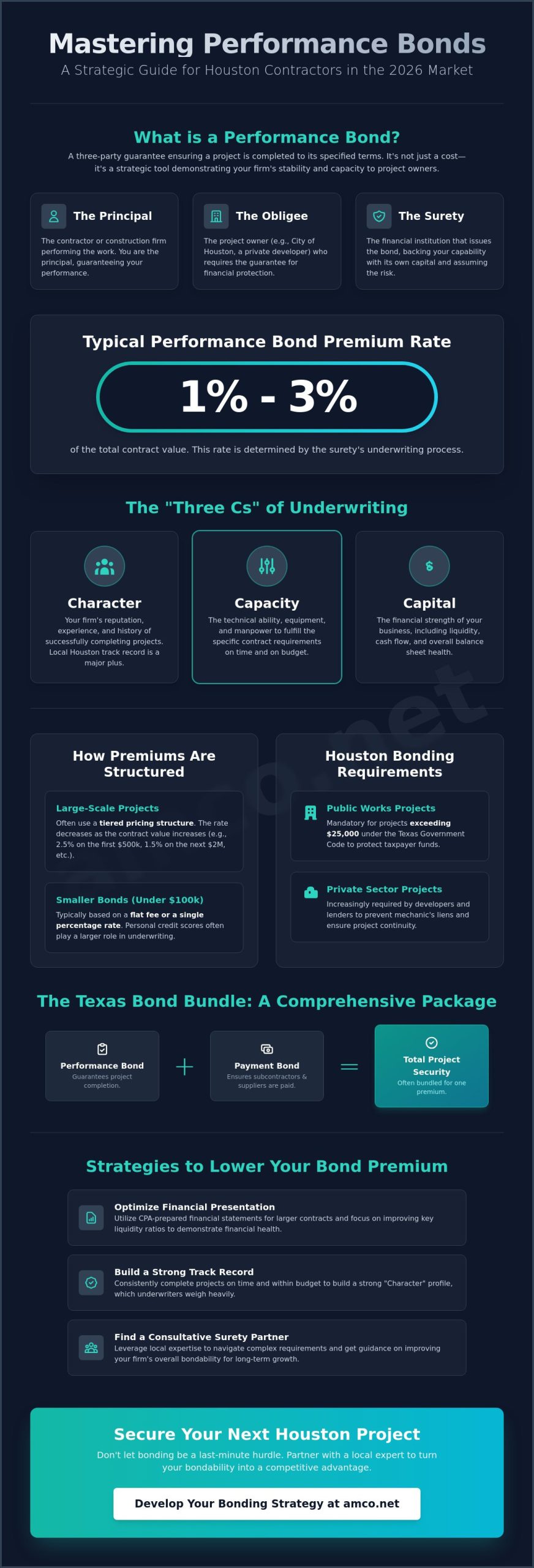
Pricing for surety products isn't static. It follows a logical progression based on the size of the obligation. For smaller projects under $100,000, many sureties move away from percentage-based calculations and apply a flat fee or a minimum premium. This ensures the administrative costs of underwriting are covered regardless of the contract size. For bonds up to $350,000, specialized programs often utilize a streamlined application process based on personal credit, with rates typically ranging from 2.5% to 3.5%. As project values climb, the performance bond cost Houston contractors pay begins to benefit from economies of scale. Estimating your total cost before receiving an official quote requires looking at your firm's historical rates and applying them to the full contract price, which is the amount the surety is technically guaranteeing.
Consider a typical $500,000 municipal renovation project in downtown Houston. A contractor with solid financials might see a premium rate of 2.5% to 3%, totaling between $12,500 and $15,000. In contrast, a $5,000,000 infrastructure project doesn't simply multiply that rate by ten. A sliding scale premium model is a tiered pricing structure where the percentage rate applied to the contract value decreases as the total project cost increases through predefined financial brackets. For instance, the first $500,000 might be billed at 2.5%, the next $2 million at 1.5%, and everything above that at 1%. This tiered approach makes large-scale projects more financially viable for the principal and reflects the surety's confidence in the contractor's ability to manage significant capital.
The initial premium isn't always the final expense. Multi-year projects, frequent in Houston's highway and drainage expansions, often require annual renewal premiums if the work extends beyond the original bond term. Beyond the premium, contractors should account for annual administrative fees that can range from $1,500 to $2,500, along with credit report charges between $50 and $150 per application. High-risk projects or those requiring funds control might also incur escrow fees of 1% to 1.5% of the bond amount plus setup costs ranging from $400 to $750. Opting for the lowest possible quote can be risky. Cheap bonds often come from carriers with slower response times or lower AM Best ratings, which can lead to delays in project approval from the City of Houston or private lenders. It's better to view the performance bond cost Houston projects demand as an investment in a seamless approval process rather than just a mandatory expense.
Lowering the performance bond cost Houston contractors face requires a shift in perspective. You shouldn't view the premium as a fixed tax on doing business. Instead, it's a dynamic variable that responds to your firm's perceived stability and risk profile. Building a long-term relationship with a single surety carrier is one of the most effective ways to secure lower rates over time. When a carrier understands your operational history and financial trajectory, they're more likely to offer aggressive pricing and higher aggregate limits than a carrier seeing your file for the first time.
Underwriters prioritize liquidity above almost all other financial metrics. Maintaining strong working capital in your business accounts demonstrates that you can weather the cash flow fluctuations common in large-scale construction. Reducing corporate debt and improving your debt-to-equity ratio can lead to immediate premium drops, as it signals a lower risk of insolvency. It's also vital to work with a CPA who specializes in the construction industry. These professionals understand how to present financial statements that highlight your firm's strengths, such as properly managing under-billings and over-billings. Transparent, well-structured financial data often translates directly into more competitive rates.
Comprehensive risk management also extends to your broader coverage strategy. You can learn more about how these pieces fit together in A Guide to Business Insurance for Houston Companies. Beyond insurance, maintaining a robust safety protocol and a low Experience Modifier Rate (EMR) shows that your firm prioritizes loss prevention. Sureties view safe contractors as lower-risk principals, which often results in more favorable bonding terms. If you're looking to optimize your bonding profile, you should consult with a surety expert to review your current financial presentation and project history.
AMCO.NET leverages 39 years of specialized experience to help contractors manage the complexities of the Texas surety market. We recognize that the performance bond cost Houston businesses encounter is a significant factor in their bidding competitiveness. Our consultative approach moves beyond simple transaction processing. We analyze your firm’s unique financial profile to match you with the specific surety carrier whose appetite aligns with your project type and size. This precision reduces the likelihood of rejection and ensures your bonding capacity grows alongside your company. We prioritize stability and technical continuity, ensuring that every bond we issue reinforces your reputation with project owners.
Our support isn't limited to bonding alone. We offer a holistic suite of solutions to protect your entire operation. This includes managing your commercial trucking insurance Houston needs and providing robust business liability coverage. By centralizing your risk management, you benefit from a more cohesive strategy that underwriters view favorably during the bonding evaluation process. A unified insurance portfolio demonstrates professional oversight and financial maturity to potential sureties.
Local expertise is an invaluable asset when dealing with municipal requirements. Contract language in Harris County and the City of Houston often contains specific clauses that can catch national brokers off guard. Our deep familiarity with these local requirements allows us to anticipate potential hurdles before they delay your project. We maintain direct access to decision-makers at leading Texas surety companies, enabling us to advocate for your firm in ways an automated online portal can't. This personalized service ensures that your technical expertise and local reputation are given the weight they deserve. When challenges arise, having a partner who can pick up the phone and speak directly to an underwriter in the same time zone makes a measurable difference in your operational speed.
Securing a quote is a methodical process designed to present your firm in the best possible light. To begin, you'll typically need your most recent financial statements, a current work-in-progress report, and details regarding the specific project you're bidding on. We also look at your organizational structure and safety records to build a comprehensive risk profile. If you're a first-time bonded contractor, our team provides step-by-step guidance to help you build your initial bonding file. We focus on transparency and speed, delivering the bid bonds and final performance bonds you need to meet tight contract deadlines. Our goal is to make the bonding process predictable and efficient. You can request your performance bond consultation today to begin optimizing your bonding profile for the 2026 construction season.
Navigating the 2026 market requires more than just meeting a regulatory requirement. It demands a sophisticated understanding of how your firm's financial health and operational safety records influence your project's bottom line. By optimizing your liquidity ratios and maintaining consistent relationships with surety carriers, you can effectively manage the performance bond cost Houston projects require while expanding your aggregate bonding capacity. These steps ensure your business remains agile and competitive in an increasingly demanding infrastructure landscape.
Since 1987, AMCO.NET has served the Houston business community with deep expertise in Texas-specific surety regulations. Our established partnerships with A+ rated surety carriers allow us to provide the stability and technical oversight your projects demand. Don't let administrative hurdles stall your next bid. Get a Professional Performance Bond Quote for Your Houston Project today and secure the financial foundation your firm needs to grow. We're ready to help you build a more resilient future for your construction operations through professional, consultative support.
Most qualified contractors pay between 1% and 3% of the total contract value for their premium. For a $1 million municipal project, this translates to a premium between $10,000 and $30,000. The specific performance bond cost Houston firms encounter depends on their corporate financial strength, technical capacity, and the project's complexity. Smaller bonds under $100,000 often carry flat fees or minimum premiums to cover administrative costs and underwriting time.
Yes, contractors with lower credit scores can still obtain bonding, though they typically face higher premiums ranging from 4% to 5% or more. In these cases, surety companies may require additional collateral or funds control to mitigate the increased risk. Small businesses should explore the SBA Surety Bond Guarantee Program, which provides federal backing to help firms with limited credit histories or financial challenges qualify for necessary project bonds.
The timeline depends on the bond amount and the depth of underwriting required for the specific project. Small bonds under $350,000 can often be approved within 24 to 48 hours using streamlined, credit-based applications. Larger, more complex contracts requiring full CPA-prepared financial statements and technical reviews usually take one to two weeks. Maintaining an established relationship with a surety broker ensures a much faster turnaround for bid bonds and final performance bonds.
No, they serve different functions, though they are almost always issued together as a bundle for Texas projects. A performance bond guarantees that the contractor will complete the project according to the contract terms. A payment bond ensures that subcontractors, laborers, and material suppliers are paid in full. This dual protection prevents mechanic's liens and ensures the project's financial supply chain remains intact throughout the construction period.
The City of Houston mandates performance bonds for all public works projects with a contract value exceeding $25,000, in accordance with the Texas Government Code. For projects below this threshold, bonding isn't legally required, but individual departments or private owners may still request them at their discretion. It's essential to review the specific solicitation documents for each bid to confirm the exact bonding requirements before submitting your proposal.
If a default occurs, the surety company conducts a thorough investigation to verify the claim's validity. If valid, the surety may hire a new contractor to finish the work, provide financial support to the original contractor to complete the project, or pay the bond amount to the obligee. Crucially, the contractor and any personal indemnitors are legally obligated to reimburse the surety for all costs, including legal fees and completion expenses incurred during the process.
Performance bond premiums are generally considered fully earned once the bond is issued and the project commences. This means that completing a project ahead of schedule doesn't result in a partial refund of the premium. The surety's risk is front-loaded during the underwriting and issuance phase. However, if a project is canceled before the bond is filed or work begins, a pro-rated refund might be possible depending on the carrier's specific terms and conditions.
A performance bond isn't a direct debt and doesn't appear on your balance sheet as a liability, so it doesn't typically reduce your bank borrowing capacity. However, sureties and banks both look at your "aggregate capacity," which is the total amount of risk they're willing to extend to your firm. A large bonded project may limit the additional credit a bank is willing to offer if they feel your firm's operational resources are already fully committed.