
What if the document you view as a simple regulatory hurdle is actually the single biggest threat to your personal assets if handled incorrectly? Many Texas business owners treat Surety Bonds as just another checkbox on a permit application, yet this three-party agreement functions very differently from the insurance policies you already carry. While your general liability insurance protects your business from losses, a bond is a financial guarantee that requires you to repay the surety company for any claims paid out. It's a high-stakes commitment that demands a clear understanding of your indemnity obligations.
It's understandable if you feel overwhelmed by the shifting 2026 requirements, like the new mandatory education for notaries or the transition to electronic filing for mortgage loan servicers. You want to operate legally without risking your financial stability. This guide will clarify exactly how these bonds work, why your Texas business needs them, and how to navigate the bonding process with expert local guidance. We'll examine current cost structures and provide a roadmap for navigating local permit requirements in cities like Houston and San Antonio with the steady hand of AMCO.NET LLC, a partner who's been on the ground since 1987.
For many Texas businesses, obtaining Surety Bonds is a fundamental step in the licensing and permitting process. It isn't merely a tax or a simple administrative fee paid to the state. Instead, it represents a legally binding contract that ensures a business will fulfill its specific obligations to the public or a government entity. This agreement builds a foundation of trust between the service provider and the consumer. By requiring these bonds, Texas regulatory bodies establish a clear standard of accountability for industries ranging from construction to motor vehicle sales, ensuring that professionals operate within the bounds of the law.
When a business carries a bond, it essentially holds a seal of approval from a financial institution. This indicates that the company has undergone a rigorous pre-qualification process and is deemed capable of meeting its contractual duties. Understanding Surety Bonds is vital for any decision-maker who wants to protect their company's reputation while remaining compliant with state law. This commitment to professional standards helps foster a stable marketplace where consumers feel confident engaging with bonded contractors and service providers.
To better understand this concept, watch this helpful video:
The primary function of this arrangement is to provide a financial guarantee of performance or payment. In the event that a business fails to follow state regulations or contractual terms, the bond provides a mechanism for the state or a consumer to recover financial losses. A surety bond is a three-party guarantee of professional conduct. This structure ensures that the public and the State of Texas are shielded from the economic fallout of business failures or unethical practices. It shifts the financial risk from the public back to the business owner and their surety partner, requiring the principal to maintain high operational standards to avoid claims.
While often grouped together, these two financial tools serve opposite purposes. Traditional business insurance is a two-party contract designed to protect the policyholder from unexpected losses, such as property damage or injury claims. In contrast, Surety Bonds protect the party requiring the work, not the business purchasing the bond. This means the premium you pay provides a safety net for your clients or the state, not for your own balance sheet.
You'll likely find that full compliance requires both components to manage different types of liability effectively. For example, if you are managing a fleet, you might coordinate your bonds alongside your Commercial Trucking Insurance in Houston to ensure every operational risk is covered. Insurance transfers your risk to a carrier, while a bond acts as a credit-based guarantee that you'll perform your duties as promised. If a claim is paid out on a bond, the surety company will seek reimbursement from you, making it a form of credit rather than risk-pooling.
To understand the operational logic of Surety Bonds, one must look past the paperwork and examine the triangular relationship they create. Unlike a standard two-party contract, this agreement involves three distinct entities, each with specific legal interests. This structure is designed to distribute accountability while ensuring that the party requiring the bond is never left with a financial deficit. It functions as a form of credit rather than a traditional transfer of risk.
The Principal is the business or individual purchasing the bond. In Texas, this might be a used car dealer in San Antonio or a general contractor in Dallas. You are the Principal, and your primary obligation is to perform your duties according to the law. The Obligee is the entity that requires the bond for protection. Often, this is a government body like the Texas Department of Motor Vehicles or the City of Houston. They set the bond amount and the rules you must follow. Finally, the Surety is the insurance company providing the financial backing. They act as a neutral guarantor, promising the Obligee that you will fulfill your promises. This is particularly crucial when seeking Surety Bonds for Government Contracts, where strict performance standards are non-negotiable.
The most critical distinction for a business owner is the indemnity agreement. When you sign for a bond, you aren't just paying a premium; you're entering a contract of full reimbursement. If a claim is filed against you, the Surety conducts a thorough investigation. If the claim is valid, the Surety pays the Obligee, but the process doesn't end there. Because bonds are underwritten with the expectation of zero loss, the Principal is legally required to repay the Surety every dollar paid out, including legal fees.
This is why your personal and business financial stability is a key factor in the approval process. A strong financial profile proves to the Surety that you have the resources to honor this indemnity obligation. If you're looking to secure your company’s standing, you can consult with a local agent at AMCO.NET LLC to review your current bonding capacity. The claim process highlights the most significant operational difference from insurance. In a standard liability policy, the insurer pays the claim and the case is closed. With Surety Bonds, the payment is simply an extension of credit. The Surety steps in to satisfy the Obligee immediately, but then turns to the Principal for reimbursement. This ensures the public is protected without the state having to pursue individual business owners through lengthy litigation.
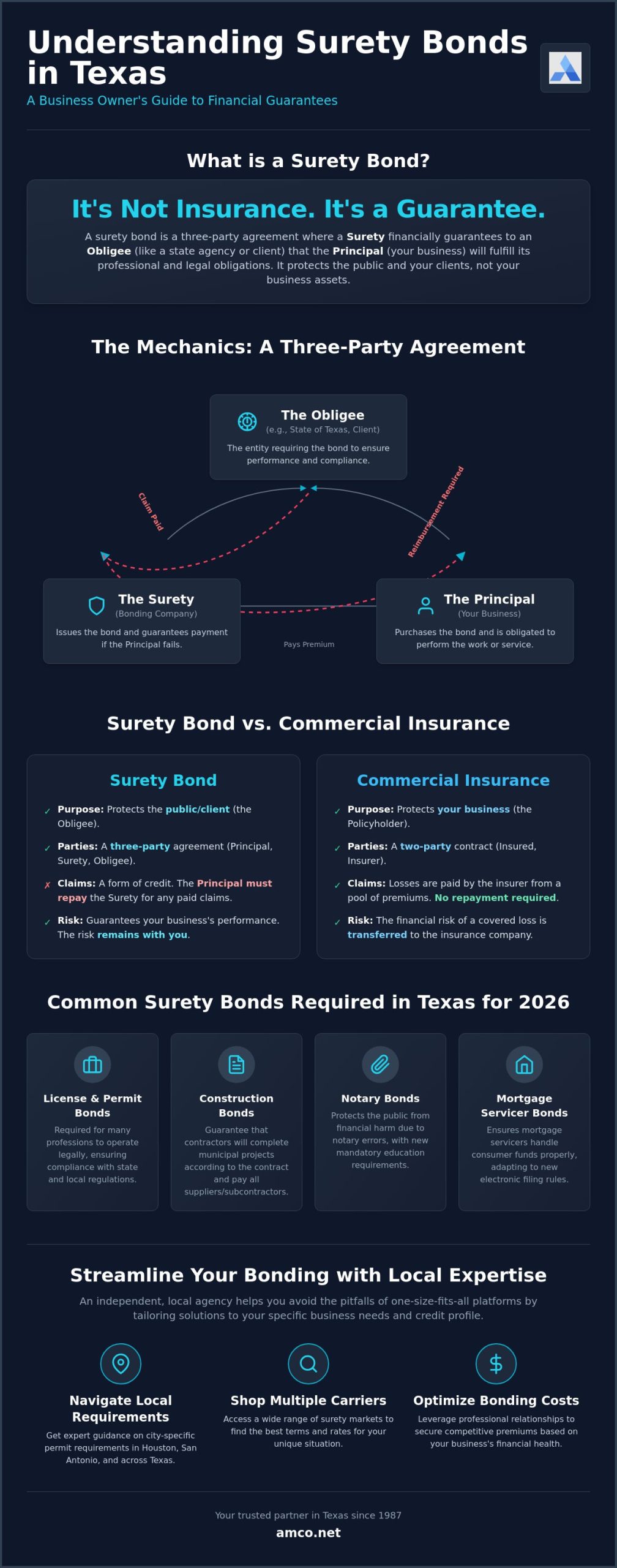
Developing a robust risk management strategy requires a clear distinction between risk transfer and risk guarantees. While both are essential for business continuity in Texas, they serve fundamentally different functions within your financial structure. Commercial insurance acts as a safety net for your company, absorbing losses from unforeseen events like fire or litigation. Conversely, Surety Bonds act as a guarantee to your clients and the state that you'll perform your professional duties. If you fail to meet those obligations, the bond protects the other party, not your own business assets.
The flow of premiums and benefits also highlights this contrast. In an insurance policy, you pay a premium to protect yourself. In a bonding agreement, you pay the premium to protect the Obligee. This is a critical component of the SBA's Surety Bond Guarantee Program, which helps small businesses secure the necessary backing to compete for large scale contracts. It's a professional credential that tells the market you have the financial backing to stand behind your work.
Underwriting processes differ significantly between these two tools. Insurance companies rely on actuarial data and large pools of similar risks to set rates. Bonding companies look at your specific credit score, financial history, and industry experience. They operate under a "zero loss" philosophy. They don't expect a claim to occur, and if it does, they expect you to reimburse them in full. This makes your bond more like a line of credit than a standard insurance policy.
Effective business leadership involves balancing asset protection with operational compliance. You use insurance to shield your equipment, property, and staff from liability. You use bonds to secure your legal right to operate in specific jurisdictions or industries. For a deeper look at the broader insurance landscape, you can refer to our Comprehensive Guide to Insurance in Houston. Managing both effectively ensures you aren't just legal, but also financially resilient against various operational threats.
The cost of most Surety Bonds in Texas typically ranges between 1% and 10% of the total bond amount. For professionals with excellent credit scores, usually 650 or higher, these rates can drop as low as 0.5% to 3%. For example, a $50,000 motor vehicle dealer bond might cost as little as $225 for a two-year term if the applicant's credit is strong. Higher-risk categories, such as construction performance bonds, often require more rigorous underwriting because the potential for complex project failure is greater. Your industry experience and liquidity play a massive role in determining whether you'll pay a standard rate or a higher-risk premium.
Texas operates with a decentralized bonding structure. While many requirements are mandated at the state level, others depend on the specific city or county where you operate. Identifying which of the Surety Bonds applies to your business is the first step toward legal compliance and professional credibility. These requirements are industry-specific and are designed to address the unique risks associated with different professional services.
These bonds are often a prerequisite for obtaining or renewing a professional license. For instance, the Texas Department of Motor Vehicles requires a $50,000 bond for most independent used-car dealers, covering a two-year term. Recent regulatory shifts have also introduced new standards for administrative professionals. As of January 1, 2026, all new and renewing Texas Notaries Public must complete a mandatory online education course before submitting their $10,000 bond application.
The logistics and financial sectors are seeing similar moves toward modernization. Residential mortgage loan servicers in Texas are now required to file their bonds electronically through the Nationwide Multistate Licensing System. In the hospitality industry, TABC bonds remain essential for ensuring businesses follow state tax laws. For logistics firms, the BMC-84 freight broker bond is a standard requirement. These bonds act as a baseline, ensuring that your business respects the legal framework of your specific industry while protecting the public from financial malpractice.
In major hubs like Houston and Dallas, construction projects often require a suite of contract bonds to ensure project continuity. Bid bonds are the entry point, providing a guarantee that if you win a contract, you'll accept the job and provide the necessary follow-up bonding. Performance bonds ensure the project is completed according to the agreed-upon specifications, while payment bonds guarantee that your subcontractors and suppliers receive their due compensation.
These bonds are vital for public works projects where taxpayer funds are utilized. Many local jurisdictions in Texas require specific bonds for various types of construction work, with amounts often ranging from $2,000 to $100,000. Beyond construction, court and probate bonds protect estates during legal proceedings, and fidelity bonds safeguard your business from internal threats like employee dishonesty. These tools collectively ensure that your operations are transparent and financially secure.
To find the specific bond required for your industry or to update your current filings, contact our Texas bonding experts for a personalized assessment and fast processing.
Choosing the right partner to manage your Surety Bonds is a strategic decision that affects your operational speed and financial overhead. While national, automated bond platforms offer a quick transaction, they often lack the nuanced understanding of Texas-specific regulatory shifts. As an independent agency, we don't represent a single carrier. We shop multiple markets on your behalf. This allows us to secure the most favorable terms based on your specific credit profile and industry experience, ensuring you aren't overpaying for your professional guarantees.
Efficiency in 2026 requires a unified approach to risk management. Many of our clients find that managing their bonds in isolation creates administrative friction. By integrating your bonding requirements with your General Liability Insurance, you create a comprehensive protection package. This holistic view ensures that while your bond satisfies the state's mandate for public protection, your insurance policy simultaneously shields your business assets from litigation and property loss.
The Texas regulatory environment is rarely uniform. A contractor working in San Antonio may face different municipal permit requirements than one operating in Dallas or Austin. AMCO has maintained a presence in the Texas market since 1987, giving us nearly four decades of historical context on these local variations. We understand the specific expectations of Texas obligees. This localized knowledge prevents the delays often caused by national "bond mills" that provide generic forms that may not meet the precise standards of a local city secretary or county clerk.
Our process is designed to be methodical and transparent, respecting the time of busy professionals. It begins with gathering essential documentation, which typically includes your business financial statements and relevant credit information. For more complex construction or performance bonds, we may also review your project history and current liquidity. This data allows our underwriters to position your application effectively across our network of carriers.
Once your documentation is ready, you can submit your application through our secure online portal. Our team reviews the details to ensure compliance with the latest 2026 standards, such as the mandatory education requirements for notaries or the electronic filing protocols for mortgage servicers. After approval, you'll receive your bond promptly. We then assist you in filing the document with the appropriate Texas obligee, ensuring your business remains in good standing and ready to pursue new opportunities without delay.
Transitioning to electronic filing systems and meeting new educational mandates requires more than just a simple transaction; it requires a strategic partnership rooted in local expertise. You now understand the fundamental difference between insurance risk transfer and the credit-based nature of Surety Bonds, as well as the personal indemnity obligations that define these three-party agreements. Whether you are managing municipal requirements in San Antonio or large-scale construction projects in Houston, having a clear roadmap for compliance is essential for protecting your professional reputation.
Since 1987, AMCO has functioned as a stable partner for the Texas business community by providing access to A+ rated surety carriers. We specialize in fast approval for most license bonds, ensuring that regulatory shifts don't become a bottleneck for your operational growth. By integrating your bonding needs with a broader risk management strategy, you position your company for long-term success and financial resilience.
Ready to finalize your documentation and secure your right to operate? Get a Fast Surety Bond Quote from AMCO Today and leverage our deep industry knowledge to streamline your application process. We look forward to supporting your business's stability and growth in the competitive Texas market.
The cost typically ranges between 1% and 10% of the total bond amount. Industry data shows that for applicants with credit scores above 650, a $50,000 motor vehicle dealer bond can cost as little as $225 for a two-year term. Your specific rate depends on the bond type, the total coverage required, and your financial history.
Yes, you can still obtain bonding even with a lower credit score. While the premium will be higher to account for the increased risk, many carriers offer programs specifically designed for business owners in this situation. The underwriting focus remains on your ability to fulfill the indemnity agreement and repay any potential claims.
Most standard license and permit Surety Bonds are approved and processed within 24 to 48 hours. Our team prioritizes fast turnaround times to ensure your business remains compliant with state deadlines. More complex construction or performance bonds may require additional time for a thorough review of your financial statements and project history.
No, they serve different financial purposes. A bank guarantee often ties up your liquid assets or business credit lines, whereas a surety bond is an extension of credit from an insurance company. This allows you to meet regulatory requirements without negatively impacting your company's cash flow or borrowing capacity.
The surety company will first conduct a detailed investigation to verify the claim's validity. If the claim is found to be legitimate, the surety pays the obligee to resolve the issue. Because of the indemnity agreement, you are then legally required to reimburse the surety for the full amount of the payout plus any associated legal costs.
The premiums you pay for bonds required to operate your business are generally considered a deductible business expense. This includes license bonds, permit bonds, and contract bonds necessary for specific projects. You should consult with a qualified tax advisor to confirm how these costs affect your specific 2026 tax filings in Texas.
It depends on the local regulations of each municipality. While some bonds are valid statewide, many cities like Houston, San Antonio, and Dallas have unique permit requirements for contractors. These local bonds often range from $2,000 to $100,000 and must be filed with the specific city secretary or building department where the work is performed.
Renewal is typically a straightforward process that involves paying a renewal premium before your current bond expires. For certain bond types, the surety may request updated financial information or credit checks to ensure your risk profile hasn't changed. We recommend starting the renewal process at least 30 days in advance to avoid any lapse in your professional licensing.