
Is the most recognizable name on a billboard actually the most expensive mistake for your Texas fleet this year? In 2026, the search for the top trucking insurance companies isn't just about finding a famous logo; it's about identifying which provider understands the narrow margins of a Houston to Laredo run. You've likely watched your premiums climb while your patience thins during slow claims processes that keep your trucks off the road. It's a frustrating cycle where complex DOT and TxDOT filing requirements only add to the operational burden.
We understand that stability and federal compliance aren't negotiable for your business. This guide identifies the highest-rated trucking insurance providers for 2026 and reveals the specific strategies you need to secure the most competitive rates available. We'll examine how an independent perspective allows you to compare multiple carriers simultaneously. This approach ensures your MCS-90 and state filings remain accurate while driving down your annual overhead through precise, data-driven carrier selection.
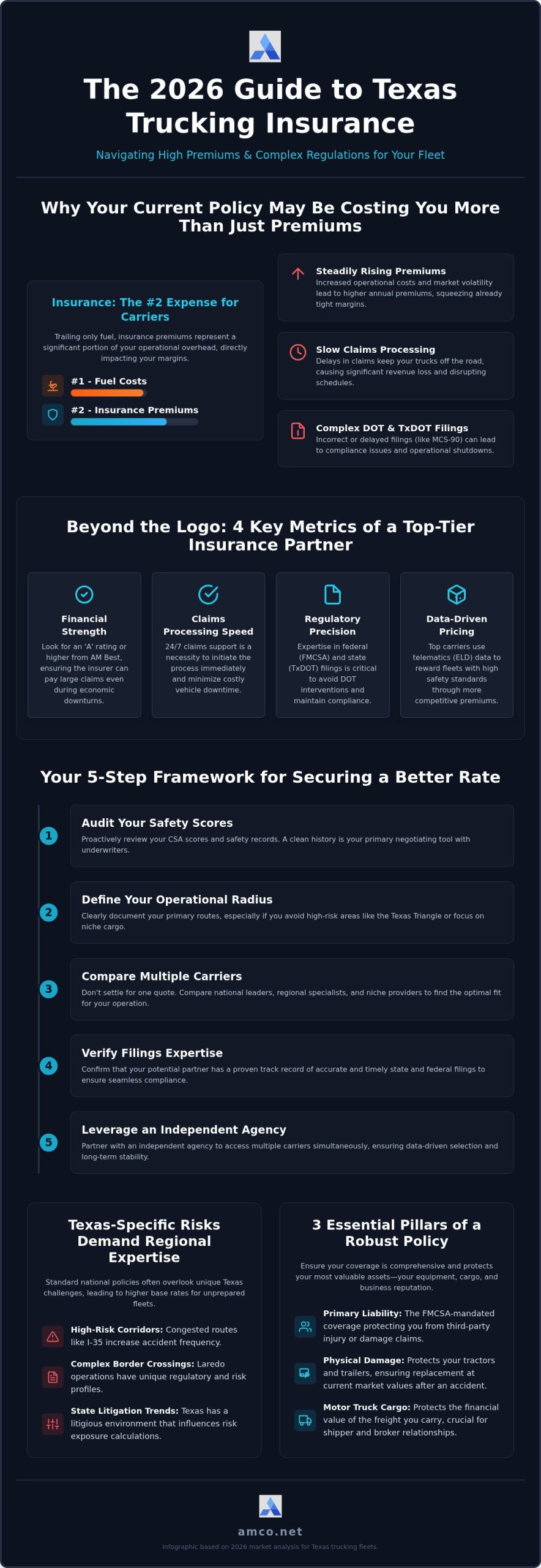
The trucking sector enters 2026 facing a stabilization of freight rates but a continued rise in fixed operational costs. Insurance premiums remain the second largest expense for carriers, trailing only fuel costs. This financial pressure forces fleet owners to be more selective when evaluating the top trucking insurance companies. It's no longer enough to simply secure coverage; the policy must integrate with your operational data to remain cost effective. Precision in choosing a partner determines whether your margins stay healthy or disappear into overhead.
Defining a "top" provider in 2026 involves looking past marketing claims to examine cold data. We prioritize financial strength, the speed of claims processing, and the precision of federal filings. A significant shift has occurred toward telematics driven pricing. Carriers now utilize real time ELD data to adjust premiums, rewarding fleets that maintain high safety standards. Understanding What is a Commercial Vehicle? from an underwriting perspective is the first step in aligning your fleet with these data focused requirements.
To better understand the current market leaders and their offerings, watch this detailed comparison:
Texas carriers operate in a high risk environment. With congested corridors like I-35 and the complexity of border crossings in Laredo, the risk profile for a Texas based fleet differs significantly from the national average. Litigation trends in the state also influence how top trucking insurance companies calculate their risk exposure. This often leads to higher base rates for those without specialized regional representation who can accurately present their safety history to underwriters.
Financial ratings are the primary indicator of an insurer's ability to pay out large claims during economic downturns. We recommend focusing on carriers with an 'A' rating or higher from AM Best. This rating ensures the company has the capital reserves to handle catastrophic losses without delaying your claim. These ratings serve as a critical safety net, providing fleet owners with the certainty that their insurer possesses the liquidity to honor commitments when the industry faces volatility.
Selecting a partner from the top trucking insurance companies requires a balance between automated efficiency and technical expertise. In 2026, the distinction between direct digital portals and agency-only carriers has become more pronounced. While digital portals offer speed for simple operations, agency-only carriers provide the specialized underwriting necessary for complex Texas fleets. This choice determines how your business handles the friction of a high-stakes claim and whether your coverage can scale as your unit count grows.
The 2026 logistics environment operates on an always-on schedule, making 24/7 claims support a critical metric rather than a luxury. When a truck is sidelined in the middle of the night, a carrier's ability to initiate the claims process immediately prevents costly delivery delays. Reliability in this area is closely tied to how well a company manages Federal Insurance Requirements and state-specific filings. For those managing specialized cargo like Hazmat or high-value equipment, these filings must be precise to avoid immediate DOT interventions.
Texas carriers must evaluate providers based on their performance within the state's specific legal and geographical landscape. For instance, understanding the nuances of commercial trucking insurance Houston helps fleet owners navigate the congestion and high accident rates of the Gulf Coast region.
| Carrier | Price Point | Filing Speed | Claims Reputation |
|---|---|---|---|
| Sentry | Competitive | 24-48 Hours | High / Personalized |
| Northland | Premium | 24 Hours | Expert / Niche |
| The Hartford | Tiered | 48 Hours | Excellent / Risk-Focused |
| Berkshire Hathaway | Moderate | 24-48 Hours | Strong / Stable |
Comparing these options side-by-side often reveals that the cheapest quote isn't the most economical choice over a full policy term. It's often beneficial to consult with AMCO.NET LLC to look across these various carriers to find the specific match for your cargo type and route profile.
National rankings of the top trucking insurance companies provide a useful baseline, but they rarely account for the specific operational hazards found within the Lone Star State. Texas carries a unique risk profile due to its massive size and diverse industrial hubs. Whether your fleet moves general freight through the "Texas Triangle" or specialized equipment into the Permian Basin, your insurance structure must reflect regional realities. Underwriters look at the high accident frequency in urban corridors differently than they view the wear and tear of West Texas oil fields. If your carrier doesn't understand these distinctions, you'll likely pay a premium for risks you don't actually face.
Laredo remains the busiest inland port in North America. For carriers involved in cross-border operations, standard liability isn't enough to satisfy the complexities of international trade. You need specific endorsements that address the hand-off of trailers and the jurisdictional shifts at the border. Similarly, the Midland-Odessa factor introduces risks like unpaved roads and extreme equipment stress. These factors can quickly disqualify you from certain national programs, making it essential to partner with carriers that have a deep appetite for Texas-specific industrial risks.
Carriers operating in Southeast Texas face some of the most congested freight lanes in the country. Securing insurance houston requires a higher focus on primary liability limits due to the increased probability of multi-vehicle incidents in urban traffic. Beyond traffic, the Gulf Coast presents environmental risks that can't be ignored. We recommend including natural disaster riders to protect your assets from hurricane-related flooding or wind damage. Having local adjusters with "boots on the ground" in Houston ensures that when an incident occurs, the investigation starts immediately, reducing the time your equipment spends sidelined in a yard.
Regulatory compliance in Texas involves a dual layer of responsibility. While the FMCSA handles interstate authority, the Texas Department of Motor Vehicles (TxDMV) manages intrastate requirements. You must ensure your provider is proficient in Texas State Insurance Regulations to avoid administrative suspensions. A Form E filing is a state-mandated guarantee of liability coverage that remains on file with the TxDMV to prove you meet the minimum financial responsibility.
Key filings include Form E and Form H, with the latter specifically covering cargo liability for intrastate movers. Additionally, the MCS-90 endorsement is a non-negotiable requirement for interstate carriers. It ensures that public liability is covered even if a specific incident technically falls outside the policy's standard terms. Missing a single filing can lead to your DOT number being placed out of service, which is why working with the top trucking insurance companies with dedicated filing departments is a strategic necessity for Texas fleets.
Selecting a partner from the top trucking insurance companies requires a methodical approach that looks beyond the initial quote. In 2026, underwriters are increasingly selective, focusing on data transparency and operational stability. A carrier that appears affordable on paper might lack the specialized claims support or filing accuracy necessary to keep your fleet compliant. To ensure you're making an informed decision, we recommend following this structured five step evaluation framework.
Precision in policy language is vital for avoiding denied claims. You must watch for radius restrictions; driving even a few miles beyond your stated limit can void your coverage during an incident. Additionally, evaluate the choice between a Scheduled Vehicle policy and an Any Auto policy. While Scheduled Vehicle policies are common, an Any Auto endorsement provides broader protection for hired or non owned equipment, which is often safer for fleets planning rapid growth.
Modern insurers reward fleets that embrace technology. In 2026, sharing your Electronic Logging Device (ELD) data with your carrier can lead to significant rate reductions if it demonstrates consistent safe driving habits. Driver tenure also remains a major factor. Fleets that employ drivers with over two years of CDL experience typically see lower costs. You can also improve your financial efficiency by bundling your general liability with your commercial trucking insurance. To find the best combination of these incentives for your fleet, consult with our expert team for a comprehensive policy review.
Identifying the top trucking insurance companies is only the first step in protecting your fleet's financial future. The way you access these carriers determines your long term operational success. Many of the most stable and specialized insurers don't sell directly to the public; they operate exclusively through trusted intermediaries. This structure exists because these carriers require an expert to vet the risk and manage the technical filings correctly. AMCO.NET LLC serves as your professional advocate, ensuring your business is presented accurately to the underwriters who control your rates.
Since 1987, Houston based carriers have relied on AMCO.NET LLC to bridge the gap between complex federal requirements and the specific needs of Texas fleets. We've spent nearly 40 years building relationships with the industry's leading providers, giving our clients a single point of contact for multiple coverage options. This longevity provides a level of stability that national call centers simply cannot match. When a major claim occurs or a filing error threatens your authority, having a dedicated professional who understands your business history is the difference between a fast resolution and a bureaucratic nightmare.
Our role extends far beyond the initial sale. We provide year round support for DOT compliance and filing maintenance. We monitor your safety data and ensure that your MCS-90 and TxDOT filings remain active and accurate. This proactive approach prevents administrative lapses that could lead to costly out of service orders. By handling these technical details, we allow you to focus on the core logistics of your business.
An independent agency works for the trucker, not the insurance company. This distinction is critical because it allows us to shop the entire market of top trucking insurance companies to find the specific program that fits your cargo type and route profile. We provide access to carriers that avoid high marketing costs, often resulting in more competitive and stable rates for our clients. Finding a reliable insurance company near me allows for face to face consultations, which remain invaluable when designing complex, multi state coverage systems.
Securing an accurate quote requires preparation and transparency. To get started, you should have your current loss runs for the past three years, a complete driver list with MVRs, and your detailed equipment schedule ready. We recommend initiating the renewal process at least 60 days before your current policy expires. This timeline provides enough room to compare multiple offers and negotiate terms without the pressure of an impending coverage lapse. When you're ready to optimize your fleet's protection and lower your total cost of risk, you can Request a specialized commercial trucking quote from AMCO.NET LLC today.
The landscape for Texas carriers continues to evolve, requiring a more technical and data-driven approach to risk management. Successfully identifying the top trucking insurance companies is only half the battle; the real advantage lies in how you implement those policies within your specific route profile. We've explored how regional expertise in corridors like the Texas Triangle and Laredo can significantly impact your premiums and how maintaining precise DOT filings protects your operating authority.
By auditing your safety scores and leveraging telematics data, you position your business as a preferred risk for high-tier insurers. This proactive strategy, combined with the independent advocacy of a long-standing partner, ensures your fleet remains both compliant and profitable. Since 1987, AMCO.NET LLC has provided Texas truckers with access to A+ rated carriers and expert filing support. We understand the operational pressures you face and are ready to help you navigate the complexities of the 2026 market.
Secure Your 2026 Trucking Insurance Quote with AMCO.NET LLC today to ensure your fleet stays on the road with the industry's most reliable protection. Your dedication to safety and efficiency deserves an insurance partner that works as hard as your drivers do.
Progressive Commercial, Sentry, and National Independent remain the most accessible providers for carriers with new operating authority. These insurers have developed specific underwriting programs that accommodate businesses with less than two years of operational history. While many top trucking insurance companies prefer established fleets, these three provide the necessary federal filings and primary liability coverage required to launch a new venture successfully.
Monthly costs for commercial coverage are determined by several variables, including your loss history, the age of your equipment, and your specific cargo classification. Your radius of operation also plays a significant role; a fleet staying within the Texas Triangle will see different rates than one crossing multiple state lines. Because every operation carries a unique risk profile, we recommend obtaining a personalized quote based on your actual ELD data and safety scores.
Bobtail insurance provides liability protection for a tractor when it's operated without a trailer attached, regardless of its dispatch status. Non-trucking liability is more restrictive, covering the truck only when it's used for personal, non-business purposes outside of a lease agreement. Most owner-operators leased to a motor carrier require non-trucking liability, while those operating under their own authority often need bobtail coverage for equipment repositioning.
Motor truck cargo insurance is a distinct coverage component that protects the financial value of the freight you transport. While it's frequently bundled into a comprehensive commercial trucking package, it functions as a separate limit from your primary liability. Shippers and brokers in Texas typically require a minimum of $100,000 in cargo coverage, though high-value freight or electronics may necessitate significantly higher limits to meet contractual obligations.
Progressive Commercial and specialized non-standard carriers often provide the most competitive options for fleets with recent violations or accidents. The top trucking insurance companies in the high-risk sector prioritize the use of telematics and inward-facing cameras to monitor driver behavior. By demonstrating a commitment to safety technology, even fleets with past incidents can often secure coverage that would otherwise be unavailable in the standard market.
You can confirm a carrier's authorization by checking the Texas Department of Insurance (TDI) database or the TxDMV’s list of approved insurance providers. It's essential to ensure your insurer can specifically issue Form E and Form H filings for intrastate operations. An independent agent can verify this authority before you bind a policy, preventing administrative delays that could result in the suspension of your Texas motor carrier certificate.
Many insurers offer premium credits or safety incentives for fleets that implement integrated dash cams and telematics systems. These technologies provide underwriters with objective data regarding braking habits, speed, and following distances. By reducing the uncertainty of the risk, carriers are often willing to lower annual premiums for fleets that maintain high safety scores through consistent electronic monitoring and driver coaching programs.
The FMCSA maintains a minimum primary liability requirement of $750,000 for interstate carriers hauling non-hazardous general freight. If your operation involves hazardous materials, the requirement increases to either $1 million or $5 million depending on the specific substance classification. It's important to note that many brokers and shippers now require a minimum of $1 million in liability coverage regardless of the federal baseline to satisfy their own corporate risk standards.