In Texas, nearly one in five drivers on the road may be operating without any insurance at all. This reality makes the search for reliable full coverage car insurance more than just a box to check for a lender; it's a critical financial safeguard. Many motorists in metropolitan areas like Houston and Dallas feel the pressure of rising premiums and wonder if they're paying for more than they need. It's common to feel overwhelmed by the technical jargon and the significant gap between state-mandated 30/60/25 minimums and the protection required to actually preserve your assets after a major accident.
You deserve a clear understanding of how your policy functions as a comprehensive risk management system. This guide explains exactly what a full coverage policy includes, why it's vital for Texas motorists in an at-fault state, and how to build the right protection for your specific vehicle. We'll examine the functional components of collision and comprehensive layers, the impact of recent legislative changes like HB 2067, and professional strategies to lower your premiums without compromising the integrity of your coverage.
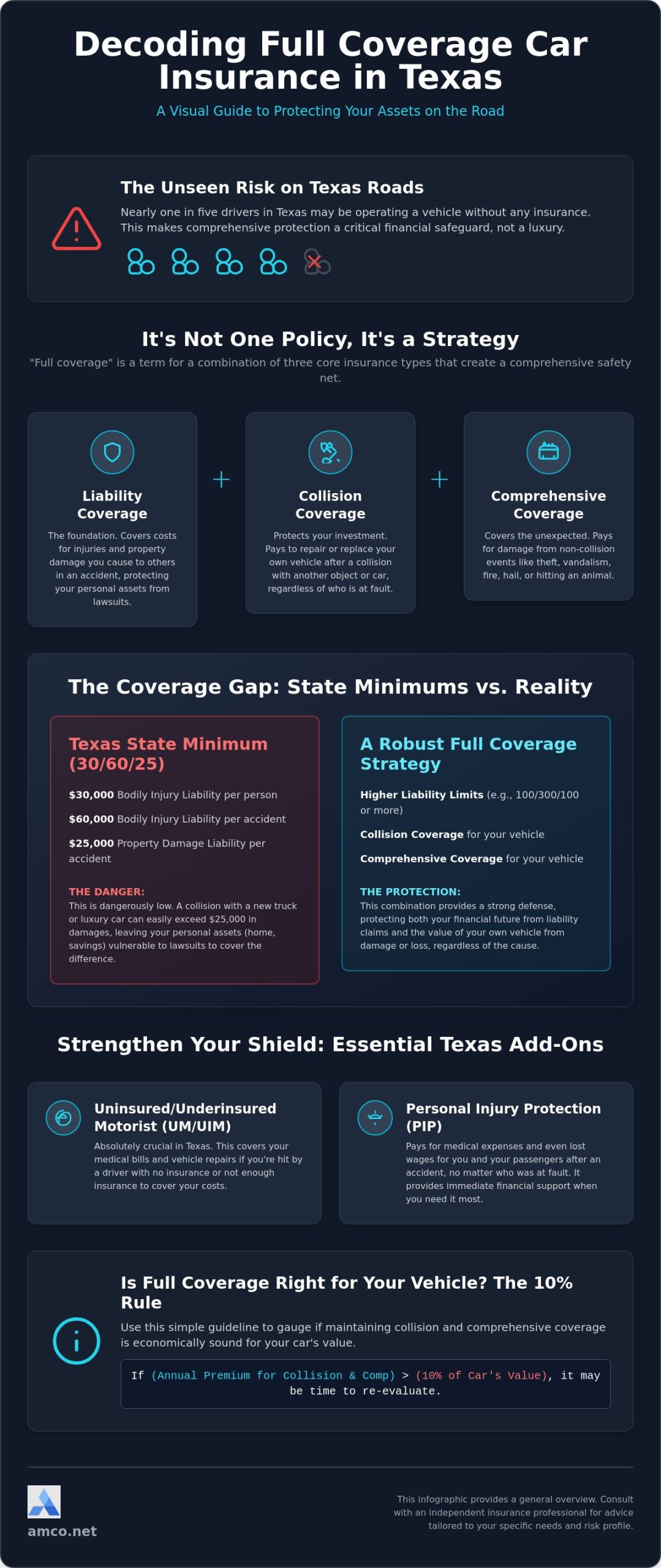
Many drivers mistakenly believe that "full coverage" is a specific product they can select from a dropdown menu. In reality, it's a colloquial term used to describe a comprehensive risk management strategy rather than a single policy type. Under the Texas Motor Vehicle Safety Responsibility Act, all motorists must demonstrate financial responsibility. While the state accepts minimum liability limits as proof, these figures rarely align with the actual costs of a major collision or vehicle theft in a modern urban environment. To provide a technical definition, full coverage car insurance is the combination of liability, collision, and comprehensive insurance. This tripartite structure ensures that you're protected against third-party claims while also securing the capital invested in your own vehicle.
To better understand this concept, watch this helpful video:
Texas law mandates minimum liability limits of 30/60/25. This translates to $30,000 for bodily injury per person, $60,000 per accident, and $25,000 for property damage. For most drivers, these limits are dangerously low. A single incident involving a luxury vehicle or a multi-car pileup can easily exceed $25,000 in property damage, leaving the at-fault driver personally liable for the deficit. Transitioning from "liability-only" to a robust protection plan is essential for anyone seeking long-term financial stability. This distinction is a core part of Vehicle insurance in the United States, where state laws vary significantly in their baseline requirements. Relying solely on the minimums leaves your personal assets vulnerable to litigation and out-of-pocket repair costs.
As we move through 2026, the economic landscape has shifted. Persistent inflation and the increasing complexity of automotive technology, such as advanced sensor arrays and electric drivetrains, have driven repair costs to historic highs. The Texas Department of Insurance continues to oversee rate filings to ensure market stability, but the burden of selection falls on the consumer. Additionally, legislative updates like HB 2067 have increased transparency regarding policy non-renewals, yet they don't change the fundamental need for adequate limits. If you're financing or leasing a vehicle, your lender will mandate full coverage car insurance as a contractual requirement to protect their lienholder interest. This ensures that the asset remains covered regardless of who's at fault or what type of incident occurs.
Building a robust full coverage car insurance profile requires a modular approach to risk. While the term implies a single blanket of safety, it actually functions as a sophisticated system of three distinct insurance layers. Each pillar addresses a specific financial vulnerability, ensuring that neither a highway collision nor a sudden weather event creates a catastrophic disruption to your capital. By understanding the technical nuances of these components, Texas motorists can move beyond basic compliance toward true asset preservation.
Liability insurance is the foundation of any professional-grade policy. It's divided into bodily injury and property damage, serving as your primary defense against third-party claims. In high-density traffic environments like Houston or Dallas, the probability of multi-vehicle incidents is statistically higher. If you're found at fault, your liability limits dictate how much the insurer pays before your personal assets, such as your home or savings, are exposed to litigation. The Texas Department of Insurance provides detailed frameworks on how these limits function. Opting for higher limits than the state minimum is a prudent strategy for drivers who want to avoid the risk of personal lawsuits after a significant accident.
While liability covers others, the remaining two pillars focus on your own property. These coverages are essential for maintaining the operational continuity of your daily life. They operate based on the Actual Cash Value (ACV) of your vehicle, which is the replacement cost minus depreciation at the time of loss.
Selecting the right deductible is a critical part of this strategy. A higher deductible typically lowers your monthly premium but requires more liquid cash on hand during a claim. Balancing these figures allows you to manage your fixed costs while keeping your out-of-pocket risks within a predictable range. If you're looking to optimize these costs, you can compare multiple carrier options to find a structure that fits your specific risk tolerance. When these three pillars work in tandem, they eliminate the most volatile financial threats facing modern drivers.
Deciding whether to maintain a high level of protection is a calculated business decision rather than an emotional one. While the state mandates a baseline, individual circumstances often dictate a more robust approach. For many, full coverage car insurance is a non-negotiable component of their financial plan. This is particularly true when the potential for a total loss could derail your long-term savings or operational mobility. Evaluating your specific needs involves looking at your vehicle's current market value, your contractual obligations, and your overall exposure to litigation in the event of an at-fault accident.
A common benchmark used by industry professionals is the "10% Rule." This suggests that if the annual cost of your collision and comprehensive premiums exceeds 10% of your vehicle's total market value, the financial return on that specific coverage may no longer be viable. However, this rule only applies to the physical damage portion of your policy. Regardless of the car's age, maintaining high liability limits remains essential to protect your personal assets from the high cost of medical claims and legal fees in Texas. You can find more detailed analysis in this guide to Full Coverage Car Insurance, which outlines how these components interact with your broader financial health.
If you're currently paying off a loan or driving a leased vehicle, the choice is usually made for you by the financial institution. Lenders require full coverage car insurance to protect their collateral. If you fail to maintain these standards, the bank may implement "force-placed insurance." This is a high-cost alternative that only protects the lender's interest, not yours. For those driving newer models in the city, reviewing A Guide to Car Insurance in Houston, TX can help you understand how to navigate these requirements efficiently. Additionally, consider how GAP insurance supplements your policy by covering the difference between your loan balance and the car's actual cash value if it's totaled early in the term.
As a vehicle depreciates, the cost-to-benefit ratio of physical damage coverage shifts. Using resources like Kelly Blue Book or NADA helps you track this depreciation accurately. If your car is worth less than $5,000, the payout after a $1,000 deductible might not justify the ongoing premium costs. In these cases, shifting to a liability-focused plan can save significant capital. Don't make the mistake of lowering your liability limits just because the car is older. In the Texas at-fault system, your liability remains tied to the damage you cause to others, not the value of the car you're driving. Protecting your future earnings and property from lawsuits is a priority that persists throughout the life of any vehicle.
While the core pillars provide the primary structure of your policy, the regional risks specific to the Lone Star State require more specialized layers. Truly optimized full coverage car insurance should address the high statistical probability of encountering an uninsured motorist or needing immediate roadside support on sprawling Texas highways. These technical add-ons transform a standard policy into a resilient financial system that maintains your mobility and protects your medical budget regardless of external variables. Strategically selecting these options allows you to manage risk with precision rather than relying on a one-size-fits-all approach.
In Texas, the risk of an accident involving an uninsured driver is a significant operational concern. Data from 2026 indicates that approximately 14% to 16% of Texas motorists are driving without any insurance coverage. This means that even if you have a robust liability policy, you could be left with substantial medical bills if an uninsured driver is at fault. Uninsured/Underinsured Motorist (UM/UIM) coverage acts as a vital safety net for your full coverage car insurance. It steps in to pay for your injuries and property damage when the other party lacks sufficient limits. Texas law requires insurers to offer this coverage in writing, and rejecting it often leaves a critical gap in an otherwise comprehensive plan.
Personal Injury Protection (PIP) and Medical Payments (MedPay) are often confused, but they offer different levels of utility. PIP is particularly valuable because it covers not only medical expenses but also 80% of lost wages and the cost of essential services you can no longer perform. MedPay is more limited, focusing strictly on medical bills. Given the high cost of healthcare in 2026, PIP provides a more thorough layer of security for your household's cash flow after a serious incident.
Maintaining high-quality protection doesn't have to lead to excessive overhead. By stacking specific discounts, you can lower your total cost of ownership. One of the most effective strategies is the multi-policy discount. Combining your auto policy with Homeowners Insurance can lead to significant premium reductions across both accounts. Other opportunities for 2026 include:
If you have an SR-22 filing on your record, your options for full coverage may be more limited, but an independent agent can still help you find competitive placements. To see how these discounts apply to your specific profile, you can request a professional insurance review to compare multiple carrier quotes. This consultative approach ensures you aren't overpaying for the security your vehicle requires.
Selecting the right full coverage car insurance requires more than just an automated algorithm; it demands a partner who understands the specific operational risks of the Texas market. While national carriers offer a single brand of protection, AMCO.NET operates as an independent agency. This model allows us to broker solutions from multiple carriers, ensuring that your protection plan is both cost-effective and technically sound. Since 1987, we've served as a stabilizing force for Texas motorists, providing the professional distance and expertise needed to navigate complex claims and premium fluctuations.
Choosing an independent agency provides a level of market transparency that single-carrier agents simply cannot replicate. Instead of fitting your needs into one company's rigid underwriting criteria, we examine the broader market to find the best fit for your risk profile. This consultative approach is essential for securing coverage that actually performs during a total loss event. Our team prioritizes technical precision over marketing slogans, ensuring every component of your policy serves a functional purpose. We don't just sell policies; we build comprehensive risk management systems tailored to your specific assets.
Texas presents unique environmental challenges that standardized policies often overlook. From the catastrophic flooding risks in Houston to the high-frequency hail events in West Texas, local knowledge is a prerequisite for effective risk management. Working with an Insurance Company Near Me provides you with a dedicated advocate who understands these regional nuances. Unlike automated platforms, a local consultant offers a human point of contact during the claims process, ensuring that your interests are represented when it matters most. This personalized oversight is vital for maintaining the continuity of your mobility in an unpredictable climate.
Transitioning to a more reliable insurance structure is a straightforward process. To receive an accurate full coverage car insurance quote, you'll need your Vehicle Identification Number (VIN), current policy limits, and a brief overview of your driving history. AMCO.NET simplifies this transition by leveraging modern technology alongside our deep industry roots. You can secure a quote in minutes via our mobile app or website, allowing you to compare multiple carrier options without the pressure of a single-brand sales pitch. Our focus remains on your long-term financial security and the stability of your household budget. Professional-grade protection is just a few clicks away, providing the confidence you need to navigate any Texas highway.
Navigating the complexities of the Texas insurance market requires a shift from basic compliance to strategic protection. We've explored how a robust full coverage car insurance policy functions as a multi-layered defense system, combining liability, collision, and comprehensive protections to safeguard your personal capital. By integrating essential add-ons like UM/UIM and leveraging multi-policy discounts, you can maintain high-tier security while managing your monthly overhead effectively in a shifting economic landscape.
Since 1987, AMCO.NET has served as a reliable partner for motorists across the state. As a Texas-owned and operated agency with an A+ rating, we offer the distinct advantage of comparing multiple carrier options to find the most efficient placement for your specific risk profile. Our bilingual agents provide personalized guidance that goes beyond automated algorithms, ensuring your assets are protected with professional precision. Get a Fast & Affordable Full Coverage Quote from AMCO.NET Today and drive with the confidence that comes from expert-led protection.
Texas law only mandates liability coverage with minimum limits of 30/60/25 to demonstrate financial responsibility. However, if you're financing or leasing a vehicle, your lender will contractually require you to maintain full coverage car insurance. This protects the financial institution's interest in the asset until the loan is satisfied or the lease term concludes.
The cost of comprehensive protection in Houston is influenced by variables such as zip code, driving history, and vehicle technology. Because Houston has high traffic density and a significant risk of flood events, premiums often reflect these operational challenges. The most effective way to determine your specific cost is through a professional comparison of multiple carriers tailored to your risk profile.
Rental reimbursement is typically an optional endorsement rather than a standard component of a basic full coverage policy. You must specifically add this coverage to your plan to ensure the insurer pays for a substitute vehicle while yours is undergoing repairs after a covered collision. It's a low-cost add-on that prevents significant disruption to your daily mobility.
If you're involved in an accident with an uninsured driver, your collision coverage will pay for your vehicle repairs after you pay your chosen deductible. To cover medical expenses or recover your deductible in this specific scenario, you should maintain Uninsured Motorist (UM) coverage. This acts as a vital safety net in a state where a notable percentage of drivers lack any insurance.
Yes, drivers with an SR-22 filing can still secure full coverage car insurance, though they may be placed with carriers specializing in non-standard risk. An independent agency can help navigate these specialized markets to find reliable protection. Maintaining comprehensive coverage is often even more important for these drivers to prevent further financial instability after an incident.
Theft and vandalism are covered under the comprehensive portion of your policy. This pillar of protection triggers for non-collision events, ensuring you receive the actual cash value of your vehicle if it's stolen or requires repairs due to criminal damage. It also covers environmental risks such as hail damage or falling objects, which are common in various Texas regions.
GAP insurance is a separate supplement designed to cover the difference between your loan balance and the car's actual cash value. While full coverage car insurance pays for the vehicle's current market value at the time of loss, GAP ensures you aren't left with remaining debt if that payout is less than what you still owe the lender.
Industry professionals often recommend carrying limits of at least 100/300/100 to protect personal assets effectively. Given the rising costs of medical care and automotive repairs in 2026, the state minimum of 30/60/25 is rarely sufficient. Higher limits serve as a professional-grade shield, preventing a single at-fault accident from leading to personal litigation or the loss of your savings.