
Texas is the only state in the country where choosing not to carry Workers Compensation Insurance is a legal right, yet for many employers, exercising that "freedom" is the quickest way to lose everything. While the law allows you to be a non-subscriber, doing so strips away your most critical legal defenses; this leaves your business vulnerable to unlimited liability in a courtroom. As of July 2026, the Texas Department of Insurance has approved a 3.8 percent decrease in loss costs. This protective shield is now more accessible than it has been in years.
You likely agree that managing a business in high-risk sectors like trucking requires a precise balance between operational costs and employee safety. This guide will help you master the 2026 regulatory environment to ensure your assets remain secure against catastrophic injury claims. We'll examine the specific legal benefits of being a subscriber. We will also break down the new $1,271.05 state average weekly wage benchmarks and show you how to secure a policy that stabilizes your long-term financial outlook.
Workers Compensation Insurance serves as a fundamental safety net within the Texas business infrastructure. At its core, this policy ensures that employees who suffer work-related injuries or illnesses receive necessary medical care and a portion of their lost wages. In exchange for these guaranteed benefits, the Workers' compensation system functions as a "grand bargain." Employees forfeit their right to sue their employer for negligence; the employer gains protection from potentially ruinous personal injury litigation.
For 2026, the Texas Department of Insurance (TDI) and the Division of Workers' Compensation (DWC) maintain strict oversight to ensure the system remains equitable. The DWC has established the 2026 State Average Weekly Wage at $1,271.05, a figure used to determine the maximum benefit amounts for injured staff. Additionally, NCCI data shows a 3.8 percent decrease in loss costs starting July 1, 2026. This marks the 13th consecutive year of declines, contributing to a "soft" market where competition among carriers benefits the policyholder.
To better understand how this coverage functions in a practical setting, watch this helpful video:
Texas remains the only jurisdiction in the United States where private employers can choose whether to provide this coverage. Currently, approximately 73 percent of Texas employers are "subscribers" to the state-regulated system. If you decide to opt out, your business is classified as a "non-subscriber." While this choice offers initial flexibility, it fundamentally changes your legal standing. You lose the "exclusive remedy" protection that prevents employees from suing for workplace injuries. Public entities, such as municipalities or state agencies, don't have this luxury; they're legally required to maintain coverage. To join the system, most businesses purchase a policy through an independent agency that can access various third-party carriers.
A standard policy typically covers all employees, including full-time and part-time staff. However, the status of independent contractors and 1099 workers is often a point of confusion. In Texas, these individuals generally aren't covered unless a specific agreement exists or the employer exercises significant control over their daily tasks. Sole proprietors and partners are also excluded by default. If you're a business owner who wants personal coverage, you must specifically request an endorsement to include yourself in the policy. As of October 2025, the fixed annual payroll for sole proprietors and partners is set at $82,600 for premium calculation purposes, based on the 2026 Workers Compensation Insurance wage benchmarks.
Choosing to bypass Workers Compensation Insurance might seem like a pragmatic cost-saving measure, but it introduces a level of operational risk that few balance sheets can survive. In Texas, the decision to opt out of the state-regulated system is known as non-subscription. While this choice is legally permitted for private employers, it fundamentally alters the legal relationship between you and your workforce. When you subscribe, you receive "exclusive remedy" protection. This legal shield ensures that the benefits provided by the policy are the only recourse for an injured worker, effectively granting you immunity from most personal injury lawsuits.
A frequent and dangerous misunderstanding among business owners is the belief that General Liability insurance covers employee injuries. This is a critical error. General Liability policies explicitly exclude claims involving your own employees. Without a specific policy in place, your business is directly responsible for every dollar of medical care and lost wages. In Texas, non-subscribers lose their common-law defenses, meaning they cannot argue that the employee's own negligence or the actions of a coworker contributed to the injury.
In a courtroom setting, non-subscribers face a steep uphill battle because they cannot use the "contributory negligence" defense. If a judge or jury finds that the employer was even one percent at fault for an accident, the business may be held liable for the entire judgment. There are no statutory caps on these awards. In high-litigation environments like Houston and Dallas, jury verdicts can reach millions of dollars for a single workplace incident. This financial exposure often far exceeds the cost of annual premiums. Smart business owners can consult with a specialist to evaluate their specific risk exposure before finalizing their 2026 insurance strategy.
Choosing to opt out of the system does not exempt you from state oversight. According to the Texas Department of Insurance guide, non-subscribers must file TDI Form DWC005 annually to maintain their status. This document officially notifies the Division of Workers' Compensation that you do not carry coverage. Failing to file this form or neglecting to post the required "Notice 5" in your facility can result in significant administrative penalties. You must also provide written notice of your non-subscriber status to every new hire. These administrative burdens are mandatory; the state uses these filings to monitor the 27 percent of Texas employers who remain outside the traditional Workers Compensation Insurance system.
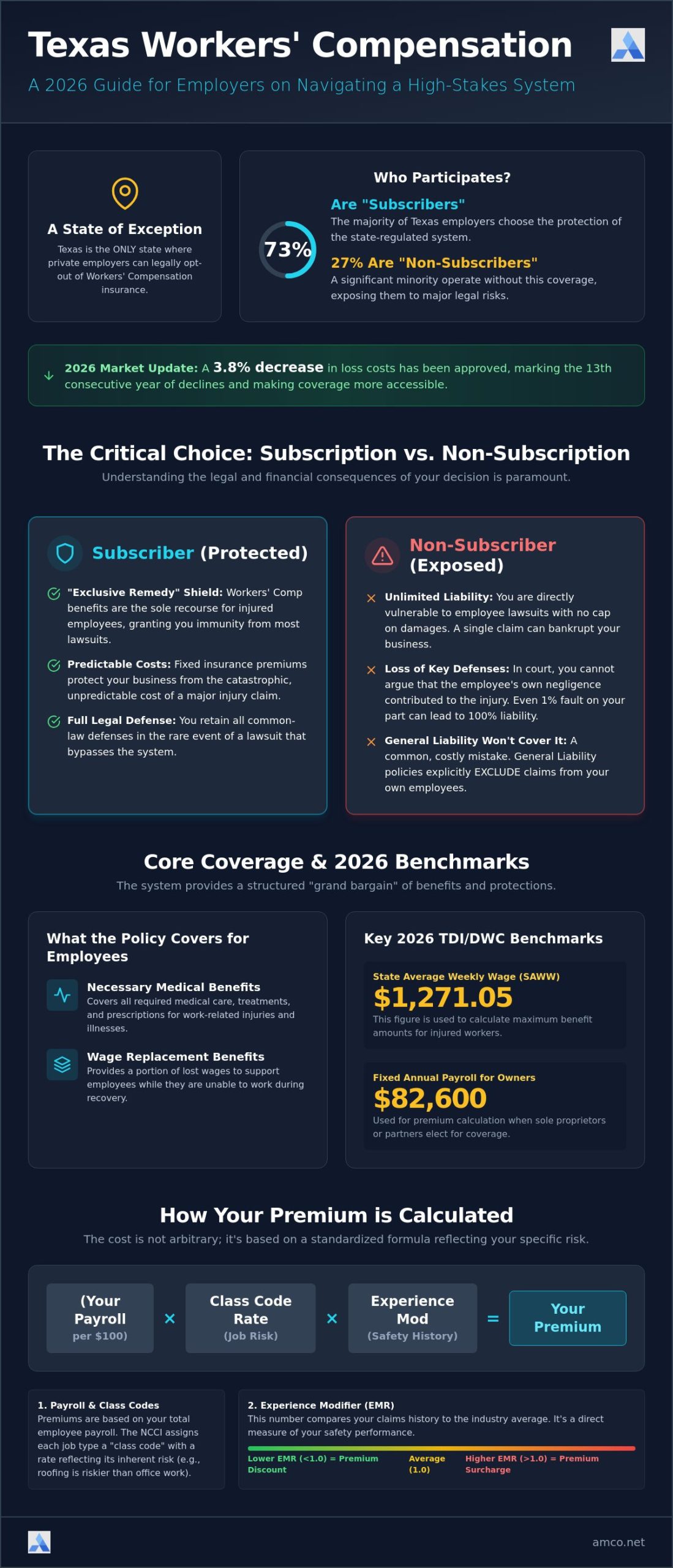
Workers Compensation Insurance provides a structured framework of benefits designed to support an employee's recovery while protecting the employer's financial stability. Unlike general health plans, this coverage applies specifically to injuries or illnesses arising out of and in the course of employment. The primary component is medical coverage, which pays for all reasonable and necessary medical care related to the injury. There are no deductibles or dollar limits for these medical treatments as long as they follow the Texas Department of Insurance (TDI) guidelines. This ensures that a single catastrophic accident doesn't leave an employee without care or a business with unmanageable debt.
Beyond immediate medical needs, the system provides income benefits to replace a portion of the wages lost during recovery. For 2026, the state average weekly wage (SAWW) has been set at $1,271.05, which serves as the benchmark for maximum benefit calculations. While 2026 workers' comp cost trends indicate that the market remains competitive for employers, the statutory benefits for injured workers remain comprehensive. In the event of a fatal workplace accident, the policy also provides death benefits to surviving family members and covers burial expenses up to state-mandated limits.
The Texas system categorizes income benefits into specific tiers based on the duration and severity of the injury. Temporary Income Benefits (TIBs) are the most common, providing up to $1,271.05 per week for employees who lose more than seven days of work. If an injury results in permanent physical damage, employees may qualify for Impairment Income Benefits (IIBs), which are currently capped at $890.00 weekly. For the most severe, life-altering cases, such as the loss of sight or total paralysis, Lifetime Income Benefits (LIBs) provide ongoing support capped at $1,271.00. Vocational rehabilitation is also available for those who must train for a new career path because they can't return to their previous role.
While the focus is often on the employee, Workers Compensation Insurance offers significant legal safeguards for the business owner. If an employee attempts to bypass the "exclusive remedy" rule and files a lawsuit, the policy typically covers the associated legal defense costs and attorney fees. This protection is vital even in cases where the employer isn't at fault. For fleet owners, this coverage is a critical component that works alongside Commercial Trucking Insurance to create a comprehensive risk management shield. It's important to understand that while the policy protects against standard negligence, it doesn't shield a business from "gross negligence" claims in cases involving employee death, though it still provides the foundation for a legal defense.
Calculating the premium for Workers Compensation Insurance follows a standardized mathematical formula: (Annual Payroll / 100) x Classification Rate x Experience Modifier. Starting July 1, 2026, the NCCI has implemented a three-decimal precision system for loss costs and rates to improve pricing accuracy across the board. While the Texas Department of Insurance approved an average 3.8 percent decrease in loss costs for 2026, your specific premium depends heavily on your industry risk profile and historical safety performance.
NCCI Class Codes categorize your employees by the risk inherent in their daily tasks. For instance, a long-haul trucker or a commercial roofer carries a higher rate than an accountant because the statistical likelihood of a severe injury is significantly greater. It's essential to audit these codes regularly. A common error is misclassifying administrative staff under higher-risk operations, which leads to unnecessary overpayment. A new class code, 8871, has been established for clerical telecommuter employees in 2026 to reflect the distinct risk profile of remote work environments.
The Experience Modifier, or E-Mod, is a multiplier that compares your claims history to the industry average. A safe workplace results in an E-Mod below 1.0, effectively acting as a discount on your policy. Conversely, frequent accidents drive this number up, increasing your costs for years. To manage these expenses, many Houston small businesses utilize "pay-as-you-go" billing models. This approach calculates premiums based on actual real-time payroll rather than annual estimates; it prevents large, unexpected audit bills at the end of the year and improves monthly cash flow.
Payroll totals serve as the primary base for your premium. For 2026, the fixed annual payroll for sole proprietors and partners is $82,600. Industry risk remains a volatile factor. High-risk sectors like HVAC, construction, or commercial trucking naturally face higher base rates due to the severity of potential injuries. Finally, your claim history is analyzed based on both frequency and severity. Insurance carriers often view multiple small claims as a higher risk indicator than a single, isolated accident because they suggest a systemic lapse in safety protocols. You can get a customized quote to see how these 2026 rate changes apply to your specific payroll and industry code.
You can actively influence your premiums by implementing a formal safety program and a "Return to Work" policy. These initiatives reduce the duration of claims and improve your E-Mod over time. Additionally, ensuring every employee is mapped to the correct NCCI code prevents premium leakage. For more strategies on optimizing your business expenses, see our Comprehensive Guide to Insurance in Houston. Proactive risk management is the most effective way to secure long-term savings in the Texas market.
Since 1987, AMCO.NET LLC has served as a stable anchor for the Texas business community. Based in Houston, our agency understands the specific operational hurdles that local employers face every day. We don't just sell a policy; we provide a system-level solution that prioritizes your company's long-term financial health. Unlike direct carriers that offer a limited suite of products, we function as an independent brokerage. We leverage our established relationships with multiple "A-rated" third-party carriers to find the most competitive rates for your Workers Compensation Insurance. This independent approach is particularly beneficial in the 2026 "soft" market, where carrier appetite varies significantly across different industry sectors.
Our specialized expertise in high-risk industries, such as commercial trucking and heavy construction, allows us to navigate complex NCCI classifications that generalist agencies often overlook. We provide dedicated support for annual audits and active claims management. By closely monitoring your claims data and verifying every employee classification, we help protect your Experience Modifier (E-Mod) from unnecessary inflation. This proactive oversight ensures your premiums remain sustainable even if an incident occurs. Our team's deep roots in the Houston and San Antonio markets provide a level of stability and professional humbleness that builds lasting B2B partnerships.
Texas is a diverse economic landscape, and a one-size-fits-all approach rarely meets the needs of a sophisticated business. AMCO.NET LLC consultants possess deep knowledge of the specific labor markets and litigation environments in Dallas, Austin, and Laredo. We provide the personalized, advisory service that national call centers simply cannot match. You'll work with an expert who understands the Texas Department of Insurance (TDI) framework and the unique regional risks associated with your workforce. This local focus allows us to secure coverage through a brokerage network that understands the Texas "grand bargain" and the importance of the exclusive remedy defense.
Securing Workers Compensation Insurance shouldn't be a source of administrative friction for your leadership team. We've streamlined our application process to ensure a fast turnaround while maintaining the technical precision your business requires. Our experts are available to consult on your subscription status and ensure you're fully compliant with all 2026 state regulations and reporting mandates. Take the next step in protecting your business and your employees by speaking with a specialist who understands the Texas market inside and out.
Request a Workers’ Comp Quote from AMCO.NET LLC and secure the professional oversight your business deserves.
The choice to subscribe to the state-regulated system remains a strategic decision for any Texas business owner looking to build a resilient operation. By securing Workers Compensation Insurance, you effectively trade the volatile uncertainty of civil litigation for a controlled and predictable premium structure. This move is essential for maintaining long-term financial stability, especially as the 2026 regulatory environment continues to refine classification precision and benefit benchmarks discussed throughout this guide.
AMCO.NET LLC has been a trusted partner for Texas businesses since 1987. We've built our reputation as an independent brokerage that provides access to multiple top-rated insurance carriers, ensuring you aren't limited to a single provider's appetite. Our team specializes in the unique risks of Houston commercial trucking and liability, helping you navigate updated reporting mandates with technical precision. We understand that your primary focus should be on growth, not administrative or legal friction.
Protect your business and employees with a custom Workers’ Comp quote from AMCO.NET LLC. Taking these proactive steps today ensures your company remains compliant and competitive in an evolving B2B landscape.
No, Workers Compensation Insurance isn't mandatory for private employers in Texas for 2026. Texas remains the only state that allows private businesses to opt out of the system. However, public employers and certain government contractors must maintain coverage. Choosing to be a non-subscriber removes your legal immunity; this means you're directly liable for workplace injury costs and potential litigation without the protection of the exclusive remedy rule.
A non-subscriber is an employer who chooses not to provide state-regulated workers' compensation coverage. While this provides initial flexibility in your insurance budget, it removes critical legal protections. Specifically, non-subscribers lose their common-law defenses in court. If an employee sues for a workplace injury, you can't argue that the employee's own negligence or the actions of a coworker contributed to the accident, leaving your business vulnerable.
Self-employed individuals and sole proprietors aren't covered by a standard policy unless they specifically request a coverage endorsement. By default, the system assumes owners don't need these benefits. For 2026, if you choose to include yourself, the premium calculation is based on a fixed annual payroll of $82,600. This benchmark is derived from the state average weekly wage and ensures consistent pricing for owners across the industry.
The cost is calculated using the formula: (Annual Payroll / 100) x Class Code Rate x Experience Modifier. Your industry risk profile determines the base rate, while your safety history influences the Experience Modifier multiplier. For 2026, the Texas Department of Insurance approved an average 3.8 percent decrease in loss costs. Utilizing a "pay-as-you-go" model can also help you manage these costs by aligning premiums with actual monthly payroll rather than estimates.
You're personally responsible for all medical bills and lost wages if an injured employee lacks coverage through a Workers Compensation Insurance policy. Beyond these direct costs, you face significant litigation risk. Because you've lost your common-law defenses, an employee only needs to prove you were minimally at fault to win a judgment. There are no statutory caps on the damages a jury can award in these civil lawsuits.
Employees generally can't sue you for workplace injuries if you carry a valid policy because of the "exclusive remedy" rule. This protection is the primary legal benefit of being a subscriber in Texas. The only exception involves cases of "gross negligence" that result in an employee's death. In those specific instances, surviving family members may seek exemplary damages; however, the policy still provides medical and standard death benefits for the claim.
You must report the injury to your insurance carrier within eight days of the incident or the date you learned of the illness. The employer uses DWC Form-001 to document the specific details of the accident. Once you notify your carrier, they're responsible for filing the necessary paperwork with the Texas Department of Insurance, Division of Workers' Compensation. Timely reporting is essential to ensure the claim is processed without administrative penalties.
NCCI class codes are four-digit identifiers that categorize employees based on the risk associated with their specific job duties. These codes matter because they dictate the base rate used in your premium calculation. For example, the 2026 introduction of code 8871 for clerical telecommuters reflects a lower risk profile than traditional office settings. Correct classification prevents you from overpaying for staff who perform low-risk tasks while ensuring high-risk roles are covered.