

Did you know that drivers aged 16 to 19 have crash rates nearly three times higher than those over 20? This statistical reality is exactly why auto insurance rates for teens in Austin often trigger immediate sticker shock for parents. In a city where traffic density continues to climb, securing a policy that balances comprehensive protection with fiscal responsibility requires more than just a basic online quote. You likely feel the pressure of these rising premiums while worrying about your child's safety on the MoPac or I-35.
We understand that managing the complexities of the 2026 Texas insurance market is a significant task for any household. This guide provides a clear path to lowering those costs without compromising on essential coverage. You'll learn how to meet the state's 30/60/25 liability requirements and use the Texas Graduated Driver License program rules to your advantage. We will detail specific strategies for stacking discounts, from telematics participation to good student credits, ensuring you find a reliable, local solution that protects both your teen and your financial stability.
Actuarial science relies on predictable data sets to determine risk, but the 2026 insurance market presents unique challenges for families in Central Texas. For carriers, the teen risk profile isn't just about age; it's a mathematical assessment of high-frequency claim probability and increasing severity. Statistical data shows that drivers aged 16 to 19 remain at the highest risk level, with crash rates nearly three times higher than those 20 and older. When calculating auto insurance rates for teens in Austin, providers must account for the city's rapid infrastructure expansion and the resulting surge in traffic density.
The technical complexity of modern vehicles also drives this shift. In 2026, even entry-level cars are equipped with sophisticated sensor arrays and driver-assistance technologies. While these features aim to prevent accidents, they significantly increase the cost of claims when a collision occurs. Replacing a bumper now involves recalibrating expensive radar systems, a factor that is foundational to understanding Vehicle insurance in the United States and its specific application in high-growth urban hubs like Travis County.
To better understand the financial implications of adding a young driver to your policy, watch this helpful video:
Austin consistently outpaces the Texas state average for insurance costs. While the average monthly rate for a teen driver across Texas is approximately $215 for liability only, Austin residents often see baseline quotes starting much higher. This discrepancy stems from local economic factors, including the high cost of labor at specialized repair facilities in the 78701 and 78745 areas. Inflation in auto parts and the scarcity of certified technicians in Central Texas directly impact the loss cost calculations used by underwriters. On average, an Austin teen driver experiences a premium increase of nearly 150% compared to a mature adult driver with a clean record.
The primary driver of high premiums is the lack of experience in complex urban environments. Carriers view the first three years of licensure as a critical probationary period where the likelihood of a total-loss accident is highest. Modern underwriting also places a heavy emphasis on distracted driving habits. Despite the wireless communication device ban for provisional license holders in Texas, digital distractions remain a leading cause of urban collisions. Carriers mitigate this risk by front-loading premiums for young drivers, especially those navigating high-traffic corridors like I-35 and MoPac daily. Auto insurance rates for teens in Austin reflect the reality that dense city driving leaves very little margin for error for an inexperienced operator.
Insurance underwriting in Central Texas has evolved beyond simple age brackets. In 2026, the specific geography of your residence plays a pivotal role in determining auto insurance rates for teens in Austin. For instance, a policy registered in the high-density environment of ZIP code 78701 typically carries a higher liability premium than one in the suburban stretches of 78745. This discrepancy exists because urban centers present a higher frequency of low-speed collisions and pedestrian-related risks. The Texas Department of Insurance (TDI) oversees these rate structures, ensuring that while carriers can adjust for localized risk, they must remain within actuarial justifications based on historical loss data within Travis County.
The duration of a teen’s daily commute also impacts the final quote. Austin’s legendary traffic congestion means drivers spend more time on the road, which statistically increases the probability of an incident. Data from Teen Driving Statistics highlights that exposure time is a primary catalyst for claims among inexperienced operators. If your teen is navigating the daily bottleneck of the I-35 or MoPac corridors to reach school or work, carriers view this as a high-exposure scenario. Understanding these variables is the first step toward optimization, and working with an experienced Austin insurance broker can help you identify which carriers weigh these geographic factors most favorably.
The rapid expansion of North Austin has created new "hot zones" for insurance claims. Areas surrounding the Domain and Tech Ridge have seen a surge in high-density housing, which directly correlates to increased local liability rates. Underwriters analyze weekend accident data specifically, noting that Austin’s vibrant nightlife and weekend events lead to unpredictable traffic patterns. This volatility makes the I-35 and Loop 1 (MoPac) corridors some of the most expensive stretches to insure for a provisional license holder. Carriers often price policies based on the assumption that a teen will eventually navigate these high-risk arteries during peak hours.
In 2026, the "old clunker" strategy is often counterproductive. While an older vehicle might have a lower market value, it lacks the structural integrity and safety systems that trigger significant premium discounts. However, modern technology is a double-edged sword. Sophisticated features like LiDAR sensors and AI-integrated braking systems can actually raise repair costs, pushing up the collision portion of your premium. When selecting a vehicle, focus on mid-sized sedans or small SUVs that balance structural safety with manageable repair costs. Recommended categories for 2026 include:
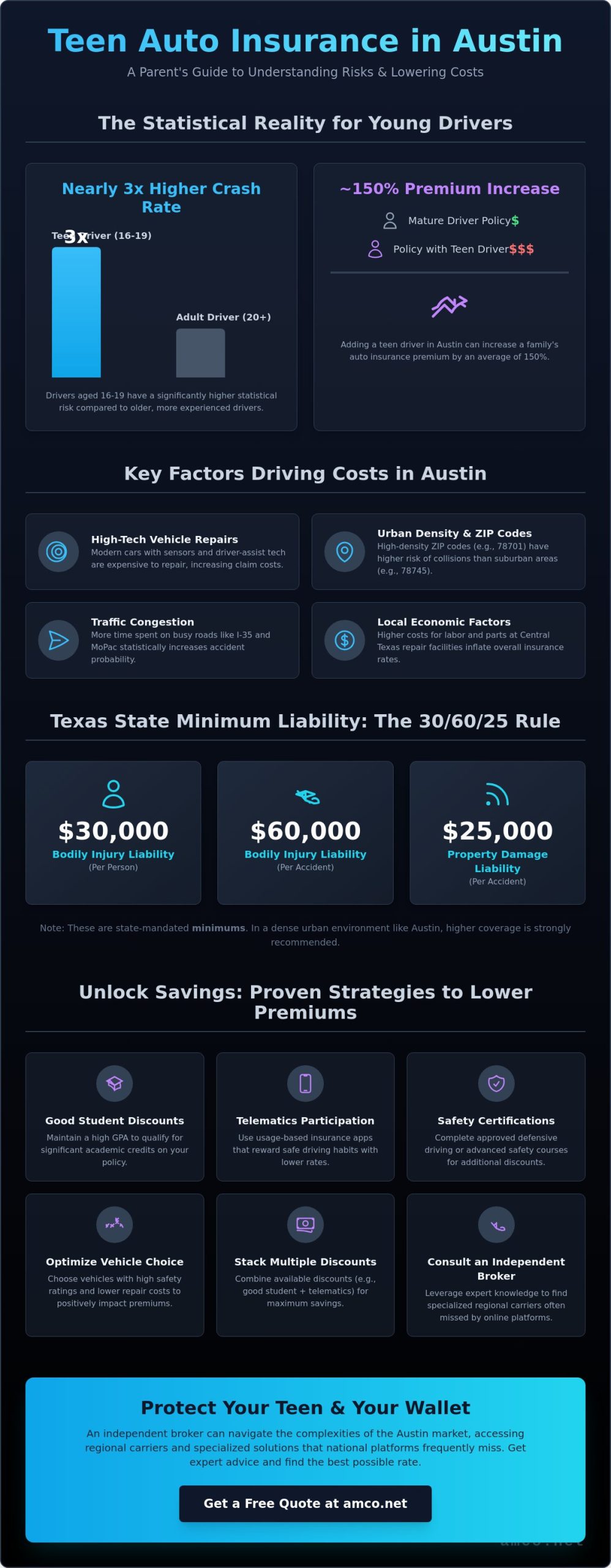
Managing the financial impact of a new driver requires a systematic approach to risk mitigation rather than a search for a single magic bullet. To effectively reduce auto insurance rates for teens in Austin, families must combine behavioral incentives with structural policy changes. One of the most immediate methods involves adjusting the collision and comprehensive deductibles. By assuming a higher portion of the initial risk, perhaps moving from a $500 to a $1,000 deductible, you can significantly lower the monthly premium. Additionally, integrating your teen's coverage into a broader multi-policy bundle that includes your homeowners insurance or renters insurance remains a cornerstone of professional risk management.
The latest data indicates that adding a teen to a parent's existing policy is substantially more cost-effective than pursuing a standalone plan. This strategy often results in a monthly savings of over $100 compared to an individual policy. This collaborative approach allows the younger driver to benefit from the established insurance score and long-term history of the adult policyholders, providing a more stable foundation for their coverage.
For students attending Austin-area institutions like the University of Texas or local high schools within AISD and Eanes ISD, maintaining a "B" average or a 3.0 GPA is a primary requirement for the Good Student discount. Verification typically involves submitting a recent transcript or official report card to the carrier. Beyond academic performance, completing a certified driver's education course provides a measurable return on investment by qualifying for specific safety credits. For families with students attending college over 100 miles from home without the insured vehicle, the "Student Away at School" discount offers an additional layer of premium relief that many overlook during the transition to university life.
By 2026, telematics has become a standard tool for quantifying driver behavior. These mobile applications monitor specific metrics such as hard braking events, excessive speed, and late-night driving patterns between midnight and 5:00 a.m. While some parents express concerns regarding data privacy, the potential for savings is significant. Families can achieve premium reductions of up to 40% by stacking telematics participation with other safety-based credits. This data-driven approach provides a transparent feedback loop, encouraging safer habits while rewarding the household with more competitive rates based on actual performance. This technical monitoring is essential for households looking to stabilize their auto insurance rates for teens in Austin over the long term.
Texas statutes mandate a minimum liability structure of 30/60/25, which covers $30,000 for bodily injury per person, $60,000 per accident, and $25,000 for property damage. While this meets the legal threshold, Austin’s unique economic environment makes these limits precarious. The city's high concentration of high-end vehicles means a minor collision can easily exceed the $25,000 property damage cap. When parents evaluate auto insurance rates for teens in Austin, they must weigh the cost of higher limits against the risk of personal financial exposure in a litigious urban market.
The Texas Graduated Driver License (GDL) program also serves as a regulatory framework that influences premium stability. During Phase Two, provisional license holders face a nighttime curfew between midnight and 5:00 a.m. and a restriction of one passenger under age 21 who isn't a family member. Adherence to these rules is vital; any citation for a GDL violation can trigger a re-classification of the driver's risk profile, leading to immediate premium spikes. For more severe infractions, the state may require an SR-22 filing. This financial responsibility certificate marks the driver as high-risk for a minimum of three years and significantly complicates the search for affordable coverage.
Relying on the state minimum for property damage is a significant risk in the 78701 and 78746 areas. If your teen is involved in an accident with a luxury vehicle, you could be held personally liable for damages exceeding $25,000. We recommend exploring Umbrella insurance, which provides an additional layer of liability protection above your standard auto policy limits. You can compare how these urban risks stack up against other Texas cities by reviewing our Car Insurance in Houston, TX: The 2026 Complete Driver’s Guide.
Data from 2026 confirms that adding a teen to a family policy is generally the most cost-effective route, often saving households over $100 per month compared to standalone plans. Separate policies are typically reserved for high-risk teens who have already incurred major violations or for families who wish to use "named driver exclusions" to protect the primary policy from a specific individual's risk profile. If you're unsure which legal structure best fits your family's needs, consult with an Austin insurance specialist to review your options.
Procuring a policy that balances cost efficiency with comprehensive protection requires a departure from generic online search tools. While direct carriers provide a streamlined interface, they are limited to their own proprietary underwriting models. In contrast, an independent broker acts as a professional consultant, scanning a broad network of "A-Rated" carriers to find the most competitive auto insurance rates for teens in Austin. This multi-carrier approach is particularly effective for high-risk demographics, as it allows for the identification of regional carriers that national platforms frequently overlook. Data from 2026 suggests that local entities often provide more favorable terms for Austin drivers than their national counterparts.
The role of a broker extends beyond the initial quote. As your teen gains experience and moves through the stages of the Texas Graduated Driver License program, your risk profile changes. AMCO.NET LLC provides long-term policy management, ensuring that discounts for aging out of high-risk brackets or completing advanced safety courses are applied promptly. This proactive oversight prevents premium stagnation and ensures your coverage remains aligned with your family's evolving needs. We prioritize this systematic review process to maintain the stability and reliability of your insurance portfolio.
Independent agencies serve as your advocate, especially during the claims process where technical expertise is required to navigate complex liability determinations. By leveraging relationships with multiple providers, brokers can pivot your coverage if a specific carrier implements a significant rate hike in Travis County. Understanding the local market dynamics is essential for securing the best value. You can learn more about the advantages of this personalized approach by reviewing our guide on finding an Insurance Company Near Me: Finding the Best Local Expertise in Texas for 2026.
AMCO.NET LLC has maintained a presence in the Texas insurance market since 1987, providing a foundation of stability and deep industry knowledge. Our "Fast & Affordable" methodology focuses on delivering precise, data-driven quotes for teen drivers without the friction of traditional manual processing. We utilize a modern mobile app that allows parents and teens to manage policies, process payments, and access digital ID cards instantly. This technological integration ensures that while our expertise is rooted in decades of experience, our delivery remains efficient and accessible for the modern Austin household. Our goal is to simplify the complexities of auto insurance rates for teens in Austin, allowing you to focus on the safety of your new driver while we manage the technical details of their protection.
Navigating the variables that determine auto insurance rates for teens in Austin doesn't have to be an overwhelming process for your household. By integrating localized geographic insights with modern safety technologies and academic discounts, you can secure a policy that offers both protection and value. Our analysis of the 2026 landscape highlights that the right combination of coverage limits and deductible structures provides the most resilient defense against urban driving risks.
We've supported Texas families since 1987, leveraging our relationships with multiple A-rated insurance carriers to find specialized solutions. Our mobile app ensures that policy management remains efficient as your teen gains experience on the road. To see the most competitive options available for your specific situation, get a fast and affordable teen auto insurance quote in Austin today. With the right expert partner, you can confidently support your teen's transition to the road while maintaining long-term financial security.
Yes, Austin premiums typically exceed the Texas state average due to high traffic density and elevated labor costs at local repair facilities. Urban centers like Travis County see higher claim frequencies compared to rural areas, which underwriters factor into local rate adjustments. This geographic risk profile makes the Central Texas market one of the more expensive regions for young drivers.
Mid-sized sedans and compact SUVs with high safety ratings but standard technology packages remain the most cost-effective vehicles to insure. Models like the Honda Accord or Toyota Camry avoid the extreme repair costs associated with luxury vehicles while providing structural safety that triggers premium discounts. Avoiding high-performance engines or specialized off-road features is essential for maintaining lower rates.
Teen drivers do not need an individual policy and generally benefit from significantly lower rates when added to a parent's existing coverage. This arrangement allows the younger driver to leverage the established insurance history and multi-policy discounts of the adult policyholders. Standalone policies are typically reserved for high-risk situations where a separate risk pool is necessary.
Maintaining a 3.0 GPA or higher can lead to premium reductions ranging from 5% to 15% depending on the specific carrier. This discount recognizes the statistical correlation between academic responsibility and safer driving habits among young operators. Families must typically provide a recent transcript or report card to verify eligibility during the policy renewal period.
Completing a TEA-approved defensive driving course typically results in an immediate discount on the liability portion of the premium. This certification demonstrates a proactive approach to risk management that carriers reward with lowered rates. It is a highly effective way to offset the initial costs associated with a new driver's lack of experience.
A speeding ticket can cause a substantial increase in auto insurance rates for teens in Austin as it re-classifies the driver into a higher risk category. Such violations often lead to the loss of "clean record" discounts and can stay on the driver's history for three to five years. In some cases, a single major violation can trigger a non-renewal notice from the current carrier.
Standard personal auto policies often exclude coverage for commercial activities like food delivery or ride-sharing. Teens using apps like UberEats must ensure their policy includes a commercial endorsement or a specific delivery rider to avoid claim denials. Failing to disclose this usage can result in a total loss of coverage if an accident occurs during a delivery run.
Rates typically begin to decrease incrementally after age 20, with the most significant reduction occurring at age 25. Consistent safe driving and a clean claims history are essential prerequisites for these scheduled rate adjustments. Each year of driving experience without an at-fault accident serves as a technical benchmark that lowers the driver's overall risk profile.