
Harris County currently holds some of the highest risk scores in the United States for hurricanes and tornadoes, making the "Texas Trinity" of wind, hail, and flood a primary concern for new residents. Securing first time home buyer insurance Houston is often the most technical and stressful phase of the mortgage process. You're likely facing sticker shock from local premium trends or feeling overwhelmed by the paperwork required to satisfy your lender before the closing deadline. It's a complex environment where a standard hazard policy is rarely sufficient on its own to protect your investment.
This guide provides the professional clarity you need to secure a policy that balances comprehensive protection with your initial homeownership budget. We'll break down the essential components of a Houston-specific insurance portfolio, including the impact of 2026 legislative updates like HB 2067 and new appraisal dispute rules. You'll learn how to identify the right coverage layers for your specific ZIP code and ensure your documentation is ready well before you reach the closing table. Our focus is on providing a logical, data-driven path to securing your home against the unique environmental challenges of the Gulf Coast.
Lenders in Texas view homeowners insurance as a non-negotiable prerequisite for financing. While the state doesn't legally mandate coverage for debt-free owners, every institutional mortgage requires a policy to protect the asset. This is why securing first time home buyer insurance Houston is a critical milestone in the escrow process. Lenders often use the term "Hazard Insurance" to describe the specific portion of your policy that covers physical damage to the structure. Understanding these home insurance basics helps you distinguish between what your bank requires and what you actually need for complete financial security.
To better understand the nuances of entering the local market, watch this helpful video:
A primary decision for any new owner involves choosing between Replacement Cost Value (RCV) and Actual Cash Value (ACV). RCV pays to rebuild or repair your home at current market prices without deducting for wear and tear. In contrast, ACV only covers the depreciated value of the property, which can leave a significant financial gap after a major loss. For the best protection in the Gulf Coast region, professionals recommend an HO-3 or HOB policy. The HO-3 is the standard "all-risk" form, while the HOB often provides superior water damage coverage, which is a vital consideration given the local climate and high humidity levels.
Lenders require an "Insurance Binder" before they'll authorize the final funding for your home. This document serves as temporary proof that coverage is in place for the closing date. Most first-time buyers find it convenient to have their insurance premium bundled into their monthly mortgage payment through an escrow account. This ensures the policy never lapses, satisfying the minimum coverage requirements set by Fannie Mae and Freddie Mac. These entities generally require coverage equal to 100% of the insurable value of the improvements or the unpaid principal balance of the mortgage.
A comprehensive policy for first time home buyer insurance Houston consists of several distinct layers. Dwelling coverage is the foundation, protecting the physical structure of your house, including the roof and walls, from covered perils. Personal property coverage extends this protection to your belongings, such as furniture and electronics, whether they're inside the home or elsewhere. Finally, liability protection provides a defense if a third party is injured on your property. This part of the policy covers legal fees and medical bills, preventing a single accident from jeopardizing your financial future.
Houston's environmental profile creates a unique risk matrix often referred to as the "Texas Trinity": wind, hail, and flood. For those seeking first time home buyer insurance Houston, understanding these risks is essential for long-term asset protection. Unlike other markets where a single policy might suffice, Houston properties often require a layered approach to coverage. This strategy addresses specific geographic threats that a standard policy excludes by default. Professional risk management in Harris County isn't about finding a single document; it's about assembling a shield against these three distinct forces.
One of the most dangerous misconceptions for new owners is that a standard homeowners policy covers rising water. It never does. In Harris County, where drainage infrastructure is constantly tested, even homes in "low-risk" zones face significant exposure. The National Flood Insurance Program (NFIP) is the primary provider of this coverage, but buyers must account for a strict 30-day waiting period for new policies. Waiting until a storm enters the Gulf is too late to protect your investment.
By 2026, private flood insurance markets have expanded, offering alternatives to government-backed plans. These private options often provide higher limits for personal property and shorter waiting periods. When reviewing Homeowners Insurance in Texas, it's vital to discuss flood riders or standalone policies with your agent to ensure no gaps exist between your structural and water damage coverage. Even if your lender doesn't mandate it, the historical data on Houston flooding suggests it's a fundamental component of a responsible risk management plan.
Coastal-adjacent properties in the Houston metro area may require coverage through the Texas Windstorm Insurance Association (TWIA). This happens if private carriers exclude wind from their standard forms. A critical technical detail is the WPI-8 certificate. This document proves a home's roof or structure meets specific windstorm building codes. Without this certificate, obtaining wind coverage can become difficult or prohibitively expensive for a new buyer.
Texas policies typically feature a separate deductible for wind and hail. This is often calculated as a percentage, usually 1% to 5%, of the home's insured value rather than a flat dollar amount. Managing these high out-of-pocket costs during your first year of ownership requires careful financial planning. Additionally, Houston's expansive clay soil causes foundations to shift during extreme wet and dry cycles. While foundation movement itself isn't typically a covered peril, maintaining your plumbing can prevent related issues. Reviewing your specific risk profile with an expert can help you navigate these technical requirements. You can explore customized coverage options to find a solution that fits your budget and protection needs.
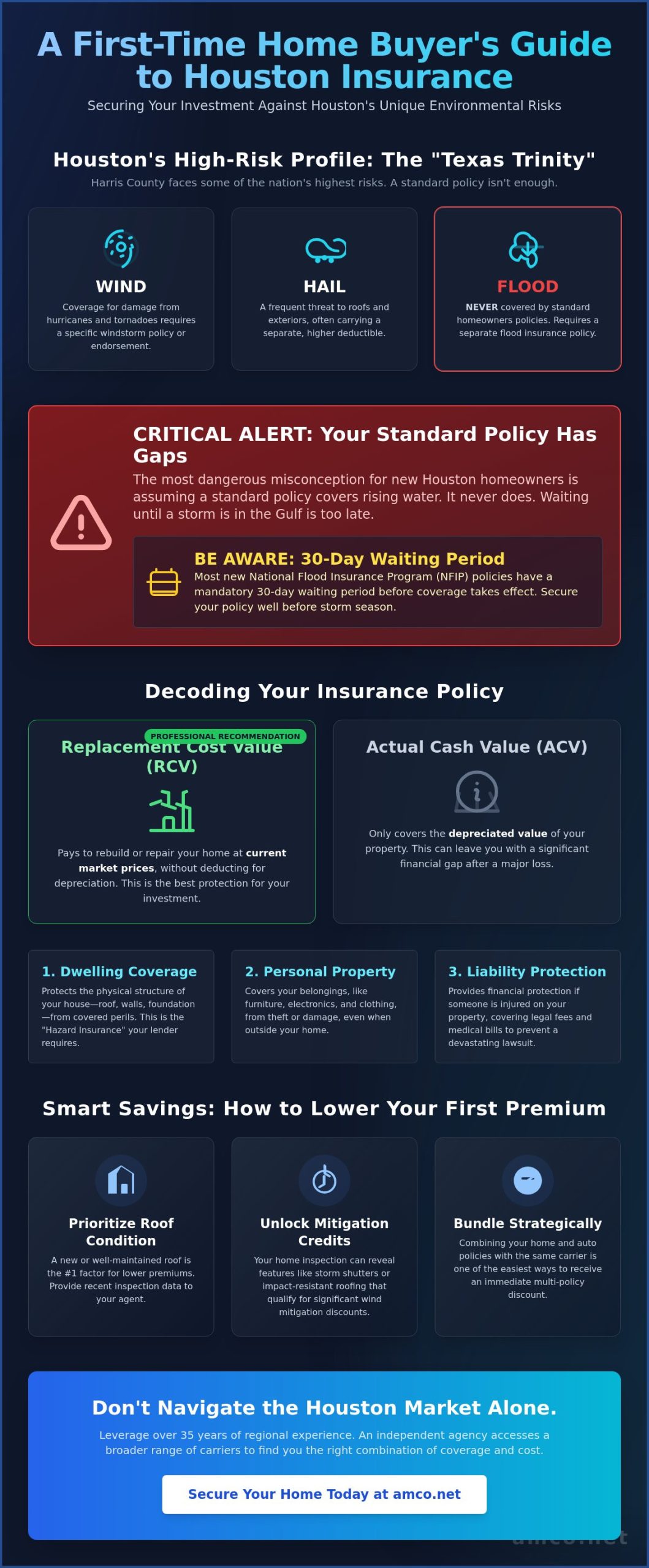
Optimizing the cost of first time home buyer insurance Houston requires a technical approach to risk mitigation rather than just searching for the lowest quote. While average premiums in the Houston metro area are significantly higher than the national average, specific policy adjustments can yield substantial savings. Bundling remains the most effective immediate strategy. By combining your homeowners coverage with an auto insurance policy, most carriers apply a multi-policy discount that reduces the total cost of both. This isn't just about convenience; it's a strategic move to lower your monthly escrow obligations and improve your overall financial liquidity.
The age and condition of your roof serve as the primary pricing factor in the Houston market. Because of the high frequency of hail and wind events on the Gulf Coast, insurers prioritize properties with newer roofing systems. A roof less than five years old often triggers a preferred rate tier. If you're purchasing an older home, consider negotiating a roof replacement before closing to secure these long-term premium reductions. Additionally, many carriers offer a "New Home" or "First-Time Buyer" discount during the initial policy term, recognizing the lower statistical risk associated with newly inspected properties. Consider these primary factors when evaluating your quote:
Modern technology provides new avenues for premium reduction. Installing monitored fire and burglar alarms is a standard requirement for many security credits. By 2026, smart water-shutoff valves have become a top-tier discount trigger. These systems detect abnormal flow and automatically close the main valve, preventing the catastrophic interior water damage that accounts for a high percentage of non-weather claims. Carriers often recognize local Houston security providers, ensuring your investment in home automation translates directly into lower operating costs.
Texas law permits insurance companies to utilize your credit history to determine your insurance score. This score is a major component in calculating your final rate. First-time buyers should verify their credit reports for accuracy at least 90 days before seeking a final quote. Even a modest improvement in your score can move you into a better pricing bracket. If your credit history is still being established, shopping through an independent agency is essential. This allows you to access carriers that weight credit scores differently, ensuring you aren't penalized by a single company's underwriting model.
Coordination between your insurance agent and mortgage lender is the backbone of a successful real estate transaction. For those navigating first time home buyer insurance Houston, the timeline begins the moment the home inspection is finalized. This usually occurs during week three or four of the contract period. Starting at this stage allows enough time to address any red flags found in the property's history or physical condition without delaying the funding of your loan. Precise timing ensures that your insurance binder is ready for the lender's final review well before the closing date.
Once you have the inspection report, share it with your agent immediately. This document is a primary tool for securing discounts. For instance, a wind mitigation inspection can prove your home has specific hurricane straps or water-resistant barriers, which is critical for any first time home buyer insurance Houston strategy. You should also request a CLUE (Comprehensive Loss Underwriting Exchange) report. This report details the last seven years of claims history on the property. If the previous owner had multiple water damage claims, it could affect your ability to secure certain coverages or impact your premium. Consulting a local auto insurance expert during this window is also recommended. Bundling your vehicles with your new home policy early ensures your lender has the most accurate figures for your debt-to-income calculations.
In the final week before closing, your agent will "bind" the policy. Binding is a formal agreement that coverage is in place even if the policy hasn't been fully issued yet. This is the green light your bank needs to finalize the loan. You must verify that the "Loss Payee" or "Mortgagee Clause" exactly matches your lender's legal name and address. Even a small typo can lead to a rejection by the lender's quality control department. Standardized mortgage protocols require this level of technical precision to ensure the bank's interest in the property is legally protected.
Reviewing the "Declarations Page" at least 72 hours before closing is a vital final step. You should confirm that the first year's premium listed on your Closing Disclosure (CD) matches your insurance quote exactly. Discrepancies here can trigger a "re-disclosure" period, which can delay your move-in date by several days. If you're ready to align your insurance with your mortgage schedule, you can request a professional insurance timeline review to ensure your closing stays on schedule and your coverage meets all technical requirements.
Selecting an insurance partner is a foundational decision that impacts your financial stability for years. Since our founding in 1987, we've navigated every major environmental and regulatory shift in Harris County, providing a level of continuity that national call centers can't match. This historical perspective is vital for first time home buyer insurance Houston, as it allows us to anticipate underwriting challenges before they threaten your closing. We don't just sell policies; we implement risk management systems tailored to the specific geographical realities of the Gulf Coast.
As an independent agency, our primary loyalty lies with the client rather than a single insurance carrier. This model is particularly beneficial in the 2026 market, where many insurers have tightened their requirements or increased premiums. We shop your profile across a broad network of reputable carriers to find the precise intersection of comprehensive coverage and competitive pricing. This objective approach ensures you aren't forced into a suboptimal policy simply because a single company's risk appetite has changed. Our deep integration into the local market allows us to provide first time home buyer insurance Houston that accounts for the hyper-local variations between neighborhoods.
Managing a new policy shouldn't be an administrative burden. The AMCO mobile app provides a streamlined interface for homeowners to access digital ID cards, review coverage limits, and monitor the status of their escrow payments. This technological infrastructure ensures that technical details are always available at your fingertips, providing transparency and control over your property’s protection. We combine this modern efficiency with the seasoned judgment of agents who've spent decades solving complex insurance puzzles for Texas residents.
Dealing with a local Houston agent offers a distinct advantage during the claims process. When a storm impacts the region, you won't be routed to an anonymous representative in a different time zone who's unfamiliar with local building codes or flood maps. We help first-time buyers translate "insurance-speak" into plain English, ensuring you understand exactly what's covered and what's excluded. Our team is committed to finding fast and reliable solutions, especially when you're working within the tight windows of a real estate closing. This professional proximity builds a partnership based on trust and verified expertise.
You can begin the process immediately by using our online quote tool for an instant estimate of your potential costs. To maximize your initial budget, we recommend exploring car insurance houston bundles that can significantly lower your overall monthly expenses. Combining your auto and home policies is one of the most effective ways to secure preferred rates while simplifying your financial management. We invite you to visit our Houston office or call our experts to discuss your specific needs. Let us provide the professional guidance required to secure your first home with absolute confidence.
Securing your first home in Harris County requires a technical understanding of the "Texas Trinity" of risks and a disciplined approach to the mortgage timeline. By prioritizing roof condition and strategic policy bundling, you can navigate the 2026 insurance landscape without compromising on structural protection or your closing schedule. This guide has detailed why a layered strategy, including flood and windstorm specific coverage, is the only reliable way to satisfy lender requirements and protect your investment in the Gulf Coast region.
As an independent agency serving the region since 1987, we provide the expert guidance necessary to decode complex policy terms and access A+ rated carriers. Our goal is to ensure your first time home buyer insurance Houston is both comprehensive and cost-effective. Get a Fast & Affordable Houston Home Insurance Quote from AMCO to leverage our local independent expertise and secure a solution tailored to your specific neighborhood. You’ve done the hard work of finding the perfect home; now let us provide the professional stability to protect it.
Average premiums for first time home buyer insurance Houston vary significantly based on the property's ZIP code, the age of the roof, and its proximity to the coast. Regional data indicates that Houston is among the most expensive metropolitan areas for coverage, but your specific rate is determined by individual risk factors rather than city-wide averages. Factors such as the claims history on the property and your credit-based insurance score will influence the final figure more than general market trends.
Lenders typically require the full first year's premium to be paid at the closing table to ensure the asset is protected from day one. This amount is usually listed on your Closing Disclosure and handled through your escrow account. Moving forward, a portion of your monthly mortgage payment is set aside so the lender can pay the renewal premium on your behalf each year. This system ensures your coverage never lapses, which satisfies the requirements of your mortgage agreement.
Flood insurance is not federally mandated for properties outside of high-risk Special Flood Hazard Areas, but it's a critical consideration throughout Harris County. Historical data demonstrates that a significant percentage of flood claims occur in areas previously designated as low or moderate risk. Because standard homeowners insurance excludes rising water, most Houston residents consider a separate flood policy a vital component of a responsible risk management strategy regardless of their zone designation.
A windstorm deductible is a separate out-of-pocket cost specifically for damage caused by hurricanes, tropical storms, or hail. Unlike your standard "All Other Perils" deductible, which is often a flat dollar amount, windstorm deductibles in Texas are typically calculated as a percentage of your home's total insured value. This means a 2% deductible on a home insured for $400,000 would result in an $8,000 out-of-pocket expense before insurance coverage begins for wind-related damage.
To obtain an insurance binder quickly, you must provide your agent with the finalized home inspection and the specific "Mortgagee Clause" from your loan officer. Having these documents ready immediately after the inspection period allows your agent to finalize underwriting and issue the binder without delay. This document acts as the official proof of coverage your lender needs to authorize the final funding of your loan and keep your move-in date on schedule.
Most homeowners policies include "off-premises" coverage for personal property, which protects your belongings while they are in transit to your new residence. This coverage is typically limited to a percentage of your total personal property limit, often 10%. While it protects against perils like theft or fire during the move, it won't cover damage caused by the moving company's handling. It's an essential layer of protection for first time home buyer insurance Houston during the chaotic transition period.
You can change your insurance carrier at any time after closing on your home. If you find a more comprehensive or cost-effective policy later, you can cancel your existing coverage and provide the new binder to your mortgage servicer. The servicer will then update your escrow account to ensure future payments are sent to the correct company. You'll also receive a pro-rated refund for any unused premium from your previous insurer, which can be deposited back into your escrow account or personal savings.