


With over 105,000 property crimes reported annually in the Houston metro area, protecting your personal assets is a critical component of financial stability. If you're currently wondering how much is renters insurance in Houston, you've likely noticed that premiums in the Bayou City reflect its specific urban and environmental risks. It's common to feel frustrated by rising costs and the technical ambiguity surrounding what a standard policy actually covers during a hurricane or a flash flood.
We understand that you need a reliable framework to protect your electronics, furniture, and liability without overpaying for unnecessary extras. This guide provides a professional breakdown of 2026 market trends and the tactical steps required to secure optimal rates for your rental home or apartment. We'll clarify the vital differences between Actual Cash Value and Replacement Cost, explain the necessity of supplemental flood protection, and demonstrate how to meet lease requirements quickly. Our goal is to help you establish a secure insurance foundation that maintains your lifestyle and your budget.
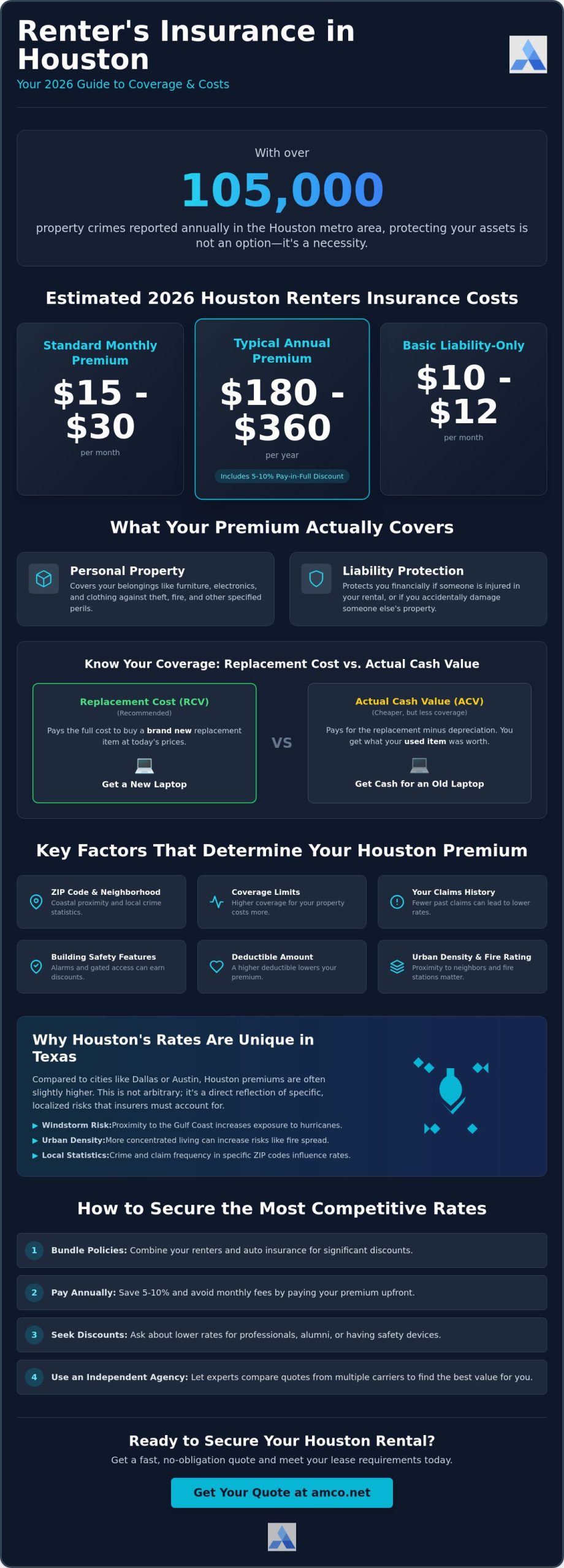
Understanding the financial commitments of urban living requires a clear view of fixed costs. For many residents, determining how much is renters insurance in Houston for the 2026 fiscal year is the first step in protecting their personal assets. Current market data suggests that most Houston renters pay between $15 and $30 per month for standard coverage levels. While these rates are slightly higher than the Texas state average, they reflect the unique environmental and urban risks inherent to the Gulf Coast region.
To gain a foundational understanding of the legal and financial frameworks involved, it's helpful to review what renters insurance is and how it serves as a risk management tool for tenants. These policies typically provide a safety net for personal property and liability that a landlord's insurance won't cover.
To better understand how these policies function in real-world scenarios, watch this helpful video:
Annual premiums in the Houston metro area generally range from $180 to $360. This variation depends heavily on chosen coverage limits and deductible structures. For individuals seeking basic protection to satisfy lease requirements, minimal liability-only policies are still available for as low as $10 to $12 per month. However, these entry-level options may not provide the comprehensive asset protection required for high-value electronics or professional equipment. It's often more cost-effective to invest in a standard policy that includes personal property coverage to avoid out-of-pocket replacement costs later.
Structuring your payments can influence the total cost of ownership for your policy. Many agencies offer a 5% to 10% discount when you settle the entire annual premium upfront. This approach eliminates monthly service fees and ensures continuous coverage without the risk of missed payments. Most Houston carriers require a modest down payment to initiate the policy immediately. Additionally, opting for automated recurring payments often triggers paperless discounts, further reducing the effective rate.
Houston's pricing model is distinct from cities like Austin or Dallas due to regional risk factors. The primary driver is windstorm risk; Houston's proximity to the coast necessitates higher premiums to account for potential tropical weather events. Local crime statistics also play a role in theft coverage pricing across different ZIP codes in the metro area. Houston's fire protection rating, which evaluates the efficiency of local fire departments and water supply systems, serves as a baseline for determining your specific rate. Urban density also impacts these costs, as the proximity of buildings can influence the perceived risk of fire spread. This combination of factors ensures that Houston rates remain specialized to the local environment.
Determining how much is renters insurance in Houston for your specific situation involves more than a simple flat rate. Insurers use complex actuarial data to assess the probability of a claim based on your environment and personal history. While the Average renters policy in Texas provides a useful baseline, Houston's unique geographic and urban variables often cause premiums to deviate from the state norm. Carriers prioritize the physical location and structural integrity of the rental unit above almost all other factors.
The Houston metro area is vast. A renter in The Heights will likely see different rates than someone in Clear Lake. Proximity to the coast directly impacts the windstorm portion of a premium because coastal areas face higher exposure to tropical weather events. Security also plays a role in geographic pricing. Gated communities or complexes with controlled access often qualify for lower rates than street-access apartments. With approximately 45 out of every 1,000 residents affected by property crime annually, insurers carefully weigh local incident densities in specific Houston wards to calculate theft premiums.
Structural characteristics are equally important for risk assessment. Older wood-frame buildings are generally more expensive to insure than modern concrete mid-rises. This is because concrete structures offer superior resistance to fire and wind damage. Safety features like monitored burglar alarms, smoke detectors, and deadbolt locks often trigger significant discounts. If your building provides 24/7 on-site security or doorman services, your risk profile improves in the eyes of the underwriter. These features demonstrate a proactive approach to loss prevention that carriers reward with lower costs.
Your personal history also dictates the final price. Texas allows insurers to use credit-based insurance scores to predict risk. A higher score typically leads to lower premiums. Similarly, a clean claims history suggests you're a lower-risk client. If you've filed multiple property claims in the last three years, you'll likely pay more. Finally, the policy structure itself is a major lever. Increasing your personal property coverage will raise your monthly cost. You can offset this by choosing a higher deductible. Opting for a $1,000 deductible instead of $500 can lower your monthly premium significantly. Balancing these coverage limits requires a strategic approach to risk management. To find the right balance for your budget, you can request a professional quote analysis to see how these factors apply to your specific Houston address.
While evaluating how much is renters insurance in Houston, you must look beyond the monthly price tag to the scope of indemnification provided. A standard policy isn't a single product; it's a multi-layered risk management system designed to protect your financial interests from diverse threats. These layers of protection work in tandem to ensure that a single catastrophic event, such as a localized fire or a significant theft, doesn't result in total financial insolvency for the tenant. Most policies are structured around four primary pillars of coverage.
The method used to value your belongings significantly influences your recovery after a loss. Actual Cash Value (ACV) policies are often cheaper but only pay the depreciated value of your items based on their age and condition. In contrast, Replacement Cost Value (RCV) provides the funds necessary to purchase brand-new versions of your lost items at current market prices. For Houston renters who own modern electronics or professional-grade furniture, RCV is the superior choice. It ensures that a stolen laptop or damaged sofa can be replaced with an equivalent new model without requiring you to bridge a significant financial gap out of your own pocket.
Standard renters insurance policies never provide coverage for damage caused by rising groundwater, storm surges, or external flooding. This distinction is vital for anyone living in the Houston metro area, where flash flooding is a recurring operational risk. You must supplement your standard policy with a separate flood insurance rider or a standalone policy through the National Flood Insurance Program to protect your assets from rising water. It's essential to identify the difference between 'covered water damage,' such as a burst pipe inside your walls, and 'excluded flood damage' coming from the street. Without this specific addition, your personal property remains exposed to one of the most common environmental hazards in the region.
Optimizing your insurance budget requires a strategic approach rather than a simple search for the lowest sticker price. While we've established the baseline for how much is renters insurance in Houston, your final premium is highly malleable based on the risk management strategies you employ. Professional renters focus on administrative efficiency and systemic discounts to reduce overhead without compromising the core integrity of their protection layers. This requires a shift from reactive buying to proactive policy management.
The most effective method for immediate cost reduction is the multi-policy bundle. When you integrate your renters coverage with your car insurance in Houston, carriers view you as a more stable, long-term client. This perceived stability allows them to offer significant percentage savings across both policies. At AMCO.NET LLC, we specialize in syncing these diverse risk management tools under a single management platform, providing you with a unified view of your protections. This operational efficiency doesn't just save money; it simplifies your administrative burden and ensures that your coverage dates remain aligned across all assets.
Beyond structural changes, don't overlook specialized discounts. Many carriers offer 'Professional' or 'Alumni' rate reductions for members of specific organizations or graduates of certain universities. These are often unadvertised and require a proactive inquiry. Safety features mentioned earlier, such as monitored alarms or smart leak detectors, also contribute to these savings. To ensure you're capturing every available credit for your specific situation, contact our expert advisors for a comprehensive rate comparison today. We provide the technical oversight needed to maintain an affordable yet robust insurance portfolio.
Selecting an insurance partner in a complex urban market requires more than just a digital interface. Since 1987, AMCO.NET LLC has served the Houston community by providing the localized expertise necessary to navigate the region's specific risk profiles. While understanding how much is renters insurance in Houston is essential for your monthly budget, the quality of your coverage and the reliability of your agent become paramount during a claim. Determining the right policy involves balancing cost with comprehensive protection, a process where our decades of experience provide a distinct advantage for local tenants.
Our agency operates as an independent broker, meaning we aren't tethered to a single carrier's pricing or underwriting restrictions. AMCO.NET LLC compares rates from multiple top-rated carriers to ensure your premium reflects the current market reality. This independence allows us to provide objective advice tailored to your specific assets and liability needs. For clients planning for the future, we also offer specialized expertise in coordinating transitions to Homeowners Insurance; this ensures your protection remains seamless as your housing needs evolve from a rental to a permanent residence.
The primary benefit of working with an independent broker like AMCO.NET LLC is the breadth of choice. Captive agents are restricted to one brand, which limits your options if that carrier raises rates or changes its risk appetite in the Houston metro area. We maintain a constant watch on the local market to keep your rates competitive year after year. Beyond initial placement, we serve as your advocate during the claims process. If an incident occurs, you'll have access to real human support to help you interface with the carrier and ensure a fair resolution. This level of professional advocacy is often missing in purely digital, direct-to-consumer models.
We've optimized our intake process to respect your time. Our online application takes less than five minutes to complete, providing you with a clear answer to how much is renters insurance in Houston for your specific address. Once a policy is bound, AMCO.NET LLC provides immediate proof of insurance, allowing you to satisfy your landlord or leasing office requirements without delay. For those who prefer a more detailed consultation, our Houston office remains available for personalized risk assessments. We combine modern digital efficiency with the stability of a firm that has seen the Houston market through every cycle since 1987. Let us help you secure your rental home with the precision and reliability your assets deserve.
Protecting a rental property in the Bayou City requires a thorough understanding of localized risks and specific market structures. We've established that geographic variables, such as windstorm exposure and urban density, define the baseline for how much is renters insurance in Houston for the 2026 fiscal year. It's clear that while basic liability might satisfy a landlord, a strategic policy utilizing Replacement Cost Value and supplemental flood protection offers the most reliable safeguard for your personal property. By bundling your policies and leveraging professional discounts, you can achieve this level of security without overextending your budget.
Since 1987, AMCO.NET LLC has served the Houston and Texas community with the stability and professional expertise needed to navigate the evolving insurance landscape. Our independent agency model grants you access to multiple top-rated insurance carriers, ensuring your premium remains competitive while maintaining A+ rated customer support. We combine efficient digital policy management with the personalized touch of an experienced advisor. Get your fast and affordable Houston renters insurance quote from AMCO.NET LLC today! We're ready to help you build a more secure future for your rental home.
Texas state law does not mandate renters insurance for tenants. However, most landlords and property management companies in Houston include a requirement for a minimum liability policy as a condition of the lease agreement. This ensures that the property owner is protected against accidental damage caused by the tenant, such as a kitchen fire or a plumbing overflow.
Most Houston renters find that a policy with $20,000 in personal property coverage and $100,000 in personal liability meets both their protection needs and lease requirements. If you own high-value electronics or professional equipment, you should conduct a detailed inventory to determine if a higher limit is necessary. This precision helps you manage how much is renters insurance in Houston for your specific household budget.
Renters insurance covers the personal belongings stolen from your vehicle, such as a laptop or luggage, but it does not cover damage to the car itself. For repairs to a broken window or a stolen catalytic converter, you must rely on the comprehensive portion of your auto insurance policy. It's a common misconception that property coverage extends to the vehicle's structural components.
You can technically share a policy with a roommate in Houston, though most insurance professionals advise against it. Sharing a policy means your claims history is linked, and the coverage limits are split between both parties. If one roommate moves out or files a claim, it can complicate the other person's insurance standing and future premiums.
A standard renters policy does not provide coverage for rising groundwater or storm surges during a hurricane. As discussed in the 'Flood Gap' section, you must secure a separate flood insurance policy through the National Flood Insurance Program or a private carrier. Without this specific addition, damage to your furniture and electronics from external flooding will not be reimbursed.
Most policies include personal liability coverage that extends to dog bites occurring away from your home, including Houston parks. However, coverage depends on your specific carrier's list of excluded breeds. It's essential to disclose your pet's breed during the application process to ensure your liability shield remains intact during off-site incidents.
You should first file a report with the Houston Police Department to obtain an official case number. Once you have the police report, contact your insurance agent or use your carrier's digital portal to submit a list of stolen items and their approximate value. Providing photos or original receipts for high-value assets will significantly expedite the reimbursement process.
Your premium will likely change if you move, as insurers re-evaluate the risk profile of your new ZIP code and building type. Factors such as local crime rates, fire protection ratings, and proximity to the coast all influence how much is renters insurance in Houston for a specific location. Moving from a street-access apartment to a gated complex with on-site security often results in a rate reduction.