


Would your current coverage survive the financial impact of the 2024 International Code Council standards if a major loss occurred today? With the July 1, 2026, effective date for updated building codes in San Antonio, many property owners are discovering that their existing office building insurance San Antonio policies leave them vulnerable to significant out-of-pocket expenses. It's frustrating to face rising premiums while managing the complexities of multi-tenant liability and shifting real estate valuations in a volatile Texas climate. We recognize that your office building is more than just a physical asset. It's a critical revenue stream that requires a stable, long-term risk management strategy to remain viable and compliant.
This guide provides a technical overview of how to safeguard your investment in the current market. We'll break down the essential differences between replacement cost and actual cash value to ensure you aren't underinsured. You'll also learn how to leverage new transparency laws like House Bill 2067 and navigate the specific tornado load requirements that now dictate commercial construction standards in the region. By focusing on data-driven protection, you can maintain competitive premiums without compromising on coverage depth.
Office building insurance San Antonio is a precision-engineered commercial property policy designed to address the specific structural and operational risks associated with professional workspaces. Unlike standard retail or industrial coverage, these policies account for high-density occupancy, complex HVAC systems, and the shared liabilities inherent in multi-tenant environments. In 2026, the San Antonio market presents a unique dichotomy: rapid commercial growth in sectors like tech and healthcare, balanced against increasing weather volatility that challenges traditional underwriting models.
The distinction between landlord-owned structures and tenant-occupied spaces is a primary consideration for any asset manager. While a tenant's policy typically focuses on their specific business personal property and professional liability, the building owner remains responsible for the "shell," common areas, and core infrastructure. Navigating this landscape requires an independent agency's perspective, as we analyze multiple carriers to find the optimal balance between premium costs and comprehensive risk transfer.
Asset protection requirements vary significantly across the San Antonio metropolitan area. Individual owners of small professional suites or medical offices in the Medical Center require policies that address specialized building systems and high-traffic common areas. Conversely, Real Estate Investment Trusts (REITs) managing Class A downtown high-rises must secure high-limit coverage that satisfies stringent lender requirements. Property management firms overseeing suburban office parks in areas like Stone Oak also rely on these policies to maintain operational continuity across diverse tenant bases.
A common misconception is that a basic building policy provides sufficient protection. However, office landlords face unique liability exposures, from slip-and-fall incidents in lobby areas to disputes over shared maintenance responsibilities. Understanding Property Insurance Basics is essential for identifying where physical asset protection ends and liability coverage begins. For many investors, benchmarking their coverage against standards for comprehensive insurance in Houston provides a clear picture of the robust protections necessary in the Texas regulatory environment. This dual-layered approach ensures that both the physical investment and the owner's legal interests are shielded from unforeseen claims.
Direct physical loss coverage forms the backbone of robust office building insurance San Antonio policies. This protection extends beyond the exterior shell to include critical infrastructure such as HVAC systems, elevators, and shared common areas. In the event of a fire or localized disaster, the policy ensures the physical structure is restored to its operational state. Consulting a Texas Department of Insurance guide can help clarify which perils are included in basic versus special forms; for most Class A and B office assets, a special form policy is the professional standard.
Business income coverage is equally vital for landlords who rely on consistent cash flow. If a covered peril renders the building uninhabitable, this provision replaces lost rental income during the restoration period. It also covers "extra expenses" incurred to keep the business running or to expedite repairs. Without this layer, a significant property loss could lead to a permanent disruption of your net operating income, even if the physical repairs are fully funded.
Tenant Improvements and Betterments (TIBs) often create gray areas during claims. These are the permanent additions, such as high-end millwork or specialized partitions, installed by tenants. Your policy must clearly define whether the landlord or the tenant is responsible for insuring these assets. Additionally, Ordinance or Law coverage is critical in 2026. Since San Antonio adopted the 2024 International Code Council standards on July 1, 2026, older buildings may require expensive upgrades to meet current codes during a rebuild. Standard property policies don't cover these "improvement" costs without a specific endorsement.
Choosing the right valuation method determines your financial recovery after a loss. For modern office builds, Replacement Cost Value (RCV) is the preferred choice because it provides the funds necessary to rebuild at current market prices. Replacement Cost is the amount to rebuild with like-kind materials without depreciation. Conversely, Actual Cash Value (ACV) factors in the age and condition of the building, which often results in a lower payout that leaves a significant funding gap. Reviewing your current declarations page with a qualified risk advisor ensures these layers are correctly synchronized.
Managing the daily operations of a multi-tenant facility involves significant third-party risks. Slip-and-fall incidents in lobbies, parking garages, or stairwells are common sources of litigation for office owners. A comprehensive General Liability Insurance policy provides the necessary legal defense and settlement funds for third-party injury or property damage claims. It serves as the primary shield for your portfolio, ensuring that a single legal dispute doesn't jeopardize the stability of your commercial investment. Expert brokerage can help you determine if your limits are adequate for the high-traffic environment of a San Antonio professional park.
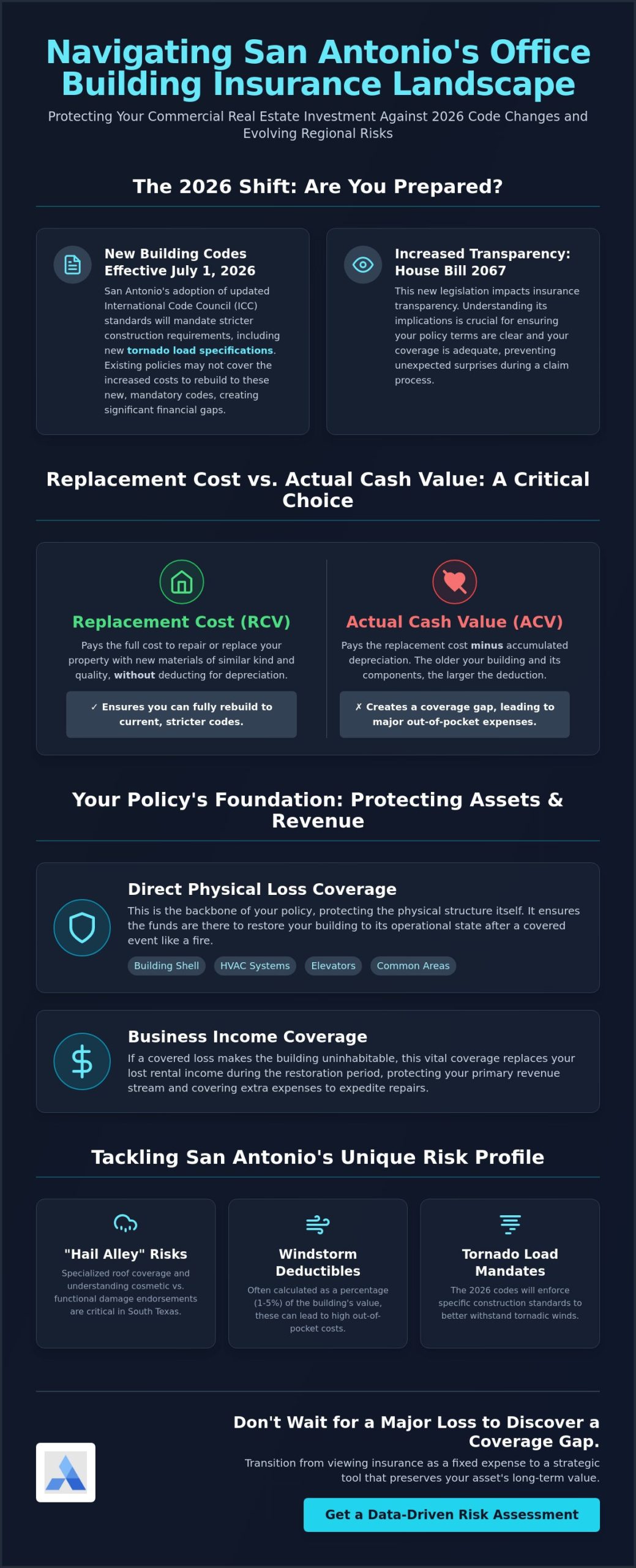
San Antonio's geographic location places it squarely within "Hail Alley," making roof integrity a paramount underwriting concern for any commercial asset. For those securing office building insurance San Antonio, it is essential to understand that carriers view Bexar County as a high-frequency zone for convective storms. Unlike standard fire perils, windstorm and hail coverage in this region often utilizes a percentage-based deductible structure. These deductibles typically range from 1% to 5% of the building's total insured value. For a property valued at $10 million, a 2% deductible results in a $200,000 out-of-pocket expense before the carrier contributes, which can significantly impact liquidity during a crisis.
Beyond atmospheric risks, the San Antonio River Basin presents specific flood exposures that standard property policies almost always exclude. Even for properties situated outside of traditional high-risk flood zones, localized flash flooding remains a documented threat during intense South Texas rain events. Equipment Breakdown coverage is another critical operational safeguard. This protects the high-value mechanical systems that maintain a professional environment, such as complex elevator banks and centralized climate control systems. Mechanical failure in these systems can lead to substantial business interruption losses that traditional property insurance does not address.
The frequency of severe weather in South Texas directly influences commercial property premiums and policy terms. To manage the financial burden of high percentage-based deductibles, many property owners utilize "deductible buy-back" policies. These specialized instruments effectively reduce the out-of-pocket cost during a claim for an additional premium. Maintaining insurance eligibility also depends on proactive risk mitigation. In 2026, carriers increasingly require documented annual roof inspections and proof of preventive maintenance to offer the most competitive rates and terms.
Building classification fundamentally shifts the risk profile used by underwriters to price coverage. Class A properties generally feature modern security systems, advanced fire suppression, and high-end amenities that may lower certain risk scores. However, their specialized finishes require higher replacement limits. Class B and C structures often present more complex challenges, such as aging electrical or plumbing systems. For these older assets, "Ordinance or Law" coverage is a critical requirement to account for the costs of bringing a damaged building up to the current 2024 ICC standards during the reconstruction process. Underwriters closely examine these classification details to determine the long-term viability of the risk.
Underwriting for office building insurance San Antonio relies on a data-driven assessment of the property's physical and operational characteristics. Carriers look beyond the surface, scrutinizing the building's ISO construction class and fire protection systems. A Class 6 fire-resistive structure, for instance, typically commands lower rates than a Class 1 wood-frame building due to its inherent durability. Age is equally significant; a structure with systems older than 20 years often faces surcharges or limited capacity unless documented upgrades are provided. Choosing the lowest premium might seem like a fiscal win, but it often indicates a policy with restrictive exclusions or high deductibles that shift the financial burden back to the owner during a claim.
Proactive loss control strategies serve as a powerful lever for reducing long-term insurance costs. Enhancing exterior LED lighting, maintaining high-resolution security monitoring, and implementing strict tenant screening protocols directly improve your risk profile. These measures don't just prevent claims; they demonstrate to underwriters that the asset is managed with a focus on technological continuity and safety. When tenants are vetted for financial stability and operational safety, the likelihood of liability disputes decreases, allowing for more favorable negotiation during renewal cycles.
For smaller professional offices or medical suites in Bexar County, a Business Owner's Policy (BOP) offers a streamlined solution. This package effectively bundles property and liability coverage into a single instrument, often providing significant cost efficiency for eligible properties. However, a BOP has strict eligibility requirements regarding square footage and total insured value. Larger, multi-story high-rises or complex office parks require a customized commercial package policy to address high-limit needs and specialized exposures that a standard BOP cannot accommodate.
Securing the most competitive terms for commercial property insurance requires access to a broad spectrum of the market. An independent broker doesn't represent a single carrier; they act as a consultant who compares options from multiple highly-rated providers to find the best fit for your specific asset. Independent brokers leverage carrier relationships to find niche coverage for unique buildings. This local expertise is invaluable in San Antonio, where understanding specific neighborhood risks can lead to better pricing. To optimize your coverage and ensure your portfolio is protected against 2026 market shifts, request a comprehensive risk assessment from our experienced team.
AMCO.NET LLC has provided specialized risk management solutions to the Texas business community since 1987. We understand that office building insurance San Antonio isn't a mere commodity; it's a structural component of your financial stability. Our consultative approach focuses on identifying operational vulnerabilities before they manifest as costly claims. By maintaining a diverse portfolio of top-rated commercial carriers, we provide San Antonio property managers with the flexibility to choose coverage that aligns with their specific net operating income goals. We don't just sell policies. We manage risk through a lens of professional continuity and technological foresight.
Our methodology goes beyond simple policy placement. We examine the technicalities of your building's infrastructure, from its fire suppression ratings to its compliance with the latest 2024 building codes. This data-driven perspective ensures that your asset is positioned favorably in the eyes of underwriters. This positioning is critical in a market where transparency and compliance are increasingly scrutinized under new Texas regulations like House Bill 2067. Our goal is to create a predictable environment for your investment, shielding you from the harshest market fluctuations through methodical planning and expert brokerage.
Stability is a prerequisite for effective risk management. Since our founding in 1987, we've navigated numerous Texas insurance market cycles, from periods of aggressive expansion to the current environment of increased weather-related volatility. This longevity provides us with a deep understanding of local San Antonio regulations and the specific risks inherent to Bexar County properties. We've seen how shifting real estate valuations and evolving building codes impact long-term coverage viability. Consistency and reliability are our hallmarks in an industry often characterized by volatility. We provide the professional distance and objectivity required to make informed decisions about your property's future.
Obtaining a comprehensive quote for your office building insurance San Antonio is a methodical process designed to ensure technical accuracy. To begin, we require a current Statement of Values (SOV) and at least three to five years of documented loss runs. This information allows our team to conduct a thorough analysis of your risk profile and present it effectively to our carrier partners. We also review your current policy for gaps in Ordinance or Law coverage or Business Income limits. Contact our office today to initiate a professional review of your real estate assets. Our team is prepared to develop a system-level solution that protects both your physical investment and your long-term revenue streams.
The 2026 commercial landscape in Bexar County requires a transition from passive insurance purchasing to active risk mitigation. It's essential to navigate the 2024 ICC building code updates and manage percentage-based hail deductibles to maintain long-term stability. Ensuring your policy utilizes Replacement Cost Value rather than Actual Cash Value prevents significant funding gaps during a recovery period. By aligning your office building insurance San Antonio with these strategic priorities, you secure both the physical structure and the net operating income it generates.
AMCO.NET LLC has served the Texas business community since 1987, providing the stability and specialized commercial risk expertise required in a volatile market. We've built our reputation on providing access to A+ rated carriers, ensuring your portfolio is backed by financial strength and comprehensive terms. We invite you to protect your San Antonio office investment with a custom quote from AMCO.NET LLC. Taking a proactive approach to your coverage today ensures your real estate assets remain resilient and compliant for years to come.
Standard commercial property policies do not provide coverage for flood damage. Property owners situated near the San Antonio River Basin or in low-lying areas must secure a separate flood insurance policy through the National Flood Insurance Program or a private carrier. This is a critical distinction, as even a minor localized flash flood can lead to significant structural and electrical damage that a basic property policy won't reimburse.
Business Income coverage replaces the net profit or rental revenue lost while the building is uninhabitable due to a covered peril. Extra Expense coverage addresses the additional costs incurred to minimize the disruption of services, such as leasing temporary office space or paying for expedited equipment shipping. While Business Income protects your bottom line, Extra Expense ensures the technological and operational continuity of your facility during the restoration process.
High-value tenants often increase the overall risk profile of a property due to specialized medical equipment, higher utility loads, and increased foot traffic. Underwriters may view these occupancies as a higher liability risk or a more complex property exposure in the event of a fire. It's important to disclose these tenant types early in the application process to ensure your limits and endorsements accurately reflect the increased complexity of the risk.
Texas is the only state that doesn't mandate Workers Compensation for private employers, but most commercial landlords maintain this coverage to mitigate the risk of employee lawsuits. Additionally, many lenders and property management contracts require Workers Compensation as a prerequisite for funding or partnership. Maintaining this coverage provides a stable framework for managing workplace injuries and avoids the unpredictable legal costs associated with being a "non-subscriber."
Ordinance or Law coverage pays for the additional costs required to bring a damaged building up to current municipal standards during a rebuild. Since San Antonio adopted the 2024 International Code Council standards on July 1, 2026, many older structures would require expensive upgrades to wiring, plumbing, or wind resistance that standard policies don't cover. This endorsement is essential for owners of older Class B and C assets to avoid massive out-of-pocket expenses.
Most commercial property policies allow you to include parking garages as appurtenant structures or as a separate line item on the same policy. You must ensure the garage is valued correctly, especially if it includes automated entry systems or specialized lighting infrastructure. Including the garage under the main policy often simplifies the claims process and ensures that liability coverage extends to incidents occurring within the parking facility.
In San Antonio's "Hail Alley," wind and hail deductibles are typically calculated as a percentage of the building's total insured value rather than a flat dollar amount. These deductibles usually range from 1% to 5%. For example, a property insured for $10 million with a 2% wind/hail deductible would require the owner to pay the first $200,000 of a claim, which makes deductible buy-back policies a popular tool for liquidity management.
Improving your property's risk profile through documented roof maintenance and high-resolution security systems is the most effective way to lower premiums. Implementing proactive loss control measures signals to underwriters that the asset is well-managed and less likely to experience a claim. Working with an independent broker allows you to compare multiple A+ rated carriers to find the most competitive rates available in the current Bexar County market.