Starting January 1, 2026, every RV owner renewing a policy in the Lone Star State faces a mandatory increase in liability requirements that could leave the unprepared facing significant legal exposure. You likely recognize that navigating the vast, remote stretches of West Texas requires more than just a reliable engine; it demands a sophisticated risk management strategy. Securing the right RV road trip insurance Texas is no longer just about basic compliance, but about ensuring operational continuity for your journey across the state's diverse terrain.
You've worked hard to invest in your mobile lifestyle, and the fear of a mechanical failure in extreme heat or a complex liability claim shouldn't overshadow your trip. This guide clarifies the transition from old liability limits to the new $50,000/$100,000/$40,000 standards while explaining the distinct legal obligations for motorhomes versus towable trailers. We will examine how to protect your personal assets and leverage specialized roadside assistance to maintain total peace of mind throughout 2026 and beyond.
Many travelers mistakenly assume their existing auto policy provides sufficient protection for a Recreational vehicle (RV). While a standard car policy focuses on basic transportation, RV road trip insurance Texas acts as a hybrid between vehicle coverage and homeowners protection. This distinction is critical because your RV isn't just a vehicle; it's a mobile residence with unique risks. In 2026, the complexity of these rigs and the rising cost of specialized repairs mean that a simple extension of your truck's policy often leaves you exposed to significant financial loss.
To better understand the nuances of these policies, watch this helpful video:
Standard auto policies usually only extend liability to a towed unit. If your travel trailer fishtails and rolls, your truck's insurance might pay for the damage you caused to others, but it won't pay to replace your trailer. Additionally, your car insurance won't cover the thousands of dollars in electronics, appliances, and personal gear stored inside. Specialized RV road trip insurance Texas includes Vacation Liability. This protects you if someone is injured inside your RV while it's parked at a Texas campsite. Without this, a simple trip and fall incident could become a personal legal liability that your standard car policy won't touch.
Texas law categorizes these vehicles based on how they move, which fundamentally alters your insurance structure. Motorhomes (Class A, B, and C) are self-propelled and require their own independent liability coverage. Class A rigs are the heavyweights, often built on commercial bus chassis, while Class C units utilize a van or truck frame. Towables, such as fifth wheels and pop-ups, don't require separate liability by law because the towing vehicle's coverage applies while in motion. However, the weight of your rig directly influences your risk profile. Heavier units have longer stopping distances and larger blind spots, factors that insurance carriers scrutinize when calculating premiums in 2026. Understanding these categories is the first step toward a secure journey.
Texas law distinguishes clearly between motorized units and towable trailers. If you operate a Class A, B, or C motorhome, you must carry a liability policy that meets state minimums. For those preparing for a journey, securing robust RV road trip insurance Texas involves understanding the legislative shift that occurred on January 1, 2026. Under House Bill 4178, any policy issued or renewed after this date must meet significantly higher financial responsibility limits. This change reflects the rising costs of medical care and vehicle repairs across the state.
The traditional "30/60/25" rule served as the Texas standard for decades. It required $30,000 for bodily injury per person, $60,000 per accident, and $25,000 for property damage. However, the 2026 update raises these thresholds to $50,000 for bodily injury per person, $100,000 per accident, and $40,000 for property damage. While this provides a better safety net, a $40,000 property damage limit remains remarkably low for most modern RVers. A single collision involving a luxury vehicle or multiple cars can easily exceed these figures, leaving your personal assets vulnerable to litigation.
For towable units like fifth wheels or travel trailers, the legal requirement is different. Texas does not mandate separate liability insurance for these trailers. Instead, the liability coverage from your towing vehicle extends to the trailer while it is hitched. This legal "flow" of coverage is convenient but creates a dangerous gap. Once you unhitch at a park, that liability often ceases. Ensuring your RV road trip insurance Texas includes premises liability is the only way to stay protected while stationary.
Beyond the legal baseline, specific protections provide necessary security for long-haul travel. Personal Injury Protection (PIP) is a standard offering in Texas that covers medical costs and lost wages regardless of who caused the accident. It's particularly valuable for travelers far from their primary healthcare networks. You must explicitly decline PIP in writing if you don't want it, but for RVers, it remains a foundational piece of a risk management plan.
Additionally, Uninsured Motorist Property Damage (UMPD) is vital in urban centers. If you are towing a trailer, your car insurance in Houston, TX serves as your primary liability source while on the move. However, that policy won't cover the trailer's physical damage if an uninsured driver strikes your rig. Integrating these layers creates a comprehensive defense against the unpredictable. You can evaluate your current coverage levels with a professional to ensure they align with these new 2026 requirements before crossing state lines.
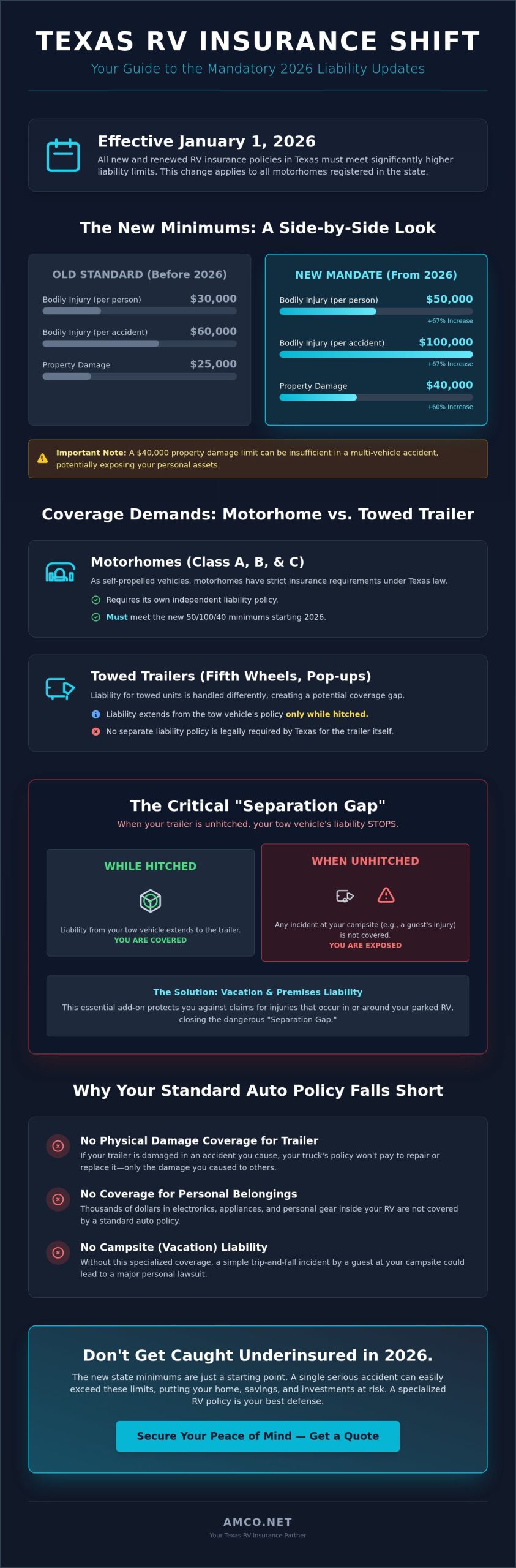
The technical distinction between a self-propelled motorhome and a towable trailer creates a fundamental split in how risk is managed. While drivable motorhomes operate as standalone units, towable trailers rely on a primary vehicle for liability while in transit. This "flow" of coverage is a legal convenience, but it stops the moment you drop the hitch. If your trailer rolls into a neighbor's rig at a state park while unhitched, your truck's policy won't provide protection. This is the "Separation Gap." Addressing this gap is a pillar of effective RV road trip insurance Texas planning, especially when navigating crowded parks during peak 2026 travel seasons.
For 2026 models, choosing between Total Loss Replacement and Actual Cash Value (ACV) is a financial decision with long-term consequences. New rigs depreciate quickly. ACV only pays the depreciated market value at the time of loss, which might leave you "underwater" on a loan. Total Loss Replacement ensures that if your new RV is totaled within the first few years, you receive a brand-new, comparable model. This level of protection provides the financial continuity necessary for those who view their RV as a significant capital investment.
Class A and C motorhomes feature massive, panoramic windshields that are susceptible to damage from road debris. A single rock chip on I-10 can lead to a replacement costing several thousand dollars. Specialized glass coverage is an essential endorsement that standard auto policies often lack. You must also distinguish between recreational use and full-time living. Full-timer coverage adds personal liability similar to a homeowners policy. This is necessary if the RV serves as your primary residence for a significant portion of the year.
Your truck's policy never covers the physical structure of your trailer. If a fire starts in the galley or a thief targets your unhitched unit, you need a separate comprehensive and collision policy. This should include external equipment like awnings, solar panels, and satellite dishes. If you use a rear rack to carry a bike, remember that specialized motorcycle insurance is often required to protect that specific asset. It may fall outside the scope of your primary RV road trip insurance Texas. Managing these separate layers of protection ensures no part of your setup is left vulnerable to the unpredictable.
Operating a heavy vehicle across the diverse Texas landscape introduces environmental risks that differ significantly from standard passenger car travel. The state's geography ranges from high-altitude deserts to humid coastal plains, each presenting distinct operational challenges. For example, the "Dry Line" in West Texas frequently generates severe weather systems that produce large hail capable of shattering RV skylights and damaging roof-mounted solar arrays. Securing RV road trip insurance Texas with a robust comprehensive package is the only way to mitigate the financial impact of these sudden atmospheric events.
Wildlife collisions represent another high-frequency risk, particularly within the Texas Hill Country. This region has one of the highest deer populations in the country. A collision at highway speeds can cause catastrophic structural damage to the fiberglass front cap of a motorhome or the frame of a travel trailer. Unlike standard vehicles, RVs often require specialized repair facilities that understand the complexities of composite materials and integrated house systems. Your insurance strategy should account for these regional realities to ensure your rig remains roadworthy throughout your journey.
Comprehensive coverage acts as your primary defense against the volatile weather patterns of North Texas and the Panhandle. These areas are prone to sudden, intense hailstorms that can cause extensive dimpling on aluminum siding or compromise the seals of your slide-outs. If your itinerary includes coastal stays near Galveston, you must also consider flood risks. Most standard policies exclude damage from rising water. It is also prudent to examine how your homeowners insurance in Texas might provide a secondary layer of protection for high-value personal belongings, such as professional camera gear or specialized outdoor equipment, while they are stored in your vehicle.
The vast, unpopulated stretches of West Texas mean a mechanical failure can occur over 100 miles from a qualified service center. Standard roadside assistance plans designed for cars are often inadequate for a 30-foot rig. They may lack the heavy-duty towing equipment or the mileage allowance required to reach a specialized shop. You need a policy that includes an emergency expense allowance. This provision covers lodging and meal costs if your RV becomes uninhabitable due to a covered loss, preventing a breakdown from becoming a total logistical failure. You can request a professional policy review to verify that your current roadside limits are sufficient for the remote corridors of the Lone Star State.
The decision to purchase insurance directly from a large national carrier or through a local broker significantly impacts both your premium costs and the quality of your coverage. In 2026, direct to consumer insurance models often prioritize speed over the specific nuances of your travel profile. By contrast, a broker acts as a strategic partner, comparing multiple carriers to identify the optimal balance of risk and value. This competitive approach is particularly beneficial for RV road trip insurance Texas, where premium rates can vary widely based on the age of your rig and your planned mileage across the state's vast highway system.
AMCO has provided this level of professional advisory since 1987. Our longevity in the market ensures a deep understanding of the underwriting criteria used by different providers. We look beyond basic liability to secure complex protections that big-box algorithms might overlook. Bundling your RV policy with existing homeowners, renters, or auto insurance remains one of the most effective methods for reducing your annual expenditure while maintaining a cohesive risk management strategy across all your assets. It's a logical way to streamline your financial obligations while maximizing your discounts.
Big-box carriers often lack the granular knowledge required to assess regional risks from the humid Gulf Coast to the arid plains of West Texas. Working with an insurance company near me provides access to specialists who understand how local weather patterns and road conditions affect your specific vehicle type. This personalized service ensures that your RV road trip insurance Texas isn't just a generic document. Instead, it becomes a tailored solution designed for the Lone Star State's unique challenges, providing a level of reliability that automated systems can't replicate.
Before hitting the highway, perform a final checklist of your documentation. Ensure your digital and physical insurance cards are updated with the 2026 liability limits. Verify that your roadside assistance contact numbers are readily accessible in areas with limited cell service. Taking these final administrative steps ensures that your focus remains on the journey rather than operational vulnerabilities. A few minutes of preparation today prevents significant logistical hurdles during your road trip.
Navigating the vast Texas landscape in 2026 requires more than just a well-maintained rig; it demands a proactive approach to risk management. You now understand the critical importance of aligning your policy with the updated state liability minimums and the necessity of bridging the coverage gap for unhitched trailers. Whether you're traversing the high plains of the Panhandle or the dense traffic of Houston, your RV road trip insurance Texas must account for both legal compliance and regional environmental hazards.
Since 1987, our Texas-based experts have helped travelers protect their investments by comparing A+ rated carriers instantly. We provide the tools you need for long-term security, including a mobile app for seamless policy management while you're on the move. Don't leave your journey to chance when professional oversight is just a few clicks away.
Get a Fast RV Insurance Quote for Your Texas Road Trip and hit the road with the confidence that comes from stable, expert-backed protection. Safe travels across the Lone Star State.
Texas law does not mandate separate liability insurance for towable units like travel trailers or fifth wheels. The liability coverage from your towing vehicle typically extends to the trailer while it is being towed. However, this coverage does not protect the trailer itself from physical damage, and once the unit is unhitched at a campsite, the tow vehicle’s liability no longer applies.
Most standard auto policies provide very limited protection for motorhome rentals and often exclude physical damage coverage for large recreational vehicles entirely. While your liability might transfer in specific circumstances, the high replacement value of a modern RV usually exceeds standard car policy limits. It is professional practice to verify your specific policy endorsements or secure a dedicated rental binder before departure.
Market data for 2026 indicates that most Texas RV owners pay between $1,000 and $2,000 annually for comprehensive recreational coverage. Rates fluctuate based on the vehicle type; travel trailers often range from $500 to $1,200 yearly, while Class A motorhomes can exceed $4,000. These figures reflect the increased liability minimums and rising repair costs associated with advanced onboard technologies.
Specialized RV road trip insurance Texas includes "Personal Effects" coverage, which is designed to protect the contents of your mobile home. Standard auto policies rarely cover personal property stored inside a vehicle. If you travel with high-value electronics, professional equipment, or expensive outdoor gear, you must ensure your policy sub-limits are sufficient to cover a total loss from theft or fire.
Standard roadside assistance plans often lack the heavy-duty equipment required to tow a 30-foot rig to a specialized repair facility. A dedicated RV policy provides access to specialized recovery services, fuel delivery, and lockout assistance tailored to large-profile vehicles. In remote areas like West Texas, these services are essential for avoiding exorbitant out-of-pocket towing fees that can easily exceed $1,000.
Full-timer insurance functions as a hybrid between vehicle and homeowners insurance for those living in their RV for more than six months per year. It provides much broader personal liability and medical payments coverage than a standard recreational policy. While road trip coverage focuses on transit risks, a full-timer policy protects you against liability claims that occur while the vehicle is your primary residence.
Most reputable carriers in Texas offer annual policies rather than short-term or daily coverage. If you are only using the vehicle for a single excursion, you might consider a policy with no cancellation fees or specialized rental insurance. Maintaining a year-round RV road trip insurance Texas policy is often more cost-effective for owners to ensure the rig is protected against theft and weather damage while in storage.
Your Texas liability insurance is not legally recognized once you cross the border into Mexico. You must purchase a separate Mexico tourist policy from a licensed Mexican insurer to meet their legal financial responsibility requirements. While some U.S. policies offer limited physical damage extensions within a short distance of the border, they will not prevent legal detention if you are involved in an accident without Mexican liability coverage.