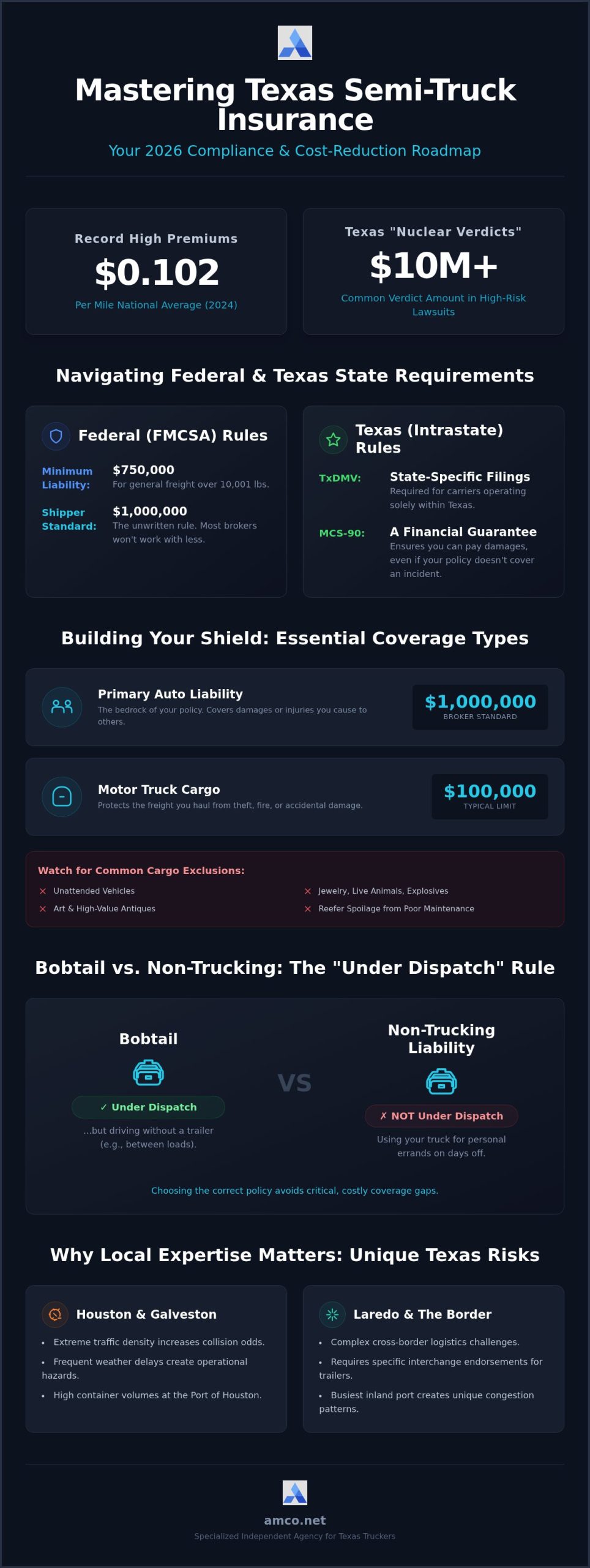
Did you know that insurance premiums for commercial trucks reached a record $0.102 per mile in 2024, according to the American Transportation Research Institute? In Texas, where "nuclear verdicts" often exceed $10 million, securing the right semi truck insurance isn't just a regulatory hurdle. It's a critical shield for your business's survival.
You likely feel that starting your own authority is a constant battle against rising costs and confusing paperwork. It's frustrating to see hard-earned revenue swallowed by premiums that climb every quarter, especially when you're trying to distinguish between Bobtail and Non-Trucking Liability. You aren't alone in wanting a more transparent, cost-effective way to manage your risk while protecting your assets.
This guide will help you master these complexities. You'll learn how to stay 100% compliant with FMCSA and Texas DOT requirements without overpaying for coverage. We'll examine the 2026 filing mandates, explain how to leverage an independent broker to lower your rates, and show you how to secure the fast COIs needed to stay on the road. By the end of this article, you'll have a clear roadmap for optimizing your insurance strategy.
Semi truck insurance isn't a single policy. It's a strategic bundle of protections designed to safeguard your tractor, trailer, and the freight you carry. For owner-operators, understanding vehicle insurance fundamentals is the first step toward building a resilient business. In 2026, the complexity of these requirements has increased, making a systematic approach to risk management essential. This coverage ensures that a single accident doesn't lead to total financial insolvency.
To better understand how liability functions within this framework, watch this helpful guide:
Texas serves as the backbone of North American logistics. The Port of Houston handles massive container volumes, while Laredo remains the busiest inland port on the Mexican border. These high-traffic corridors create a risk profile that differs significantly from rural transit. Choosing an independent agency is vital in this environment. Unlike captive agents who represent one brand, independent brokers analyze multiple carriers to find solutions that fit these specific regional demands.
Compliance begins with the Federal Motor Carrier Safety Administration (FMCSA). For general freight over 10,001 lbs, the federal minimum liability is $750,000. However, most shippers and brokers in 2026 won't touch a carrier with less than $1,000,000 in coverage. If you operate strictly within Texas, you must adhere to Texas Department of Motor Vehicles (TxDMV) rules. A key component is the MCS-90 endorsement. This isn't insurance itself; it's a guarantee to the public that you have the financial responsibility to cover damages, even if an incident isn't technically covered by your policy.
Operating in the Houston-Galveston area involves managing extreme traffic density and frequent weather-related delays. These factors increase the likelihood of collisions and claims. Conversely, Laredo-based carriers face unique cross-border logistics challenges. Interchanging trailers with Mexican carriers requires specific endorsements to ensure coverage doesn't lapse at the point of transfer. Local expertise in these hubs isn't just helpful. It's a requirement for maintaining uptime and avoiding the out-of-service orders that can cripple a new authority. Partnering with a broker familiar with these corridors ensures your semi truck insurance remains valid across every mile of your route.
Building a robust semi truck insurance policy requires more than just meeting legal minimums. You need a configuration that protects your capital and satisfies demanding freight brokers. Primary Auto Liability acts as the bedrock of your protection. It's the coverage that pays for damages or injuries you cause to others while operating your vehicle. Most shippers won't even look at your authority if you don't carry at least $1,000,000 in liability, even though the legal floor remains lower for certain freight types. This coverage is mandatory for every truck on the road, ensuring that a single mistake doesn't end your career.
Motor Truck Cargo insurance covers the freight you're hauling against risks like theft, fire, or accidental damage, typically carrying a 2026 standard limit of $100,000 per load. Shippers demand this coverage because it ensures they're reimbursed if their goods are destroyed while in your care. Your specific cargo limits are often dictated by the commodities you transport. For example, hauling high-value electronics or hazardous materials requires significantly higher limits than dry van general freight. You should watch for common exclusions in cargo policies, such as:
Physical Damage coverage protects your own equipment. It's usually required by lienholders if you're financing your truck. This coverage is split into Collision, which covers accidents on the road, and Comprehensive, which covers non-collision events like fire, theft, or vandalism. Choosing between Actual Cash Value (ACV) and Stated Amount is a pivotal decision for owner-operators. ACV pays the market value of the truck at the time of loss, while Stated Amount allows you to specify a value, which is often preferable for customized rigs or older trucks in excellent condition. Consulting with an experienced agent at amco.net can help you determine which valuation method best suits your fleet's age and market value.
Your deductible choice directly impacts your monthly premium. A higher deductible lowers your fixed costs but increases your out-of-pocket risk during a claim. If you operate specialized equipment like reefers or flatbeds, ensure your policy specifically includes these units and any attached equipment like tarps, chains, or cooling units.
Finally, don't overlook General Liability. While Primary Liability covers you on the road, General Liability protects your business from "off-road" risks. This includes incidents like a slip-and-fall at your office or a delivery error that causes damage to a customer's property. It provides a comprehensive safety net for your entire operation.
One of the most persistent areas of confusion for owner-operators involves the distinction between secondary liability coverages. While your primary liability policy handles the risks of active hauling, you need specific protection for the moments between loads. Both Bobtail and Non-Trucking Liability (NTL) address these off-clock periods, but they apply in very different operational contexts. Understanding these differences is crucial for ensuring total compliance and managing your semi truck insurance budget effectively.
The "Under Dispatch" rule is the primary trigger for coverage. When you're under dispatch, your motor carrier's primary liability insurance is active. The moment that dispatch ends, you transition into secondary coverage territory. Leasing companies typically require specific endorsements to ensure there's no gap in coverage during these transitions. Selecting the correct secondary policy prevents expensive double-coverage while ensuring you aren't left vulnerable during a claim. It's a matter of legal precision that protects your business from catastrophic out-of-pocket expenses.
Bobtail insurance provides liability protection when you're operating a tractor without a trailer attached, regardless of whether you're on business or personal time. Consider a scenario where you've just dropped off a trailer at a receiver in Dallas and are driving your tractor back to your home or a terminal. Even though you aren't hauling freight, you're still operating a heavy commercial vehicle. Bobtail coverage fills this gap. It's generally more expensive than NTL because the risk profile is higher; the insurer covers the vehicle for a broader range of movements, including those that might still be considered business-related by some legal definitions.
Non-Trucking Liability is more restrictive than Bobtail insurance. It specifically covers the truck for personal, non-business use. This might include driving the tractor to a grocery store, a repair shop, or a truck wash while you're off-duty. The critical limitation is that NTL never applies when you're hauling any freight or performing any task that generates revenue for a carrier. Because the scope of use is so limited, NTL premiums are often lower, providing a cost-effective solution for leased-on owner-operators who use their rigs for personal transit.
For those looking for a deeper dive into how these coverages fit into a larger fleet strategy, our Commercial Trucking Insurance in Houston guide offers broader carrier insights. Getting this distinction right isn't just about saving money. In the event of an accident, an insurer will scrutinize your dispatch logs to determine which policy should pay. Having the right semi truck insurance configuration ensures that your claim is processed without the delays or denials that arise from misclassified usage.
Determining the financial commitment for semi truck insurance requires an analysis of several operational variables. In 2026, underwriters place heavy emphasis on data-driven metrics to assess risk. Five primary factors influence your premiums: your Motor Vehicle Record (MVR), the radius of your operation, the type of cargo you haul, your driver experience, and your SAFER scores. If you plan to operate with a radius exceeding 500 miles, expect higher rates due to the increased exposure associated with interstate travel. Maintaining a clean MVR and a strong safety profile is the most effective way to keep these costs manageable over the long term.
New motor carrier authorities typically face a significant premium spike during their first year of operation. Research indicates that new ventures often pay between $13,000 and $22,000 annually, which can be 25% to 50% more than what seasoned carriers pay. Insurance companies view new businesses as higher risks because they lack a multi-year safety track record on the SAFER system. However, having a driver with extensive CDL experience can help mitigate this increase. Carriers often prioritize the individual's time behind the wheel over the age of the business entity itself.
To secure the most competitive rate, you should prepare your documentation before requesting a quote. This includes having your VINs, driver's license numbers, and target commodities ready for review. Working with an independent agent is particularly beneficial for new ventures. We have access to "new venture friendly" carriers that captive agents cannot reach. You can get a customized quote from amco.net to compare multiple carriers and find a policy that balances cost with comprehensive protection.
A filing is a formal guarantee from your insurance provider to federal or state governments that you possess the required financial responsibility. Without these filings, your authority will remain inactive. The most common federal filing is the BMC-91, which provides proof of primary liability insurance to the FMCSA. For carriers operating within specific states, a Form E is required to satisfy state-level liability mandates. If you move household goods, you may also need a Form H for cargo proof.
Managing these filings is a technical process that requires precision. AMCO handles these submissions directly to ensure your status stays active on the SAFER system. Any lapse in filing can lead to an immediate suspension of your operating authority, which halts your revenue and damages your reputation with brokers. By coordinating these requirements through an experienced agency, you ensure that your business remains compliant and ready to haul from day one.
Choosing the right partner for your semi truck insurance is as critical as choosing your equipment. Many owner-operators mistakenly believe that a large, brand-name captive agent offers the best protection. However, a captive agent is limited to a single carrier's products. If that carrier raises rates or changes its risk appetite, you're forced to start your search over. As an independent agency, AMCO operates differently. We represent multiple top-rated insurers, allowing us to pivot with the market and keep your costs stable.
Since 1987, AMCO has served the Texas trucking community from our Houston headquarters. This longevity provides a level of stability that automated call centers simply can't match. When you call our office, you speak with experts who understand the operational realities of the road. We prioritize the "personal touch" because we know that behind every policy is a business owner trying to stay profitable. One of our key advantages is the speed of Certificate of Insurance (COI) delivery. We understand that missing a load because of a delayed certificate is a loss you shouldn't have to bear.
AMCO shops your specific driver profile across a network of specialized trucking insurers. This competitive approach ensures you receive the best possible terms for your situation, whether you're a seasoned fleet owner or a new authority. We act as your advocate during the annual renewal process, proactively looking for ways to lower your expenses as your business matures. Finding an insurance company near me with these deep Texas roots ensures your agent understands the state's unique legal and regulatory environment.
Our expertise extends across all major Texas logistics hubs. We provide comprehensive support for carriers in San Antonio, Austin, Dallas, and the Permian Basin. Specifically, our team understands the unique dynamics of the Laredo border. Crossing freight through the busiest inland port in North America requires precise coverage endorsements and an understanding of international interchange agreements. We ensure your semi truck insurance remains valid and compliant, regardless of where your route takes you within the Lone Star State.
Decades of experience in the Texas market have taught us that trucking is a relationship business. We're committed to being the stable partner you need to navigate the complexities of 2026 and beyond. Get your semi truck insurance quote from AMCO today and experience the difference that local, independent expertise makes for your business's bottom line.
Managing the many variables of 2026 requires a proactive approach to risk and compliance. You've seen how precise primary liability limits and the correct classification of secondary coverages protect your business's capital. Whether you're navigating the Laredo border or the Port of Houston, staying active on the SAFER system depends on accurate filings and a clean safety profile. These operational steps aren't just about following rules; they're about building a resilient foundation that allows your new authority to scale.
Securing the right semi truck insurance doesn't have to be a source of constant friction. By partnering with Texas-based experts who've served the industry since 1987, you gain access to a broad network of A-rated carriers. This independent approach ensures you receive competitive rates and the instant Certificates of Insurance (COI) required to keep your wheels turning. Don't let paperwork or high premiums slow your momentum.
Get a Fast Semi Truck Insurance Quote from AMCO today and let us help you navigate the complexities of the Lone Star State. Your road to long-term profitability starts with a partner who understands the unique dynamics of your route.
Annual premiums for semi truck insurance in Texas vary based on the age of your authority and your safety record. For 2026, seasoned owner-operators can expect to pay between $9,500 and $18,500 annually. New authorities often face higher rates, ranging from $13,000 to $22,000 per year. Monthly costs generally fall between $750 and $1,585. Factors like your driving history, cargo type, and operating radius will ultimately determine your specific quote and total financial commitment.
The federal minimum liability requirement for non-hazardous freight over 10,001 lbs is $750,000. However, most shippers and brokers contractually require $1,000,000 in coverage to book loads. If you transport hazardous materials, the requirement increases to $5,000,000. Oil and petroleum haulers must carry at least $1,000,000. It's essential to match your policy limits to your specific cargo and the demands of the freight brokers you intend to work with to ensure business continuity.
Yes, you can secure coverage for a new trucking authority, although premiums are typically 25% to 50% higher during the first year. Insurance providers view new ventures as higher risks due to the lack of a multi-year safety record on the SAFER system. Working with an independent agency allows you to access carriers that specialize in new authorities. Highlighting the CDL experience of your drivers can often help mitigate the "new venture" price increase during underwriting.
Bobtail insurance provides liability protection when you operate your tractor without a trailer attached, regardless of the purpose. Non-Trucking Liability (NTL) is more restrictive, covering the vehicle only for personal, non-business use, such as driving to a repair shop while off-duty. NTL never applies when you're hauling freight or generating revenue. Choosing the right semi truck insurance configuration depends on your specific leasing agreement and how you use the truck when you aren't under dispatch.
At AMCO, we prioritize speed and can often provide a certificate of insurance (COI) instantly or within a few hours. In the trucking industry, time is revenue, and waiting days for a certificate can cause you to miss profitable loads. Our systems are designed to deliver these documents rapidly to brokers and shippers, ensuring your authority remains active and your equipment stays on the road without the administrative delays that plague larger, less specialized agencies.
Standard policies protect your tractor, but covering a trailer you don't own requires a Trailer Interchange or Non-Owned Trailer endorsement. This is critical for owner-operators who pull trailers for different carriers or use intermodal equipment. It protects against physical damage while the trailer is in your possession. Without this specific addition to your semi truck insurance, you could be held personally liable for damage to equipment belonging to shippers or leasing companies during an accident.
For interstate operations, your insurance company must file a BMC-91 with the FMCSA to provide proof of primary liability. You also need a BOC-3 filing to designate a process agent in every state where you operate. If you haul household goods, a BMC-34 filing for cargo is also required. Within Texas, state-specific filings like Form E may be necessary for intrastate commerce. AMCO manages these submissions directly to keep your operating authority active and compliant.
You can lower your premiums by maintaining a clean Motor Vehicle Record (MVR) and a strong safety score on the SAFER system. Implementing safety technology, such as dash cams and ELDs, can also lead to discounts from certain carriers. Additionally, choosing a higher deductible reduces your monthly fixed costs. Finally, working with an independent agency allows you to compare multiple quotes, ensuring you aren't paying a "brand premium" for a standard policy from a captive agent.